A boat’s propeller is one of the hardest-working parts on the vessel, and when it starts to fail, performance, fuel economy, steering response, and even engine life can suffer. Signs your boat’s propeller needs to be replaced are often subtle at first: a slight vibration at cruise, a small drop in top-end RPM, a steering pull that seems worse in turns, or unexplained cavitation when accelerating onto plane. Because the propeller sits at the center of propulsion and directly affects how the hull behaves in the water, understanding propeller and steering maintenance is essential for safe, efficient boating.
In practice, propeller maintenance covers more than checking for bent blades. It includes inspecting pitch and diameter suitability, tracking engine RPM against manufacturer recommendations, monitoring the condition of the hub, shaft, skeg, cutlass bearing, trim tab, steering cable or hydraulic helm, and watching for electrolysis or impact damage. Steering maintenance overlaps heavily because many “steering problems” start at the prop. A damaged prop can create uneven thrust, vibration, torque steer, and strain throughout the steering system. I have seen boat owners replace cables, helms, and even lower units before discovering the real issue was a spun hub or a blade with barely visible deformation.
This hub article explains the clearest warning signs, what causes them, how to diagnose them, and when repair is possible versus when replacement is the correct decision. It also connects the broader topic of propeller and steering maintenance so you can make better service decisions before a minor issue turns into an expensive haul-out or midseason breakdown.
Performance changes that point to propeller trouble
The most common sign your boat’s propeller needs to be replaced is a noticeable change in performance without another obvious cause. If the boat struggles to get on plane, loses top speed, burns more fuel at the same cruising speed, or the engine suddenly runs outside its recommended wide-open-throttle RPM range, the propeller is a prime suspect. On outboards and sterndrives, engine manufacturers publish target RPM bands for full throttle with a normal load. If your engine used to hit that range and now cannot, blade damage, incorrect pitch, or hub slippage may be reducing efficiency.
Acceleration issues matter because propellers convert engine torque into thrust. Even a small ding on a leading edge can disturb water flow enough to increase slip. In real use, that means the engine revs but the boat does not respond proportionally. A pontoon may feel sluggish leaving the dock, a center console may labor to climb onto plane, or a wake boat may need more throttle to hold speed. These are not merely convenience issues. Running an overloaded propeller can lug the engine, increasing combustion stress and carbon buildup, while an underpropped setup can push RPM too high and shorten engine life.
Watch for sudden loss of bite in turns or during hole shot. If the propeller ventilates easily, especially in conditions where it previously held well, the blades may be worn, nicked, or mismatched to the hull’s current setup. Trim changes, added gear, and seasonal loading can influence performance, but abrupt changes almost always justify a prop inspection before deeper drivetrain work.
Vibration, noise, and handling symptoms you should not ignore
Persistent vibration is one of the strongest signs of propeller damage. A healthy propeller should run smoothly through the entire speed range. If vibration starts after striking a submerged object, grounding lightly on sand, or backing into debris, assume the prop has changed shape until proven otherwise. Stainless steel props can hide damage better than aluminum because they resist obvious bending, but even slight distortion can create significant imbalance at speed. That imbalance transfers through the gearcase or shaft, stressing bearings, seals, couplers, and mounts.
Noise also provides clues. A rhythmic thump, humming, or growl that changes with RPM can point to blade damage, an out-of-balance prop, or shaft misalignment on inboards. Steering feedback is another indicator. If the wheel suddenly feels heavier, pulls more strongly to one side, or produces a pulsing sensation, inspect the propeller and steering components together. Uneven blade geometry can create asymmetrical thrust that feels like a steering fault. On hydraulic systems, this may show up as wandering at cruise. On cable systems, it may feel like added friction or inconsistent helm effort.
Do not dismiss handling changes as normal aging. Boats develop familiar patterns, and experienced operators notice when those patterns shift. A bay boat that used to track cleanly but now wanders, or a runabout that vibrates only under load, is telling you something specific. The propeller is often the fastest and least invasive place to start diagnosis.
Visible damage: when a repair is possible and when replacement is smarter
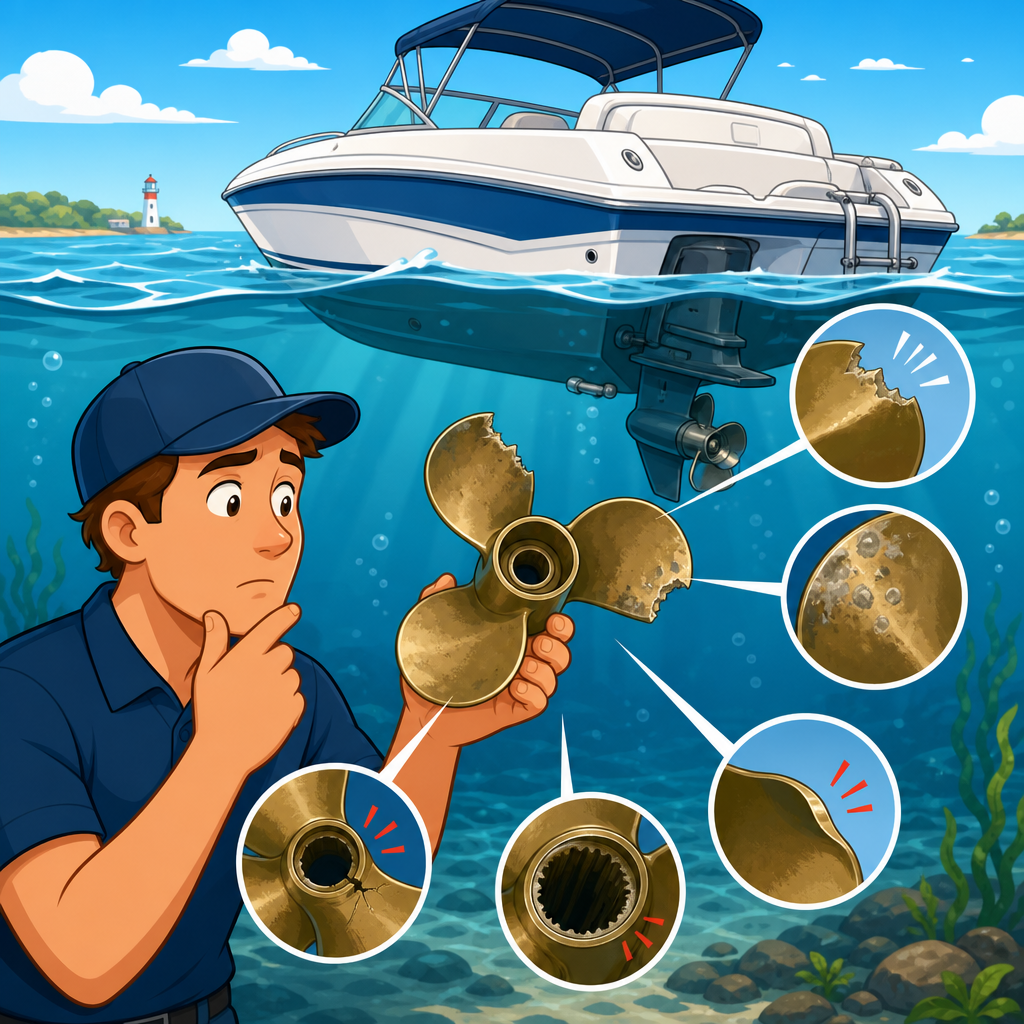
Any propeller with cracks, missing metal, severe cupping loss, or multiple bent blades should be evaluated for replacement immediately. Minor nicks can sometimes be repaired by a qualified prop shop, especially on stainless steel props where restoring original geometry is possible with specialized tooling. However, there is a limit. Once the metal has work-hardened, cracked near the blade root, or lost too much material, repair becomes a temporary compromise rather than a dependable fix.
Aluminum props are cheaper and often sacrificial by design, which makes replacement the practical choice after moderate impact. Stainless steel props cost more but deliver better durability, thinner blades, and better performance retention. Even so, replacement is often smarter if repair costs approach a large percentage of a new prop, or if the blade shape can no longer be restored precisely. Poorly repaired props frequently cause repeat vibration, lower efficiency, and additional drivetrain wear.
| Symptom | Likely cause | Best action |
|---|---|---|
| Small edge nicks, no vibration | Minor impact wear | Inspect and consider professional repair |
| Bent blade, noticeable vibration | Impact distortion | Repair if geometry is fully restorable; otherwise replace |
| Crack near blade root | Fatigue or severe strike | Replace immediately |
| Missing chunk of blade | Impact damage or corrosion loss | Replace immediately |
| Engine revs high, boat barely accelerates | Spun hub | Rehub or replace propeller |
During inspection, look at the blade edges, the cup at the trailing edge, the barrel, the hub, and any signs of pitting from corrosion. Fishing line behind the prop can damage seals and should always be removed. If the prop has struck something hard enough to mark the blades, also inspect the prop shaft for runout and the lower unit or strut for hidden damage.
Hub failure, cavitation, and corrosion-related replacement signs
A spun hub is a classic replacement sign that many owners misread as engine trouble. Most modern propellers use a rubber or composite hub designed to absorb shock. When the hub slips, the engine can rev normally or even flare upward, but thrust drops sharply because the prop no longer turns in full lockstep with the shaft. The symptom often appears during hard acceleration, towing, or after an impact. Some hubs can be replaced, but if the prop body is also damaged or worn, replacing the full prop assembly is usually the better long-term move.
Cavitation and ventilation are often confused, yet both deserve attention. Cavitation occurs when low-pressure bubbles form and collapse on the blade surface, eroding metal over time. Ventilation happens when exhaust gas or surface air reaches the blades and breaks traction. A propeller with worn cup, incorrect design, or damaged edges can be prone to either problem. If you see pitted blade surfaces that resemble sandblasting, especially on the suction side, the prop may already be suffering cavitation erosion and require replacement.
Corrosion is another clear warning. In saltwater, stray current corrosion and galvanic corrosion can attack aluminum and even stainless assemblies in mixed-metal environments. White powdery oxidation on aluminum, deep pitting, or wasted metal around the hub weakens the prop structurally. Anodes help, but they do not save a neglected prop forever. If corrosion has changed blade thickness or profile, replacement is safer than repair. This is also the point to inspect bonding systems, shaft grounding, and anode condition because propeller damage from corrosion is often a symptom of a broader electrical protection issue.
How propeller problems affect steering systems
Propeller and steering maintenance belong together because thrust quality directly affects helm behavior. A balanced, correctly sized prop produces predictable steering loads. A damaged or mismatched prop creates steering torque, vibration, and tracking issues that can mimic worn steering hardware. On single-outboard boats, prop torque can pull the wheel consistently if trim tab adjustment is off, but a new pull combined with vibration strongly suggests blade damage or a changed prop setup.
On cable steering, excess vibration accelerates wear inside the cable jacket and at articulation points. On hydraulic steering, pulsation can aggravate seals and make small air-in-system issues more noticeable. Inboards add another layer: a bent prop can overload the shaft, coupling, strut, and rudder alignment. I have diagnosed “stiff steering” complaints that were actually caused by a propeller strike that slightly bent the shaft and changed how the boat tracked. The owner felt resistance at the wheel because the rudder was constantly correcting for irregular thrust.
This is why any propeller incident should trigger a steering check. Turn the wheel lock to lock, inspect hoses or cables, confirm engine or rudder movement is smooth, and sea-trial the boat after repair or replacement. If steering remains abnormal with a known-good prop, continue with helm, cylinder, cable, or rudder diagnostics. Starting with the prop saves time because it eliminates a major source of false steering symptoms.
Routine inspection, sizing, and replacement timing
The best way to avoid sudden propeller failure is to inspect it regularly and match it properly to the boat. At minimum, check the prop at haul-out, before peak season, and after any grounding or strike. Spin it by hand with the engine off and secured, looking for wobble, edge damage, fishing line, seal leaks, and unusual resistance. For inboards, measure shaft runout if vibration appears. For outboards and sterndrives, compare current wide-open-throttle RPM with the manufacturer’s recommended range. That number is one of the most useful maintenance signals on the boat.
Replacement timing depends on condition, not age alone. A well-maintained stainless prop may last many years, while an aluminum prop used in shallow, debris-filled water may need replacement much sooner. Size also matters. Diameter, pitch, rake, blade count, and cup determine how the prop loads the engine and handles the hull. A three-blade prop often favors speed, while a four-blade can improve grip, hole shot, and low-speed handling. Neither is universally better. The right choice depends on hull type, engine power curve, load, elevation, and use case such as cruising, watersports, or offshore running.
As the hub page for propeller and steering maintenance, this topic naturally connects to deeper service areas: choosing the right propeller material, diagnosing vibration, inspecting prop shafts and cutlass bearings, adjusting trim tabs, replacing steering cables, bleeding hydraulic steering, and preventing galvanic corrosion. Keeping these systems linked in your maintenance plan leads to better performance and fewer surprise repairs.
The clearest signs your boat’s propeller needs to be replaced are vibration, reduced performance, abnormal steering behavior, visible blade damage, hub slippage, cavitation erosion, and corrosion that changes blade shape or strength. These symptoms matter because the propeller is not an isolated component. It influences engine loading, fuel burn, tracking, steering feel, and the service life of surrounding parts. When boat owners ignore propeller warning signs, they often end up paying for additional damage that could have been prevented with a timely inspection.
The practical takeaway is simple: treat any change in thrust, smoothness, or helm response as a maintenance clue. Inspect the propeller first, compare engine RPM to spec, and look beyond the blades to the hub, shaft, seals, steering system, and anodes. Minor issues can sometimes be repaired, but cracks, severe deformation, heavy corrosion, and persistent vibration usually mean replacement is the right call. A fresh, properly sized propeller restores efficiency, improves handling, and protects expensive drivetrain components.
If you are building a smarter Boat Maintenance & Repairs plan, use this page as your starting point for the full propeller and steering maintenance topic, then move into detailed inspections and service guides for your specific hull and drivetrain. A short check at the dock today can prevent a long repair bill tomorrow.
Frequently Asked Questions
What are the most common signs your boat’s propeller needs to be replaced?
The most common warning signs usually show up as changes in performance rather than a dramatic failure. If your boat suddenly feels slower to plane, struggles to reach its normal top speed, or cannot hit its usual RPM range at wide-open throttle, the propeller may be worn, bent, chipped, or otherwise out of spec. Many owners also notice a new vibration through the deck, helm, or seat, especially at certain speeds. That kind of vibration often points to a propeller that is damaged or out of balance.
Other signs include poor fuel economy, a steering pull that feels stronger than normal, slipping or blowing out in turns, and cavitation or ventilation during acceleration. In some cases, visible damage is obvious, such as bent blades, cracks, dings, excessive edge wear, or missing material from impact with sand, rocks, debris, or shallow bottom. Even minor-looking damage can disrupt water flow enough to reduce efficiency and place extra strain on the engine and drivetrain. If the boat no longer handles the way it used to and no other cause is apparent, the propeller should be high on the inspection list.
Can a slightly damaged propeller really affect fuel economy and engine performance?
Yes, absolutely. A propeller does much more than simply spin and push the boat forward. It is a precisely shaped component designed to convert engine power into efficient thrust. When a blade is bent, nicked, thinned from corrosion, or worn unevenly, that efficiency drops. The engine may have to work harder to move the boat at the same speed, which increases fuel consumption and can reduce acceleration, cruising efficiency, and top-end performance.
Damage can also affect engine loading. Depending on the type of propeller problem, the engine may over-rev because the prop is no longer gripping the water properly, or it may under-rev because the damaged shape is creating drag and imbalance. Neither condition is ideal. Over time, running with the wrong propeller load can contribute to unnecessary wear on the engine, lower unit, prop shaft, and related components. That is why even subtle issues like a small vibration or a modest drop in RPM should not be ignored. A replacement propeller can often restore smooth operation, proper performance, and normal fuel burn far more effectively than many owners expect.
Should you repair a damaged propeller or replace it entirely?
That depends on the extent of the damage, the propeller material, and the overall condition of the prop. Minor dings, small bends, and light edge damage can often be repaired by a qualified propeller shop, especially on stainless steel and some aluminum props. Professional reconditioning can restore balance, pitch, cup, and blade shape when the damage is limited. In those cases, repair may be a cost-effective option.
Replacement is usually the better choice when there are cracks, missing chunks, severe blade deformation, repeated previous repairs, hub problems, or significant corrosion. If the propeller has already been repaired multiple times, the metal may no longer be as strong or as true as it should be. Likewise, if the cost of repair approaches the price of a new propeller, replacement typically makes more sense. A new prop is also worth considering if your current one has never matched the boat well in the first place. In other words, replacement is not only about damage; it can also be the right move when you want to restore factory-correct performance, improve handling, or solve a long-standing RPM or efficiency problem.
How can you tell if vibration is coming from the propeller and not something else?
Propeller-related vibration often has a very specific pattern. It may appear after striking an object, after launching in shallow or debris-filled water, or after the boat has sat long enough for damage or corrosion to go unnoticed. The vibration is commonly speed-dependent, meaning it becomes more noticeable at particular throttle settings or while accelerating onto plane. If the boat previously ran smoothly and now has a new buzz, shake, or pulsing sensation through the helm or hull, the propeller is a likely suspect.
That said, vibration can also come from fishing line wrapped around the shaft, a damaged hub, a bent prop shaft, drivetrain issues, engine mounting problems, or even hull-related factors. The best first step is a visual inspection. Look for bent blades, chips, uneven wear, cracks, and anything wrapped around the propeller shaft. If the propeller looks intact but the vibration persists, a marine technician should inspect the hub and shaft alignment. It is important not to assume the problem is minor, because continuing to run a vibrating propeller setup can worsen damage elsewhere. A proper diagnosis protects both performance and long-term reliability.
How often should a boat propeller be inspected and when is replacement the safest choice?
A boat propeller should be inspected regularly, not just when something feels wrong. A quick visual check before and after outings is smart, especially if you operate in shallow water, around stumps, rocks, oyster beds, sandbars, or floating debris. A more careful inspection should be part of routine maintenance, seasonal commissioning, and winter layup. Any time the boat strikes an object, runs aground, or suddenly develops handling or performance issues, the propeller should be examined immediately.
Replacement is the safest choice when there is structural damage such as cracks, severe blade distortion, heavy corrosion, spun hub symptoms, or repeated cavitation and vibration that cannot be corrected through minor repair. It is also the right choice if the propeller no longer allows the engine to operate within the manufacturer’s recommended RPM range, because incorrect loading can affect both safety and engine life. In practical terms, if you cannot trust the propeller to deliver smooth, predictable thrust under load, it is time to replace it. A healthy propeller is essential for acceleration, steering control, fuel efficiency, and dependable operation, so treating replacement as preventive maintenance rather than waiting for a complete failure is usually the smarter approach.