Boating distress signals are the visual, audible, and electronic methods mariners use to communicate grave danger, summon assistance, and help rescuers find them, and knowing what is legal and what is not can determine whether an emergency ends in a timely rescue or escalates into a preventable tragedy. In practical terms, a distress signal is any recognized message or device that tells nearby vessels, aircraft, or rescue authorities that a boat or person is in immediate need of help. The legal side matters because many signals are regulated by the U.S. Coast Guard, the International Regulations for Preventing Collisions at Sea, and state boating laws, while some tools are required carriage items only in certain waters, boat sizes, or operating conditions. I have helped boat owners prepare for vessel safety checks, and the same pattern appears every season: people buy flares at the last minute, store them badly, confuse signaling gear with navigation lights, or assume a cell phone replaces required equipment. It does not. Distress signaling sits at the center of boating safety because it connects equipment rules, operator judgment, communication protocols, and search-and-rescue response. This hub explains what counts as a legal boating distress signal, when federal rules require it, which devices are approved, what common mistakes make a setup noncompliant, and how traditional flares compare with modern alternatives such as VHF Digital Selective Calling, EPIRBs, PLBs, and AIS man overboard beacons. It also clarifies a critical distinction many boaters miss: a device may be useful in an emergency but still fail to satisfy carriage requirements. Understanding that difference helps you comply with the law and build a signaling plan that actually works when visibility drops, batteries die, or help is miles away.
What qualifies as a legal boating distress signal
A legal boating distress signal is one that the applicable rule recognizes for emergency use and, where carriage is required, one that meets the approval standard for the vessel and waterway involved. In the United States, the baseline federal rule most recreational operators encounter is the Coast Guard requirement for approved visual distress signals on recreational boats operating on coastal waters, the Great Lakes, territorial seas, and connected waters deep enough for seagoing traffic. Boats under 16 feet have narrower obligations during daytime, while boats 16 feet and over generally need approved day and night signals unless a specific exception applies. Open sailboats under 26 feet without propulsion machinery and manually propelled boats have limited exemptions, but those exemptions are often misunderstood and do not remove the need for prudent emergency equipment.
The legal categories matter. Visual distress signals include handheld red flares, aerial red flares, orange smoke, and approved electric distress lights. Audible distress signals include a sound signal made at intervals of about one minute, usually with a horn or whistle, and they are recognized under navigation rules even though they do not replace required visual signals where those are mandated. Electronic communication methods such as VHF radio distress calls, DSC alerts, EPIRBs, and satellite messengers are often the fastest way to start a rescue, but they are governed under separate equipment and radio rules. A cell phone can be helpful, especially on inland waters with good coverage, yet it is not a substitute for legally required visual distress signals because it is not universally reachable, may not provide precise location automatically, and cannot alert nearby vessels monitoring marine channels.
Another common point of confusion is approval labeling. If a flare kit is marketed for camping, roadside use, or general emergency preparedness, it may be bright and still not satisfy marine carriage rules. A legal device must carry the relevant approval marking and be within service life where expiration applies. During safety inspections, expired pyrotechnics do not count toward the minimum requirement, although many boaters keep them as backup if stored separately and handled with caution. The rule is simple: useful is not always legal, and legal is only the starting point for effective distress communication.
Where distress signal laws apply and when you must carry them
The geography of boating law is as important as the equipment list. Federal visual distress signal requirements generally apply on coastal waters, the Great Lakes, territorial seas, and connected waters that are deep enough and wide enough for seagoing traffic. Many inland lakes and rivers do not fall under the federal carriage rule, but state law can add requirements, and prudent operators often carry signaling gear anyway because emergencies do not wait for jurisdictional clarity. I have seen boaters assume a reservoir trip needed no signaling equipment, then lose power after sunset in cold weather with no practical way to attract attention beyond a flashlight. Legal minimums are not the same as safe minimums.
Time of day changes the compliance analysis. Some boats may satisfy daytime-only carriage rules with orange smoke or orange distress flags, while nighttime operation requires night signals such as red flares or an approved electric distress light. If you leave the dock in daylight but could reasonably return after dark, your carriage plan should reflect the actual risk window, not just departure time. This is where enforcement and common sense align. If conditions deteriorate, sunset approaches, or the trip runs long, nighttime distress capability becomes essential.
Vessel type also shapes the requirement. Recreational boats 16 feet and over are the clearest case for carrying both day and night approved signals in affected waters. Boats under 16 feet usually need night signals when operating at night. Manually propelled craft and certain open sailboats have narrower federal exemptions, but offshore paddlers and sailors are among the operators who benefit most from redundant signaling because they sit low in the water and are hard to spot. The law describes the floor. Your operating environment should determine the ceiling.
Approved visual distress devices and common compliance mistakes
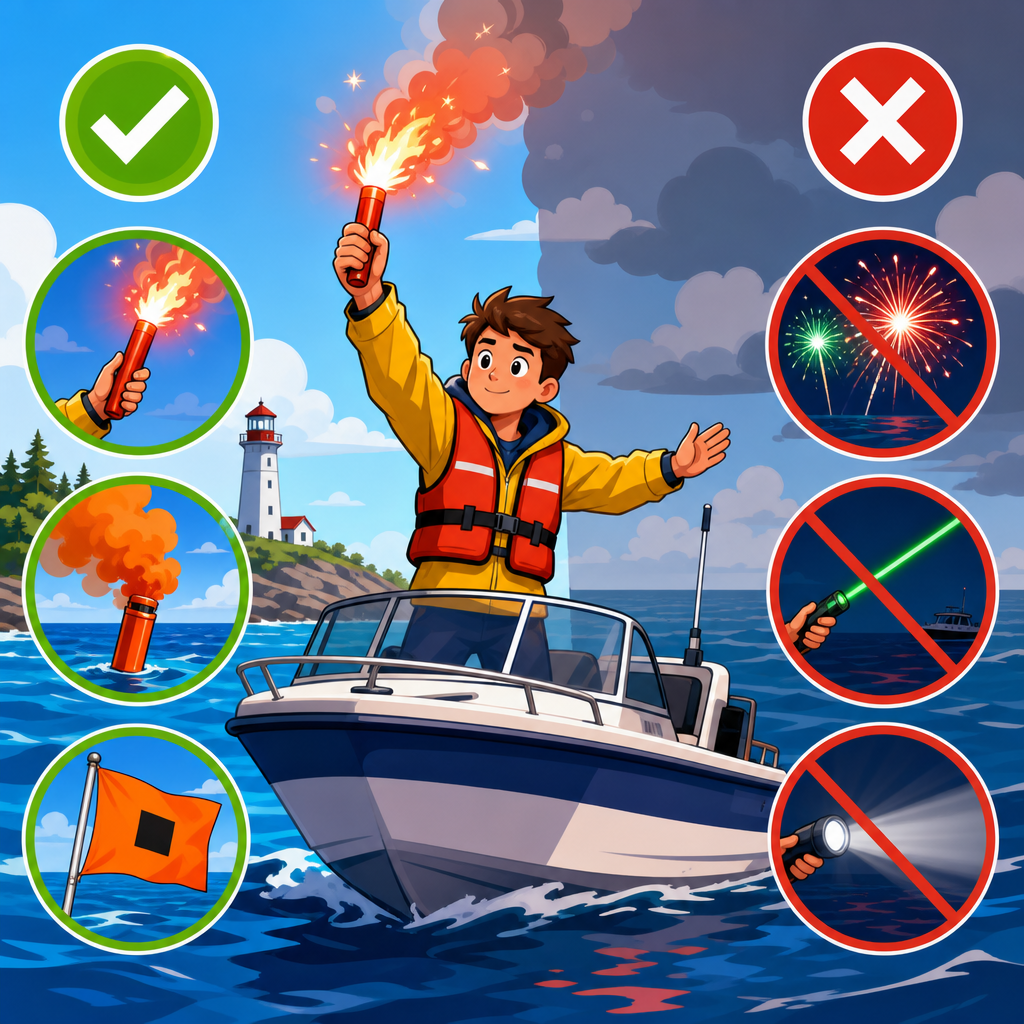
Most recreational boaters meet the visual requirement with pyrotechnics, non-pyrotechnics, or a combination of both. Pyrotechnic options include handheld red flares, meteor or parachute aerial flares, and orange smoke devices for daytime use. Non-pyrotechnic options include an orange distress flag for day use and an approved electric distress light for night use. The practical advantage of mixed kits is obvious: smoke and flags work well in daylight, while electric lights avoid burn risk and expiration issues at night. Still, pyrotechnics remain valuable because they produce intense light and altitude that can be seen from longer distances or over wave tops.
The biggest compliance errors are mundane. Expired flares are the number one issue I encounter. Most pyrotechnics have a 42-month service life from the manufacture date, and once that period passes they no longer satisfy the minimum legal requirement. Poor storage is next: moisture, heat, fuel vapors, and physical damage all reduce reliability. Another mistake is carrying only nighttime red flares and assuming they also cover daytime needs. Some combinations do, but not all kits satisfy both day and night rules. Reading the label matters. Boaters also routinely stash signaling gear under coolers, in locked cabins, or deep inside console compartments, which is functionally equivalent to not having it when a fire or capsize develops quickly.
Legality also turns on quantity and combination. An approved set often means three day and three night signals, or three combination day-night pyrotechnics, though exact compliance depends on the device type. Because products vary, the approval label is the controlling guide. When in doubt, use a package specifically sold as Coast Guard approved marine visual distress signals and verify both the approval and expiration date before every season.
Pyrotechnic versus non-pyrotechnic options
Choosing between pyrotechnic and non-pyrotechnic distress signals is not just a budget decision; it is a tradeoff among visibility, maintenance, safety, and legal coverage. Pyrotechnics are vivid, immediate, and familiar to search crews. Aerial flares can rise hundreds of feet and are effective for alerting distant traffic. Handheld red flares are excellent when rescuers are already nearby and need a final visual fix. Orange smoke is highly visible in daylight, especially against blue water. The downsides are expiration, fire risk, disposal difficulty, and the fact that stressed users sometimes activate them incorrectly.
Non-pyrotechnic tools are safer to store and easier to maintain. An approved electric distress light can satisfy nighttime carriage requirements for many recreational boats, and an orange distress flag can cover daytime obligations in qualifying situations. They are simple and reusable, but they require line of sight and may be less attention-grabbing than a flare, especially in rough weather or cluttered visual environments. I recommend that boaters think in layers rather than either-or choices: legal non-pyrotechnic devices for baseline compliance, plus pyrotechnics and electronic tools for resilience.
| Signal type | Best use | Main advantage | Main limitation |
|---|---|---|---|
| Handheld red flare | Night or close-range final location | Very bright and unmistakable | Burn hazard and expiration |
| Aerial red flare | Alerting distant vessels or aircraft | Long visibility range | Single-use and weather sensitive |
| Orange smoke | Daytime position marking | Highly visible by day | Short duration and wind drift |
| Electric distress light | Nighttime legal carriage | Reusable and safer storage | Less dramatic than pyrotechnics |
| Orange distress flag | Daytime legal carriage | No expiration in normal care | Needs daylight and line of sight |
Radio distress calls, DSC, and mayday procedure
The most effective distress signal is often the one that starts the rescue fastest, and that is usually a VHF radio distress transmission. On navigable waters, a marine VHF radio connected to a GPS source gives rescuers speed, clarity, and reach that visual signals alone cannot match. Channel 16 remains the primary hailing and distress frequency. A proper mayday call states “Mayday” three times, identifies the vessel, gives position, describes the emergency, notes the number of people aboard, and states the assistance needed. That structure is not ceremony; it is information management under stress.
Digital Selective Calling adds another layer. With an MMSI programmed and the radio linked to GPS, pressing the distress button transmits the vessel identity and position automatically to the Coast Guard and nearby DSC-equipped vessels. This is one of the highest-value upgrades a recreational boater can make because it reduces the chance that panic, injury, language barriers, or poor reception will prevent a useful distress report. Yet many owners install DSC radios and never complete the MMSI registration or GPS connection, which defeats the feature. A radio with an unprogrammed distress button is a missed safety opportunity.
Legally, VHF equipment does not usually replace required visual distress carriage, but operationally it is often your first move. The recommended sequence in a true emergency is stabilize the boat if possible, send a DSC distress alert if equipped, make a mayday call on channel 16, and then deploy visual signals when another vessel or aircraft may be in a position to see them. Distress communication works best when voice, digital alerting, and visual cues reinforce one another.
EPIRBs, PLBs, AIS beacons, and satellite messengers
Electronic distress devices have changed survival odds, especially offshore. An Emergency Position-Indicating Radio Beacon, or EPIRB, transmits on 406 MHz through the international Cospas-Sarsat satellite system and, in modern units, often includes GNSS position data and a 121.5 MHz homing signal for final location. For offshore cruisers and passagemakers, an EPIRB is not optional in practical terms; it is foundational. A Personal Locator Beacon performs a similar satellite alerting function in a smaller package intended for an individual rather than a vessel. Registration is critical for both because rescue authorities use the registration data to identify the boat, contacts, and likely voyage profile.
AIS man overboard beacons serve a different but important role. They transmit an AIS target that can appear directly on nearby chartplotters and AIS receivers, which is particularly valuable during a crew-overboard event where the fastest rescuer is often the victim’s own vessel or another ship nearby. Satellite messengers such as Garmin inReach or ZOLEO can also summon help and send texts beyond cell coverage, but they are not substitutes for approved marine distress beacons unless the operator understands the monitoring and response pathway. Their strength is two-way messaging and trip tracking; their limitation is that they may rely on commercial emergency coordination rather than the dedicated marine rescue architecture used by EPIRBs.
What is legal and what is best practice diverge here. Federal carriage rules for many recreational boats still focus on visual signals, not mandatory satellite beacons. But if you run offshore, cross shipping lanes, or boat in cold water, a registered EPIRB or PLB can be the decisive tool because it alerts rescuers even when nobody is in visual range.
What is not legal, what is misused, and how to stay ready
Not every bright light, loud noise, or emergency gadget qualifies as a lawful boating distress signal. Fireworks are not legal substitutes for approved marine flares. Laser devices, unless specifically approved for marine distress signaling under current regulations, should not be assumed compliant. Flashlights, deck lights, and phone flash functions are useful improvised tools but do not meet carriage rules for approved night distress signals. The same is true for road flares, hunting signal devices, and consumer smoke products sold outside the marine approval system.
Misuse can also create legal exposure. Firing a flare for celebration, testing, or non-emergency attention-seeking is dangerous and can trigger a search response, civil penalties, and criminal consequences in severe cases. False mayday calls carry similar risk. Distress signals are reserved for situations of grave and imminent danger. Urgent but non-life-threatening problems, such as a mechanical breakdown without immediate hazard, may call for a pan-pan urgency call rather than mayday. Knowing the distinction helps protect rescue resources and your credibility.
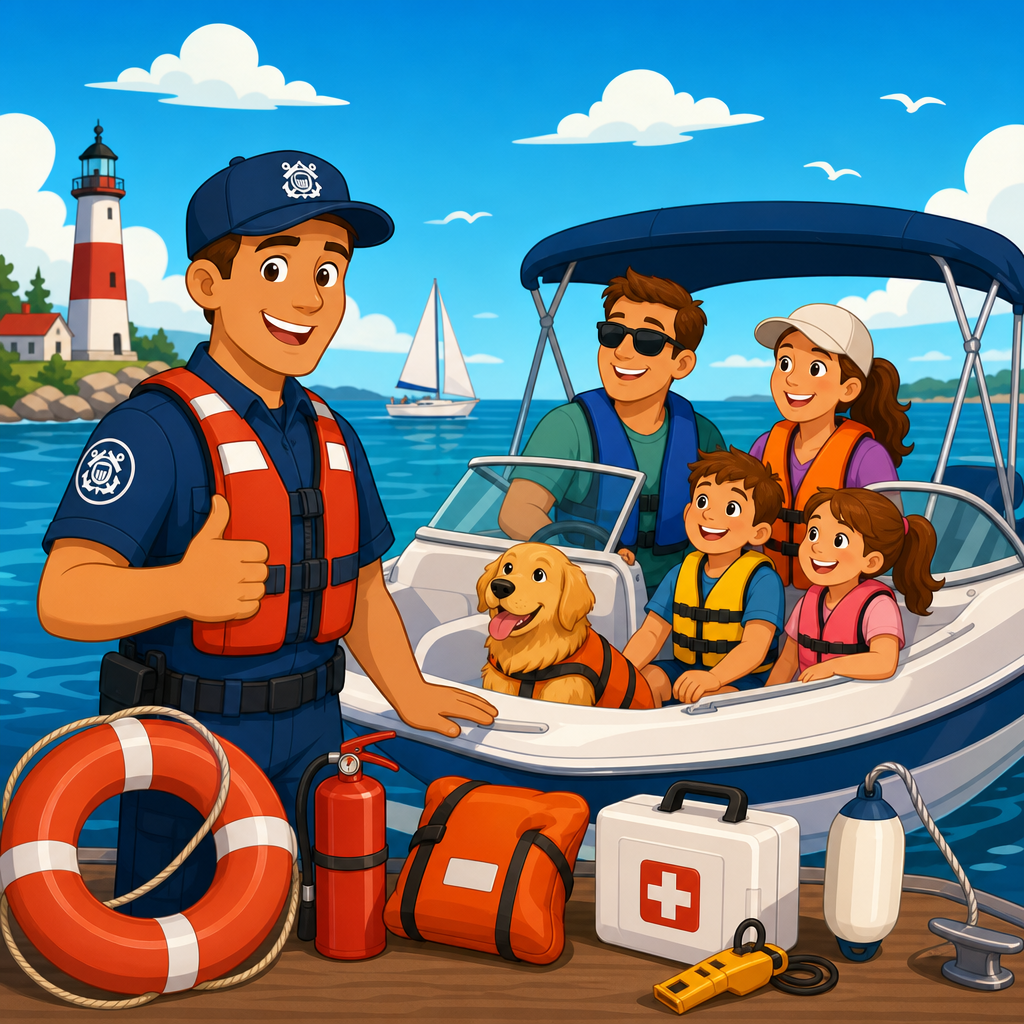
Readiness comes down to inspection and drills. Check expiration dates before the season and again before long trips. Store pyrotechnics in a dry, accessible, clearly marked container. Test radios, confirm the MMSI and GPS connection, and review the mayday script with everyone aboard. Register EPIRBs and PLBs, then update contact information when ownership, phone numbers, or operating areas change. Build your distress plan around layers: approved visual devices for legal compliance, VHF and DSC for rapid communication, and satellite or AIS beacons for redundancy.
Boating distress signals are not a box to check; they are a system for being found fast, and the legal rules are there to ensure every recreational boater carries a proven baseline that rescuers recognize instantly. The core lessons are straightforward. First, approved marine visual distress signals remain the primary legal requirement on many coastal and Great Lakes waters, and expired or non-approved substitutes do not count. Second, the right setup depends on where you boat, when you boat, and what kind of vessel you operate, with day and night capability often treated differently under the rules. Third, electronic communication tools such as VHF radio, DSC, EPIRBs, PLBs, and AIS beacons dramatically improve rescue outcomes, even when they do not replace carriage requirements. Finally, compliance alone is not enough if gear is buried, unregistered, water-damaged, or unfamiliar to the crew.
The real benefit of understanding maritime distress signals and communication is confidence under pressure. When a fire starts, fog closes in, an engine fails offshore, or someone goes overboard, you do not want to improvise. You want a legal, tested, layered signaling plan that matches your boating environment and gives rescuers multiple ways to locate you quickly. Review your current equipment, replace expired devices, register every beacon, and practice your distress procedure before your next trip.
Frequently Asked Questions
What legally counts as a boating distress signal?
A boating distress signal is any recognized visual, audible, or electronic signal used to communicate that a vessel or person is in grave and immediate danger and needs assistance. In legal and practical terms, this includes devices and methods that rescuers, law enforcement, and other mariners are trained to recognize as a call for help. Common examples include red pyrotechnic flares, orange distress flags, electric distress lights, sound signals, EPIRBs, PLBs, VHF marine radio distress calls, and emergency messages sent through approved electronic systems. The key point is that the signal must clearly indicate a true emergency rather than routine communication or general caution.
What is considered “legal” depends on both the type of signal and the circumstances in which it is carried or used. For example, some boats are required by law to carry U.S. Coast Guard-approved visual distress signals when operating on coastal waters, the Great Lakes, territorial seas, and connected waters where boats are commonly used by the public. There are also distinctions between signals approved for daytime use, nighttime use, or both. A device may be effective in practice but still not satisfy carriage requirements if it is expired, not Coast Guard-approved where required, or not suitable for the time of day in which it would need to be used. In short, a legal distress signal is one that is officially recognized, properly carried, and used only to communicate a genuine emergency.
When are boaters legally required to carry distress signals?
Boaters are generally required to carry approved visual distress signals on coastal waters, the Great Lakes, territorial seas, and certain connected inland waters. The exact requirement depends on the type and size of the vessel, whether it is manually propelled, whether it is open or decked, and whether it is operating during the day, at night, or both. In many cases, recreational boats under 16 feet that are not manually propelled may have different requirements than larger boats, while manually propelled craft such as canoes and kayaks may be exempt from some carriage rules but are still strongly encouraged to carry practical emergency signaling devices. Even when a specific legal exemption applies, carrying distress signals is still one of the smartest safety steps a boater can take.
The legal requirement is not just about having “something onboard.” The signals must usually be serviceable, unexpired if expiration applies, and appropriate for the intended operating conditions. For example, if you may be out after dark, you need signals suitable for nighttime distress use. If you operate during the day, you need daytime signals. Some devices meet both requirements, while others cover only one. Because state rules can supplement federal requirements, and special rules may apply in local waters, the safest approach is to check both U.S. Coast Guard guidance and your state boating regulations before departure. Compliance is not only about avoiding a citation; it ensures that if you have to call for help, your signal will be recognized quickly and treated seriously.
Are expired flares still legal to carry, and can you use them in an emergency?
Expired flares generally do not satisfy legal carriage requirements, even if they still appear to be intact. Most approved pyrotechnic visual distress signals are marked with an expiration date, and once that date has passed, they are no longer counted as compliant for required onboard equipment. The reason is reliability: pyrotechnics are exposed to age, moisture, temperature shifts, and storage conditions that can make ignition less dependable over time. From a legal standpoint, carrying only expired flares can place a boater out of compliance, especially in waters where approved visual distress signals are mandatory.
That said, many boating safety professionals recommend keeping expired flares as backup equipment in addition to a fresh, legal set, provided they are stored safely and separately marked so there is no confusion during an emergency. In an actual life-threatening situation, an expired flare may still be better than no signal at all. The priority in a true distress event is preserving life and attracting rescue attention. However, expired flares should never be relied on as your primary legal equipment, and they should never be casually tested or fired for practice outside approved conditions. Disposal rules for expired pyrotechnics vary by location, and boaters should check local law enforcement, fire authorities, hazardous waste programs, or marine safety agencies for proper disposal guidance rather than throwing them in the trash or setting them off recreationally.
What distress signals are illegal to use when there is no real emergency?
Using a distress signal when there is no actual emergency is illegal and potentially dangerous. This includes firing red flares for fun, activating an EPIRB or PLB as a test outside approved test procedures, making a false MAYDAY call on VHF Channel 16, displaying an orange distress flag as a joke, or using SOS lights or sound patterns to attract attention for non-emergency reasons. These actions can trigger search-and-rescue responses, divert rescue assets from real emergencies, and create confusion for nearby boaters who may alter course or put themselves at risk trying to assist.
False distress signaling can carry serious legal consequences, including fines, civil liability, and even criminal penalties in some cases, especially if the misuse causes unnecessary deployment of the Coast Guard or other emergency responders. Beyond the legal risk, it undermines trust in distress communications. Rescuers must be able to assume that a recognized distress signal means what it says: someone may be in immediate danger. If you need help for a non-life-threatening mechanical issue, low fuel, or a routine tow, use proper non-distress communications such as a standard radio call, phone contact with a towing service, or another appropriate assistance channel. Save formal distress signals for situations involving grave and imminent danger.
What are the best legal distress signals to carry for real-world boating safety?
The best setup combines legal compliance with practical rescue effectiveness. A strong distress-signal kit often includes U.S. Coast Guard-approved visual distress signals for both day and night use, a properly registered EPIRB or PLB if appropriate for your boating area, a waterproof VHF marine radio with Digital Selective Calling if available, a sound-producing device, and backup signaling tools such as a signal mirror, whistle, flashlight, and strobe. Pyrotechnic flares remain highly visible and widely recognized, but many boaters are also choosing approved non-pyrotechnic options because they reduce fire risk, last longer, and can be easier to store and maintain. The right combination depends on where you boat, how far offshore you travel, how long you stay out, and how many people are aboard.
Legally, the best signal is one that satisfies the rules for your vessel and operating area. Practically, the best signal is one you can deploy quickly under stress, in darkness, bad weather, or rough water. Electronic distress beacons are especially valuable because they alert rescue authorities beyond visual range, while radio distress calls can provide immediate details about your location and situation. Visual signals then help rescuers pinpoint you once they are nearby. In other words, no single device does everything. The most safety-minded boaters think in layers: alert rescuers electronically, communicate by radio, and mark position visually. That approach not only keeps you on the right side of the law but also gives you the best odds of a fast and effective rescue.