Best boat trailer tires and how to extend their lifespan is a practical topic every trailer owner should understand, because tires carry the full weight of the boat, trailer, fuel, gear, and momentum every mile to and from the ramp. In trailer maintenance and towing, tire performance affects safety, handling, braking distance, wheel bearing temperature, fuel economy, and the likelihood of roadside breakdowns. A boat trailer tire is not the same as a passenger-car tire. Trailer-specific tires use stiffer sidewalls, construction intended for high load carrying, and tread designs built for straight-line stability rather than steering response. Choosing the right tire means matching load range, speed rating, size, inflation pressure, and service type to the trailer’s actual operating weight. Extending tire life means controlling heat, ultraviolet exposure, saltwater corrosion, alignment errors, underinflation, and long periods of storage. I have seen more ruined trailer tires caused by neglect in driveways than by hard miles on highways. This hub explains how to choose the best boat trailer tires, how to inspect and maintain them, and how tire care fits into the broader trailer maintenance and towing routine.
What makes a boat trailer tire the best choice
The best boat trailer tires are the ones correctly sized and rated for the trailer, not simply the most expensive set on the shelf. Start with the sidewall markings. Most boat trailers should use ST tires, which stands for Special Trailer. ST tires are engineered for higher load capacity at a given size than many light-truck tires, and their sidewalls resist sway better when a trailer is pushed by crosswinds or lane changes. Common sizes include ST175/80R13, ST205/75R14, and ST225/75R15. The size must match the wheel width and the trailer manufacturer’s specification. Changing diameter or section width without checking fender clearance, suspension travel, and axle spacing creates rubbing and heat buildup.
Load range matters as much as size. Load Range C, D, and E indicate how much weight a tire can carry at a stated pressure. For example, a typical ST205/75R14 Load Range D tire may carry around 2,040 pounds at 65 psi, though exact values vary by manufacturer. To choose correctly, use the trailer’s gross vehicle weight rating and actual loaded weight, then divide by the number of tires, leaving a reserve margin rather than running each tire near maximum all the time. I prefer at least a 10 percent cushion in real use because boats gain weight with batteries, coolers, waterlogged gear, and full fuel tanks.
Construction is the next decision. Radial trailer tires generally run cooler, track better on long highway trips, and wear more evenly than bias-ply tires. Bias-ply tires can be useful for slower, short-haul applications on rough roads because of their robust sidewall characteristics, but for most modern towing, radial ST tires are the better default. Reputable brands regularly used by trailer owners include Goodyear Endurance, Maxxis M8008, Carlisle Radial Trail HD, and Provider ST tires. These lines are popular because they offer modern speed ratings, dependable load capacity, and widespread availability if you need a replacement on the road.
How to match tires to towing conditions and trailer setup
Boat trailers operate in harsher conditions than utility trailers because they combine highway heat with repeated immersion near water, often saltwater. That environment changes how you choose tires and wheels. Galvanized or aluminum wheels resist corrosion better than painted steel wheels, but each must still be inspected for pitting around the bead seat and lug holes. A great tire mounted on a corroded wheel can leak slowly, leading to chronic underinflation and sidewall failure. If your trailer sits outside near the coast, valve stems should also be replaced with high-pressure stems rated for the tire’s inflation requirement.
Towing speed is another overlooked factor. Many older trailer tires carried a 65 mph speed limit. Newer premium ST radials often provide higher speed ratings, but only when inflated properly and used within load limits. Heat is the enemy. Every increase in speed, ambient temperature, or load raises casing temperature. That is why a trailer that feels fine on a short local run may lose a tire on a two-hour interstate trip in summer. Tire choice should reflect your real use case: long-distance highway towing, frequent ramp launches, seasonal storage, and occasional rough pavement all matter.
Single-axle and tandem-axle trailers stress tires differently. Tandem axles add capacity and redundancy, but they also scrub tires during tight turns, accelerating shoulder wear. If you own a tandem trailer, it is normal to see faster wear than on a single axle, especially if the trailer is maneuvered often in parking lots or driveways. That does not mean uneven wear should be ignored. Feathering, inside-edge wear, or one tire running hotter than the others points to alignment, bent axles, weak suspension components, or uneven loading. Tire life is directly linked to overall trailer setup, not just tire quality.
Best maintenance practices that extend boat trailer tire lifespan
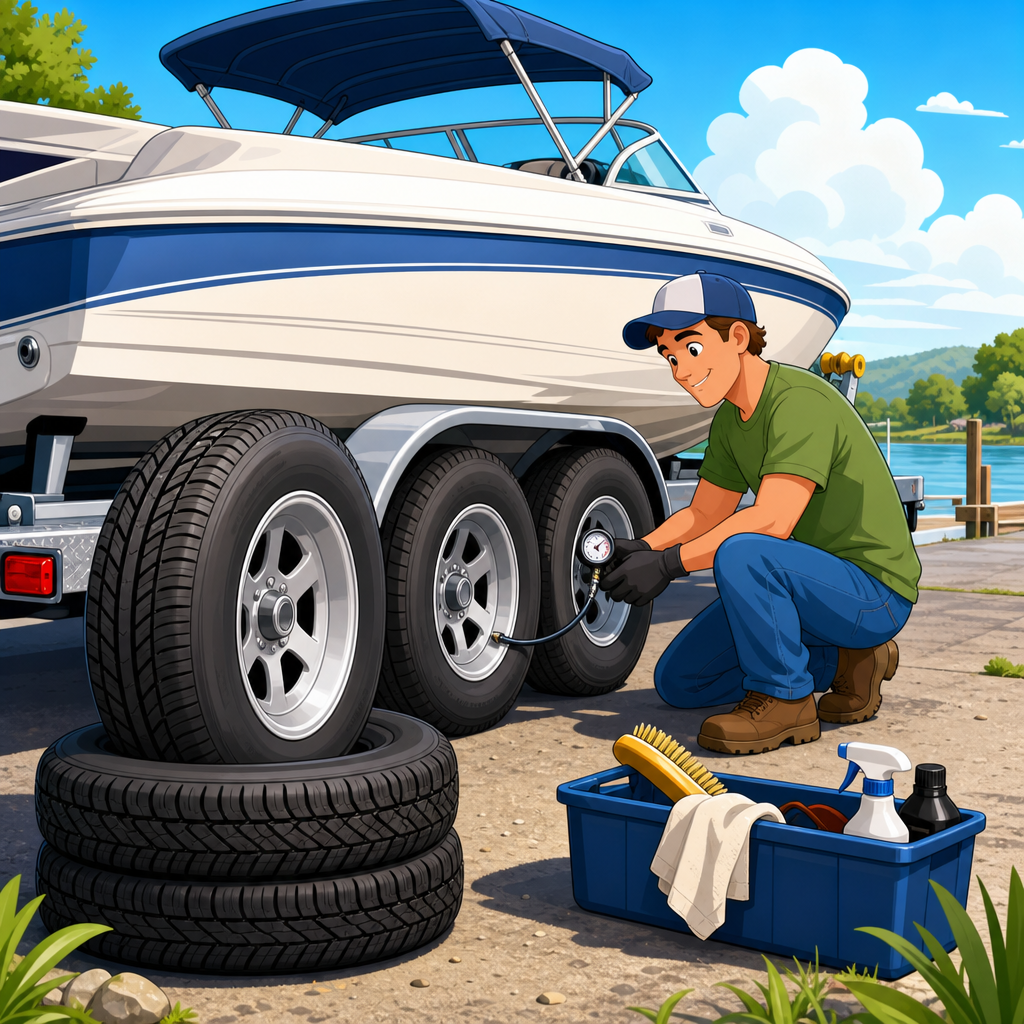
The single most effective way to extend boat trailer tire life is maintaining correct cold inflation pressure. Trailer tires are designed to carry rated loads at specified pressures, and they lose life quickly when run soft. Underinflation increases sidewall flex, which creates heat and breaks down internal structure. Check pressure before every trip with a reliable gauge when the tires are cold, ideally before the trailer has moved more than a mile. I also recommend using a quality tire pressure monitoring system on longer trips. A TPMS gives early warning of leaks, overheating, and pressure rise patterns that tell you how evenly the tires are working.
Routine inspection should be part of every launch-day and pre-tow checklist. Look for cracking between tread blocks, sidewall weather checking, bulges, punctures, exposed cord, uneven tread wear, and foreign objects embedded in the tread. Measure tread depth, but do not rely on depth alone. Trailer tires often age out before they wear out. Most manufacturers and trailer service shops advise close inspection after five years from the DOT date code and replacement before the tire reaches six to seven years in typical boat trailer use, especially if it lives outdoors. Sun, ozone, and long storage periods can age the casing even when the tread still looks usable.
Storage conditions strongly influence lifespan. Use tire covers to block ultraviolet light, keep the trailer on a clean hard surface rather than bare soil, and move it occasionally so one section of the tread is not continuously loaded. If the trailer will sit for months, inflate tires to the specified pressure and, where practical, unload some weight with properly placed jack stands under the frame, not under the axle in a way that interferes with suspension geometry. Clean tires and wheels after saltwater exposure with fresh water. Petroleum-based dressings should be avoided because they can accelerate rubber degradation. Simple washing and shaded storage do more for longevity than cosmetic products.
Inspection points across the full trailer maintenance and towing system
Boat trailer tire life depends on the health of the entire running gear. Bearings, hubs, brakes, springs, equalizers, bunks, lights, coupler, winch strap, and tongue jack all affect towing reliability. In my experience, owners who inspect the whole trailer consistently get better tire life because they catch root causes early. A dragging brake caliper can overheat one wheel. A failing bearing can let the hub wobble and wear a tire abnormally. Broken spring leaves or worn shackle bushings can shift load distribution enough to overload one tire on a tandem axle.
Hub temperature checks are an easy field test. After driving for a while, stop safely and compare hub temperatures by hand carefully or with an infrared thermometer. One hub that is much hotter than the others indicates a bearing or brake issue that can also damage the tire. Torque is another key item. Lug nuts should be tightened to wheel manufacturer specifications using a calibrated torque wrench, then rechecked after the first 25 to 50 miles on newly installed wheels or tires. Overtightening can distort the wheel or damage studs. Undertightening can elongate lug holes and lead to wheel loss.
Suspension and alignment deserve more attention than they usually get. Trailer axles can bend from pothole impacts, curb strikes, or overloading. On leaf-spring trailers, worn hangers and equalizers create tracking problems. On torsion-axle trailers, a damaged arm angle changes camber and causes edge wear. If a trailer pulls oddly, the tires show one-sided wear, or the boat seems to sit off-center, measure alignment or have a trailer shop inspect it. Tire replacement without correcting the underlying geometry simply resets the failure cycle.
| Component | What to check | Why it affects tire life |
|---|---|---|
| Tire pressure | Cold PSI before every trip | Low pressure creates heat and sidewall damage |
| Wheel bearings | Play, noise, grease condition, hub temperature | Bearing wear causes wobble and uneven tread wear |
| Brakes | Dragging calipers, shoe adjustment, rotor condition | Overheating transfers heat into wheel and tire |
| Suspension | Springs, bushings, equalizers, torsion arms | Poor load distribution overloads individual tires |
| Alignment | Camber, toe, axle position | Misalignment causes rapid shoulder wear |
| Wheel condition | Corrosion, cracks, bead seat, lug holes | Damaged wheels leak air and stress the casing |
When to replace trailer tires and how to avoid roadside failure
Replace a boat trailer tire immediately if you see cord exposure, sidewall bulges, deep cracking, tread separation, puncture damage outside repairable areas, or repeated unexplained air loss. Age alone is also a valid reason to replace. Read the DOT code on the sidewall; the last four digits show the week and year of manufacture. A tire marked 2421 was made in the 24th week of 2021. Even if it looks acceptable, an aging trailer tire is a poor place to save money, because failure usually damages the fender, wiring, brake lines, or hull support hardware when the tread lets go.
The spare tire should match the working tires in size, load rating, and inflation capability. Too many trailers carry an old spare that is already aged out or mounted on a corroded wheel. Carry the tools to use it: jack, lug wrench sized for the trailer’s lug nuts, torque wrench, wheel chocks, and a wood block for soft shoulders. On long trips, I also carry a grease gun or spare bearing kit, because tire and bearing failures often arrive together after a heat event. If one tire fails, inspect the adjacent tire on the same side closely. It may have been overloaded in the moments before the blowout.
Smart driving reduces failures. Leave more following distance, avoid curb strikes, slow down for expansion joints and potholes, and back the trailer without scrubbing tandem tires any more than necessary. Weigh the fully loaded rig at a public scale at least once. Actual numbers remove guesswork and help you set up the tow vehicle, tongue weight, and tire capacity correctly. As a hub within boat maintenance and repairs, this page ties directly to related work on wheel bearing service, trailer brake maintenance, lighting and wiring, corrosion control, and safe towing setup. Keep those systems in shape, choose quality ST radial tires, maintain pressure and alignment, and your boat trailer tires will last longer, run cooler, and deliver safer trips to every launch. Inspect yours before the next tow.
Frequently Asked Questions
What makes boat trailer tires different from regular passenger-car or light-truck tires?
Boat trailer tires are built for a very different job than the tires on a passenger vehicle. A trailer tire has to support heavy vertical loads for long periods, stay stable while towing, resist sway, and handle the stress of sitting parked between trips. That is why most boat trailers use ST-rated tires, which stands for Special Trailer. These tires are engineered with stiffer sidewalls than typical passenger-car tires, and that extra stiffness helps the trailer track more predictably behind the tow vehicle, especially during lane changes, braking, crosswinds, and highway speeds.
Another key difference is load design. Passenger tires are optimized for ride comfort, steering response, and traction during acceleration and braking on a driven vehicle. Trailer tires do not need to steer or deliver engine power to the road, but they do need to carry substantial weight consistently and resist heat buildup under load. That heat resistance matters because excessive heat is one of the main causes of tire failure on trailers. A properly matched trailer tire helps reduce sidewall flex, improve towing stability, and lower the risk of blowouts.
Boat trailers also face conditions that many road tires never see, including water exposure, extended storage, sun, salt, and repeated immersion near launch ramps. Because of that, many trailer owners choose radial ST tires designed for durability, cooler running temperatures, and better highway performance. In short, using the correct trailer-specific tire is not just a recommendation. It is a basic safety requirement that affects handling, braking distance, tire life, and overall towing reliability.
How do I choose the best boat trailer tires for my trailer and load?
The best boat trailer tire is the one that matches your trailer’s real-world load, wheel size, speed needs, and usage conditions. Start with the trailer’s placard or manufacturer specifications. You need to know the correct tire size, load range, and minimum load capacity required for the fully loaded trailer. That means the total weight of the boat, motor, fuel, batteries, gear, coolers, anchors, and anything else being hauled. Many tire problems begin when owners estimate lightly and end up running too close to the tire’s maximum capacity.
Look closely at the tire’s load range and its capacity at the recommended inflation pressure. The combined capacity of all trailer tires should comfortably exceed the actual loaded trailer weight, with a sensible margin for safety. If your trailer is frequently loaded near its limit, stepping up to a higher load range may be worth considering, provided the wheel is also rated for that pressure. Tire and wheel ratings must work together. Installing a higher-pressure tire on a wheel that is not designed for that pressure creates a new problem instead of solving the old one.
Construction type matters too. Radial trailer tires are often the best choice for boat trailers that travel longer distances or spend more time at highway speeds because they generally run cooler and wear more evenly. Bias-ply tires can still be found on some trailers and may be useful in certain lower-speed or specialized applications, but radial ST tires are the preferred option for many recreational boaters. Also pay attention to speed rating, age, corrosion resistance in marine environments, and brand reputation for trailer-specific products. A quality tire from a reputable manufacturer, properly sized and properly inflated, will almost always outperform a cheaper tire that merely “fits.”
What tire pressure should I run on a boat trailer, and how often should I check it?
The correct tire pressure is the pressure specified for that exact trailer tire and load setup, not a generic number pulled from another trailer or a passenger car habit. In most cases, ST trailer tires are intended to be inflated to the pressure listed on the tire sidewall when carrying their rated load. That pressure is critical because underinflation creates excessive sidewall flex, and sidewall flex creates heat. Heat is the enemy of trailer tires. It accelerates internal damage, increases rolling resistance, shortens tread life, and raises the odds of a failure on the road.
You should check pressure when the tires are cold, ideally before every trip. “Cold” means the trailer has been parked long enough that the tires are at ambient temperature and have not been warmed by driving or direct afternoon heat. Use an accurate tire gauge, and do not forget the spare. A spare that has been ignored for two seasons is not much help during a roadside emergency. It is also smart to inspect valve stems, valve caps, and the wheel itself for signs of leaks, cracking, or corrosion.
Pressure checks should be part of a broader pre-trip inspection. While checking inflation, look for uneven tread wear, bulges, weather cracking, punctures, and signs that the tire has been overloaded or run low. If one tire repeatedly loses pressure, investigate immediately rather than simply topping it off. Maintaining the right inflation pressure helps the tire carry weight correctly, improves towing stability, reduces heat buildup, protects fuel economy, and can significantly extend tire lifespan. It is one of the simplest maintenance habits and one of the most important.
How can I make my boat trailer tires last longer?
Extending boat trailer tire life comes down to controlling the factors that cause damage: overload, underinflation, heat, sunlight, storage stress, and neglect. Start with the basics. Keep the tires inflated to the proper cold pressure, stay within the trailer’s weight limits, and make sure the load is distributed correctly. Poor weight balance can overload one axle or one side of the trailer, causing premature wear and unstable towing. If the trailer sits nose-high or nose-low, that can also affect load sharing and tire wear.
Storage habits matter more than many owners realize. Boat trailers often spend long stretches parked, and that can be hard on tires. UV exposure, ozone, moisture, and long-term contact with hot pavement or damp ground all contribute to deterioration. Whenever possible, store the trailer on a firm surface, use tire covers, and avoid leaving the tires in direct sun for months at a time. If the trailer will be stored for an extended period, moving it occasionally can help prevent flat spotting. Some owners also take weight off the tires during long-term storage, but this should be done only with proper support and safe trailer stabilization.
Routine inspections are equally important. Check tread depth, sidewalls, manufacturing date, and signs of irregular wear. Uneven wear can point to alignment problems, worn suspension components, bent axles, or bearing issues. Hot wheel hubs may indicate bearing trouble, which can indirectly damage tires by increasing rolling resistance and heat. Driving habits count too. High speeds, aggressive cornering, curb impacts, and long highway runs in hot weather all add stress. Slowing down, inspecting often, and replacing aging tires before they fail will usually save money and frustration in the long run.
When should boat trailer tires be replaced, even if the tread still looks good?
Trailer tires should be replaced based on age, condition, and performance, not tread depth alone. Unlike vehicle tires that wear out primarily from mileage, boat trailer tires often age out before they wear out. A trailer may only travel a limited number of miles each season, but the tires still endure UV exposure, moisture, temperature swings, heavy static loads, and long storage periods. Over time, the rubber compounds and internal structure degrade, even if the tread still appears serviceable.
One of the most useful things to check is the DOT date code on the tire sidewall, which identifies the week and year the tire was manufactured. Many trailer owners begin evaluating replacement more seriously as tires approach the mid-life range, and they replace them before age-related failure becomes likely. The exact timing depends on climate, storage conditions, maintenance, and usage, but age absolutely matters on boat trailers. Cracking in the sidewall, tread separation, bulges, exposed cords, repeated air loss, or vibration while towing are all signs that replacement should happen immediately.
It is also wise to replace tires that have been overloaded, run severely underinflated, or damaged by impact, even if the harm is not obvious from the outside. Internal damage can remain hidden until a failure occurs at speed. If you are buying a used boat trailer, do not assume the tires are roadworthy just because they hold air and look decent from a distance. Check the date codes, verify the size and load rating, and inspect for marine-environment wear. Proactive replacement is far less expensive and far safer than dealing with a blowout on the highway while towing a boat.