Upgrading your boat’s steering system is one of the most effective ways to improve handling, reduce driver fatigue, and make every trip safer, especially when the work is approached as part of a broader propeller and steering maintenance plan. In practical terms, a steering upgrade means replacing worn mechanical components, moving to hydraulic assist, correcting helm play, or matching steering hardware to the boat’s hull, engine, and propeller load. Better handling refers to quicker response, more predictable tracking, easier docking, and less fight at the wheel in chop, current, or high-speed turns. I have worked through these upgrades on center consoles, aluminum fishing boats, and sterndrive runabouts, and the difference is obvious the first time you leave the marina.
This subject matters because steering and propulsion are tightly linked. A boat does not steer in isolation; the propeller creates thrust, torque, ventilation behavior, and load changes that the steering system must control. When owners complain that a boat wanders, pulls hard to starboard, chine walks, or feels unstable in reverse, the root cause may involve the cable, helm, hydraulic ram, engine mounting height, prop condition, or alignment between all of them. Treating propeller and steering maintenance as one system prevents wasted money and solves handling issues at the source. This hub explains how to evaluate what you have, choose the right upgrade path, maintain critical components, and spot related problems before they become failures on the water.
How Boat Steering Systems Work and Why They Wear Out
Most recreational boats use one of three steering layouts: mechanical cable, hydraulic, or power-assisted hydraulic. Mechanical steering uses a helm gear that pushes and pulls a cable connected to the outboard or sterndrive. It is common on smaller boats because it is simple and relatively affordable. Hydraulic steering replaces the cable with fluid pressure, usually using a helm pump, hoses, and a steering cylinder. Power-assisted systems add an electric or engine-driven pump to reduce effort on heavier boats or multi-engine setups. Each system can steer well when correctly specified, but each fails in predictable ways.
Mechanical steering usually degrades gradually. You feel increased wheel effort, backlash at center, stiffness after storage, or uneven resistance from lock to lock. Corrosion in the tilt tube is a frequent culprit on outboards, especially in saltwater. I have pulled steering rods that looked polished in one section and heavily rusted in another, a classic sign of neglected grease and trapped moisture. Hydraulic steering problems present differently: spongy response, wheel drift, visible fluid seepage at fittings, or inconsistent engine movement under load. Power-assist systems can add pump noise, electrical faults, or lag if voltage is low or lines are restricted.
Wear accelerates when the propeller and setup are wrong. A damaged propeller can introduce vibration that shakes the steering linkages and helm. Excessive prop torque from an aggressive stainless prop on a single outboard can make a cable system feel much worse than it is. Poor engine trim habits also matter. Running bow-high with too much positive trim increases steering load and can exaggerate chine walk or wandering. Before recommending any upgrade, I inspect the whole chain: helm, cable or hoses, cylinder, tie bar if twin engines are involved, transom hardware, skeg condition, and propeller balance. That system view saves time and produces better handling than replacing one part blindly.
Signs Your Steering System Needs an Upgrade, Not Just a Repair
Some steering issues can be corrected with maintenance, but others indicate the boat has outgrown its original system. The clearest sign is chronic wheel effort. If a boat is hard to steer at cruising speed even after greasing pivot points, correcting engine trim, and verifying cable movement, the steering design may simply be undersized for the hull and power. This is common on repowered boats. An older 18-foot center console originally rigged for a 90 horsepower outboard may feel acceptable with cable steering, but after a repower to 150 horsepower and a modern stainless prop, the helm loads can become excessive.
Another strong indicator is persistent helm play. A small amount of movement at the wheel before engine response is normal in older mechanical systems, but if the delay is noticeable while docking or correcting course in a crosswind, the boat will never feel precise. High-speed instability is an even bigger warning. If the boat requires constant correction, falls off one side in hard turns, or becomes tiring to run for long distances, a steering upgrade can change the entire character of the hull. This is particularly true on bass boats, bay boats, and stepped hulls that benefit from immediate, controlled steering input.
Repeated component failures also justify an upgrade. If cables seize every few seasons, seals leak despite proper bleeding, or transom steering hardware loosens under normal use, it is smarter to move to a more suitable system than to keep replacing parts. I also advise upgrading when owners add autopilot, jack plates, dual stations, or kicker motors. Those additions increase complexity and often expose the limitations of entry-level steering. Good handling is not only about comfort; it is also about maintaining control during emergency maneuvers, towing, rough-water quartering, and close-quarters docking where response time matters.
Choosing Between Mechanical, Hydraulic, and Power-Assist Steering
The best steering upgrade depends on horsepower, hull type, usage, and budget. Mechanical steering still makes sense on smaller tiller conversions, skiffs, jon boats, and lightweight runabouts where engine loads are modest. Modern no-feedback mechanical helms improve control by reducing wheel feedback from prop torque. They are a worthwhile step up from older rotary systems, especially for single outboards under roughly 115 horsepower, though manufacturer ratings always take precedence. They cost less, install more easily, and are straightforward to service, but they will never match the smoothness of hydraulic steering on heavier or faster boats.
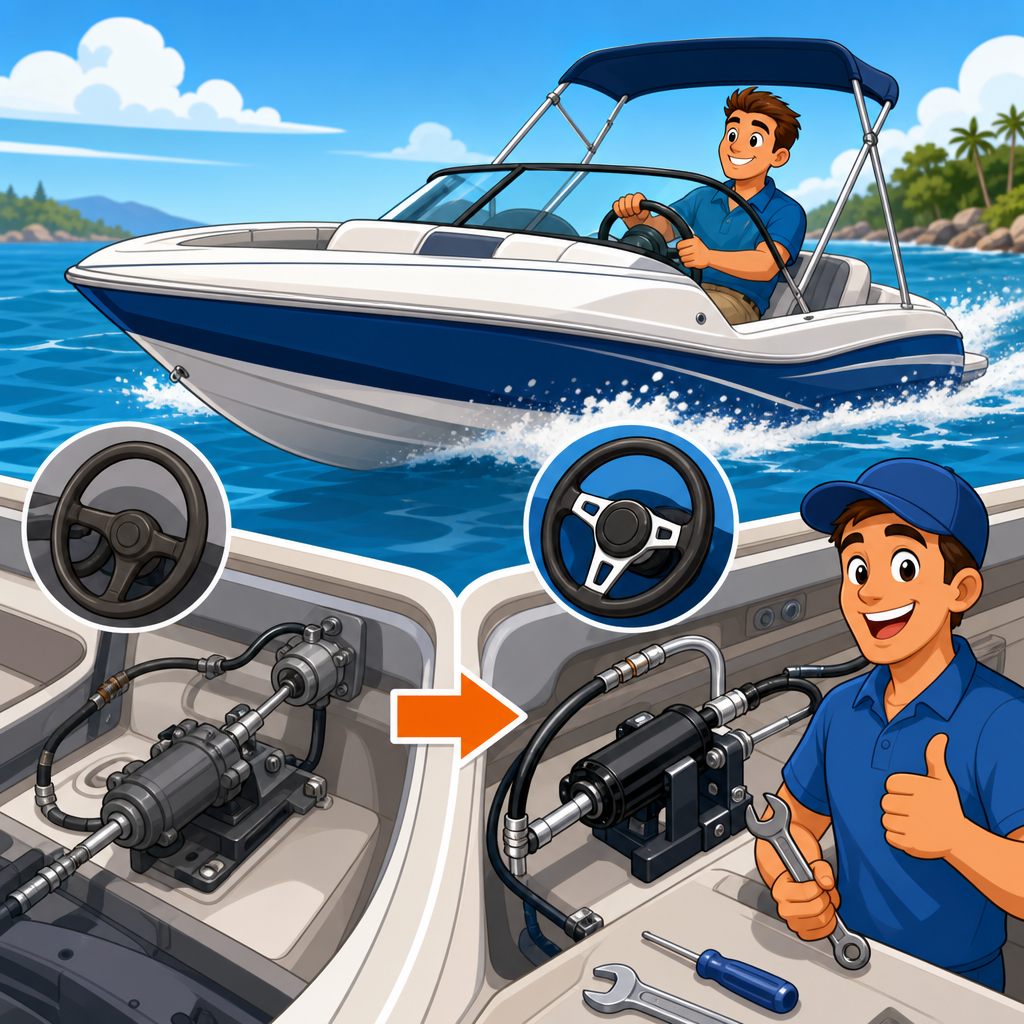
Hydraulic steering is the standard recommendation for many mid-size outboards because it removes cable friction and dramatically improves steering consistency. On the water, the advantage is immediate: smoother lock-to-lock motion, less kickback, and easier control at speed. SeaStar, Uflex, and BayStar are widely used systems, each with specific cylinder and helm capacities matched to engine output and displacement. The right choice depends on actual engine rating and application, not guesswork. Hydraulic systems also route more cleanly through tight rigging spaces and are better suited to boats with auxiliary controls, though installation quality matters enormously. Poor hose routing or incomplete bleeding will undermine the benefits.
Power-assist steering is the premium option for larger center consoles, offshore boats, and twin or triple outboard installations. It is also valuable for sterndrives and heavy pilothouse boats where steering loads stay high all day. With assist, the helm effort drops substantially, making long runs less tiring and fine corrections easier in rough conditions. The tradeoff is cost, added electrical demand, and more components to inspect. For serious offshore use, though, the improvement in control and fatigue reduction can be worth every dollar. When owners ask me which system gives the best handling, the honest answer is the one correctly sized to the boat and maintained as part of the propulsion package.
| System | Best Use Case | Main Benefit | Main Limitation |
|---|---|---|---|
| Mechanical no-feedback | Small single-outboard boats | Lower cost and simpler installation | Higher effort and more wear over time |
| Hydraulic | Mid-size outboards and many sterndrives | Smoother response and reduced feedback | Higher cost and requires proper bleeding |
| Power-assist hydraulic | Heavy boats, offshore use, multi-engine rigs | Lowest helm effort and best control under load | Most expensive and more complex |
Propeller and Steering Maintenance: The Handling Connection
Propeller condition directly affects steering feel, yet many owners separate the two. A propeller with bent blades, uneven cup, excessive pitch for the engine’s operating range, or spun hub symptoms can create handling problems that mimic steering faults. I have seen boats with a slight pull at the wheel improve immediately after a prop repair because blade damage was producing uneven thrust. Vibration is another clue. If you feel wheel shake, seat vibration, or rattling in the helm at specific RPM, inspect the prop before condemning the steering system. A balanced propeller reduces stress on bearings, steering linkages, and engine mounts.
Correct prop selection also changes steering load. Stainless steel props generally flex less than aluminum, which improves performance, but the added bite can increase steering torque on single-engine boats. Four-blade props often improve stern lift, midrange grip, and low-speed control, useful for towing, heavy loads, or rough-water holding, but they can alter wheel effort and trim sensitivity. High rake designs can improve bow lift and speed on some hulls while making others feel less planted in turns. There is no universal best prop. The right match depends on wide-open-throttle RPM, gear ratio, load profile, engine mounting height, and how the boat is actually used.
Routine maintenance should include prop removal, shaft inspection, and grease application at least seasonally, or more often in silty or saltwater use. Fishing line behind the prop is a classic hidden problem; it cuts into seals and can lead to lower-unit oil contamination. While the prop is off, inspect the thrust washer, cotter hardware, hub condition, and shaft splines. At the steering end, grease the tilt tube where applicable, inspect steering arm fasteners, check for fluid leaks, and test full lock movement with the engine trimmed through its operating range. These checks are simple, but they eliminate many causes of poor handling before you spend money on major upgrades.
Installation Priorities That Deliver Better Real-World Handling
A steering upgrade only performs as well as the installation. The first priority is compatibility. Helm displacement, cylinder volume, hose diameter, and engine rating must match manufacturer specifications. Mixing parts without confirming compatibility is one of the fastest ways to create slow response or over-pressurization. On mechanical systems, cable routing deserves special attention. Tight bends increase friction and shorten cable life. I prefer the widest practical sweep with secure support points and no chafe near rigging boots or bulkheads. A clean route feels better at the wheel and stays reliable longer.
Bleeding hydraulic systems correctly is equally critical. Air in the lines causes softness, delayed response, and wandering. Follow the prescribed bleeding sequence, use the recommended fluid, and cycle the engine repeatedly while monitoring for trapped air. After sea trial, recheck fittings for seepage because small leaks often appear only under real steering loads. Torque values matter on cylinder mounts and steering link arms, and locking hardware should be renewed rather than reused casually. If the boat has twins, tie-bar geometry must be exact or the engines will not track evenly, which hurts handling and can accelerate wear.
Sea trial evaluation should include idle maneuvering, acceleration onto plane, cruise in flat water, quartering chop, hard-over turns, and reverse control. Note wheel effort, center feel, pull under acceleration, and whether the boat tracks straight with neutral trim. If it still pulls, investigate torque tab adjustment, engine alignment, trim technique, and propeller influence before assuming the new steering is defective. The best installations feel natural rather than dramatic. The wheel responds smoothly, the boat holds a line with fewer corrections, and docking becomes more precise because the engine follows your input without hesitation.
Maintenance Schedule and Hub Topics Every Boat Owner Should Cover
As a hub for propeller and steering maintenance, this page should guide a complete care routine. Start with monthly visual checks during the season: inspect the helm for looseness, verify smooth lock-to-lock movement, look for hydraulic leaks, and confirm mounting hardware remains tight. Every 50 to 100 engine hours, examine the steering link arm, support tube, engine pivot points, and hose or cable jackets. At least once per season, remove the propeller, inspect for line, dings, and hub wear, then grease the shaft and reinstall with correct hardware. Annual service should also include checking lower-unit oil for seal damage that may trace back to prop-shaft issues.
Owners should also build supporting articles and tasks around this hub: how to diagnose steering wheel stiffness, how to bleed hydraulic steering, how to replace a steering cable, how to choose the right propeller pitch, how to inspect a prop hub, how to adjust an outboard torque tab, and how to winterize steering components. These jobs are connected. For example, a wheel that stiffens after winter storage often points to corrosion in the tilt tube, while steering pull after a prop change may indicate altered torque characteristics rather than a failed helm. Organizing maintenance by symptoms and systems helps owners troubleshoot logically instead of replacing expensive parts by trial and error.
Documentation is part of maintenance as well. Keep records of propeller specs, part numbers, hydraulic fluid type, helm model, cylinder model, cable length, and installation date. I also note baseline wide-open-throttle RPM, cruise speed, and wheel effort observations after any change. Those records make later diagnosis far easier. If handling worsens after striking debris, changing load distribution, or swapping props, you have a reference point. Good records turn maintenance from guesswork into controlled problem solving, and that is how experienced boat owners keep handling sharp year after year.
Conclusion
Upgrading your boat’s steering system for better handling starts with understanding that steering, propeller condition, engine setup, and maintenance all work together. The right upgrade may be a modern no-feedback cable system, a properly sized hydraulic package, or full power assist for heavy offshore use. What matters is matching the equipment to the boat, installing it correctly, and maintaining the entire propulsion and steering chain as one system. When you do, the results show up immediately in smoother response, less wheel effort, cleaner tracking, and more confidence in tight maneuvering or rough water.
The biggest takeaway is that many handling complaints are not caused by one bad part. They come from accumulated wear, poor rigging, neglected prop inspection, or components that no longer match the boat’s power and use. A careful evaluation saves money and leads to upgrades that actually solve the problem. If your boat pulls, wanders, vibrates, or tires you out at the helm, use this hub as your starting point, inspect the basics, and plan the next step with the full steering and propeller system in mind.
For better handling and safer time on the water, review your current setup, schedule a full steering and prop inspection, and upgrade the components that are limiting control.
Frequently Asked Questions
1. How do I know if my boat’s steering system needs to be upgraded instead of simply repaired?
A repair may be enough when the problem is isolated, such as a loose connection, a worn cable, or minor helm play that can be corrected with replacement parts. An upgrade makes more sense when steering problems are part of a larger pattern that affects control, comfort, and safety. Common signs include heavy wheel effort, delayed response when turning, excessive free play at the helm, torque steer that constantly pulls the wheel to one side, vibration during turns, or steering that becomes difficult under higher throttle settings. These symptoms often point to a steering system that is undersized, worn beyond practical repair, or no longer matched to the boat’s current setup.
You should also think about an upgrade if you have changed your boat in ways that increase steering load. For example, adding a more powerful outboard, switching to a different propeller design, carrying heavier loads, or using the boat more often in rough water can all expose the limitations of an older mechanical system. In those cases, replacing individual parts may restore function temporarily, but it may not deliver the improved handling you want. A modern hydraulic or power-assisted system can reduce steering effort, improve tracking, and give you more consistent control across a wider range of speeds and conditions.
Another practical factor is maintenance history. If cables are corroded, the helm feels inconsistent, and steering components show wear in multiple areas, repeated repairs can quickly become less cost-effective than a full upgrade. A complete steering evaluation should include the helm, cables or hoses, cylinder or actuator, tiller connection, engine mounting condition, and the effect of propeller choice on steering load. When the whole system is looked at together, it becomes easier to decide whether you need a targeted repair or a true upgrade for better long-term handling.
2. What type of steering upgrade is best for improving boat handling: mechanical, hydraulic, or power-assisted hydraulic?
The best choice depends on your boat’s size, speed, engine output, and how you use it. Traditional mechanical steering can work well on smaller boats with modest horsepower, especially when the system is in good condition and properly adjusted. It is usually the most affordable option and can still deliver decent response for light-duty applications. However, mechanical systems tend to require more steering effort, and they are more likely to develop stiffness, cable wear, and play over time. If your goal is noticeably better handling with reduced fatigue, mechanical steering is often the least capable option once boat size and steering loads begin to increase.
Hydraulic steering is one of the most common upgrades because it offers a major improvement in control without requiring constant physical effort from the operator. By using fluid pressure instead of a direct cable link, hydraulic systems provide smoother wheel movement, more predictable turning, and much less feedback from engine torque. This is especially helpful on boats with larger outboards, heavier stern loads, or propeller setups that create noticeable steering pull. In real-world use, hydraulic steering can make the boat feel more balanced and easier to hold on course, particularly at cruising speed or in choppy water.
Power-assisted hydraulic steering is the premium option and is typically best for larger, faster, or higher-horsepower boats where steering loads are significant. It combines the smoothness of hydraulic steering with additional steering assistance, which reduces wheel effort even further and provides excellent responsiveness. This type of system is especially valuable for offshore fishing boats, multi-engine setups, performance hulls, or any boat that spends long days on the water where driver fatigue becomes a real concern. If you regularly operate at speed, carry heavy loads, or want the most refined helm feel possible, power assist can be a worthwhile investment.
To make the right decision, the steering system should be matched not only to horsepower but also to hull design, transom setup, engine trim range, and propeller characteristics. A steering upgrade works best when it is treated as part of the entire handling package rather than as a stand-alone component choice.
3. Will upgrading the steering system really improve handling, or do propeller setup and engine alignment matter just as much?
Upgrading the steering system can absolutely improve handling, but it works best when propeller setup, engine alignment, and overall rigging are considered at the same time. Steering is only one part of how a boat responds on the water. If the propeller creates excessive torque, the engine is mounted at the wrong height, or the trim tab and alignment are off, even a high-quality steering system may not fully solve poor handling. In other words, better steering hardware improves the driver’s control, but the boat still needs to be set up correctly so that the steering system is not constantly fighting avoidable forces.
Propeller choice has a direct effect on steering feel. Blade design, pitch, diameter, rake, and cup can all influence stern lift, bow lift, torque steer, and turning behavior. A propeller that is efficient for speed or load carrying may also increase wheel pull or make the boat feel more sensitive in turns. Similarly, engine mounting height affects how the propeller runs in the water and how much leverage the engine applies to the steering system. If the engine is too high or too low, you may notice ventilation, inconsistent bite in turns, or a feeling that the boat wanders rather than tracks cleanly.
That is why the most effective approach is a broader propeller and steering maintenance plan. Inspect the steering system for wear, evaluate the propeller for damage or mismatch, verify engine alignment and mounting height, and check for looseness in related hardware such as tie bars, transom bolts, and pivot points. When these elements are corrected together, the improvement in handling is usually much more noticeable. You get quicker response, better directional stability, smoother turning input, and less strain at the helm. So yes, a steering upgrade helps, but its full benefit comes when the entire control and propulsion setup is working as a system.
4. Can I upgrade my boat’s steering system myself, or should it be installed by a professional?
Some experienced boat owners can handle certain steering upgrades themselves, but whether that is a good idea depends on the type of system, the boat’s rigging complexity, and your familiarity with marine mechanical and hydraulic work. Replacing a basic mechanical cable on a small boat may be manageable if you have the correct tools, access to the rigging path, and the manufacturer’s installation specifications. Even then, steering components must be installed with precise routing, correct attachment points, proper torque values, and full range-of-motion testing. A small error can create stiffness, binding, or a dangerous loss of control on the water.
Hydraulic upgrades are more demanding. They require careful hose routing, cylinder mounting, helm installation, fluid filling, air bleeding, and confirmation that the system operates smoothly under load. If air remains in the lines or fittings are not properly secured, steering performance can become inconsistent. In addition, some boats have limited access behind the helm or at the transom, making it difficult to install components cleanly and safely. Multi-engine systems, power-assisted steering, and high-performance setups are especially strong candidates for professional installation because the tolerances and rigging requirements are more complex.
A professional marine technician can also help with system selection, which is often where steering upgrades succeed or fail. Installing a high-quality unit that is not correctly sized for the engine, hull, and use case will not produce the handling gains you expect. A technician can evaluate load requirements, check related rigging issues, inspect for hidden wear in the engine pivot or mounting hardware, and verify that the propeller and trim setup are not contributing to the steering complaint. If you are confident in your skills, a DIY install may be possible on a simple boat. If safety, performance, and long-term reliability are priorities, professional installation is usually the better choice.
5. What maintenance should I perform after upgrading the steering system to keep handling sharp and reliable?
Once the steering system has been upgraded, ongoing maintenance is what preserves the handling improvements. Start with regular inspections at the helm and transom. Look for mounting hardware that has loosened, fluid seepage around hydraulic fittings, wear at the cylinder or tiller connection, and any return of free play at the wheel. With mechanical systems, check cable condition, movement smoothness, and corrosion at exposed ends. With hydraulic systems, monitor fluid level and inspect hoses for abrasion, cracking, or swelling. Catching small issues early helps prevent the gradual loss of steering precision that many boat owners do not notice until handling has already deteriorated.
It is also important to maintain the rest of the control package. Propeller condition should be checked regularly for dings, bent blades, or imbalance, because prop damage can introduce vibration and unwanted steering feedback. Confirm that the engine remains securely mounted and that trim and alignment settings have not shifted. If your boat has a torque tab, tie bar, jack plate, or other performance rigging hardware, those components should also be inspected. Better steering can only perform at its best when the engine and propeller are operating correctly and the hull is not being influenced by loose or worn hardware.
On the water, pay attention to changes in feel. If steering suddenly becomes heavier, less responsive, noisier, or more prone to pull to one side, treat that as a maintenance signal rather than normal aging. Seasonal service is a smart habit,