How to keep your boat battery from dying in the winter starts with understanding why marine batteries fail during storage. Cold weather does not automatically ruin a healthy battery; neglect does. In my work with seasonal layups, I have seen far more batteries damaged by partial charging, unnoticed parasitic loads, and poor off-season inspection than by low temperatures alone. Winter storage magnifies every weakness in a battery system, from sulfation in flooded lead-acid cells to voltage imbalance in aging AGM banks. If your boat sits for months, your battery needs a plan, not just a disconnect switch.
A boat battery is the stored energy source that powers engine starting, electronics, pumps, lighting, and onboard accessories. Depending on the boat, that may mean a starting battery, a deep-cycle house battery, or a dual-purpose design. Common chemistries include flooded lead-acid, AGM, gel, and increasingly lithium iron phosphate. Winterizing boat batteries means preparing the battery, charging system, cables, and storage environment so the battery remains stable, safe, and ready for spring commissioning. Seasonal prep also includes related systems that affect battery life, such as bilge pumps, shore power chargers, solar maintainers, and battery switches.
This matters because batteries are one of the most common avoidable spring failures. A discharged battery can freeze, case pressure can rise, plates can sulfate, and internal capacity can drop permanently. Replacing marine batteries is expensive, especially when a boat uses multiple Group 27, Group 31, or 8D units. Dead batteries also create hidden costs: missed launch days, troubleshooting labor, charger strain, and unnecessary alternator load once the engine is started. Good winter battery care preserves performance, extends service life, and reduces surprise failures across the wider winterizing and seasonal prep process.
This hub article covers the full winterizing picture: how temperature affects batteries, how to charge and disconnect them correctly, where to store them, what to inspect monthly, and when replacement is the smarter choice. It also points toward the broader tasks that sit beside battery care in a solid cold-weather layup, including electrical inspection, corrosion control, charger setup, and spring recommissioning checks. If you want your boat battery to survive winter, the goal is simple: keep it fully charged, physically protected, electrically isolated from unwanted draws, and checked often enough that small problems never become expensive ones.
Why Boat Batteries Die in Winter Storage
Most winter battery failures come from self-discharge plus parasitic load. Every battery loses some charge over time, but marine boats often add memory circuits, stereo presets, GPS units, automatic bilge switches, alarms, and battery monitors that quietly draw power all winter. A lead-acid battery left below full charge begins sulfation, where lead sulfate crystals harden on the plates and reduce capacity. The lower the state of charge, the greater the risk. Once a battery stays deeply discharged for weeks, even an advanced charger may not recover its original performance.
Temperature affects battery behavior in two important ways. First, cold slows chemical activity, so available cranking power drops as temperatures fall. Second, a discharged battery freezes at a much higher temperature than a fully charged one. A fully charged lead-acid battery can tolerate severe cold, while a heavily discharged one can freeze around typical winter conditions in many storage yards. Freezing can crack the case or buckle internal plates. AGM batteries resist vibration and leakage better than flooded cells, but they are not immune to damage from prolonged low voltage.
Charging errors are another major cause. I often find boats plugged into shore power all winter with an old ferroresonant charger that never truly transitions to a safe float stage. Constant overcharging drives off electrolyte in flooded batteries, accelerates plate corrosion, and shortens life. On the other side, some owners remove the battery and leave it untouched in a garage for five months, assuming cold storage alone protects it. Without periodic maintenance charging, that battery may be dead by late winter. The real issue is not indoor versus onboard storage; it is whether the battery stays in the correct voltage window for its chemistry.
Choose the Right Winter Strategy for Your Battery Type
The correct winterizing method depends on battery chemistry. Flooded lead-acid batteries need a full charge, clean terminals, electrolyte level inspection, and storage where they will not freeze while discharged. Use only distilled water when topping off, and fill after charging unless the plates are exposed. AGM batteries are sealed, spill-resistant, and have lower self-discharge, making them easier to store, but they still require a charger with an AGM-compatible profile. Gel batteries are less common today and are highly sensitive to overvoltage, so a charger with the correct gel setting is essential. Lithium iron phosphate batteries require a manufacturer-approved storage procedure, and some should not be charged below freezing.
For most recreational boats, three winter approaches work. First, remove the batteries, charge them fully, and store them in a dry location on a maintainer. Second, leave them onboard, disconnect all loads, and use a smart marine charger or solar maintainer if power and supervision are reliable. Third, leave them onboard fully charged with no maintainer, but check and recharge them regularly based on resting voltage. The best choice depends on access, safety, charger quality, and whether the boat has systems that must remain active, such as a bilge pump in wet storage.
| Battery type | Winter priority | Best charging approach | Main risk if neglected |
|---|---|---|---|
| Flooded lead-acid | Keep fully charged and electrolyte at proper level | Smart charger with bulk, absorption, and float stages | Sulfation, freezing, water loss |
| AGM | Maintain correct voltage and avoid chronic undercharge | AGM-compatible smart charger | Capacity loss from low voltage or overcharge |
| Gel | Prevent overvoltage | Gel-specific charge profile | Pocketing and permanent damage |
| Lithium iron phosphate | Follow manufacturer storage state-of-charge guidance | Approved lithium charger and battery management system | Charging damage in freezing conditions, shutdown from BMS limits |
If you are unsure which battery you have, read the label and the manufacturer data sheet before winterizing. Trojan, Interstate, Lifeline, Battle Born, Victron, and Dakota Lithium all publish storage guidance, voltage recommendations, and charging limits. That documentation matters because marine charging equipment is not universal. A charger that treats every bank the same can shorten battery life, especially in mixed banks or older systems with worn alternators and fixed-output shore chargers.
Step-by-Step Winter Battery Prep Before Storage
Start with a full inspection before the boat is laid up. Look for swollen cases, electrolyte leakage, corroded terminals, frayed cables, loose hold-downs, and heat damage around lugs or breakers. Clean terminals with a battery cleaner or a baking soda solution, but keep that solution away from cell openings on flooded batteries. Rinse, dry, and protect connections with a corrosion inhibitor such as Boeshield T-9, CRC Heavy Duty Corrosion Inhibitor, or dielectric protection intended for marine electrical use. Good contact reduces resistance and improves charging efficiency.
Next, fully charge the battery with a quality marine charger. For lead-acid batteries, resting voltage after the surface charge dissipates should generally indicate a full state of charge. If possible, verify condition with more than voltage alone. A hydrometer works well on flooded batteries, and a conductance tester from brands like Midtronics or a shop-grade carbon pile load test can reveal weakness that voltage hides. I prefer testing before storage because a marginal battery often survives fall but fails on the first cold spring start. Replacing it during layup is easier than diagnosing it at the ramp.
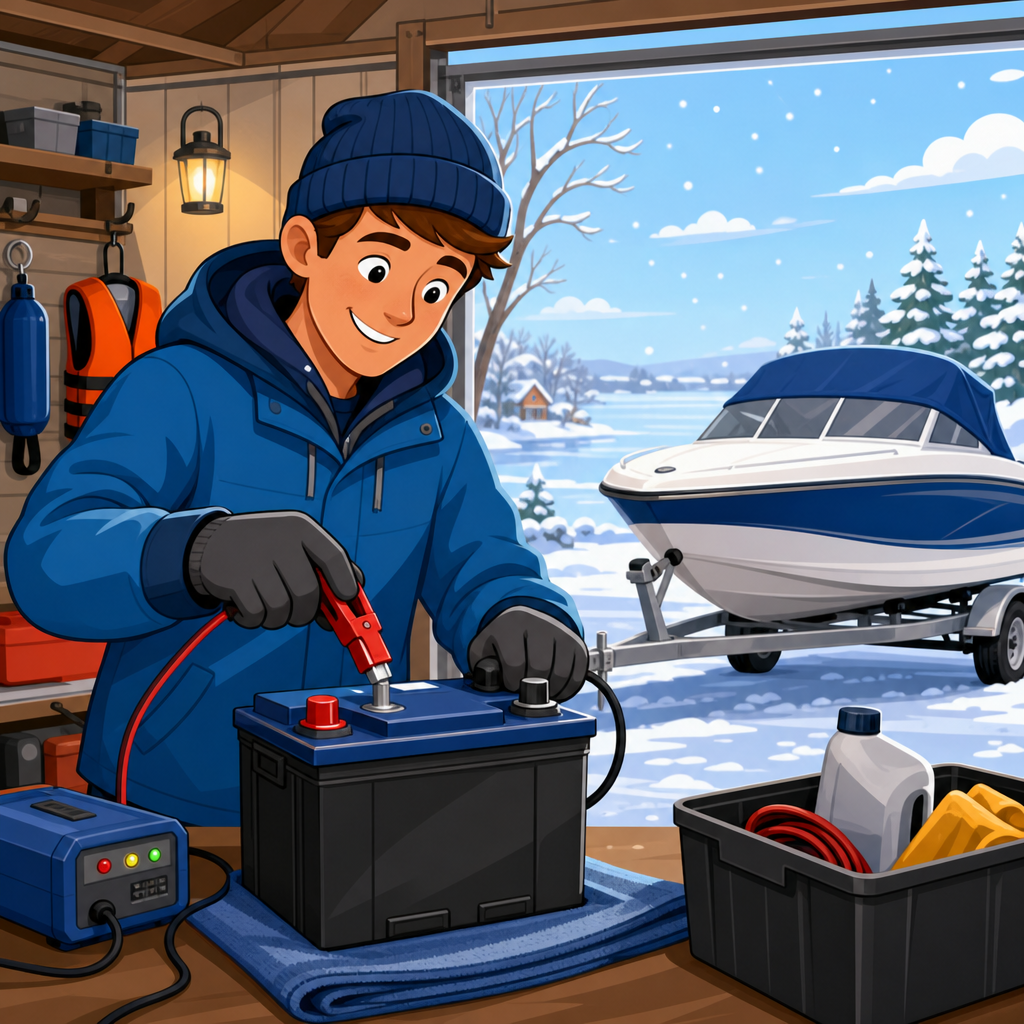
Once charged, disconnect the negative cable first, then the positive if removal is planned. Label each cable if your boat has multiple banks, battery switches, ACRs, inverter feeds, or parallel jumpers. Photograph the installation before removal. If the batteries stay onboard, use the battery switch to isolate circuits only if you have confirmed that no critical loads need power. On many boats, the bilge pump automatic float circuit bypasses the main switch, so simply turning the switch off does not eliminate battery drain. Trace the wiring rather than guessing.
Finally, secure the storage environment. Batteries should remain upright, dry, clean, and protected from direct snow or rain intrusion. Contrary to an old myth, modern battery cases can sit on a concrete floor without harm, but they should still be placed where they will not collect moisture or be struck by tools. If you remove them from the boat, store them where temperatures remain stable and where a charger can operate safely with ventilation. If the boat is wrapped, make sure humidity and condensation are controlled, because moisture accelerates terminal corrosion and weakens nearby electrical connections.
Charging, Maintenance, and Monitoring Through the Off-Season
The best answer to how to keep your boat battery from dying in the winter is to maintain full charge without overcharging. For lead-acid batteries, that usually means a modern smart charger with temperature compensation and proper stages: bulk, absorption, and float. Higher-end systems from ProMariner, NOCO, Minn Kota, Victron Energy, and Mastervolt can maintain separate banks accurately and report voltage history. Temperature compensation matters because charge voltage should drop as battery temperature rises and increase as it falls. Without compensation, winter charging can be either inadequate or excessive.
If shore power is dependable, a smart charger can stay connected all winter, but only if the charger is truly designed for long-term maintenance. Older constant-output chargers should not be left unattended for months. If shore power is unreliable, many owners do better with periodic charging every three to six weeks, depending on battery type and measured resting voltage. Solar maintainers can work well in outdoor storage, especially with a quality controller, but they must be sized to exceed self-discharge and any residual parasitic loads. A tiny panel clipped to a cloudy winter-stored boat rarely solves a real drain problem.
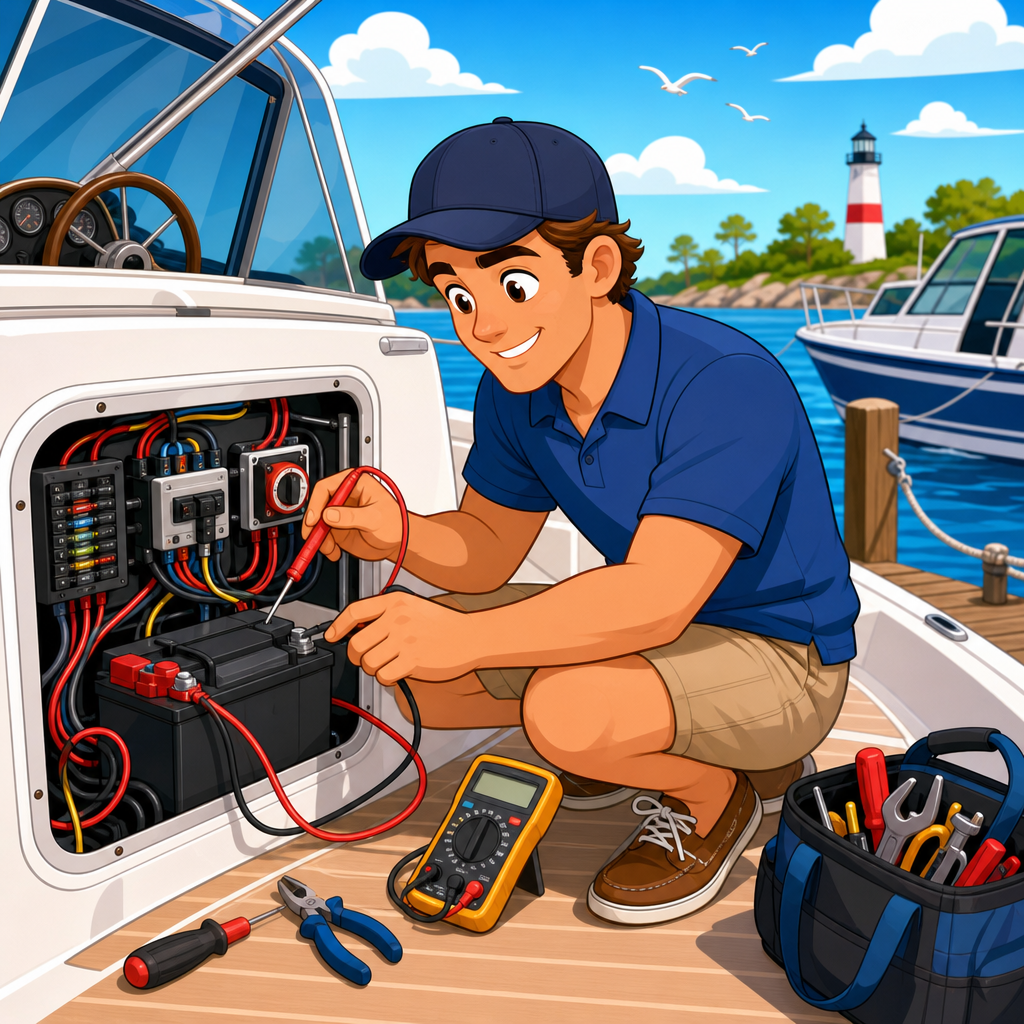
Check batteries regularly even when a maintainer is installed. I recommend recording date, voltage, charger status, and ambient temperature at least monthly. For flooded batteries, inspect electrolyte level and top off only with distilled water. Look for unexplained voltage decline, which may indicate a failing cell, hidden current draw, or charger fault. Measure parasitic load with a multimeter in series or with a clamp meter designed for low DC amperage. On some fishing boats, I have found stereo amplifiers, aftermarket fish finder backfeeds, and corroded battery switches pulling enough current to flatten a bank over several weeks.
If a battery repeatedly drops below maintenance voltage during storage, solve the cause rather than charging around it. Chronic undercharge invites sulfation, and each cycle through low voltage reduces useful life. This is also where broader winterizing and seasonal prep connects to battery care. Inspect onboard chargers, alternator output, shore power inlets, fuses, busbars, grounding points, and battery compartment ventilation. A healthy battery can still fail in spring if the charging system is weak or if corrosion creates voltage drop between the charger and the bank.
Common Winter Battery Mistakes and How to Avoid Them
The biggest mistake is storing a battery partially charged. Many owners assume they can use the boat one last time, park it, and handle charging later. That delay is enough to start sulfation. Charge the same day the boat is winterized. Another common mistake is relying only on the dashboard voltmeter or charger indicator light. Those tools are useful but not precise enough for seasonal storage decisions. Use a digital multimeter, and if the battery is older, test actual capacity or conductance before winter rather than trusting appearance.
Another error is ignoring small loads. A bilge pump counter, radio memory, NMEA network device, or security tracker may draw only milliamps, but over months that is significant. Owners also forget that corrosion itself can create problems by increasing resistance and reducing charging efficiency. Loose terminal nuts are especially common after a busy season of trailering and vibration. I routinely torque and recheck battery lugs before layup because a connection that seems fine in autumn can become a no-start complaint in April.
Some mistakes come from using the wrong charger settings. AGM on flooded mode, gel on AGM mode, or lithium on a lead-acid charger can all cause problems. Mixing old and new batteries in one bank is another poor practice because the weak unit drags down the stronger one. For twin-engine boats and cruiser house banks, batteries should be matched by type, age, and capacity whenever they operate together. If one battery in a house bank has failed, replacing the full set is often the more reliable long-term decision.
Finally, do not confuse battery winterizing with complete seasonal prep. Battery survival depends on surrounding systems. A leaking deck fitting can drip into the battery compartment. A failed cover can allow snowmelt to flood wiring. A neglected shore power cord end can overheat the charger circuit. Good winterizing and seasonal prep includes electrical inspection, moisture control, corrosion prevention, and a spring recommissioning checklist that verifies resting voltage, charger operation, and engine cranking performance before launch day.
Conclusion: Build a Simple Winter Routine That Protects Battery Life
Keeping a boat battery from dying in the winter is not complicated, but it does require discipline. Charge the battery fully before storage, match the charger to the battery chemistry, eliminate parasitic loads, inspect terminals and cables, and recheck condition through the off-season. Those steps prevent the three failures that matter most: sulfation, freezing, and unnoticed discharge. Whether you store the battery onboard or off the boat, success comes from stable voltage, clean connections, and periodic verification, not guesswork.
As the hub for winterizing and seasonal prep, this topic connects directly to charger selection, corrosion control, bilge pump planning, electrical inspections, and spring recommissioning. If you treat the battery as part of a complete storage system, you will save money, avoid false engine or electronics diagnoses, and start the season with confidence. Build a monthly winter battery checklist now, use it every year, and your boat will be far more likely to launch on the first turn of the key.
Frequently Asked Questions
Why do boat batteries die over the winter even when the boat is not being used?
Most boat batteries that fail during winter storage do not die because of cold alone. They die because they are stored in a weakened state and then left unattended for months. A partially charged battery is especially vulnerable. In lead-acid batteries, partial charge encourages sulfation, which is the buildup of hard lead sulfate crystals on the plates. Once that buildup becomes severe, the battery loses capacity, struggles to accept a full charge, and may never recover to its previous condition. This is one of the most common reasons a battery seems “fine in the fall” but is dead or unreliable in the spring.
Another major cause is parasitic drain. Even when the boat is shut down, small electrical draws from bilge pumps, stereo memory circuits, GPS units, alarms, battery switches wired around accessories, or onboard electronics can slowly pull voltage down over time. A healthy battery can tolerate short periods of inactivity, but months of unnoticed drain will deeply discharge it. That kind of deep discharge is hard on any marine battery and especially damaging if temperatures fluctuate during storage.
Winter also magnifies existing weaknesses. A battery with low electrolyte, dirty terminals, internal corrosion, loose cable connections, or an aging cell may have been getting by during the season. Once storage begins, those hidden issues become much more serious. A fully charged battery handles cold better than a discharged one, but a neglected battery enters winter at a disadvantage. The key takeaway is simple: winter storage does not automatically kill batteries, but poor charging habits, unaddressed electrical loads, and lack of inspection very often do.
Should I leave my boat battery connected during winter storage, or disconnect it?
In most cases, disconnecting the battery is the safer choice if the boat is going into long-term winter storage and there is no critical equipment that must remain powered. Disconnecting removes the risk of slow parasitic drains silently discharging the battery over several weeks or months. Many boat owners assume everything is “off,” but onboard systems often continue drawing power in the background. Even a small draw can become a serious problem during the off-season.
If you do disconnect it, disconnect the negative cable first and reconnect it last when the season returns. That reduces the chance of accidental shorting. If the boat has multiple batteries, label cables and battery positions so everything goes back exactly where it belongs. It is also smart to clean the terminals before storage and protect them with a corrosion inhibitor after they are dry and secure.
That said, disconnecting alone is not enough. A disconnected battery still self-discharges over time, and if it was not fully charged before storage, it can still deteriorate. The best approach is usually to fully charge the battery, disconnect it if appropriate, and maintain it with a quality marine-compatible smart charger or check and recharge it at regular intervals. If the boat must remain connected because of a monitoring system or another essential load, then you need a maintenance charging plan and a clear understanding of exactly what is drawing current. The goal is not simply to isolate the battery, but to prevent it from sitting in a partially discharged condition all winter.
Is it better to remove a boat battery for the winter, or can it stay in the boat?
A boat battery can often stay in the boat over the winter if the storage environment is secure, dry, and suitable for battery maintenance. Removing it is not always necessary. In fact, a fully charged battery generally tolerates cold storage better than many people realize. The bigger issue is whether the battery will remain clean, dry, protected from parasitic drain, and properly maintained while it is onboard. If those conditions are met, leaving it in place can be perfectly acceptable.
Removing the battery does have advantages. It makes inspection easier, allows charging in a controlled environment, and reduces the likelihood of hidden electrical drains. It also gives you the opportunity to check the battery tray, hold-down hardware, and cables for corrosion or wear. For flooded lead-acid batteries, removal can make it easier to verify electrolyte levels safely and top off with distilled water if needed before storage. If your boat is stored in a location where shore power is unreliable or where regular winter checks are difficult, removing the battery is often the better option.
If you do store the battery off the boat, place it in a cool, dry, well-ventilated area away from direct sources of heat and away from anything that could create sparks. Keep it on a stable surface and maintain it according to the battery type. Modern batteries do not need the old “wood board” myth treatment nearly as much as people once believed, but they do need a clean storage space and consistent charging care. Whether the battery stays in the boat or comes out, the best result comes from keeping it fully charged, preventing discharge, and checking it periodically rather than forgetting about it until spring launch.
How often should I charge or check my boat battery during winter storage?
The right schedule depends on the battery type, its age, the storage temperature, and whether it is connected to any loads, but the general rule is that winter-stored batteries should not be left unchecked for months. If you are using a high-quality smart maintainer designed for marine batteries, it can often stay connected throughout storage and automatically keep the battery at an appropriate state of charge without overcharging. This is one of the simplest and most effective ways to prevent winter battery failure.
If you are not using a maintainer, check the battery voltage regularly, typically at least once a month. For flooded lead-acid and AGM batteries, allowing voltage to sit too low for too long leads to sulfation and permanent capacity loss. Monthly checks give you time to recharge before the battery reaches a harmful state of discharge. Older batteries or batteries with known self-discharge issues may need more frequent attention. During these inspections, look beyond voltage. Check cable tightness, inspect terminals for corrosion, and for flooded batteries, verify electrolyte levels if the design allows access.
It is also worth remembering that “charging” and “maintaining” are not exactly the same thing. Repeatedly letting a battery discharge and then blasting it with a charger is not as good as keeping it consistently near full charge. Stable maintenance is easier on the battery and more reliable over a long off-season. If you are unsure about battery condition, a load test before storage and another one before spring commissioning can reveal whether the battery is simply discharged or truly nearing the end of its service life. Regular winter checks are less about doing a lot of work and more about catching small problems before they become an expensive replacement.
What is the best way to prepare a boat battery for winter so it is ready in the spring?
The best winter-prep process starts before the boat is put away. First, fully charge the battery with a charger that matches the battery chemistry. This step matters more than many owners realize. A battery that goes into storage partially charged is much more likely to sulfate, lose capacity, or freeze if it is severely discharged. Once it is fully charged, inspect the battery case for swelling, cracks, or leaks, and check the age of the battery if you are unsure of its remaining service life. Winter is a smart time to identify a weak battery rather than discovering it at launch.
Next, clean the terminals and cable ends so corrosion does not worsen during storage. Make sure connections are tight and in good condition. If you have a flooded lead-acid battery, check electrolyte levels and top off with distilled water if needed, but only according to manufacturer guidance and never overfill. Then address parasitic loads by turning off battery switches where appropriate, disconnecting cables if long-term storage calls for it, and identifying any circuits that may continue drawing current. This is also the right time to inspect the entire battery system, including trays, hold-downs, charger leads, and fuse protection, because winter storage exposes weaknesses that may have gone unnoticed during the season.
Finally, choose a maintenance strategy and stick to it. A marine smart charger or battery maintainer is usually the most effective solution, especially for multi-month layups. If that is not possible, set a calendar reminder to inspect and recharge the battery regularly through the winter. Store the battery in a dry, stable environment, and avoid the common mistake of assuming cold weather itself is the main threat. In practice, the batteries that survive winter best are the ones that are fully charged, electrically isolated from unnecessary loads, and checked often enough to prevent small voltage losses from becoming permanent damage. That combination gives you the best chance of having a dependable, ready-to-go battery when spring arrives.