Personal watercraft age restrictions determine who can legally ride a Jet Ski, WaveRunner, or Sea-Doo, and they sit at the center of broader personal watercraft regulations across the United States. A personal watercraft, usually shortened to PWC, is a small vessel powered by an inboard motor driving a water jet pump, designed for a rider who sits, stands, or kneels on top rather than inside the hull. In everyday use, many people say Jet Ski as a generic term, but the legal rules apply to all brands and models. The question sounds simple: how old do you have to be to ride a Jet Ski? In practice, the answer depends on the rider’s age, whether they are operating alone or under supervision, whether they have completed a state-approved boater safety course, and the laws of the state where the craft is used.
I have worked with rental operators, marina staff, and boating safety course materials long enough to know that confusion usually starts at the launch ramp. Parents assume driving rules are the same everywhere. Teen riders think a boating certificate overrides every other restriction. Visitors bring a PWC from one state to another and expect reciprocity to solve everything. It rarely does. States set their own age thresholds, rental requirements, supervision standards, and education rules, while federal navigation laws, local ordinances, and manufacturer warnings add more limits. That is why understanding PWC age restrictions matters: it helps families stay legal, reduces crash risk, and prevents fines, impoundment, denied insurance claims, or rental cancellations on the day of the trip.
This hub article explains the legal framework for personal watercraft and Jet Ski regulations, with special focus on age rules, operator education, and practical compliance. It also gives you a reliable starting point for related topics under boating laws and regulations, including life jacket requirements, registration, towing rules, reckless operation, and rental policies. If you need the short answer, here it is: in most states, children cannot legally operate a PWC below a minimum age, and many states require teen operators to carry a boater education card. Adults may still need safety certification depending on birth year or state law. The details vary, but the pattern is consistent: younger riders face the strictest limits because PWCs accelerate fast, turn sharply, and account for a disproportionate share of reported boating accidents relative to their fleet size.
What counts as a PWC, and why age restrictions are stricter
A PWC is legally distinct from many other motorboats because of its design and handling profile. The U.S. Coast Guard defines personal watercraft as inboard boats powered by water jet pumps and intended for operation by a person sitting, standing, or kneeling on the vessel. That definition matters because state statutes often create separate PWC rules even when general boating laws would otherwise apply to all motorized vessels. Age restrictions tend to be stricter for PWCs than for small fishing boats or pontoons because PWCs are highly maneuverable, can reach high speeds quickly, and require throttle to steer effectively. Inexperience on a PWC creates a very specific hazard: when a rider panics and releases the throttle, steering response is reduced on many models just when the rider most needs control.
From a safety standpoint, legislators are not guessing. Boating accident data has long shown that operator inattention, improper lookout, excessive speed, and inexperience are major contributing factors in PWC collisions. Manufacturers include extensive warnings, lanyard engine cutoff devices, passenger limits, and towing guidance for the same reason. In rental environments, I have repeatedly seen inexperienced riders underestimate stopping distance, overcorrect during turns, and misjudge wake crossings. Those are manageable skills for trained operators, but they are poor candidates for unsupervised experimentation by younger children. This is the policy logic behind minimum age laws, mandatory boater education, and restrictions on carrying passengers, towing skiers, or riding after dark.
Minimum age to operate a Jet Ski: the legal baseline
The minimum age to operate a Jet Ski is set by state law, not by a single national rule. Many states prohibit operation by children under 12, some set the threshold at 14, and others allow younger operation only under direct adult supervision. Several states also divide rules into age bands, such as under 12, 12 to 15, and 16 or older, with separate education or accompaniment requirements for each group. A common pattern is that riders under 16 may operate only if they have passed an approved boating safety course and carry proof on board. Another common pattern is that no one under a certain age may rent a PWC regardless of education status.
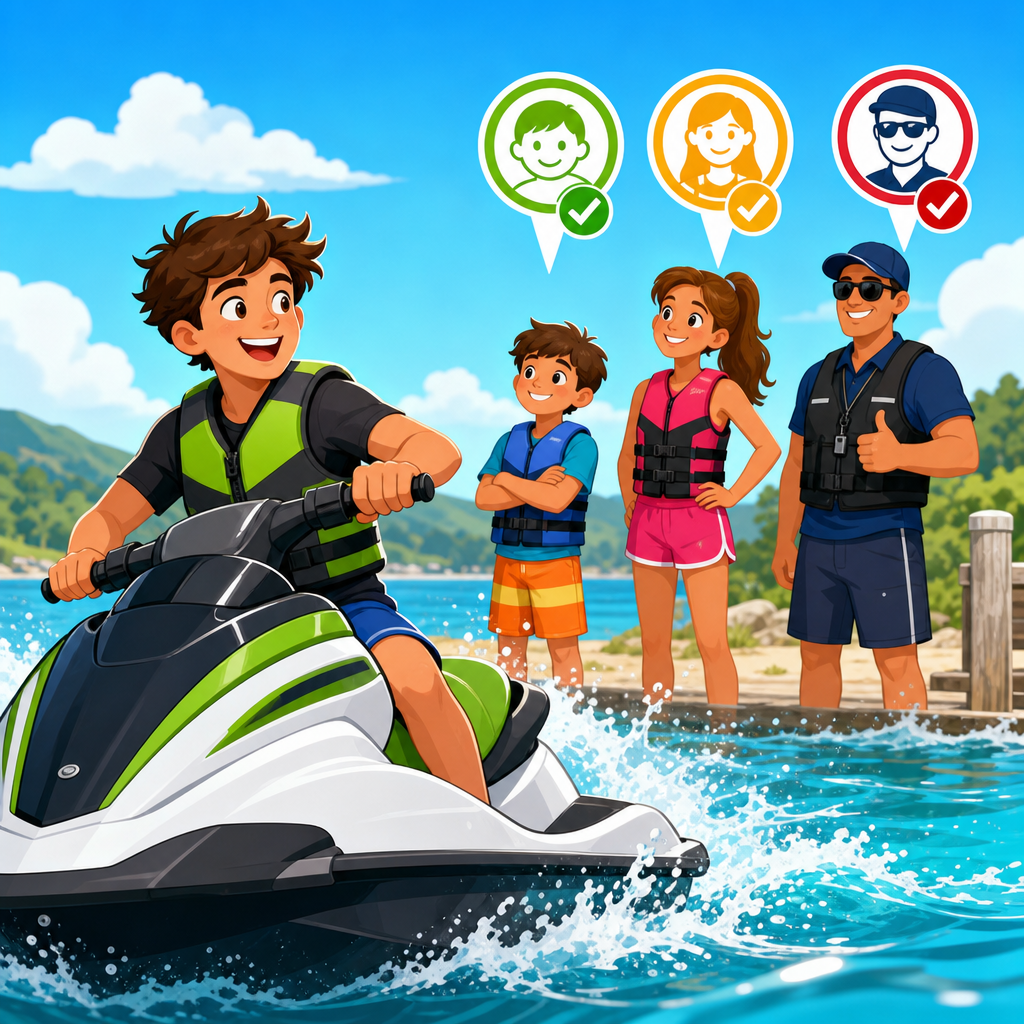
The cleanest way to think about PWC age restrictions is to separate three questions. First, can this person legally operate the craft at all? Second, do they need a boater education certificate to operate it lawfully? Third, can they rent one from a livery or marina, which usually requires a higher minimum age and a signed liability agreement? These are related but not identical issues. A 14-year-old may be legal to operate a family-owned PWC in one state after passing a course, while that same teenager would still be barred from renting one. Likewise, an adult visitor may be old enough to operate but still need state-recognized safety education because the state’s law applies by birth date, not simply age.
| Regulatory question | Typical rule pattern | Why it matters |
|---|---|---|
| Minimum operator age | Set by state statute, often 12 to 16 | Determines whether a child or teen can ride independently |
| Boater education requirement | Required for minors or operators born after a cutoff date | Certificate may be needed to avoid citation |
| Supervision standard | Adult on board, nearby, or directly supervising | Supervision definitions vary and affect legality |
| Rental minimum age | Often 18 or older, sometimes 16 with conditions | Rental operators can impose stricter rules than state law |
| Passenger or towing limits | Restricted by capacity plate and state rules | Young operators may be barred from towing or carrying others |
Boater education, safety cards, and supervision rules
Boater education is the second half of the legal answer to who can ride a Jet Ski. In many jurisdictions, age alone does not authorize operation. The rider must also complete an approved boating safety course, often one recognized by NASBLA, the National Association of State Boating Law Administrators. These courses cover navigation rules, emergency procedures, PWC-specific handling, life jacket obligations, engine cutoff switch use, and state operating laws. On the enforcement side, wardens and marine patrol officers usually want to see the education card, temporary certificate, or digital proof if state law permits electronic display.
Supervision requirements deserve special attention because they are easy to misunderstand. Some states allow younger riders only when accompanied by an adult on board the same PWC, which is very different from having a parent watching from shore. Others require direct adult supervision nearby on another vessel or within visual range. Rental concessionaires often go further by requiring the responsible adult to sign all documents, remain present, and accept liability for minor operators. I have seen families lose prepaid reservations because they assumed “supervised” meant an adult staying at the beach. Legally, the required level of supervision is whatever the state statute or rental policy specifically says, not what seems reasonable in casual conversation.
State variation: why one answer never fits every launch ramp
State variation is the reason responsible articles on PWC age restrictions avoid single-number answers. Florida, Texas, California, New York, and other high-use states all regulate personal watercraft, but they do so with different age floors, education rules, and temporary visitor provisions. Some states exempt certain age groups if an older licensed operator is on board. Others focus on anyone born after a specified date, which means a 45-year-old visitor may need a boating safety card while an older resident may not. Local governments can also layer on no-wake zones, environmental closures, horsepower restrictions in small lakes, and seasonal enforcement campaigns that affect where and how a PWC can be used.
Because this article is a hub, the practical rule is simple: always verify the law in the state of operation and, if renting, the policy of the rental business. Start with the state boating agency or fish and wildlife department, then confirm whether there are county, reservoir, or park-specific rules. This step is not bureaucracy for its own sake. A youth operator who is lawful on a private lake in one state can become unlawful immediately after crossing into neighboring waters with different standards. Reciprocity between states often helps with boater education credentials, but it does not erase age prohibitions or local operating restrictions.
Rental rules, insurance exposure, and parental responsibility
Rental rules are often stricter than ownership rules because liveries face direct liability exposure. Even in states that allow younger teens to operate under certain conditions, many rental businesses set a minimum rental age of 18 and a minimum operator age of 16, sometimes higher. They may also prohibit passengers under a certain age, require a government-issued photo ID, hold a damage deposit, and provide a mandatory safety briefing before releasing the craft. These policies are driven by insurers, franchise standards, claims history, and the reality that vacation riders are often the least experienced operators on the water.
Parents should also understand that letting a child ride in violation of age or education rules creates downstream problems beyond a simple ticket. If a crash occurs, the violation can influence civil liability, comparative fault arguments, rental agreement enforcement, and insurance coverage disputes. Some policies exclude illegal operation or impose reporting requirements that become more difficult when an unauthorized minor was at the controls. In my experience, the most preventable conflicts arise when adults treat PWC laws as casual guidelines rather than operating conditions. The better approach is to document the rider’s age, education card, fitted life jacket, and local legality before the engine starts.
Related Jet Ski regulations every rider should know
Age restrictions are only one piece of personal watercraft and Jet Ski regulations. Nearly every state requires U.S. Coast Guard-approved life jackets for each person aboard, and PWC riders generally must wear them rather than merely carry them. Operators must use the engine cutoff switch lanyard where required, obey no-wake zones, maintain proper lookout, and avoid reckless maneuvers such as wake jumping too close to other vessels. Many states prohibit nighttime PWC operation, often from sunset to sunrise, because visibility and collision risk change sharply after dark. Capacity limits, observer rules for towing, and registration numbering requirements also apply.
Alcohol and drug laws are another major enforcement area. Boating under the influence thresholds commonly mirror road DUI standards, but marine officers also evaluate impairment based on handling, judgment, and reaction time. Environmental rules matter too. Sensitive habitats, manatee zones, and drinking water reservoirs may have speed limits or PWC bans. This hub should guide your next questions: What safety equipment is mandatory on a Jet Ski? Can a child be a passenger? Do I need insurance? How do registration and title rules work? Those topics connect directly to age restrictions because lawful operation is never just about age; it is about meeting the full set of equipment, education, and conduct standards that govern PWC use.
How to check compliance before anyone rides
The easiest compliance process is a five-point check. Confirm the state’s minimum operator age. Confirm whether the rider needs a boater safety certificate and that proof is available. Confirm the PWC is registered, numbered, and carrying required equipment, including properly sized life jackets. Confirm the intended activity is allowed, especially towing, passenger carriage, and hours of operation. Finally, confirm the launch site or rental operator does not impose stricter local rules. This simple routine catches most legal problems before they become expensive mistakes.
PWC age restrictions exist because personal watercraft demand mature judgment, quick hazard recognition, and practiced control inputs. The exact legal age to ride a Jet Ski depends on the state, supervision status, and education credentials, but the broader lesson is consistent everywhere: legality and safety move together. Younger operators usually face tighter restrictions, renters face additional limits, and every rider must follow the full framework of boating laws and regulations. Use this article as your hub for personal watercraft and Jet Ski regulations, then check your state agency’s current rules before your next outing. A ten-minute verification now can save a canceled trip, a citation, or a serious injury later.
Frequently Asked Questions
What is the minimum age to legally ride or operate a personal watercraft like a Jet Ski?
The minimum age to legally operate a personal watercraft, or PWC, depends on the state where you are riding. There is no single nationwide age rule that applies everywhere in the United States. In many states, children below a certain age cannot legally operate a Jet Ski, WaveRunner, or Sea-Doo at all, while older teens may be allowed to ride only if they have completed an approved boater safety course or are under the direct supervision of an adult. That is why the most accurate answer is always state-specific.
It also helps to separate the idea of “riding” from “operating.” A child may be allowed to ride as a passenger in some situations, but not to control the PWC. The legal operator is the person steering and using the throttle, and that is where age restrictions usually apply. States often treat PWCs more strictly than ordinary motorboats because of their speed, maneuverability, and the higher risk of accidents involving inexperienced riders. Before heading to the water, riders should check the current rules from the state boating authority, fish and wildlife agency, or marine law enforcement division to confirm both age requirements and any training obligations.
Do teenagers need a boating license or safety certificate to ride a Jet Ski legally?
In many states, yes. Teen operators are commonly required to complete a boating safety course and carry proof of certification before they can legally operate a PWC. Even in places where people casually refer to this as a “Jet Ski license,” what the law usually requires is a boater education certificate rather than a traditional driver-style license. The exact age cutoff varies by state, but it is very common for operators under a certain age, and sometimes all PWC operators regardless of age, to need approved safety education.
These courses typically cover navigation rules, right-of-way, safe speeds, no-wake zones, emergency procedures, environmental protection, and the unique handling characteristics of personal watercraft. Because PWCs accelerate quickly, turn differently than many first-time riders expect, and often operate in crowded recreational areas, lawmakers frequently use mandatory education as a condition for legal use. Parents should not assume that a teenager who is old enough to drive a car can automatically operate a Sea-Doo or WaveRunner. Waterway rules are separate, and enforcement officers may ask for age identification and proof of completed boater education during a stop or after an incident.
Can a child ride as a passenger on a personal watercraft if they are too young to operate it?
Possibly, but several legal and safety factors come into play. Passenger rules are often different from operator rules. A child who is too young to legally control a PWC may still be allowed to ride with a qualified adult operator, but some states impose additional requirements related to seating, life jackets, supervision, or the child’s ability to sit securely and hold on properly. A PWC must also never carry more people than its manufacturer-rated capacity allows. If a craft is designed for two or three persons, that rating must be respected regardless of the passenger’s age.
Safety matters just as much as legality here. Every passenger should wear a properly fitted, U.S. Coast Guard-approved life jacket suitable for PWC use, and very young children may not be safe passengers even if the law does not specifically prohibit them. Operators should consider whether the child can keep both feet planted, understand basic riding instructions, and remain stable during acceleration, turns, and choppy conditions. Some rental businesses and insurance policies also set stricter minimum passenger ages than state law. So while a child may legally be able to ride in certain states, the smarter question is whether the ride can be done safely and responsibly under the actual conditions on the water.
Are PWC age restrictions the same in every state, or do Jet Ski laws vary across the U.S.?
Jet Ski laws vary significantly from state to state. Personal watercraft age restrictions are part of a broader set of boating regulations that each state largely controls, so the rules can differ on minimum operator age, supervision requirements, boater education, rental restrictions, and whether temporary certificates are accepted. One state may allow a younger teen to operate with a safety certificate, while another may prohibit operation entirely below a higher age threshold. Some states also distinguish between residents and visitors or between privately owned PWCs and rentals.
This variation is one of the biggest reasons riders should avoid relying on general advice, outdated blog posts, or what “everyone does” at a local lake. Enforcement officers apply the law of the state where the vessel is being used, not the rules from the rider’s home state. If you travel with your own WaveRunner or rent a Jet Ski on vacation, you should review that destination’s current laws before launch. In addition to age restrictions, many states regulate hours of operation, towing skiers or tubers, reckless riding, distance from swimmers, and mandatory safety equipment. Understanding the full legal framework is the best way to avoid citations and, more importantly, to reduce the risk of serious accidents.
What happens if someone under the legal age operates a Jet Ski anyway?
If an underage person illegally operates a PWC, the consequences can include fines, citations, impoundment or removal of the craft from use, and potential liability for the owner, parent, or supervising adult. In many cases, law enforcement may issue penalties not only to the young operator but also to the adult who knowingly allowed the violation. If the PWC was rented, the rental company could also face issues if proper screening was not followed. The seriousness of the consequences increases if the underage operation leads to reckless behavior, property damage, injury, or a collision.
There can also be important civil and insurance consequences. If an accident occurs and the operator was below the legal age or lacked required boater education, insurers may scrutinize coverage, and injured parties may argue that the operation was negligent from the start. That can create expensive legal exposure for families and vessel owners. Beyond penalties, age restrictions exist because PWCs demand quick judgment, awareness of traffic, and practiced control. Following the law is not just about avoiding tickets; it is about making sure the person at the controls has the maturity, training, and legal authority to operate safely on shared waterways.