
Operating a jet ski legally in your state starts with understanding that “jet ski” is a brand name often used to describe a personal watercraft, or PWC, a small vessel powered by an inboard motor driving a water jet rather than a propeller. In boating law, that distinction matters because states regulate PWCs under specific statutes covering age limits, boater education, equipment, registration, reckless operation, and local waterway restrictions. I have worked with boat registration offices, launch operators, and safety course providers long enough to see the same problem repeat every summer: riders assume a PWC follows the same rules as a rental kayak or small runabout, then get cited for avoidable violations. A legal ride is not just about avoiding fines. It affects insurance coverage, accident liability, eligibility to launch at public facilities, and, in serious cases, whether an operator faces criminal penalties after a collision.
State jet ski laws vary, but the legal framework is consistent nationwide. Every PWC must comply with state vessel registration requirements unless a narrow exemption applies, display required numbers and decals, carry specific safety gear, and be operated according to navigation rules and state reckless boating laws. Many states also require a boater safety certificate for operators born after a certain date, and nearly all states impose minimum age rules or direct adult supervision requirements. Federal law adds another layer through U.S. Coast Guard equipment standards, manufacturer capacity labels, and navigation rules on waters subject to federal jurisdiction. Then local governments, lake authorities, and parks agencies may restrict speed, hours of operation, wake activity, or access in environmentally sensitive areas.
This hub explains how to operate a jet ski legally in your state by breaking the subject into the rules that apply almost everywhere and the state-specific details you must verify before riding. It also serves as the central guide for the broader PWC and jet ski regulations topic, so you can use it to understand the core legal issues before drilling into age laws, registration procedures, safety certificate requirements, or accident reporting rules for a particular state. If you know what documents to carry, what equipment to check, where to look for official restrictions, and how officers evaluate unsafe conduct on the water, you will be prepared to ride lawfully, confidently, and with fewer expensive surprises.
Know How Your State Classifies a Jet Ski
The first legal question is simple: what is the vessel under state law? Most states define a PWC as a motorboat less than a specified length, designed to be ridden on rather than operated from within the hull. That definition triggers special rules. A state may treat a pontoon boat and a jet ski as motorboats for registration, but reserve stricter age, lanyard, and hours-of-operation standards for PWCs. In practice, officers, insurers, and rental operators rely on the manufacturer’s hull identification information and the title or registration record, not on what owners call the craft. If your vessel is a Sea-Doo, Yamaha WaveRunner, or Kawasaki Jet Ski, it almost certainly falls within the PWC category.
Classification matters because it determines what education requirement applies, whether towing is allowed, what safety equipment must be onboard, and whether certain waters prohibit your craft entirely. Some reservoirs allow motorboats but ban PWCs due to shoreline erosion, noise, or swimming conflicts. Others permit PWCs only during daylight hours. When I review state boating codes, the most common mistake is reading the general motorboat rule and missing the separate PWC section. Start with your state wildlife agency, parks department, or natural resources office, then confirm any local ordinances for the county, city marina, or lake district where you intend to ride.
Registration, Title, and Decal Rules Come First
In most states, you cannot legally operate a jet ski on public water without current registration, and many states also require a certificate of title. Registration numbers usually must be attached on both sides of the forward half of the vessel in block letters of a specified size, with the validation decal placed according to state instruction. Numbers that are too small, incorrectly spaced, or hidden by graphics can still produce a citation. Owners who buy used PWCs often overlook transfer deadlines, unpaid taxes, or lien releases, then discover at launch that the paperwork is incomplete.
Keep your registration certificate onboard in the manner your state allows, whether printed, laminated, or carried electronically where permitted. If your state requires a title, store the original securely and carry copies only if local rules allow. States commonly impose short deadlines, often 15 to 30 days, to apply for title and registration after purchase. If the PWC came from another state, check whether a hull inspection, tax affidavit, or prior registration surrender is required. Renting is different: the rental business usually handles registration, but the operator still must follow all equipment, age, and reckless operation rules.
Boater Education and Age Requirements Are Frequently the Deciding Factor
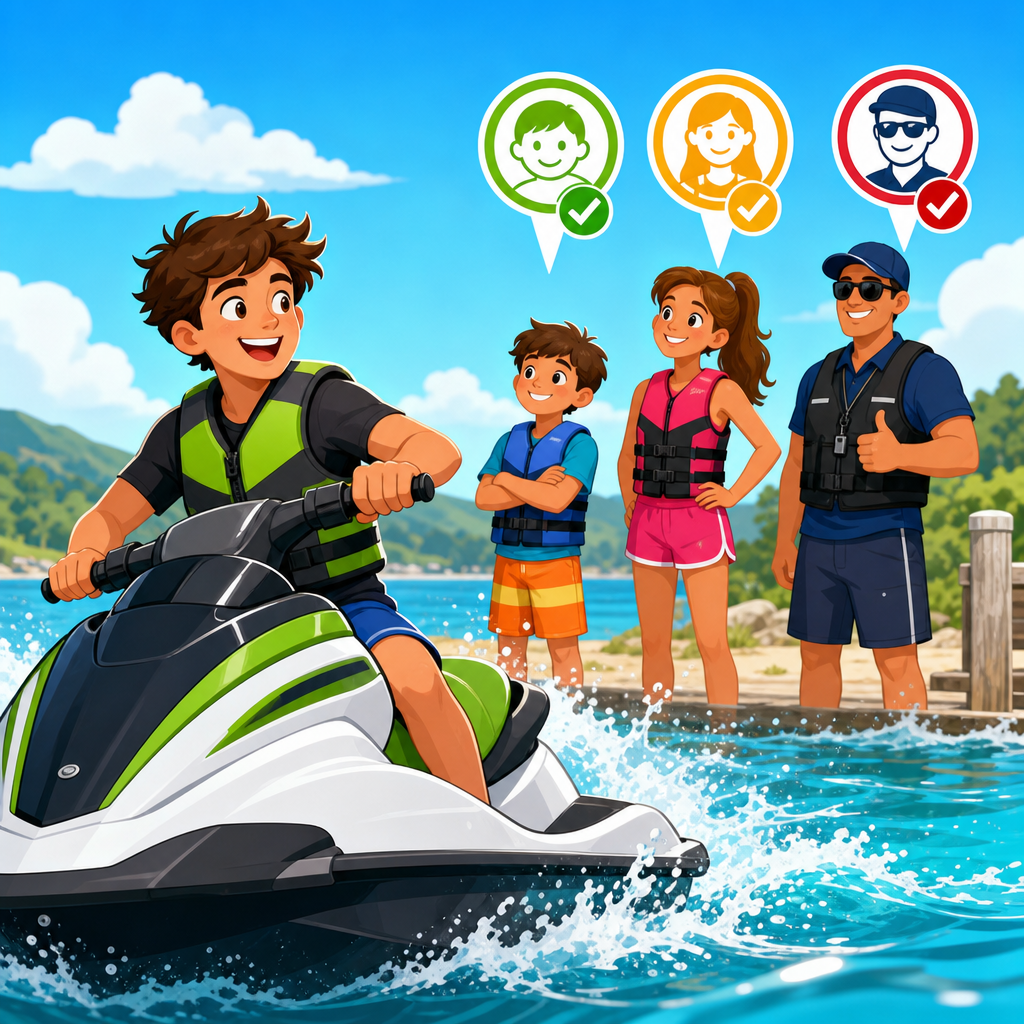
Ask, “Do I need a boating license for a jet ski?” In many states, the answer is yes, though the credential is usually a boater education certificate rather than a driver-style license. States commonly require anyone born after a cutoff year, or anyone under a certain age, to complete a NASBLA-approved boating safety course before operating a PWC. Some states require all PWC operators to hold the certificate regardless of age. Others permit supervised operation by minors if an eligible adult is onboard or directly observing. Because these rules are state specific, a certificate that is valid for one resident may not eliminate age restrictions for another rider.
From experience, age compliance creates more launch-day disputes than registration. Parents assume a teenager with good judgment can ride alone; the statute may say otherwise. Rental operators are especially strict because their insurance policies often mirror or exceed state minimums. A 14-year-old may be legal to operate in one state after completing a course, while another state may require the operator to be 16. Reciprocity is common for visiting boaters who hold an approved education certificate from their home state, but it is not universal. Verify the rule before traveling across state lines with your PWC.
Required Safety Equipment Must Be Onboard and Usable
A legally operated jet ski must carry the safety equipment required by federal and state law, and the gear must be in serviceable condition. The universal baseline is a U.S. Coast Guard-approved wearable life jacket for each person on board. For PWCs, occupants generally must wear the life jacket at all times, not merely have it available. Most states also require an engine cut-off switch, often called a safety lanyard, attached to the operator whenever the PWC is underway. If the rider falls off, the engine stops. Since 2021, federal law has expanded engine cut-off switch use requirements for many recreational vessels, reinforcing the safety principle already common for PWCs.
Other equipment may include a sound-producing device such as a whistle, fire extinguisher depending on the model and state interpretation, navigation lights if operation is allowed during low-light periods, and ventilation or backfire flame control systems where applicable under manufacturer design. Never assume factory-installed gear still complies after modifications. I have seen owners remove mirrors, alter seating, or install aftermarket fuel systems without understanding the legal consequences. At inspection, officers look for approved labels, accessible extinguishers, intact lanyards, and life jackets sized for actual riders, including children.
Operating Rules: Speed, Distance, Wake, and Reckless Behavior
Most jet ski citations arise from how the craft is operated, not from missing paperwork. States prohibit reckless or negligent operation using broad language that covers weaving through traffic, jumping wakes too close to another vessel, following within an unsafe distance, operating in swimming areas, and creating hazardous wake near docks or shorelines. Many statutes specifically ban “wake jumping” within a stated number of feet of another vessel and prohibit circling fishermen, harassing wildlife, or crossing behind a tow sport vessel too closely. No-wake zones around marinas, ramps, fuel docks, and moored boats are heavily enforced because collisions there are predictable and preventable.
Another rule riders often miss is the daylight limitation. Many states prohibit PWC operation from sunset to sunrise, even if the craft has lights, because PWCs are maneuverable, low to the water, and difficult to see. Environmental and local-use restrictions matter too. Drinking while operating a jet ski is subject to the same boating under the influence standards that apply to larger boats, often using the 0.08 blood alcohol concentration threshold, with enhanced penalties when minors are involved.
| Legal Area | What to Check | Common Violation | Best Practice |
|---|---|---|---|
| Registration | Current certificate, numbers, decals, title status | Expired decal or improper display | Photograph both sides after applying numbers correctly |
| Education | State age cutoff and approved course requirement | Minor operating without certificate | Carry digital and printed proof of course completion |
| Equipment | Life jackets, lanyard, whistle, extinguisher if required | Non-approved or damaged life jacket | Inspect gear before every launch |
| Operation | No-wake zones, distance rules, daylight-only limits | Wake jumping near another vessel | Ride with generous separation and reduce speed early |
| Local Rules | Park hours, county ordinances, reservoir restrictions | Launching where PWCs are restricted | Check the managing authority the night before travel |
Insurance, Accidents, and Law Enforcement Encounters
Jet ski insurance is not legally required in every state, but operating without it is a financial risk. Marinas, storage facilities, and lenders often require liability coverage, and some states effectively force the issue through rental or commercial rules. If you cause injury or property damage, your legal exposure can be substantial because PWC accidents often involve speed, ejection, and multiple passengers. Policies vary on towing, racing, operator age, and modifications, so read exclusions carefully. A cheap policy that excludes unlisted operators or certain waterways may fail when you need it most.
Accident reporting is a legal duty, not a courtesy. States generally require prompt reporting when there is death, disappearance, injury beyond basic first aid, or property damage above a specified threshold. That threshold varies by state and can change with legislation, so use the current figure from the boating agency. Leave the scene only as the law allows, render aid when safe, exchange identifying information, and document conditions with photos. When stopped by marine patrol or conservation officers, be ready to present registration, identification, and boater education credentials. Professional, calm compliance usually shortens the encounter and avoids escalation.
How to Check Your State’s Exact Jet Ski Laws Before You Ride
The most reliable way to operate a jet ski legally in your state is to verify the rule from the agency that enforces it. Start with the state boating handbook issued by the department of natural resources, fish and wildlife agency, parks department, or state police marine unit. Then review statutes or administrative code sections covering vessel registration, PWC operation, mandatory education, and accident reporting. For federal waters, consult U.S. Coast Guard boating safety guidance and the Navigation Rules. If you ride on a reservoir managed by the U.S. Army Corps of Engineers or a power authority, check site-specific restrictions as well.
Build a pre-launch checklist and use it every time. Confirm registration validity, age and certificate compliance for every operator, life jacket fit, lanyard function, local hours, and weather. Save official links on your phone, but also keep screenshots in case service is weak at the ramp. This hub should be your starting point for the full PWC and jet ski regulations topic, then the next step is simple: look up your state-specific page, review the exact statutes, and ride only after every legal requirement is satisfied.
Frequently Asked Questions
Is a jet ski legally different from a personal watercraft, and why does that matter?
Yes. “Jet Ski” is a brand name, while the legal category used by states is usually “personal watercraft” or “PWC.” That distinction matters because state boating laws, registration rules, and enforcement guidance are written around the vessel type, not the brand. In most states, a PWC is defined as a small vessel powered by an inboard motor that uses a water jet for propulsion and is designed for a rider to sit, stand, or kneel on rather than ride inside like a traditional boat. If you own a Kawasaki Jet Ski, Sea-Doo, Yamaha WaveRunner, or another similar craft, the law will generally treat it as a PWC.
This matters in practical terms because PWCs are often subject to stricter rules than other recreational boats. States commonly impose minimum operator age requirements, mandatory boater education, equipment rules, and operating restrictions that specifically mention PWCs. For example, your state may prohibit nighttime PWC operation, require the use of an engine cut-off switch, or impose special reckless-operation standards because of the way these vessels accelerate and maneuver. If you assume your craft follows only general boating laws and overlook the PWC-specific statutes, you can easily end up with citations, registration issues, or liability problems after an accident.
The safest approach is to treat “jet ski” as a casual term and look up the laws under your state’s boating agency, department of natural resources, fish and wildlife agency, or marine patrol using the term “personal watercraft.” That will help you find the exact rules that apply to licensing or education, registration decals, titling, required life jackets, local speed zones, towing laws, and any county or lake-specific restrictions.
Do I need a license or boater education certificate to operate a jet ski legally in my state?
In many states, yes, you will need some form of boater education certificate, especially if you were born after a certain date or if you are under a specified age. States vary widely on the details. Some require all PWC operators to complete an approved boater safety course. Others require it only for younger operators or for anyone operating a motorized vessel above a certain horsepower. A few states do not issue a traditional “license” in the same way they do for driving a car, but they still require you to carry proof that you passed an approved boating safety course. Legally, that certificate functions much like a license for compliance purposes.
Age rules are also important. Many states set a minimum age to operate a PWC alone, and some allow minors to operate only if they have completed an approved education course or are directly supervised by an adult. There may also be restrictions on renting a PWC if you are below a certain age, even if you are otherwise allowed to operate one owned by your family. If you lend your jet ski to a friend or teenager, you should verify that the operator meets your state’s age and education rules, because owners can face consequences for allowing unlawful operation.
To stay legal, check your state boating agency’s official website for the current requirements, including whether online courses are accepted, whether a temporary certificate is valid until the permanent card arrives, and whether your state honors another state’s boater education credential. Keep proof of course completion with you on the water if required. If you are traveling, review the destination state’s reciprocity rules as well, since temporary visitors are sometimes treated differently from residents.
What registration, title, and paperwork do I need for a jet ski?
Most states require a personal watercraft to be registered, and many also require a title, just as they would for a motorboat. Registration generally involves submitting an application, proof of ownership such as a manufacturer’s certificate of origin or signed title, payment of state fees, and possibly proof that sales or use tax has been paid. Once approved, the state typically issues a registration certificate and registration numbers and decals that must be displayed on the vessel in a specific format and location. If your numbers are missing, improperly displayed, or expired, you can be cited even if you are otherwise operating responsibly.
Paperwork problems often come up when a used jet ski changes hands. If you buy from a private seller, make sure the title is properly signed, the hull identification number matches the paperwork, and there are no unresolved lien issues. Some states are strict about title assignments, notarization, deadlines for transfer, and penalties for late registration. If the seller cannot produce proper ownership documents, do not assume you can sort it out later. Registration offices frequently reject incomplete or inconsistent paperwork, and that can delay your ability to use the craft legally.
You should also carry whatever documents your state requires while operating. That often includes the registration certificate on board or otherwise available for inspection. If your PWC is financed, insured, stored at a marina, or used in multiple states, keep copies of title records, insurance information, and any local launch permits or aquatic invasive species permits that may apply. Some waterways also require separate access stickers or municipal permits. In short, legal operation is not just about how you ride; it starts with having the right ownership and registration records in place before the craft ever touches the water.
What safety equipment and on-water rules usually apply to personal watercraft?
Although exact rules vary by state, several legal requirements appear again and again for PWCs. A properly fitted, U.S. Coast Guard-approved life jacket is almost always required for each operator and passenger, and on many PWCs it must be worn at all times, not just carried on board. Most states also require use of the engine cut-off switch, often called a lanyard, so the craft shuts off if the operator falls off. Depending on the state and the way the vessel is equipped, you may also need a sound-producing device such as a whistle, and in some cases fire extinguisher rules may apply if the craft has enclosed compartments or other specified features.
Operational rules are equally important. PWC operators are commonly prohibited from reckless or careless operation, weaving through congested traffic, jumping wakes too closely behind another boat, following too closely, operating in designated swim areas, or exceeding no-wake speed in marked zones. Many states also prohibit nighttime operation of PWCs, even when general motorboats may be allowed out after dark if properly lighted. Towing a skier, tube, or wakeboard rider may require an additional observer besides the operator, and there may be time-of-day, flag, or spotter requirements. These are not minor technicalities; they are frequently enforced because they relate directly to collision risk and injuries.
Local restrictions can be just as important as state law. Lakes, reservoirs, and coastal areas may impose special no-wake zones, shoreline buffer distances, seasonal closures, manatee or wildlife protection zones, horsepower restrictions, or rental-only operating areas. Before launching, review posted signs, marina rules, and any local ordinances for the waterbody. A rider can be fully compliant with state registration and education rules and still receive a citation for violating a county, city, park, or reservoir-specific regulation. The best habit is to think in layers: state law first, then local waterway rules, then real-time safety conditions.
What are the most common legal mistakes jet ski owners make, and how can I avoid them?
The most common mistakes are usually preventable. First, many owners fail to verify whether the operator meets age and boater education requirements. This happens often when a family member, guest, or friend wants to take the PWC out “just for a few minutes.” If the operator is underage, lacks the required safety certificate, or is not legally permitted to rent or operate in that state, both the rider and, in some situations, the owner can face legal consequences. Second, expired or incomplete registration is a frequent issue, especially after a recent purchase, move to a new state, or lapse in renewing decals.
Another common problem is equipment noncompliance. Riders may have life jackets on board but not worn when the law requires wearing them, or they may forget to attach the engine cut-off lanyard. Some assume general boating customs apply, then learn too late that PWCs are restricted from nighttime use or are held to special towing and spacing rules. Reckless-operation citations are also common because PWCs are fast and highly maneuverable; behavior that feels playful to the operator can be viewed by law enforcement as unsafe passing, wake jumping, harassment, or operating too close to docks, swimmers, or other boats.
To avoid these mistakes, create a simple compliance checklist: confirm registration and title status, display current numbers and decals properly, carry required documents, verify every operator’s age and boater education eligibility, inspect life jackets and safety gear, attach the lanyard before departure, and review both state and local rules for the specific waterway. If you are crossing state lines, do not assume your home-state habits remain lawful elsewhere. Spending a few minutes checking the law before launch is far easier than dealing with citations, impound issues, insurance disputes, or liability after an accident.