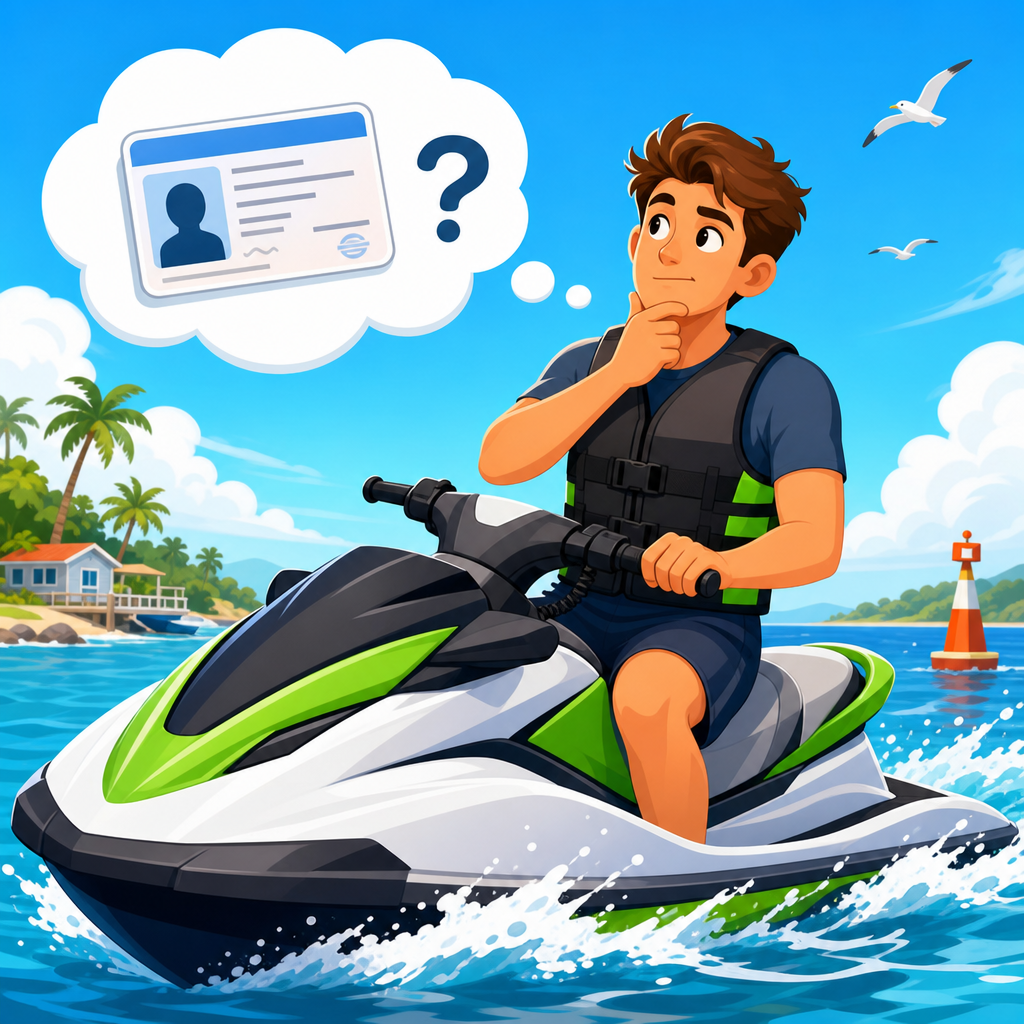
Do you need a special license to drive a jet ski? The short answer is usually no, but in many places you still need some form of boater education card, personal watercraft certificate, temporary permit, or age-based authorization before you can legally operate one. That distinction matters because riders often use the word license to mean any legal approval, while state agencies separate a driver’s license, a boating safety certificate, and a registration requirement. If you misunderstand those terms, you can end up fined at the launch ramp, denied a rental, or liable after an accident.
A jet ski is a personal watercraft, often shortened to PWC, a category that includes sit-down and stand-up models made by brands such as Yamaha WaveRunner, Sea-Doo, and Kawasaki Jet Ski. In law, a personal watercraft is not treated exactly like a car or motorcycle. It is usually regulated under state boating laws, not highway licensing rules, and those boating laws can include minimum operator ages, mandatory safety courses, lanyard engine cutoff requirements, no-wake rules, time-of-day limits, and special rental procedures. In my experience helping boaters sort out compliance before trips, the biggest source of confusion is assuming one state’s rules apply everywhere.
This article serves as a practical hub for boating licenses and permits as they relate to personal watercraft. It explains what counts as a license, when a boating safety certificate is required, how rental rules differ from ownership rules, which federal standards matter, and how reciprocity works when you travel. It also points you toward the related topics that usually come next, including boat registration, titling, age restrictions, safety equipment, and on-water enforcement. If you want to know whether you can legally ride this weekend, what documents to carry, and how to stay compliant across state lines, start here.
What “license” means for jet ski laws
When people ask whether they need a special license to drive a jet ski, they are usually asking one of four different legal questions. First, do I need a state-issued boating license or boater education card? Second, do I need a regular driver’s license? Third, does the watercraft itself need registration or titling? Fourth, do I need a temporary permit because I am renting instead of owning? Those are separate requirements, and states mix them differently.
Most states do not issue a dedicated jet ski driver’s license in the same way they issue a driver’s license for a car. Instead, they require completion of an approved boater education course and proof of that completion while operating. The National Association of State Boating Law Administrators, commonly called NASBLA, sets education standards that many state-approved courses follow. If a state accepts a NASBLA-approved certificate, that card often functions as the practical equivalent of a license for everyday enforcement. An officer may ask for it during a stop, and lacking it can lead to citations even if you are operating safely.
A regular motor vehicle driver’s license typically does not replace a boater education requirement. Some states allow adults of a certain age to operate without taking a course, especially if they were born before a cutoff year. Others require anyone operating a PWC to have completed education regardless of age. The age cutoff model is common in boating law because legislatures phase in safety training over time. If your friend says, “I never needed a license,” that may be true for their birth year in their home state and still completely wrong for you.
When a boating safety certificate is required
The most common legal requirement for jet ski operation is a boating safety certificate. States use different names, including boater education card, boating license, vessel operator card, or certificate of personal watercraft operation. Whatever the label, the substance is similar: complete an approved course, pass the exam, and carry proof. Courses cover navigation rules, aids to navigation, emergency procedures, PWC handling, intoxication laws, and required equipment such as life jackets and sound-producing devices.
Personal watercraft are often regulated more strictly than larger recreational boats because they accelerate quickly, turn differently from propeller-driven boats, and are commonly used close to shore, docks, swimmers, and rental areas. For that reason, some states require education for all PWC operators even when operators of slower boats are exempt. Others require renters to watch a safety video and sign an acknowledgment, even if they already hold a boating card. Rental companies also add insurance and waiver policies that are stricter than state law.
The practical rule is simple: before operating, check the state wildlife agency, marine patrol, parks department, or boating authority where you will ride. Confirm three things: whether your age triggers mandatory education, whether your certificate from another state is accepted, and whether PWC-specific restrictions apply. Do not rely on marina staff, social media groups, or general travel sites for legal compliance. Agencies publish the controlling rules, and many update them before each boating season.
State rules, age limits, and reciprocity
State law controls most jet ski operator requirements in the United States, so the answer changes at every border. Florida, for example, generally requires anyone born on or after January 1, 1988, who operates a vessel with ten horsepower or more, to have completed an approved boater safety course and carry the card plus photo identification. California requires boater card compliance by age phases that have expanded over time and now apply broadly. New York requires all operators of motorized vessels, including personal watercraft, to hold a boating safety certificate. Texas has separate age limits and supervision rules for younger operators.
Reciprocity means one state may honor another state’s approved education credential, especially if it is NASBLA-approved, but reciprocity is not universal. A state may accept your out-of-state card for operation while visiting and still enforce its own age restrictions, rental conditions, horsepower thresholds, and local waterway rules. Some states recognize temporary certificates for a limited period while the permanent card is processed. Others require a paper or digital copy on board at all times.
| Requirement area | Common state approach | Why it matters for riders |
|---|---|---|
| Boater education | Mandatory for all operators or by birth year cutoff | You may need a certificate even with boating experience |
| Minimum age | Often stricter for PWC than for standard motorboats | Teens may be barred or require adult supervision |
| Out-of-state cards | Frequently honored if state approved or NASBLA compliant | Travelers should still verify local exceptions |
| Rental authorization | May require temporary briefing, test, or signed acknowledgment | Owning and renting can involve different paperwork |
| Proof on board | Paper card, digital card, or temporary certificate | Failure to carry proof can trigger citations |
Because this page is a hub for boating licenses and permits, the key takeaway is that licensing is rarely one universal document. It is a framework of education, age eligibility, reciprocity, and proof-of-compliance rules. If you are building out your compliance checklist, the next related topics to review are state boating license guides, PWC age restrictions, reciprocal recognition of out-of-state boater cards, and rental-specific operator rules.
Owning a jet ski versus renting one
Ownership and operation are separate legal issues. You can own a jet ski and still be prohibited from operating it without the required education card. Likewise, you can be legally qualified to operate but still violate the law if the PWC is not properly registered, numbered, or titled. Registration usually belongs to the vessel, not the operator, and is handled through a state boating agency or department of motor vehicles depending on the jurisdiction. Many first-time buyers incorrectly assume a bill of sale is enough to get on the water that day.
Rentals add another layer. Liveries and resorts must comply with commercial rules and insurance requirements, and they often impose stricter policies than the statute requires. I routinely see rental operations requiring a government photo ID, a minimum age above the legal floor, a safety orientation, a damage deposit, and an acknowledgment of local operating zones. In some states, the rental company may issue a temporary certificate after a short course or checklist. That temporary approval may be valid only for the rental period and only with that livery.
If you are comparing ownership and renting, remember the document stack differs. Owners should expect registration decals, a registration certificate, possibly title documents, proof of education, and any local permits for restricted waters. Renters usually need identification, course proof if required, and compliance with the livery’s rules. The legal question “Do I need a special license?” therefore cannot be answered without also asking whether the craft is yours, borrowed, or rented.
What federal law covers and what it does not
Federal law influences jet ski safety, but operator licensing is mainly a state matter. The U.S. Coast Guard sets and enforces broad recreational boating safety standards, including carriage requirements for life jackets, manufacturer labeling, navigation rules, and boating under the influence enforcement on federal waters. Personal watercraft must have a U.S. Coast Guard-approved life jacket for each person aboard, and operators must follow the Navigation Rules, often called the Rules of the Road, just like other vessel operators.
Federal standards also affect equipment and manufacturing. An engine cutoff switch, often called a safety lanyard, has long been standard on PWCs, and modern boating safety enforcement increasingly emphasizes proper use because a rider thrown from the craft can otherwise leave it circling unmanned. The Coast Guard’s Boating Safety Division publishes guidance and annual recreational boating statistics that consistently show operator inattention, improper lookout, excessive speed, and inexperience among leading contributing factors in accidents. Education requirements at the state level are designed to reduce exactly those risks.
What federal law usually does not do is give you a nationwide license to operate a jet ski. There is no single federal PWC operator license that overrides state education laws for ordinary recreational use. If you boat on boundary waters, national recreation areas, or waterways patrolled by multiple agencies, you still need to meet the state operator requirements that apply there.
How to get legal before you ride
The fastest compliant path is straightforward. First, identify the state where you will operate. Second, look up that state’s official boating agency website. Third, confirm whether PWC operation requires a boater education course based on your age or the vessel’s horsepower. Fourth, complete a state-approved or NASBLA-approved course through a recognized provider such as Boat-Ed, BOATsmart, or the state portal if offered directly. Fifth, print or download the completion proof and carry it with photo identification if your state requires both.
Then confirm vessel-side paperwork. For an owned jet ski, verify registration is current, decals are displayed correctly, and title transfer has been completed if recently purchased. Check required equipment: properly sized Coast Guard-approved life jackets, fire extinguisher if required for the model, sound-producing device where applicable, and working engine cutoff switch. Review local rules on no-wake zones, towing, time-of-day operation, and environmental restrictions around springs, manatee zones, or protected habitats. These local rules are often the source of citations because riders focus only on the education card.
Finally, if you are traveling, carry more documentation than the minimum. A printed card, a phone copy, registration paperwork, rental contract if applicable, and emergency contacts save time during enforcement stops or accident reporting. Compliance is not paperwork for paperwork’s sake. It is the easiest way to prevent a fun day from turning into a preventable legal problem.
Common mistakes and the penalties that follow
The most common mistake is assuming a car driver’s license authorizes PWC operation. It usually does not. The second is assuming an online course from any website will satisfy state law. Only approved providers count. The third is forgetting that minors may face stricter rules than adults, including direct supervision or complete prohibition below a certain age. The fourth is treating registration, titling, and operator qualification as interchangeable. They are enforced separately.
Penalties vary, but they can include civil fines, mandatory court appearances, impoundment in extreme situations, rental denial, loss of deposit, or increased liability after a collision. If an unqualified operator causes injuries, the lack of required education can become a serious issue for insurers and in civil claims. That is especially true when the violation is tied to the cause of the crash, such as excessive speed in a no-wake zone or failure to understand right-of-way rules.
The safest approach is to treat jet ski legality the same way you would treat towing laws or trailer brake rules: verify the exact jurisdiction, use official sources, and document compliance before departure. For most riders, the answer to whether you need a special license is no in name but yes in practice, because some approved credential is often required. Check your state’s boating authority, complete the right course, and review the related boating licenses and permits topics before your next ride.
Frequently Asked Questions
Do you need a special license to drive a jet ski?
Usually, no—you typically do not need a separate, special “jet ski license” in the same way you need a driver’s license to operate a car. However, that does not mean anyone can legally hop on a personal watercraft and ride without meeting any requirements. In many states and local jurisdictions, operators must carry a boating safety education card, complete an approved personal watercraft course, obtain a temporary operator permit, or meet specific age-based rules before riding legally. This is where confusion happens: many riders casually use the word “license” to mean any legal approval, while government agencies often distinguish between a driver’s license, a boating education certificate, and vessel registration. If you assume “no special license required” means “no paperwork or training required,” you could end up breaking the law without realizing it.
The exact rule depends on where you plan to ride. Some states require anyone born after a certain date to complete a boater safety course. Others impose stricter rules specifically for personal watercraft, which are often regulated more closely than ordinary boats because of their speed, maneuverability, and higher accident risk. In rental situations, the operator may be allowed to use a temporary certificate or short-form safety checklist instead of a permanent card, but that also varies by state. The safest answer is this: you probably do not need a “special license” by name, but you may absolutely need some form of legal operator approval before you can drive a jet ski.
What is the difference between a jet ski license, a boater education card, and registration?
These terms are often mixed together, but they mean very different things. A “jet ski license” is usually an informal phrase people use when they mean the legal permission required to operate a personal watercraft. In most places, the actual document is not called a license at all. Instead, it may be a boater education card, boating safety certificate, marine operator card, or personal watercraft certificate showing that you completed an approved safety course. That card applies to the operator—the person controlling the jet ski—not the machine itself.
Registration is something different entirely. Registration applies to the vessel, not the rider. Just as a car has license plates and registration, a jet ski generally must be registered with the state and display identification numbers according to state law. A registered jet ski is not automatically legal for every person to operate, and a trained operator is not automatically legal if the watercraft itself is unregistered or improperly numbered. On top of that, some states or marinas may require proof of ownership, decals, insurance, or compliance with local equipment rules. So when people ask whether they need a license, they may really be asking about three separate issues: whether the operator needs a safety credential, whether the watercraft needs registration, and whether local laws impose extra conditions for riding in that area.
Do age restrictions affect whether you can legally operate a jet ski?
Yes, age restrictions are one of the most important factors in jet ski laws, and they often matter just as much as education requirements. Many states set a minimum age to operate a personal watercraft alone, and some also create different rules depending on whether the rider has completed a state-approved boating safety course. For example, a state may prohibit children below a certain age from operating a jet ski at all, allow teenagers to operate only if they have a boater education card, or require direct adult supervision for younger riders. These rules are especially common for personal watercraft because they accelerate quickly, turn sharply, and can be dangerous in crowded waterways if operated by inexperienced riders.
Parents and younger riders should be especially careful not to assume that being allowed to drive a car, hold a learner’s permit, or ride as a passenger translates into legal authority to operate a jet ski. Watercraft laws are usually written separately from road traffic laws, and the age thresholds can be completely different. Rental companies may also impose stricter internal policies than state law requires. For example, even if a state allows a 16-year-old to operate a jet ski with a safety certificate, a rental company may require the renter or operator to be 18 or older. The practical takeaway is simple: age, safety education, and supervision requirements often work together, and you need to check all three before heading out on the water.
If you are renting a jet ski, do the rules change?
Sometimes, yes—but not in the way many people expect. Renting a jet ski does not automatically exempt you from operator requirements. In some states, rental operators can issue a temporary boating safety certificate, provide a brief state-approved education session, or use a temporary permit process that allows tourists and first-time riders to operate legally. In other places, the renter must already have the required boater education credential before arriving. Rental businesses are typically very familiar with local regulations, but they still expect customers to meet the legal minimums, and they may deny a rental if you are too young, lack required identification, or do not satisfy the safety training rules.
It is also common for rental companies to require more than the law does. They may ask for a valid government-issued ID, a signed waiver, a safety briefing, a damage deposit, or proof that the operator understands local navigation rules and no-wake zones. They may also set minimum age requirements for both the renter and the actual driver, restrict where the jet ski can be used, and prohibit passengers under certain conditions. Even if the state does not require a formal “license,” a rental company can still enforce stricter policies to reduce liability and improve safety. That is why it is smart to call ahead and ask exactly what documentation, training, and age qualifications are needed before you show up ready to ride.
How can you find out what your state requires before driving a jet ski?
The best way is to check official state or local boating authorities rather than relying on general internet summaries or advice from friends. Personal watercraft laws vary widely by state, and even within a state, there may be additional county, city, park, or lake-specific rules about operation, speed zones, hours of use, and safety equipment. Start with the website of your state’s boating agency, fish and wildlife department, parks department, natural resources agency, or equivalent marine law enforcement office. Look specifically for sections on “personal watercraft,” “boater education,” “operator requirements,” and “minimum age.” Those pages usually explain whether you need a boating safety card, whether temporary certificates are allowed, and what documents you must carry while operating.
If you are traveling, renting, or riding on unfamiliar water, verify the rules again with the marina, rental outfitter, or local enforcement authority. Ask direct questions: Do I need a boater education card? Is there a temporary permit option? What is the minimum operator age? Does the jet ski need to be registered in this state? Are there local rules for life jackets, observer requirements, or no-wake areas? Taking a few minutes to confirm the legal requirements can prevent fines, rental refusals, and unsafe mistakes. More importantly, it helps ensure you are not just technically compliant, but genuinely prepared to operate a jet ski responsibly and safely.