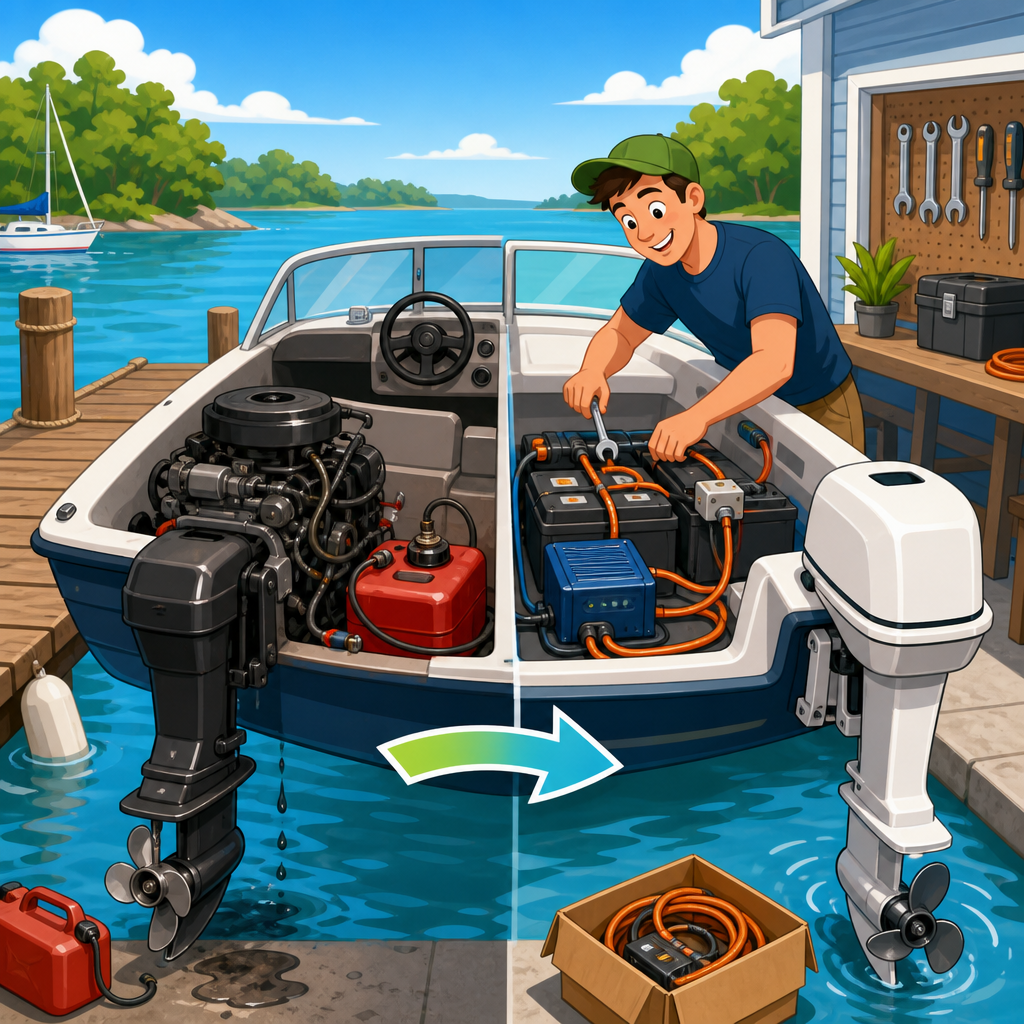
Converting a gas-powered boat to an electric engine is one of the most practical ways to make recreational and utility boating quieter, cleaner, and less expensive to operate. In simple terms, an electric boat conversion replaces an internal combustion engine, fuel tank, and related systems with an electric motor, battery bank, charging equipment, and digital controls. In many projects, owners also add solar panels to extend range, support house loads, or reduce time plugged into shore power. I have worked on repower planning for small fishing boats, inland cruisers, and sailboats with auxiliary motors, and the same lesson comes up every time: the best electric conversion starts with honest use-case math, not motor marketing.
That math matters because electric propulsion behaves differently from gasoline or diesel propulsion. A gas engine stores a large amount of energy in a small volume of fuel, can be refilled quickly, and usually tolerates high peak power demands. Electric systems are far more efficient, especially at low and moderate speeds, but battery energy density is still much lower than liquid fuel. As a result, electric propulsion excels on lakes, canals, harbors, short coastal hops, and sailboats that mainly need auxiliary power. It is less forgiving for long, high-speed planing runs unless the boat is specifically designed around a large battery pack.
Electric and solar-powered boats matter because they solve several problems at once. They eliminate exhaust emissions at the point of use, reduce noise dramatically, simplify routine maintenance, and improve the onboard experience for anglers, wildlife watchers, and marina neighbors. Regulations also push the market in this direction. More inland waterways now restrict or discourage combustion engines, and many marinas are upgrading shore power for charging. Battery technology has matured too. Lithium iron phosphate batteries, commonly called LiFePO4 or LFP, offer stable chemistry, long cycle life, and usable depth of discharge that makes modern electric boat conversion projects far more viable than they were a decade ago.
As a hub topic within eco-friendly and sustainable boating, electric and solar-powered boats include more than full engine swaps. The category covers purpose-built electric boats, hybrid propulsion, electric outboards, electric inboards, solar charging strategies, battery safety, charging infrastructure, and range management. This guide focuses on how to convert a gas-powered boat to an electric engine, while also giving you the broader framework needed to evaluate related decisions. If you understand hull efficiency, duty cycle, battery sizing, voltage selection, motor type, and charging options, you can assess nearly every other article in this subtopic with confidence and avoid the expensive mistake of buying components that do not match your real boating pattern.
Decide Whether Your Boat Is a Good Candidate
The first question is not which electric motor to buy. It is whether your boat is suitable for conversion at all. The strongest candidates are displacement or semi-displacement hulls that spend most of their time below hull speed, plus sailboats that use the engine mainly for docking, harbor maneuvering, and short motoring periods. Pontoon boats on inland lakes are also good candidates when owners prioritize quiet cruising over top speed. By contrast, heavy planing hulls that require large bursts of power to get on plane often need very large battery banks, making conversion costly, heavy, and sometimes impractical.
A quick screening method is to document your current usage. Record average trip length, cruising speed, peak speed, hours per outing, reserve requirement, and access to charging. When I review owner logs, many discover they do not actually need the range they assumed. A boater who says they “go out all day” may only run the engine for ninety minutes total. That profile can work well with electric propulsion, especially if hotel loads are separate. On the other hand, a guide boat making multiple long runs daily may need either a hybrid approach or a very careful analysis of charging turnaround between trips.
Weight distribution and available space also matter. Batteries are heavy, although less so than many people think when replacing an engine, fuel, tankage, and exhaust components together. You need room for secure battery mounting, ventilation where required by component manufacturers, cable runs, a charger, and access for service. Survey the hull structure carefully before committing. A sound transom, dry bilge, and serviceable wiring backbone make the project safer and cheaper.
Choose the Right Electric Propulsion Architecture
Most conversions fall into three architectures: electric outboard replacement, direct electric inboard replacement, or pod and saildrive-style systems. For small runabouts, tenders, and lightweight fishing boats, an electric outboard is often the simplest path. It minimizes installation complexity, keeps high-voltage components relatively self-contained, and allows easy removal for service. Brands such as Torqeedo, ePropulsion, Mercury Avator, and Elco dominate this segment with integrated controls and app-based monitoring.
For cruisers, launches, and sailboats, a direct inboard replacement is usually the better fit. In this setup, an electric motor couples to the existing propeller shaft through a reduction arrangement or direct coupling, depending on the motor’s torque characteristics and the shaft speed needed. Systems from companies such as Electric Yacht, Oceanvolt, and Bellmarine are common reference points. The major advantage is preserving the boat’s driveline and underwater geometry while replacing the engine room with a simpler, cleaner propulsion package.
Motor type matters less than many marketers imply, but system integration matters more. Permanent magnet synchronous motors are common because they deliver strong torque from zero rpm and high efficiency across useful operating ranges. The controller, throttle mapping, battery management system, and display are just as important as the motor itself. A poorly integrated system can feel abrupt, under-informative, or difficult to troubleshoot. A well-integrated one gives precise control around docks and clear range feedback underway.
| Boat type | Best-fit electric setup | Main advantage | Main limitation |
|---|---|---|---|
| Small skiff or tender | Electric outboard | Simple installation and low maintenance | Limited range at high speed |
| Pontoon or lake cruiser | High-thrust outboard or inboard | Quiet low-speed cruising | Battery size grows quickly for fast runs |
| Sailboat auxiliary | Inboard shaft-drive electric motor | Excellent for docking and short motoring | Careful range management needed in calms |
| Displacement launch | Inboard electric with large LFP bank | High efficiency near hull speed | Upfront conversion cost |
| Planing powerboat | Specialized high-power system | Possible for short missions | Very expensive and battery intensive |
Size the Motor, Propeller, and Battery Bank Correctly
The most important technical step in any electric boat conversion is power and energy sizing. Power answers how much thrust you need right now. Energy answers how long you can sustain it. People often focus on motor horsepower equivalents, but range failures usually happen because the battery bank was undersized or because the hull was operated at an inefficient speed. The right approach starts with actual shaft power requirements. If your existing gas outboard is 25 horsepower, that does not mean you need a 25-horsepower electric motor for your real-world operating profile. Electric motors deliver torque instantly and can feel stronger at low speed, but they still obey the same physics.
A practical method is to estimate required propulsive power at target speeds, then validate it with sea trial data from the current setup. For displacement hulls, power demand rises sharply as you approach hull speed, roughly calculated as 1.34 times the square root of waterline length in feet. That means pushing the last knot is disproportionately expensive in energy. I regularly advise owners to target an efficient cruise speed below the maximum. On many converted launches and sailboats, dropping from 6 knots to 5 knots can nearly double endurance.
Battery capacity is usually expressed in kilowatt-hours. Multiply average propulsion load in kilowatts by desired runtime in hours, then add reserve. If your boat needs 6 kW at cruise and you want three hours of useful operation with a 20 percent reserve, you need about 22.5 kWh of usable energy. With LFP chemistry, using around 80 to 90 percent of nominal capacity is common, depending on the battery maker’s guidance. That means a nominal bank of roughly 25 to 28 kWh may be appropriate. This is why battery-first design is essential.
Do not ignore the propeller. Electric motors often want a prop optimized for torque-rich, lower-rpm operation. A propeller that worked adequately with a gas engine may not be ideal after conversion. Prop shops can analyze pitch, diameter, blade area, and expected slip using existing shaft dimensions and target rpm. This step often unlocks better acceleration and more efficient cruising than increasing motor size.
Plan Batteries, Charging, and Solar Support
For most modern projects, LFP batteries are the default choice because they combine long cycle life, relatively stable chemistry, low maintenance, and high usable capacity. Quality marine batteries include a battery management system that monitors cell voltage, temperature, and current while protecting against overcharge, over-discharge, and fault conditions. Reputable suppliers provide ABYC-conscious installation guidance, communication protocols for chargers and displays, and clear continuous discharge ratings. Cheap, lightly documented batteries are a false economy on the water.
Voltage selection affects efficiency and cable size. Smaller boats may run 24 or 48 volts, but larger systems increasingly use higher voltages to reduce current and copper weight. This must be handled with rigorous safety practice, proper overcurrent protection, isolation procedures, and marine-rated enclosures. Follow ABYC E-11 for AC and DC electrical systems and align component installation with manufacturer instructions. That is not bureaucracy; it is basic risk control in a wet, vibrating, corrosive environment.
Charging strategy should reflect how the boat actually lives. Shore power charging is the backbone for most owners. A properly sized marine charger matched to battery chemistry and capacity determines turnaround time between outings. If you routinely deplete 20 kWh and your charger delivers 3 kW after losses, full recovery will take many hours. Owners who keep boats on slips often benefit from higher-capacity charging if marina service allows it. Trailer boaters may need home charging plans that account for tow vehicle parking and weather exposure.
Solar helps, but it should be described accurately. On small electric boats, solar can make a meaningful contribution to hotel loads and low-speed cruising. On larger powerboats, it is usually a supplemental source rather than the primary propulsion energy source. A practical bimini array might produce a few hundred watts to perhaps over a kilowatt in excellent conditions, depending on area and panel quality. That can offset electronics, refrigeration, and standby consumption, and it may add useful daily energy for slow-speed boats. It will not magically replace shore charging for a high-speed powerboat.
Manage Installation, Safety, and Compliance
A clean electric repower removes more than an engine. You may also remove fuel lines, the fuel tank, venting, filters, exhaust components, mufflers, cooling water plumbing tied to the engine, and mechanical controls. This creates an opportunity to simplify the boat significantly, but it also requires disciplined systems engineering. Every removed circuit and hose should be documented, and every remaining load should be reassessed. Many older boats hide poor splices, undersized conductors, or corroded grounds that should be corrected during the conversion.
Battery mounting is a structural job, not just an electrical one. Packs must be restrained against pounding, rollover forces, and collision loads while remaining accessible for inspection. Cable routing should minimize chafe, heat exposure, and electromagnetic interference with sensitive electronics. Emergency disconnects must be obvious and reachable. Labels matter. In an onboard incident, responders need to know what system they are dealing with.
Thermal and fire safety deserve straight talk. LFP chemistry is safer than several other lithium chemistries, but no energy storage system is risk-free. Use listed or well-documented components, install Class T fusing or manufacturer-specified protection where appropriate, and segregate propulsion circuits from low-voltage accessory wiring. Ventilation needs vary by equipment design, and you should never improvise around charger or inverter requirements. Surveyors and insurers increasingly ask detailed questions about electric propulsion installations, so documentation, diagrams, and receipts are part of the project, not afterthoughts.
Understand Costs, Performance, and Real-World Tradeoffs
Cost is the biggest reason some owners hesitate, and it should be evaluated honestly. A small electric outboard conversion can be straightforward, but a serious inboard repower with quality LFP batteries, charger, controls, cabling, fabrication, and labor can cost more upfront than replacing a gas engine. The long-term economics improve when the boat is used frequently, when local fuel prices are high, or when maintenance avoidance matters. Electric systems eliminate oil changes, fuel system service, spark issues, and many winterization tasks, but they do not eliminate all maintenance. Shafts, bearings, cooling circuits where fitted, and electrical connections still require inspection.
Performance tradeoffs are just as important. Electric boats are superb at instant torque, low-speed control, silent cruising, and predictable operation. They are constrained by recharge time and battery weight when asked to deliver long, high-speed runs. The most satisfied owners are those whose mission profile aligns with electric strengths. A lake cruiser doing evening tours, a marina launch, or a sailboat auxiliary user often reports that electric feels better than combustion in daily use. Someone expecting all-day planing range with quick refueling will be disappointed unless they invest in a highly specialized platform.
The upside is substantial when the match is right. You get cleaner bilges, far less vibration, easier conversation underway, and a boating experience that feels modern instead of mechanical. If you are considering the change, start by auditing your real usage, then speak with a qualified marine electrician, propulsion supplier, and insurer before purchasing components. A well-planned electric boat conversion turns sustainable boating from an idea into a durable, practical reality.
Frequently Asked Questions
Is it practical to convert a gas-powered boat to an electric engine?
Yes, for many boats it is very practical, and in the right use case it can be one of the smartest upgrades an owner can make. An electric boat conversion is especially well suited to boats used for day trips, lake cruising, harbor runs, canal use, marina shuttles, fishing, and other applications where the vessel returns to a dock or charging point regularly. The biggest advantages are quieter operation, lower routine maintenance, cleaner performance, instant torque, and reduced fuel-related costs. Instead of maintaining a gasoline engine, fuel system, exhaust, cooling components, and many moving parts, the boat is powered by an electric motor, battery bank, motor controller, charger, and monitoring system.
That said, practicality depends on hull type, weight, operating speed, and range expectations. Displacement hulls and slower semi-displacement boats generally convert very well because they require less power to move efficiently through the water. High-speed planing boats can also be converted, but they often need much larger battery banks to deliver the same performance and runtime, which can raise costs and add substantial weight. In other words, the conversion tends to be most successful when the boat’s mission profile matches the strengths of electric propulsion. If your current boating habits involve short, predictable outings rather than long-distance, high-speed runs, electric propulsion is often an excellent fit.
What parts are replaced during an electric boat conversion?
In a typical conversion, the gasoline engine, fuel tank, fuel lines, exhaust system, throttle linkages, and related combustion-engine support components are removed. They are replaced with an electric motor sized for the boat, a battery bank to store energy, a motor controller to regulate power delivery, a charger for shore power charging, and a digital control and monitoring system. Depending on the setup, the conversion may also include a reduction drive or direct coupling to the existing propeller shaft, upgraded cabling, a main battery disconnect, fuses or breakers, ventilation provisions, and a battery management system, especially when lithium batteries are used.
Many owners also take the opportunity to modernize the electrical side of the boat at the same time. That can include adding DC-DC converters, inverters for AC appliances, dedicated house batteries, smart displays, and solar panels. Solar is not usually a complete replacement for charging from shore power, but it can be very useful for extending range modestly, maintaining batteries, and running house loads like lights, instruments, refrigeration, or electronics. A well-planned conversion treats the propulsion system and the onboard electrical system as one integrated package, which improves reliability, safety, and day-to-day usability.
How do you choose the right electric motor and battery bank for a boat?
The correct motor and battery sizing comes from matching the electric system to the boat’s real operating requirements, not simply trying to duplicate the gasoline engine’s horsepower number. The most important factors are the boat’s displacement, hull design, propeller setup, desired cruising speed, top speed goals, and expected runtime. In many conversions, the target is efficient cruising rather than maximum speed, because electric propulsion performs best when the boat is operated within its most efficient speed range. A professional assessment may include shaft power calculations, sea trial data, or an estimate of how much power the boat actually uses at various speeds.
Battery bank sizing is based on how far and how long you want to travel between charges. If you want several hours of low-speed cruising, the battery requirement may be very manageable. If you want long range at high speed, battery capacity requirements rise dramatically. Lithium batteries are commonly used because they offer high energy density, lighter weight, longer cycle life, and better usable capacity than lead-acid alternatives. However, they require proper battery management and system integration. The best approach is to define your normal boating day honestly, then size the batteries around that profile with an appropriate reserve. Oversizing slightly for comfort is usually wise, but excessive battery weight and cost should be avoided if it does not serve the boat’s actual use.
How much does it cost to convert a gas-powered boat to electric?
The total cost can vary widely depending on boat size, power requirements, battery chemistry, desired range, installation complexity, and whether the work is done professionally or partly by the owner. In general, the major cost categories are the electric motor, motor controller, battery bank, charger, battery management system, wiring and protection hardware, displays and controls, fabrication or mounting work, and labor. If the conversion also includes solar panels, an inverter, upgraded house electrical systems, or propeller and shaft modifications, those will add to the final budget as well.
While the upfront cost can be significant, it is important to look at long-term operating economics. Electric propulsion usually reduces routine maintenance because there are fewer moving parts, no oil changes, no spark plugs, no fuel filters, and fewer combustion-related service items. Electricity is also often less expensive and more price-stable than marine fuel. Over time, many owners value the non-financial benefits just as much: less noise, no gasoline fumes, easier starting, smoother control, and a more enjoyable onboard experience. A realistic budget should include not only parts and installation, but also haul-out costs, marine-grade safety components, and any structural or balance adjustments needed to distribute battery weight properly.
Can solar panels power an electric boat conversion on their own?
Usually not by themselves, at least not for most boats used for propulsion at meaningful speeds, but they can still play an important supporting role. Solar panels are excellent for maintaining batteries, reducing shore power use, covering hotel or house loads, and adding a modest amount of propulsion energy over the course of the day. On smaller, slower boats with very efficient hulls and conservative cruising habits, solar can make a noticeable difference in usable range. On larger boats or boats requiring higher propulsion power, solar output is typically too limited relative to motor demand to serve as the sole energy source for regular operation.
The real value of solar in an electric boat conversion is as part of a broader energy strategy. For example, solar can keep electronics and auxiliary loads from drawing down propulsion batteries as quickly, and it can top up the system between outings or while the boat is moored. It can also reduce charging time from shore power in some situations. The amount of benefit depends on available deck or hardtop space, panel efficiency, local sunlight conditions, and how the boat is used. When designed correctly, solar is a highly worthwhile addition, but it should be viewed as a range extender and system support feature rather than a complete substitute for a properly sized battery bank and shore charging setup.