How long it takes to get a boating license depends on where you boat, your age, the type of vessel you operate, and whether your state requires a true license, a boater education card, or a rental-only safety certificate. In most cases, a first-time recreational boater can complete the required course and exam in one day to a few weeks, then receive temporary proof immediately and a permanent card by mail later. That short answer is useful, but it hides the details that matter when you are trying to get legal before a trip, buy a boat, insure a new vessel, or understand boating laws and regulations across state lines.
In day-to-day boating practice, “boating license” is often used as a catchall term. Many states do not issue a traditional operator’s license the way they issue a driver’s license. Instead, they require completion of a state-approved or National Association of State Boating Law Administrators approved education course and then issue a boater education card, certificate, endorsement, or proof of competency. Some states require operators of personal watercraft or younger boaters to carry this proof, while others require nearly every motorboat operator to have it. If you plan to captain a vessel for hire, the timeline changes completely because a U.S. Coast Guard Merchant Mariner Credential has sea-time, testing, medical, and federal documentation requirements.
This matters because boating rules are enforced on the water, at launch ramps, and during registration or rental transactions. I have worked with new owners who assumed their online course completion was enough everywhere, only to learn that age restrictions, horsepower thresholds, and temporary certificate rules varied by state. The result can be denied rentals, citation risks, insurance delays, or trip cancellations. A clear understanding of licenses and permits saves time and reduces legal exposure.
As a hub for boating licenses and permits, this guide explains the full timeline, the factors that speed it up or slow it down, what counts as legal proof, how state reciprocity works, and when you need something more than a basic education card. It also points to the practical questions searchers usually ask: Can you get a boating license online? How long is the course? Do you have to renew it? Does a temporary certificate let you boat right away? What changes if you move states or operate a jet ski? Those are the questions that decide whether you can launch this weekend or need to plan farther ahead.
Typical timeline for a recreational boating license
For a standard recreational boating license, permit, or education card, the shortest realistic timeline is a few hours. Many approved online courses are self-paced, take roughly three to eight hours, and include quizzes plus a final exam. In states that allow online completion and instant digital proof, a motivated applicant can start in the morning and legally operate by afternoon, assuming there is no mandatory waiting period. Other states require in-person proctoring, classroom attendance, or agency processing that extends the timeline to several days or weeks.
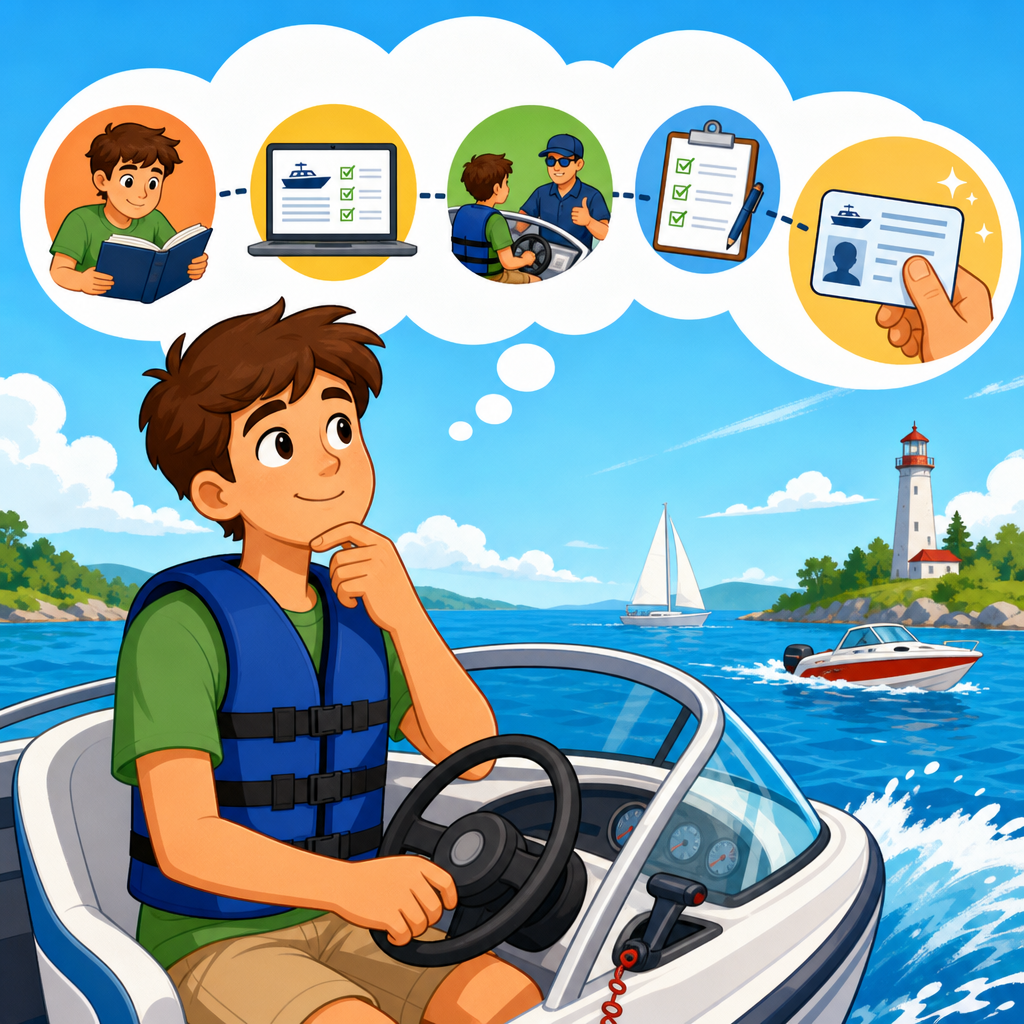
The process usually follows the same sequence. First, confirm the rule in your state of residence and the state where you will boat. Second, enroll in a recognized course provider such as BOATERexam, Boat-Ed, Aceboater, or a state agency portal. Third, complete the curriculum covering navigation rules, required safety equipment, right-of-way, aids to navigation, alcohol rules, emergency procedures, and local law. Fourth, pass the exam at the required score, often 70 to 80 percent. Fifth, print or download temporary proof if allowed, then wait for the permanent card.
What slows this down most often is not the class itself; it is verification and administration. Some states need you to create an agency account, match your legal name to registration or DMV records, or pay a separate issuance fee after course completion. If you are under 18, a parent signature may be required. If you fail the exam, some providers impose a retake delay. During peak spring demand, mailing the permanent credential can take two to six weeks even when temporary proof is immediate.
What changes the timeline from state to state
State law is the biggest variable. Boating is regulated primarily at the state level for recreational operators, so the same person may be legal in one jurisdiction and noncompliant in another if the paperwork is not recognized there. Some states require boater education for anyone born after a certain date. Others apply the rule only to operators under a specific age or to users of personal watercraft. A few states still have no broad education mandate for adult operators, though insurers, marinas, and rental companies may effectively require it anyway.
Course format also matters. Online instruction is usually fastest, but some states preserve classroom options through wildlife agencies, sheriff departments, Coast Guard Auxiliary units, or United States Power Squadrons. Those classes can be excellent, especially for beginners who benefit from live questions and local examples, but they run on a schedule. If the next class is two weeks away, your timeline is automatically longer. Proctored exams create another delay, particularly in rural areas.
Documentation rules are another source of variation. In one state, your temporary completion certificate may be valid for 30 or 60 days. In another, you are not legal until the state issues the official card. Names differ too: boating safety education certificate, boater card, vessel operator card, watercraft operator permit. The practical point is the same: read the agency language carefully and carry the exact proof the law requires.
| Requirement factor | Fastest case | Slower case | Typical impact on timeline |
|---|---|---|---|
| Course format | Self-paced online | Scheduled classroom | Hours versus days or weeks |
| Exam method | Built into online course | Separate proctored test | Same day versus added scheduling time |
| Proof of eligibility | Instant digital certificate | State-issued card required first | Immediate use versus waiting for processing |
| Age or guardian rules | Adult applicant | Minor with extra consent steps | Little delay or several extra days |
| Seasonal processing volume | Off-season application | Spring and early summer rush | Normal mailing versus backlog |
Online courses, exams, and instant certificates
If your goal is speed, online boating education is usually the answer. Most major providers break the material into short modules on navigation rules, environmental compliance, emergency response, and legal responsibilities. Because the course saves progress, many people complete it over one evening or across a weekend. In my experience, the operators who finish fastest are those who already spend time around docks and channels, but true beginners should not rush. The exam is manageable, yet the content matters when you face crossing situations, no-wake zones, or an engine fire.
Instant certificates are common, but not universal. Some providers issue a printable certificate immediately after you pass and pay. In many states, that document is valid as temporary proof while the permanent card is mailed. In other states, the provider forwards completion records to the agency, and the agency decides when you may begin operating. Always verify whether law enforcement accepts mobile display, paper printout, or only the official plastic card. That detail decides whether you can legally boat during the mailing period.
Cost is modest compared with most other vessel expenses. Many online courses fall roughly in the $20 to $50 range, though state fees may be added. Free classroom courses exist through public agencies or volunteer organizations, but they may be less convenient to schedule. If you need legal proof quickly before a vacation, paying for an approved online option is usually the most efficient path.
Special cases: minors, personal watercraft, rentals, and out-of-state boaters
Minors often face stricter timelines because education is tied to age-based operating privileges. A teenager may complete the course in one day, but state law could still limit unsupervised operation, nighttime use, or horsepower. Personal watercraft operators are also singled out frequently. Because jet skis accelerate fast, turn differently from propeller-driven boats, and are common in collision reports, states often require formal education for younger riders even when small boat operators are exempt.
Rental situations create a separate path. Some states or marinas offer a temporary rental permit after a brief dockside or online safety briefing. That can reduce the timeline to less than an hour, but the permit may apply only to that rental company, that date, or that class of vessel. It is not a substitute for a full boating education card if state law otherwise requires one. Travelers regularly confuse these two documents.
Out-of-state operation is where reciprocity becomes important. Most states recognize a valid boater education credential issued by another state if it meets comparable standards, especially when approved through nationally recognized curricula. Recognition is not unlimited, though. Long-term relocation, seasonal residence, or obtaining local registration may trigger the need for a resident credential. Before towing your boat across state lines, check the destination agency’s website for age rules, temporary proof rules, and personal watercraft requirements.
When a boating license takes much longer
Not every boating license timeline is measured in hours or days. If you intend to carry passengers for hire, guide fishing trips, operate a towboat commercially, or work on inspected vessels, you are entering the federal credentialing system. A Coast Guard captain’s license, commonly called an OUPV or Six-Pack license, requires documented sea service, a Transportation Worker Identification Credential in many cases, a medical exam, drug testing compliance, CPR and first aid in some pathways, and either an approved course or a formal exam package. That process typically takes months, not weekends.
State permits can also add time in specific contexts. Examples include local mooring permits, aquatic invasive species permits, oversized load permits for transport, marine sanitation compliance paperwork, or special event permits for races and regattas. Those are not operator licenses, but boaters often search for them under the same umbrella because they are part of legal use. As a licensing and permits hub, it is important to separate operator competency requirements from vessel registration, titling, and waterway use permits. They overlap in practice, yet they are issued by different authorities and follow different timelines.
How to get legal faster without making mistakes
The fastest safe approach is simple. Start with your state boating agency, not a random course ad. Confirm who must be certified, whether your age group is covered, and whether online completion is accepted. Choose an approved provider, use your full legal name exactly as it should appear on the credential, and keep screenshots, payment receipts, and your completion record. If the state allows temporary proof, print a paper copy even if you also save it on your phone. Batteries die, screens crack, and some officers still prefer paper.
Do not assume your boat registration, insurance binder, or driver’s license substitutes for an education card. They serve different legal purposes. Also, do not leave the process until the night before a holiday weekend if your state requires agency processing. Memorial Day and Fourth of July create predictable bottlenecks. When clients ask me how to avoid delays, my answer is always the same: complete the course in the off-season, verify reciprocity before travel, and store your credential with registration and safety equipment checklists so it is ready at launch.
It also helps to think beyond the minimum legal requirement. A boating education course teaches the rules, but practical competency comes from repetition. New operators should pair the card with hands-on practice in docking, lookout habits, chart interpretation, VHF radio basics, and man-overboard drills. That investment does not lengthen the licensing timeline much, yet it dramatically reduces on-water risk.
So, how long does it take to get a boating license? For most recreational boaters, the honest answer is anywhere from a few hours to a few weeks, with online state-approved courses offering the fastest path and commercial credentials taking far longer. The timeline depends on state law, course format, exam rules, temporary certificate policies, age restrictions, and whether you need a simple education card or a more advanced permit.
The main benefit of understanding boating licenses and permits early is not just compliance. It is confidence. When you know exactly which credential you need, how reciprocity works, and what proof to carry, you can plan trips, rentals, purchases, and family boating days without last-minute surprises. That is why this topic sits at the center of any serious Boating Laws & Regulations resource: licensing touches safety, enforcement, insurance, and access.
Use this page as your starting hub for boating licenses and permits, then check the detailed rules for your state, your vessel type, and your intended use before you launch. If you have a trip coming up, verify your requirements today and complete the approved course now, not the night before you hit the ramp.
Frequently Asked Questions
How long does it usually take to get a boating license?
For most first-time recreational boaters, the process can take anywhere from a single day to a few weeks, depending on the state, the type of credential required, and how quickly you complete the steps. In many states, what people call a “boating license” is actually a boater education certificate or safety card rather than a true operator’s license. If your state allows you to take the course online, you may be able to finish the educational requirement and final exam in just a few hours. Some providers issue temporary proof of completion immediately after you pass, which means you may be legally eligible to boat right away while you wait for your permanent card to arrive in the mail.
However, not every situation moves that fast. Some states require in-person classes, proctored exams, age-specific requirements, or paperwork processing times that stretch the timeline out. Mailing delays can also affect when you receive your permanent credential. If you are planning a trip, renting a boat, or buying a vessel, it is smart to start early instead of assuming same-day approval. The quickest path is usually an approved online course followed by an instant printable certificate, but your actual timeline depends on your state boating agency and the rules that apply to your age and vessel type.
What factors can affect how long it takes to get a boating license?
Several factors can change the timeline, and this is where many boaters get caught off guard. The biggest variable is location. Boating laws differ by state, and some states have straightforward online education systems while others require more formal training or have different standards for different age groups. Your age matters because younger operators are often subject to additional education requirements, supervision rules, or minimum-age restrictions before they can legally operate certain boats on their own.
The type of vessel you plan to operate can also influence the process. A basic recreational powerboat may fall under one set of rules, while personal watercraft such as Jet Skis often come with stricter requirements. If you are only renting a boat, some states or rental operators may allow a temporary rental safety certificate that can be completed much faster than obtaining a standard boater education card. Another factor is whether your state recognizes NASBLA-approved courses and offers immediate digital proof after completion. Even if you finish the course quickly, administrative processing, identity verification, exam retakes, and mailing times can all add days or weeks. That is why the real answer is not just “how long is the course,” but “what exact credential do you need, and what steps does your state require before you can legally operate the boat?”
Can I get a temporary boating license or proof of certification right away?
In many cases, yes. A large number of approved boating safety course providers issue a temporary certificate, completion receipt, or printable proof as soon as you pass the final exam. This temporary document is often enough to satisfy legal requirements until your permanent card is mailed. For boaters who need to get on the water quickly, this can reduce the practical wait time from weeks to just a few hours. That said, whether immediate proof is valid depends on the state and the specific program you use, so it is important to confirm that the course is officially approved and that the temporary document is accepted by local enforcement and rental companies.
It is also worth remembering that “immediate” does not always mean universally usable. Some states may accept digital copies on your phone, while others may prefer a printed certificate. Some rental marinas have their own policies and may ask to see specific documentation before handing over a boat. If you are boating while traveling, check whether the state you are visiting honors your home-state credential or temporary proof. The safest approach is to complete a recognized course, print or save every confirmation document, and verify acceptance before your boating date. Doing that can help you avoid the frustrating situation of technically passing the course but still not having the right proof in hand when you need it.
Does every state require the same boating license process?
No, and this is one of the most important things to understand. There is no single nationwide boating license process that applies everywhere. States set their own rules for who needs boater education, what counts as an approved course, whether an exam is required, and how credentials are issued. In one state, an adult may be able to complete a self-paced online course in one afternoon and receive instant proof. In another, the requirement may depend on your birth year, whether you are operating a motorized vessel, or whether you are using a personal watercraft. Some states also phase in requirements over time, meaning certain age groups must carry proof of education while older boaters may be exempt.
This variation is why broad estimates can be misleading. Even the term “boating license” is often used informally, while the legal document may actually be called a boater education card, boater safety certificate, or vessel operator card. If you are trying to estimate timing accurately, the best first step is to check the requirements of the state where you will operate the boat, not just where you live. If you plan to rent during vacation, ask the rental company what they accept. Knowing the exact state rule can save you time, help you choose the right course format, and prevent delays caused by taking a course that does not meet local requirements.
How can I get my boating license as quickly as possible?
The fastest approach is usually to identify the exact credential you need and then choose an approved course provider that offers online, self-paced instruction and immediate exam results. Start by checking your state boating authority or wildlife agency website to confirm whether you need a permanent boater education card, a temporary rental certificate, or another form of operator proof. Once you know the requirement, select a course that is explicitly recognized by your state. If same-day eligibility matters, look for a provider that issues a temporary certificate immediately after passing the exam. Be sure to complete all registration details accurately so there are no delays caused by name mismatches, incomplete forms, or payment issues.
You can also speed up the process by preparing for the exam instead of rushing through the material and having to retake it. Set aside uninterrupted time, use a computer or device with a stable internet connection, and save digital and printed copies of every document you receive. If you are under a certain age, operating a personal watercraft, or boating in a different state from your residence, double-check those special rules before enrolling. For rentals, call ahead and ask whether the operator accepts temporary certificates, out-of-state cards, or same-day course completions. A little planning can make the difference between being ready to boat in a matter of hours and losing days sorting out the wrong course or missing paperwork.