A blown fuse can shut down your bilge pump, navigation lights, fish finder, or VHF radio without warning, and on a boat that is more than an inconvenience. It is a safety issue. Knowing how to replace a blown fuse on your boat is one of the most useful emergency boat repairs any owner can learn, because it restores critical circuits quickly and helps you diagnose whether the problem is a simple overload or a deeper electrical fault. In practical terms, a fuse is a sacrificial device placed in a circuit to melt when current exceeds a safe limit. That controlled failure protects wiring, switches, electronics, and in the worst cases prevents heat buildup that can lead to fire.
On boats, fuse replacement matters more than it does in cars because marine electrical systems operate in a harsher environment. Salt, vibration, moisture, heat cycling, and improvised aftermarket wiring all increase the odds of poor connections and short circuits. Most recreational boats use a 12-volt DC system, though larger vessels may also have 24-volt DC or 120-volt AC shore power systems. The emergency repair discussed here focuses on low-voltage DC branch circuits, where blade fuses, glass cartridge fuses, inline fuse holders, and resettable breakers are common. If you can identify the failed circuit, isolate power safely, verify the correct fuse rating, and inspect for the reason it failed, you can often get an essential system back online in minutes.
I have had to do this underway when a washdown pump seized and took out an accessory circuit, and again at anchor when corroded navigation light wiring popped a fuse after a rain squall. In both cases, replacing the fuse was only half the job. The real task was confirming whether the replacement would hold. That is the mindset behind all emergency boat repairs and quick fixes: restore function fast, but never ignore root cause. As a hub for emergency boat repairs and quick fixes within broader boat maintenance and repairs, this guide explains fuse replacement in detail while connecting it to the bigger onboard troubleshooting framework that also includes dead battery response, temporary hose repairs, bilge pump failures, steering issues, loose terminals, and damaged fuel or water lines.
If you want the short answer, here it is: turn off the circuit and battery switch if possible, locate the failed fuse, match the exact amperage and type, inspect the wiring and device for damage, install the new fuse firmly, and test the circuit while monitoring for heat, smell, or repeat failure. Never install a larger fuse to “get by.” Marine wiring is sized for a specific current load under ABYC guidance, and oversizing a fuse can allow the wire to overheat before the fuse opens. The right replacement is not simply the one that fits. It is the one that matches the circuit design.
When a blown fuse is the real problem
A blown fuse usually announces itself through a dead accessory on an otherwise powered boat. A live panel with one nonworking circuit is the classic sign. Your chartplotter may go dark while cabin lights still work, or your horn may fail while the engine starts normally. Some blade fuses have a visible broken element; others look intact but fail electrically, especially when corrosion hides the break. The most reliable test is with a multimeter or a simple 12-volt test light. If voltage reaches one side of the fuse but not the other, the fuse is open. If no voltage reaches either side, the issue may be upstream at the battery switch, breaker, bus bar, or panel feed.
Boaters often mistake low battery voltage for a blown fuse because both produce dead equipment. The difference is scope and symptom pattern. Low voltage affects multiple circuits, causes dim lights, weak pump performance, and electronics that reboot. A blown fuse usually affects one branch circuit. Another common mix-up is the tripped breaker. Many helm panels combine blade fuses for accessories with push-button breakers for higher draw loads. Resettable breakers can also live near batteries, trolling motors, windlasses, and trim tabs. Before pulling fuses at random, verify that the problem is not a switched-off battery bank, a bad ground, or a corroded connector at the device itself.
Fuse failures have causes, and the cause informs the repair. The most common are overload, short circuit, water intrusion, corroded terminals, seized motors, and chafed wire insulation. A bilge pump that ingests debris can stall and exceed normal current draw. A livewell pump with worn bearings can do the same. Trailered boats often develop pinched wiring around folding towers, hinges, seat bases, and battery compartments. On older boats, previous owners may have added stereos, USB chargers, spotlights, or sonar units to existing circuits without recalculating load. The fuse then becomes the weak point, which is exactly its job.
Tools, spare parts, and the right fuse types to carry
Your emergency electrical kit should be small, dry, and standardized. At minimum, carry a digital multimeter, fuse puller, needle-nose pliers, heat-shrink butt connectors, marine-grade crimp terminals, a ratcheting crimper, electrical tape for temporary bundling, adhesive-lined heat shrink, dielectric grease, spare blade fuses in common ratings, spare glass fuses if your boat still uses them, a headlamp, and a wiring diagram if available. I also recommend a noncontact label system or waterproof marker so you can note what failed and when. Pattern recognition matters if the same circuit blows two trips in a row.
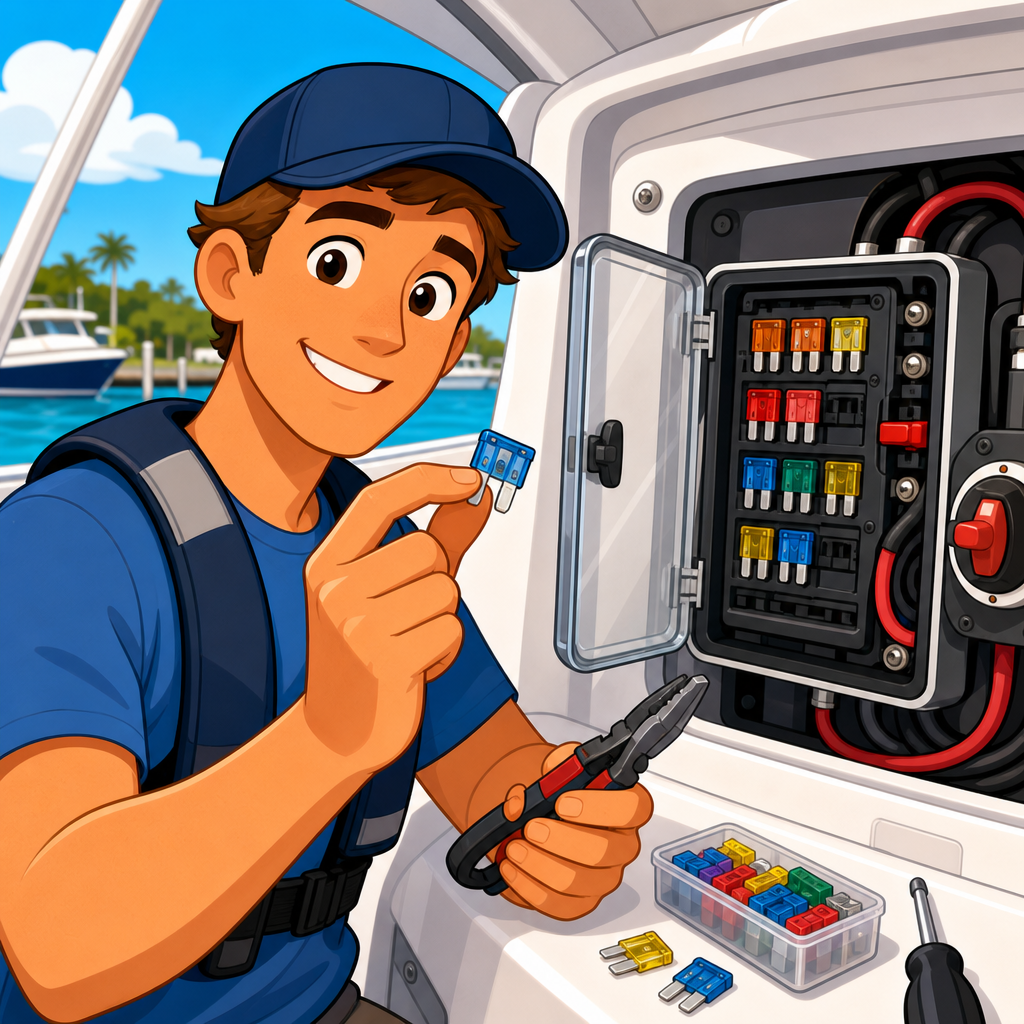
Most modern small boats use ATO/ATC blade fuses. They are color coded by amperage, which helps in poor light: 5 amp tan, 10 amp red, 15 amp blue, 20 amp yellow, 25 amp clear, and 30 amp green. Mini and maxi blade fuses are also common. Older boats may use AGC glass cartridge fuses in inline holders. High-current circuits, including inverters and trolling motors, may use ANL, MIDI, or MRBF fuses mounted near the battery. These are not interchangeable. The replacement must match not just amperage but physical type, voltage rating, and in many cases time-delay characteristics specified by the equipment manufacturer.
| Fuse type | Common location on boats | Typical use | Emergency replacement note |
|---|---|---|---|
| ATO/ATC blade | Helm fuse panel, accessory block | Lights, electronics, pumps | Most common spare to carry in multiple ratings |
| Mini blade | Compact electronics panels | Modern accessories, USB chargers | Easy to confuse with ATO/ATC; check size before forcing |
| Glass AGC | Inline holders behind dash or near devices | Older radios, legacy accessories | Inspect end caps for corrosion as well as filament failure |
| ANL/MIDI/MRBF | Near battery banks | High-amperage feeds, inverters, windlass | Usually indicates a serious fault; investigate before replacing |
Spare parts should reflect your boat’s actual electrical map, not a generic assortment. Open the panel at the dock, list every fuse rating in service, and stock at least two replacements for each critical circuit. Add more for 10, 15, and 20 amp sizes because they serve many common loads. Keep them in a sealed organizer away from spray. If your fuse block uses printed labels that have faded, remake them now. During an emergency, the time lost reading brittle panel markings is avoidable.
Step-by-step: how to replace a blown fuse on your boat safely
Start by stabilizing the situation. If the failed circuit affects safety equipment, such as bilge pumping, navigation lights, or communications, decide whether you need an immediate underway repair or whether you should reduce load, anchor safely, or return to port first. Water and electricity demand discipline. Dry your hands, secure footing, and ventilate the compartment if batteries are nearby. If there is any smell of burning insulation, visible smoke, or heat at the panel, shut down the circuit and battery switch before touching anything. On boats with separate house and start banks, isolate only the affected bank if doing so will not create a bigger hazard.
Next, identify the exact fuse. Use the panel legend, owner’s manual, or wiring diagram. Remove the suspect fuse with a fuse puller rather than metal tools when possible. Inspect it visually, then test continuity with a multimeter. A good fuse usually reads near zero ohms; a blown fuse reads open. Before inserting a new one, inspect the holder. Green or white corrosion, loose female terminals, melted plastic, or signs of arcing mean the holder itself may be the failure point. Clean light corrosion, but replace damaged holders as soon as practical because a loose connection creates resistance, heat, and repeated failures.
Now verify the replacement. Match amperage exactly. Match form factor exactly. If the old fuse is missing or unreadable, do not guess based on what “seems right.” Check the device manual, panel schedule, wire gauge, or manufacturer documentation. Install the new fuse firmly, restore power, and switch on only the affected circuit first. Watch and listen. If the device runs normally and the fuse holds, continue monitoring for several minutes. Feel the wiring insulation and holder carefully for abnormal warmth. If the fuse blows immediately, stop replacing fuses. You now have a fault that requires troubleshooting, not repeated resets.
One practical rule from experience: if a replacement fuse survives initial startup but blows after a few minutes, suspect a motor drawing excess current under load, such as a pump, blower, or wiper. If it blows instantly when power is applied, suspect a short to ground or a device with an internal fault. If it blows only in wet weather or when the boat pounds in chop, suspect water intrusion or chafe. These patterns help you narrow the cause quickly, which is essential when this repair is part of a broader emergency boat repairs and quick fixes situation.
Diagnosing why the fuse blew and preventing repeat failures
Fuse replacement is temporary unless you identify why the circuit exceeded its limit. Begin with the load side. Inspect the accessory connected to that fuse. Pumps should spin freely and not be jammed with debris. Lights should have dry housings and intact gaskets. Electronics should have clean power and ground connections with no salt bridge across terminals. Follow the wire run as far as you can. Common damage points include bulkhead penetrations, zip ties tightened too hard, battery lids, seat pedestals, engine rigging tubes, and areas where aftermarket gear was tapped into an existing harness.
A multimeter makes diagnosis faster. With power off, check for continuity from the load conductor to ground where none should exist. That suggests a short. With power on, measure voltage at the device under load. Significant voltage drop indicates resistance from corrosion, loose crimps, or undersized wire. ABYC marine electrical recommendations are clear on keeping voltage drop within acceptable limits for critical and noncritical circuits. In real terms, low voltage can make motors labor harder and draw more current, which contributes to nuisance fuse failures. Many boat owners replace the fuse when the real fix is cleaning a ground bus or remaking a corroded butt splice with tinned marine wire.
Prevention is straightforward but often neglected. Use marine-grade tinned copper conductors, adhesive-lined heat shrink terminals, properly supported harnesses, drip loops where water can travel, and correctly rated overcurrent protection within the recommended distance of the power source. Label every added circuit. Avoid household wire nuts and automotive open-barrel connectors in wet compartments. During seasonal maintenance, open the helm, inspect fuse blocks, tighten terminals to specification, and exercise critical devices before the first trip. The best emergency repair is the one you never need because your system was built and maintained correctly.
How fuse repair fits into emergency boat repairs and quick fixes
A blown fuse rarely happens in isolation. It often appears alongside the other failures that define emergency boat repairs and quick fixes. A dead bilge pump circuit overlaps with water ingress response. A failed horn or VHF ties into communication redundancy. A blown navigation light fuse at dusk becomes a legal and collision-avoidance problem. That is why this hub topic matters. Competent boat owners do not learn fuse replacement as a standalone trick. They learn it as part of a system of quick diagnostics, safe temporary repairs, and decision-making about whether to continue, slow down, anchor, call for assistance, or return to the dock.
The broader subtopic includes temporary battery terminal repairs, jump-start procedures for marine engines, emergency hose patching with self-fusing tape, fuel line leak response, seized hatch latches, steering cable checks, propeller fouling removal, and rapid bilge control measures. Fuse replacement intersects with all of them because electrical distribution powers pumps, lights, electronics, trim systems, and alarms. If you maintain an internal library of procedures, start with the circuits that preserve flotation, visibility, communication, and engine reliability. Then organize your onboard spares so those procedures are actionable. A laminated quick-reference card near the helm is more useful in rough weather than a saved bookmark.
The key takeaway is simple: replace the fuse correctly, but treat the blown fuse as evidence. Match the exact rating, inspect the circuit, test methodically, and never bypass protection to keep moving. Build a dry electrical kit, label your panel, and learn your boat’s wiring before an emergency. That preparation turns a dead accessory into a manageable interruption instead of a dangerous escalation. As you work through the rest of this emergency boat repairs and quick fixes hub, use fuse troubleshooting as your template for every onboard repair: isolate the problem, restore the essential function safely, and fix the root cause at the first proper opportunity. Before your next trip, check your fuse inventory and confirm every critical circuit is protected, labeled, and understood.
Frequently Asked Questions
What should I do first when a fuse blows on my boat?
The first step is to stay calm and identify exactly what stopped working. A blown fuse may cut power to something minor, but it can also disable important equipment such as a bilge pump, navigation lights, VHF radio, or fish finder. Start by turning off the affected device and, if possible, the circuit at the switch panel. This reduces the chance of further arcing or repeated fuse failure while you inspect the problem. Next, locate the fuse panel, inline fuse holder, or accessory-specific fuse that protects that circuit. Many boats have more than one fuse location, so check the helm, battery compartment, and behind electronics if needed.
Once you find the fuse, inspect it carefully. A blade fuse often shows a broken or blackened metal strip inside the plastic body, while a glass fuse may have a visibly separated filament or discoloration. If you have a multimeter or test light on board, use it to confirm that the fuse has actually failed instead of assuming it is the only issue. Before replacing anything, look for obvious causes such as loose wiring, signs of corrosion, water intrusion, melted insulation, or a device that may have drawn too much current. Replacing a fuse without checking for the reason it blew can lead to another immediate failure. In an emergency, restoring power quickly matters, but safe troubleshooting matters just as much.
How do I replace a blown fuse on my boat safely and correctly?
To replace a blown fuse safely, begin by shutting off the device and removing power from the circuit if practical. On many boats, that means turning off the breaker at the panel or disconnecting the battery switch for the affected bank if the wiring arrangement allows it. Then remove the blown fuse carefully using a fuse puller or insulated fingers, depending on the fuse style. Check the amperage rating marked on the fuse body, such as 5A, 10A, or 15A, and replace it only with the same type and same rating. For example, a 10-amp blade fuse must be replaced with another 10-amp blade fuse, not a larger fuse and not a different style unless the holder is specifically designed for it.
After inserting the new fuse, restore power and test the device. If the circuit comes back on and operates normally, continue monitoring it for a few minutes. If the new fuse blows immediately or shortly afterward, stop there. That usually indicates an unresolved overload, a short circuit, damaged wiring, or a failing piece of equipment. Never install a higher-amperage fuse just to “get by,” because the fuse is there to protect the wiring from overheating and potentially causing a fire. On a boat, where vibration, moisture, and salt exposure are constant factors, proper fuse replacement is not just about convenience. It is a critical part of onboard electrical safety.
Can I use a higher-rated fuse if I do not have the exact replacement on board?
No. Using a higher-rated fuse is one of the most dangerous mistakes you can make in a marine electrical system. The fuse rating is matched to the wire size and the expected load of the circuit. If a 10-amp circuit is protected by a 15-amp or 20-amp fuse, the fuse may no longer blow when it should. That means the wire could overheat, insulation could melt, and nearby materials could be damaged before the fuse finally opens, if it opens at all. In the confined and often damp environment of a boat, that creates a serious fire risk.
If you do not have the exact fuse, the safest option is to leave the circuit off until you can install the proper one. In a true emergency involving critical safety equipment, the priority is still to protect the boat and passengers from a larger electrical hazard. Carrying a well-organized onboard fuse kit is the best prevention. Stock common blade fuse sizes, glass fuses if your boat uses them, and any specialty fuses required by your electronics or engine systems. Labeling spare fuses and keeping them in a dry container can save valuable time when a problem happens underway. Matching the exact fuse type and amperage is not a suggestion. It is the correct repair.
Why does a boat fuse blow more than once?
If the same fuse keeps blowing, the fuse is doing its job by warning you that something is wrong. Repeated fuse failure usually points to one of three issues: too much current draw, a short circuit, or a faulty component. An overload can happen when too many accessories are placed on one circuit or when a device begins drawing more current than normal because it is failing internally. A short circuit may occur when positive wiring contacts ground due to chafed insulation, loose terminals, corrosion, vibration damage, or water intrusion. On boats, wiring often runs through tight spaces and damp areas, so physical wear and moisture-related faults are common causes.
To diagnose the problem, disconnect or switch off everything on that circuit and then reconnect items one at a time if the setup allows it. Look closely at fuse holders, switch panels, connectors, and wire runs for green corrosion, burned spots, soft insulation, or evidence of heat. Pay special attention to places where wires pass through bulkheads, under consoles, or near moving equipment. If a specific device causes the fuse to blow as soon as it is turned on, the issue may be inside that unit or in its supply wiring. If the fuse blows even with the device off, the fault is likely in the circuit wiring itself. Persistent fuse problems are a sign to troubleshoot methodically rather than repeatedly replacing fuses and hoping the issue goes away.
What tools and spare parts should I keep on board for blown fuse emergencies?
At a minimum, every boat should carry a selection of spare fuses that match the types and amperage ratings installed on board. For many boats, that means assorted marine blade fuses in common sizes, but older or custom setups may also use glass tube fuses, inline fuse holders, or specialty protection for electronics. It is smart to inspect your boat in advance and build a fuse kit around your actual system rather than relying on a generic assortment. Include extras for critical circuits such as bilge pumps, lights, electronics, and radios. Keeping a laminated diagram or simple list of fuse locations and sizes can make a big difference when you need to respond quickly in poor light or rough conditions.
Beyond spare fuses, carry a fuse puller, a digital multimeter or 12-volt test light, screwdrivers, a flashlight or headlamp, electrical tape, heat-shrink connectors, spare wire, and a small set of crimping tools if space allows. A corrosion inhibitor and a few replacement terminals are also useful for marine environments where connections degrade over time. These items help you do more than just swap a fuse. They help you confirm whether power is present, identify a failed connection, and make a safe temporary or permanent repair. A blown fuse is often the symptom, not the full problem, so having the right tools on board turns a frustrating breakdown into a manageable repair situation.