A boat trailer should support the hull evenly, launch and retrieve without drama, and tow straight at highway speed. When the fit is wrong, every trip becomes harder on the boat, the trailer, and the tow vehicle. I have adjusted enough trailers in yards, ramps, and storage lots to know that most problems start with a simple mismatch: bunk height too low, rollers pressing the wrong place, axle position off, tongue weight incorrect, or the winch stand set for a different hull shape. Learning how to adjust a boat trailer for a better fit matters because trailer maintenance and towing are not separate jobs. Fit affects bearing load, tire wear, braking stability, launch angle, hull protection, and even whether your transom straps stay tight. In practical terms, a properly adjusted trailer keeps the keel centered, carries weight on structural areas of the hull, and places enough load on the hitch for stable tracking. This hub article explains the full system so you can diagnose poor fit, make common adjustments safely, and understand when a major correction or replacement parts are the smarter choice.
What a correct boat trailer fit looks like
A correct fit means the boat sits level side to side, centered over the frame, and supported where the manufacturer intended. On a bunk trailer, the bunks should contact strong hull sections consistently, usually parallel to the keel and adjusted to the deadrise so the carpeted faces bear weight evenly. On a roller trailer, the rollers should guide and support without creating pressure points. The keel should align with keel rollers or a centerline path rather than hanging off to one side. The bow eye should meet the winch post naturally, without needing to force the boat hard forward with excessive strap tension. At the stern, the hull should not overhang the rear crossmember so far that road shock stresses the transom.
Fit also includes geometry for towing. Proper tongue weight is typically around 5 to 7 percent of gross trailer weight for many boat trailers, though some setups perform best closer to 7 to 10 percent depending on frame design, axle configuration, and braking. Too little tongue weight invites sway. Too much can overload the rear axle of the tow vehicle and reduce steering authority. The trailer should sit level or slightly nose down when connected, because extreme nose-up or nose-down attitude changes axle loading and braking behavior. If one tire wears faster, the boat leans, or the bunks polish one narrow strip of gelcoat, the trailer is not fitted correctly even if it seems usable.
How to inspect trailer fit before making adjustments
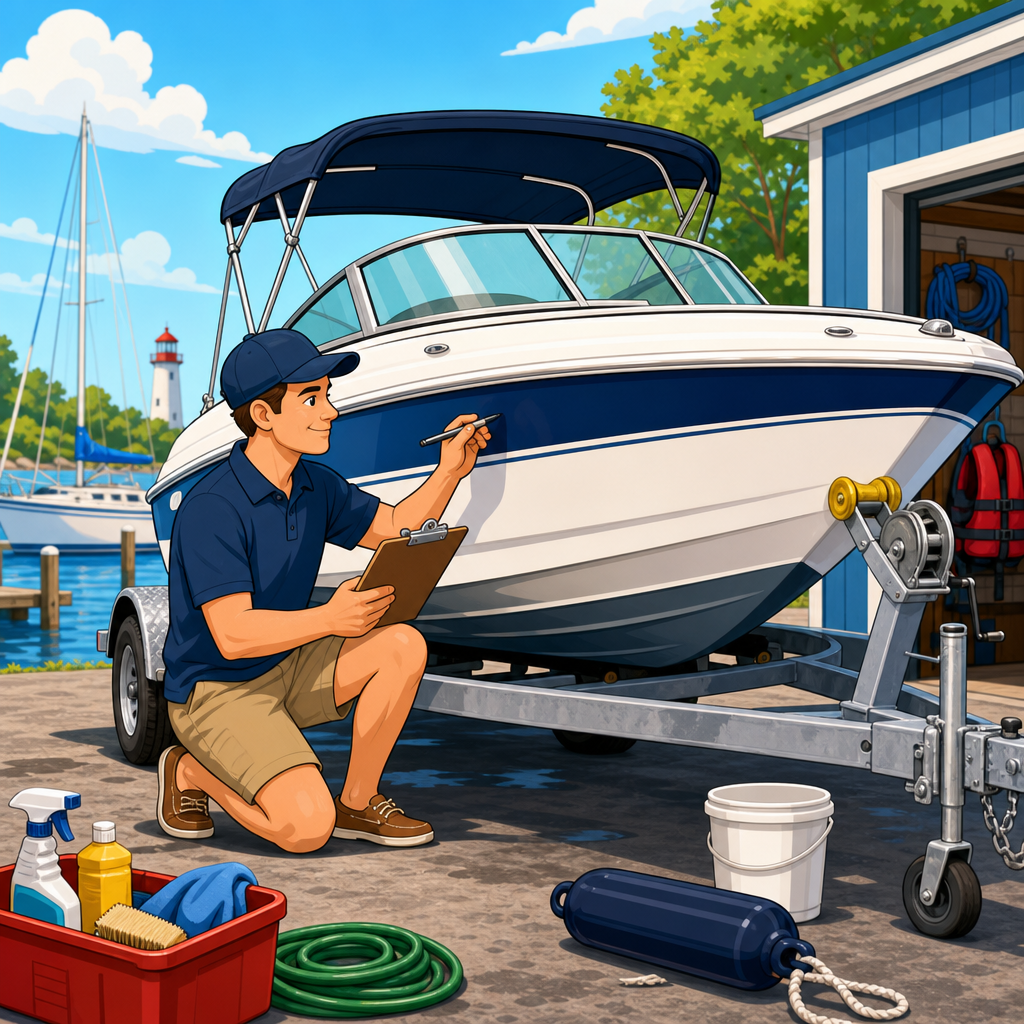
Start on level ground with the boat fully loaded as it is normally towed: fuel, batteries, gear, coolers, and outboard or sterndrive in the trailering position recommended by the engine maker. Chock the wheels and disconnect shore power or chargers. Then inspect six points. First, check centering. Measure from each gunwale or chine to the frame on both sides. Second, inspect bunk or roller contact. You want broad, even contact, not isolated shiny spots. Third, examine bow position at the winch stand. The bow eye should align with the winch and bow stop. Fourth, estimate stern overhang relative to the aft support. Fifth, review tongue weight with a scale or a tongue-weight gauge. Sixth, check tow attitude with the trailer hitched at travel height.
I also look for evidence left by the road. Uneven tire wear can indicate overloaded sides, bent components, or poor axle alignment. Cracked bunk brackets often mean the bunks are carrying load at the wrong angle. Frayed winch straps suggest the bow eye and winch drum are misaligned. If the boat shifts aft after braking, the bow stop may be set too high or too far back. Use a straightedge, tape measure, torque wrench, and camera. Photographs taken before disassembly save time when you are resetting bracket positions. If the trailer has adjustable torsion axle mounts, sliding winch stands, or multiple bunk bracket holes, note all hardware sizes and any corrosion before turning bolts.
Adjusting bunks, rollers, and the winch stand
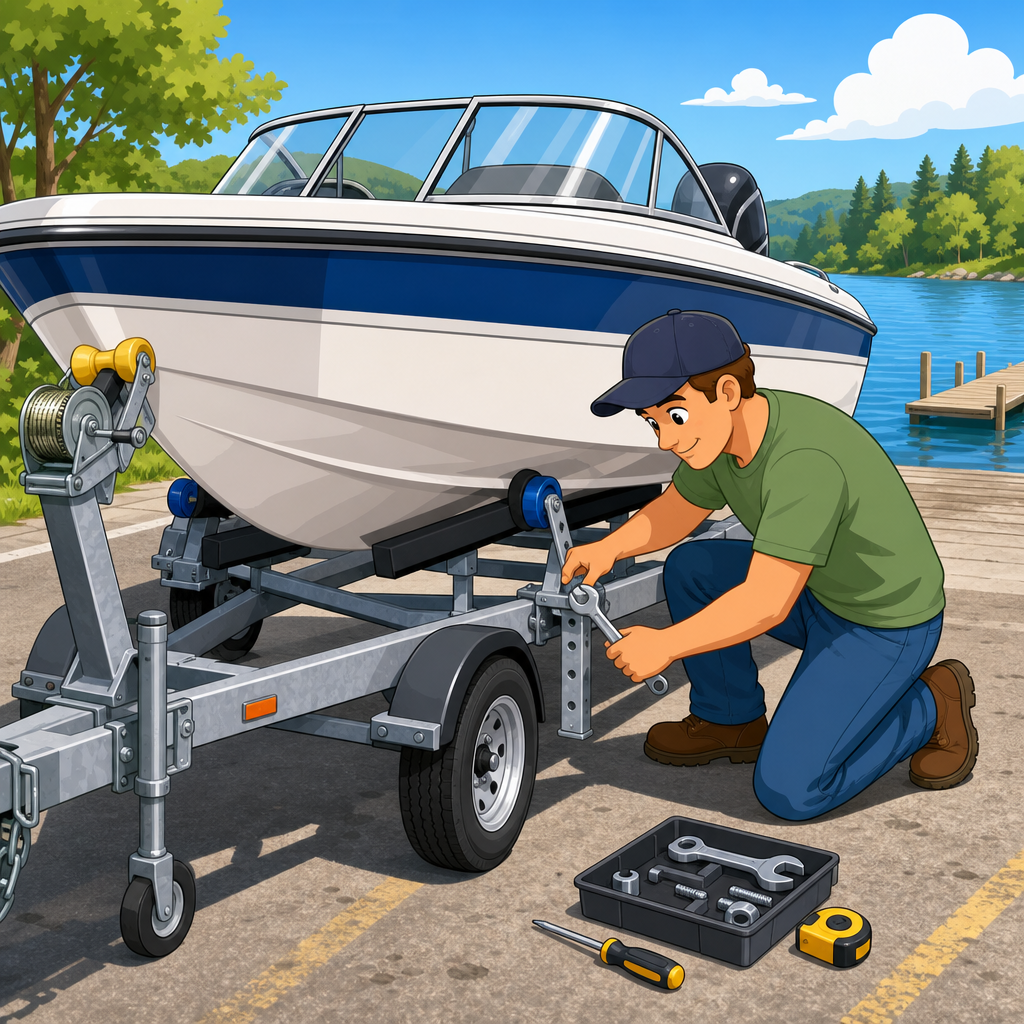
Bunk adjustment is the most common fit correction. Loosen one side at a time just enough to move the brackets, not enough to lose the original reference. Raise or angle the bunk so it matches the hull shape and contacts along its useful length. A bunk that only touches at the front and rear creates a span that can concentrate load mid-hull. On many fiberglass fishing boats and bowriders, the inner bunks sit close to the keel and carry most of the weight, while outer bunks stabilize the hull. On aluminum boats, support strategy depends on the builder’s guidance and the location of ribs, strakes, or welded seams. Never assume the same bunk spacing works across hull materials or designs.
Roller adjustment should prioritize guidance and distributed support, not point loading. Rollers that are too high can dent thin hull sections or leave the keel unsupported. Keel rollers should touch enough to share load while side rollers mainly center the boat during retrieval. If a roller is seized, replace it rather than forcing adjustment around a failed part. The winch stand should move so the bow eye meets the winch line straight and the bow stop contacts the bow where it stabilizes without crushing trim. On many rigs, moving the winch stand a small amount forward after final boat positioning improves tie-down security and reduces stern bounce.
| Component | Adjustment goal | Common symptom when wrong | Best correction |
|---|---|---|---|
| Bunks | Even contact on strong hull sections | Hull scuffing, rocking, bracket stress | Reset height and angle to match deadrise |
| Keel rollers | Support keel without lifting hull unevenly | Keel off-center, point pressure | Level roller heights and replace seized parts |
| Side rollers | Guide hull during loading | Boat loads crooked, side scuffs | Lower slightly and align symmetrically |
| Winch stand | Align bow eye and bow stop | Strap chafe, boat slides aft | Slide stand and set stop at firm contact point |
| Axle position | Set correct tongue weight | Sway or heavy hitch load | Move axle group in small measured increments |
Setting tongue weight, axle position, and tow height
If the boat fits the supports but the trailer still tows poorly, focus on weight distribution. Tongue weight is the clearest indicator. Measure it with the boat loaded for travel and the trailer level. If tongue weight is too light, the usual fix is to move the boat slightly forward on the trailer, move the axle assembly slightly rearward, or relocate gear such as batteries, anchors, and coolers. If tongue weight is too heavy, do the opposite. Make one change at a time and remeasure. A half inch at the axle can matter. On leaf-spring trailers, axle relocation may involve moving spring hangers or adjustable seats. On torsion systems, follow the axle maker’s bracket instructions precisely.
Tow height matters just as much. Use the correct ball mount rise or drop so the frame runs level or slightly nose down when coupled. A trailer that points up at the tongue often unloads the hitch and amplifies sway. Surge brake trailers are especially sensitive because extreme angle can affect actuator behavior and braking smoothness. If you have a tandem-axle trailer, confirm both axles carry load evenly. One clue is tire temperature after a short tow; a significantly cooler tire can indicate poor load sharing or a suspension issue. Proper fit is not only about where the boat sits when parked. It is about how loads transfer through the hitch, coupler, suspension, and tires at 65 miles per hour in crosswind and traffic.
Trailer maintenance that directly affects fit and towing
Trailer maintenance and towing are the backbone of this subtopic because adjustment does not stay correct on a neglected chassis. Wheel bearings should be inspected, cleaned, and repacked at intervals appropriate to immersion and mileage, or replaced if pitted or overheated. Bearing protectors help, but they do not excuse inspection. Tires should be trailer-rated, inflated to the pressure on the sidewall unless the manufacturer specifies otherwise, and replaced for age as well as tread. Many trailer tires age out before they wear out. Springs, equalizers, U-bolts, torsion arms, and frame welds need regular inspection because sagging suspension changes bunk contact and ride height.
Brakes and lights also influence safe towing. Disc brakes resist corrosion better than drums in saltwater use, but calipers, slide pins, flexible lines, and actuators still require service. A dragging brake can mimic poor fit by heating one hub and overloading one side. Corroded grounds cause intermittent light failures that often show up only at the ramp after immersion. Winches, safety chains, couplers, and transom straps deserve equal attention. I replace dry-rotted bow stop rubber, frayed straps, and bent chain hooks immediately because these small parts control how the boat stays positioned between launches. Good trailer fit is maintained by torque checks, lubrication, corrosion control, and hardware replacement, not by a one-time adjustment session.
Loading, launching, and retrieval techniques that protect your setup
Many fit complaints are actually loading problems. If the trailer is backed too deep, the boat floats over the bunks and lands crooked. If the trailer is too shallow, power-loading grinds the bow into the stop while the stern remains unsupported. The correct depth depends on ramp angle, hull type, and trailer design, but the repeatable method is simple: note the waterline on the fenders or bunks when retrieval works well, then reproduce it. Centering guides help, especially in wind or current, but they should not be adjusted so tightly that they carry hull weight during towing. Their job is alignment, not structural support.
During launching, loosen but do not remove transom straps until the boat is close to the water, and keep the winch strap attached until the boat is controlled. During retrieval, winch the boat snug to the stop rather than relying on acceleration to force it forward. If the bow does not reach the stop without excessive effort, revisit bunk angle, roller height, or trailer depth before blaming the hull. After pulling out, stop on level ground and retighten the winch, attach the safety chain, and install transom straps. On long trips, recheck strap tension after a few miles because hulls settle as water drains and suspension compresses. These habits reduce shifting that can undo careful fit adjustments.
When to repair, upgrade, or replace trailer components
Some trailers can be tuned into excellent performers with adjustment alone. Others need parts. Replace bunks when wood is soft, fasteners spin, carpet traps grit, or composite covers are worn through. Replace rollers that are cracked, flat-spotted, or seized. Upgrade to stainless or hot-dip galvanized hardware where appropriate, but match fastener grade and avoid mixing metals carelessly in corrosive environments. If the frame is heavily rusted, crossmembers are thinning, or the axle is bent, adjustment is no longer the primary issue. Structural defects change alignment and make repeatable setup impossible.
Upgrades should solve a defined problem. Radial trailer tires generally tow cooler and track better than bias-ply tires on many highway setups. Disc brake conversions make sense for frequent saltwater immersion. Guide-ons, a better jack, LED lighting, a spare tire mount, and a tongue step all improve daily use. For hull support, however, follow the boat manufacturer’s recommendations before converting from rollers to bunks or changing bunk layout. The hub value of trailer maintenance and towing is understanding the full chain: support, weight distribution, braking, tires, loading technique, and corrosion management all interact. Get those fundamentals right, and the trailer becomes predictable instead of stressful.
Adjusting a boat trailer for a better fit starts with recognizing that support and towing behavior are the same system. A good fit means the hull is centered, the bunks or rollers contact the right places, the bow eye aligns with the winch stand, stern overhang is controlled, and tongue weight is in a stable range. From there, towing setup must be verified with the trailer level behind the vehicle, the suspension carrying load evenly, and the brakes, tires, bearings, and coupler all in sound condition. Small changes matter. An inch at the winch stand, a bracket hole on a bunk, or a measured axle shift can transform loading ease and highway manners.
The main benefit is protection with predictability. A properly fitted trailer reduces hull stress, cuts tire and bearing wear, improves braking and stability, and makes every launch less frustrating. It also gives you a reliable baseline for every other article in this Trailer Maintenance & Towing hub, from bearing service and brake troubleshooting to tire selection, corrosion prevention, and safe ramp technique. Inspect your setup on level ground, measure instead of guessing, make adjustments in controlled increments, and replace worn parts before they cause secondary damage. If your trailer still loads crooked or sways after these checks, bring in a qualified trailer shop and get the geometry verified professionally.
Frequently Asked Questions
How do I know if my boat trailer is adjusted correctly?
A properly adjusted boat trailer supports the hull evenly, keeps the boat centered, launches and retrieves smoothly, and tows without sway or steering drama. The easiest way to tell if the fit is right is to look for even contact at the bunks or rollers and stable behavior on the road. The boat should sit level side to side, the keel should be properly guided where the trailer design intends, and there should not be obvious pressure points digging into one area of the hull. If one bunk is carrying more weight than the other, if rollers are contacting strakes or unsupported sections, or if the bow eye does not line up naturally with the winch post, the trailer likely needs adjustment.
Road manners are another major clue. A well-set trailer tracks straight behind the tow vehicle, does not bounce excessively, and does not feel light or loose at highway speed. If the trailer sways, if the tongue weight feels too light, or if the stern seems to shift during braking, the axle position, boat position, or winch stand location may be off. At the ramp, a good fit also shows itself by how predictable the launch and retrieval process feels. If the boat loads crooked, needs too much power to climb onto the bunks, or stops short of the bow stop every time, the support geometry is usually not matched to the hull. In short, correct adjustment means the trailer fits the boat instead of forcing the boat to fit the trailer.
What trailer adjustments make the biggest difference in boat fit?
The most important adjustments are usually bunk height and angle, roller position, winch stand placement, axle location, and overall tongue weight. Bunks should match the hull shape closely enough to spread weight over strong areas rather than creating isolated pressure points. On many trailers, raising or lowering the bunks a little and rotating them to better match the hull deadrise makes a dramatic improvement. Rollers, if the trailer uses them, should guide and support the boat where intended without pressing into fragile or uneven areas of the hull. Misplaced rollers are a common source of poor loading, hull stress, and frustrating ramp performance.
The winch stand also matters more than many owners realize. If the bow stop sits too far forward or too far back, the boat will never settle naturally in the right spot. That affects not only launch and retrieval but also balance on the trailer. Axle position and tongue weight then determine how the whole package behaves while towing. Even if the bunks are set well, a trailer with incorrect balance can still sway, push the tow vehicle, or overload the hitch. These adjustments work together, so the biggest improvement often comes from treating trailer setup as a system rather than changing just one part and hoping the rest falls into place.
How much tongue weight should a boat trailer have, and why does it matter?
For most boat trailers, a good rule of thumb is tongue weight in the range of about 7 to 10 percent of the total loaded trailer weight, though the exact target depends on the trailer design, tow vehicle, and manufacturer recommendations. Too little tongue weight is one of the most common causes of trailer sway. When the front of the trailer is too light, the trailer can wander or oscillate at speed, especially in crosswinds, on rough pavement, or when passing trucks. Too much tongue weight creates a different problem by overloading the hitch and rear suspension of the tow vehicle, reducing steering control and braking balance.
If tongue weight is wrong, the usual correction is to change the relationship between the boat and the axle. Moving the boat forward increases tongue weight, while moving it back reduces tongue weight. On some setups, shifting the axle assembly is the better solution, especially if the boat is already positioned correctly relative to the bunks and winch post. The key is to measure rather than guess. A tongue weight scale, a public scale, or another reliable method gives a much better answer than visual judgment alone. Once the numbers are right, most owners notice the improvement immediately in towing stability, braking confidence, and overall predictability on the road.
Should the boat rest on bunks, rollers, or the keel when adjusting the trailer?
That depends on the trailer design and the hull, but in every case the goal is proper support in the right places. On bunk trailers, the bunks typically carry the primary load and should contact the hull evenly over a broad area. They need to sit under structurally appropriate parts of the hull and match its angle closely enough to distribute weight without creating hard spots. On roller trailers, the rollers are designed to support and guide the boat, but they still need to contact the hull correctly and avoid areas where they can concentrate stress. Some trailers also use keel rollers to support the keel line while bunks or side rollers stabilize the hull laterally.
The mistake to avoid is assuming any contact is good contact. A roller pressing against a strake, a bunk edge digging into the hull, or a keel roller carrying too much weight because the side supports are too low can all cause trouble over time. When adjusting the trailer, look for balanced support, proper hull alignment, and natural loading behavior. The boat should settle onto the trailer without being twisted or forced into position. If you are unsure which parts of the hull are intended to carry weight, the boat manufacturer and trailer manufacturer specifications are the best references. Hull construction varies, and what works for one boat can be completely wrong for another.
Can I adjust a boat trailer myself, or should I have a professional do it?
Many boat trailer adjustments can be done by an owner with basic tools, patience, and a careful process, especially minor changes to bunks, guide-ons, winch stand position, and some roller settings. If you are comfortable working safely around a loaded trailer, understand how each adjustment affects hull support and towing balance, and can verify the results, doing it yourself is realistic. The best approach is to make small changes, check contact points carefully, confirm alignment, and test the trailer at low speed before assuming the job is finished. It also helps to work on level ground and, whenever possible, use the ramp as part of the evaluation because some fit problems only reveal themselves during launch and retrieval.
That said, professional help is worth considering when the trailer needs axle relocation, major bracket changes, suspension work, or repeated adjustment attempts have not solved the problem. It is also a smart choice if the hull is expensive, unusually shaped, or sensitive to support issues. A professional who regularly sets up boat trailers can spot problems faster, measure tongue weight and alignment accurately, and make corrections without guesswork. If the boat has been loading crooked, the trailer has been swaying, or there are signs of hull stress, it is better to solve the problem properly than keep towing with a setup that is only close enough. Good trailer adjustment is not just about convenience at the ramp; it is about protecting the boat, the trailer, and everyone sharing the road with you.