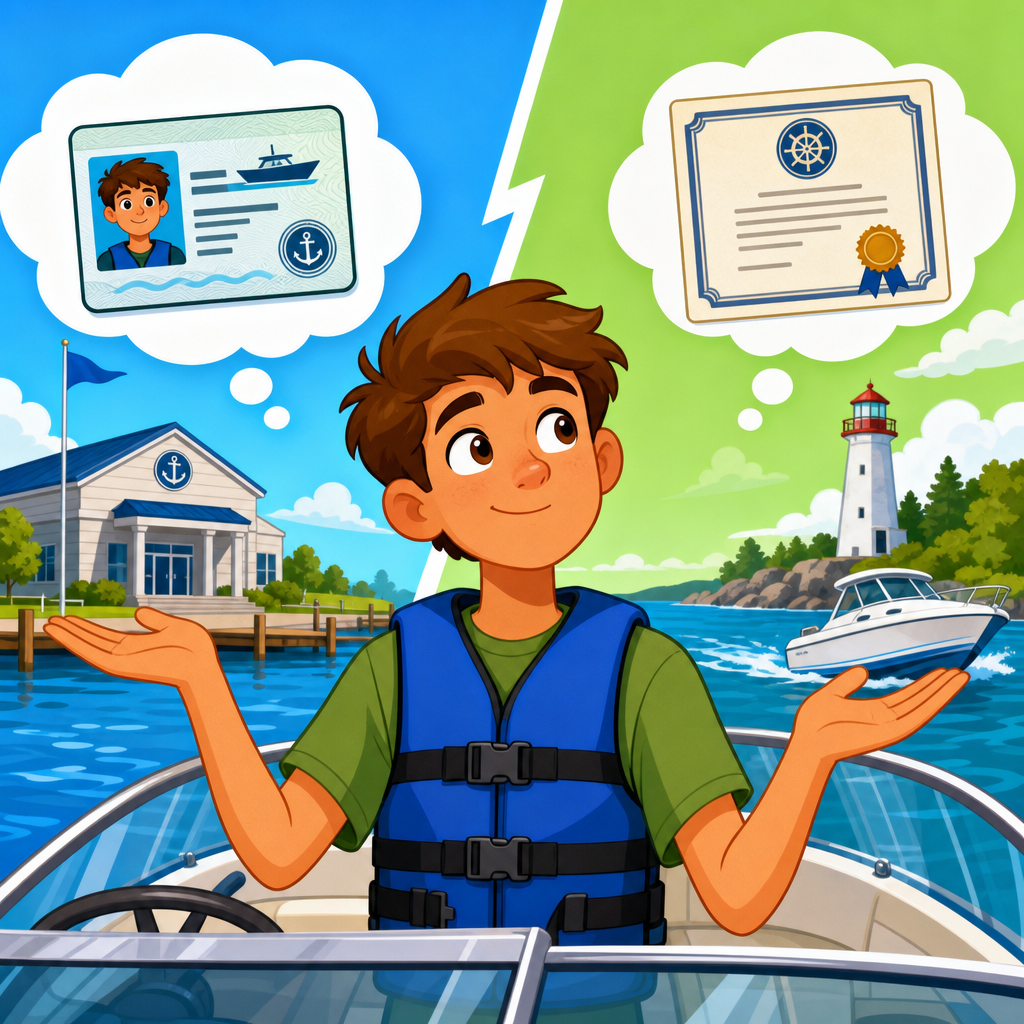
Boating license and boating certification are often treated as interchangeable terms, but they mean different things in law, enforcement, insurance, and everyday boating practice. A boating license usually refers to a government-issued authorization to operate a vessel in a specific jurisdiction, while a boating certification commonly refers to proof that a person completed an approved boating safety course. In the United States especially, that distinction matters because many states do not issue a true recreational boating license, yet they do require operators to carry a boater education card based on course completion. If you are trying to comply with boating laws and regulations, rent a boat, register for a safety class, or understand age-based operating rules, knowing the difference prevents expensive mistakes.
I have worked with boat owners, rental operators, and first-time buyers who assumed passing an online class gave them unrestricted legal authority everywhere. It does not. The legal requirement may depend on your age, the type of vessel, horsepower, whether the boat is a personal watercraft, and where you launch. Some states honor reciprocal education credentials from other states. Others require additional permits for commercial use, fishing charters, or environmentally sensitive waterways. In practice, “license” is often used casually to describe any boating credential, but statutes, marina contracts, and insurance applications usually draw clearer lines.
This topic matters because recreational boating is regulated through a patchwork of state law, federal navigation rules, and local enforcement. The U.S. Coast Guard sets carriage and navigation standards for many boats, but states generally decide who must complete boater education. Canada, by contrast, uses the Pleasure Craft Operator Card system, which functions more like a national operator competency credential. In parts of Europe and Australia, licensing models can be even more formal. For anyone searching for boating licenses and permits, the first question is not “How do I get licensed?” but “What credential does my jurisdiction actually require?” That question determines your next step, your compliance risk, and whether you can legally operate right now.
To make this hub useful, it helps to define the key terms. A boating license is a formal permit issued by a public authority that grants operating privileges, sometimes with conditions tied to vessel type, waters, or operator age. A boating certification is evidence that you completed approved training and passed an exam. A boater education card is the physical or digital document many states accept as proof of certification. A permit is narrower: it may allow temporary access, special use, or operation under limited conditions, such as a lake use permit, commercial launch permit, or marine event authorization. Registration is separate again; it applies to the vessel, not the operator.
Boating License vs. Certification: the Core Legal Difference
The simplest answer is this: a license grants authority, while a certification proves competency. In everyday boating, those can overlap, but they are not the same thing. If a state says an operator born after a certain date must complete a National Association of State Boating Law Administrators approved course, the resulting card is typically a certification-based education credential, not a broad operating license comparable to a driver’s license. That is why many boating agencies deliberately use phrases like “boater education card,” “certificate of completion,” or “safe boating card.”
From an enforcement standpoint, officers usually care about whether you meet the statutory requirement in that location. If the law requires education, showing a valid approved card may be enough. If the law requires a commercial captain’s credential, however, a safety certificate is nowhere near sufficient. I have seen this confusion often with anglers who move from private recreation into paid guide work. The moment money changes hands for transportation or charter service, the credential question changes dramatically and may involve federal merchant mariner requirements, not just state boater education rules.
Another practical distinction involves portability. Certification-based boater education is frequently recognized through reciprocity agreements, especially when the course meets accepted national standards. A true license can be more jurisdiction-specific and may not transfer as easily. Searchers often ask, “Can I use my boating license in another state?” The more accurate question is, “Will the other state recognize my education card or operating credential under its temporary visitor rules?” That language matters because legal recognition often depends on residency status and the duration of your visit.
How Boating Licenses and Permits Work in the United States
In the United States, recreational boating licenses in the strict sense are less common than people expect. Most states regulate operators through mandatory boater education rules rather than a universal boating license. Requirements vary widely. Some states mandate education for all operators of motorized boats. Others apply the rule only to younger operators or to personal watercraft users. The approved course may be offered through state agencies, Boat Ed, Aceboater, U.S. Powerboating, or local classroom providers. What matters is state approval, not just course availability.
Federal law also shapes the landscape, although it does not create a single national recreational boating license. The U.S. Coast Guard enforces equipment requirements, navigation rules, and certain operator responsibilities, while states manage most education and age eligibility standards for recreational use. Personal watercraft rules are often stricter because of accident history, speed capability, and visibility issues. Some states prohibit very young operators entirely unless they are directly supervised. Others require temporary certificates for rental customers who do not already hold approved credentials.
Permits add another layer. Depending on where you boat, you may need aquatic invasive species permits, reservoir use permits, mooring permits, marine park permits, or launch passes. These are not operator licenses, but they can still be mandatory. For example, western states commonly require invasive species decals or inspection compliance before launching. Certain city or county lakes require paid local access permits regardless of your state education card. In other words, being qualified to operate the boat does not automatically authorize you to use every waterway.
| Credential | Who Issues It | What It Proves | Typical Use |
|---|---|---|---|
| Boater education card | State agency or approved provider | Completion of an approved safety course | Meets recreational operator education laws |
| Boating license | Government authority | Legal operating privilege | Used in jurisdictions with formal licensing systems |
| Temporary rental permit | Rental operator or state-approved provider | Short-term compliance for renters | Vacation and one-time boat hire |
| Waterway or launch permit | State park, county, or local authority | Permission to access a specific waterbody or facility | Reservoirs, lakes, ramps, protected areas |
| Commercial captain credential | U.S. Coast Guard | Authority to operate commercially under applicable rules | Charters, guide services, passenger operations |
When Certification Is Enough and When It Is Not
Certification is enough when the relevant law says operator education satisfies the requirement for recreational boating. That is the most common scenario for private owners and family boaters. If your state requires completion of an approved course and you carry the corresponding card, you are usually compliant for that class of recreational operation. The certification may also help with insurance underwriting, because insurers often view formal boater education as a favorable risk factor, especially for higher-horsepower vessels or first-time owners.
Certification is not enough when law or contract demands a separate operating authority. Commercial use is the clearest example. If you transport passengers for hire, conduct charters, or guide trips where boating is part of the paid service, a recreational safety certificate does not replace a Coast Guard credential when one is required. The same principle applies internationally. A U.S. boater education card may satisfy a rental operator in one country and be meaningless in another that expects an International Certificate of Competence or a local skipper license.
There are also gray areas. Some homeowners associations, private marinas, camps, and youth programs impose their own operator standards beyond state law. A summer camp may require instructors to complete NASBLA-approved education plus on-water rescue training. A boat club may insist on a checkout ride before allowing members to use larger boats. Those are not public licenses, but they function as gatekeeping requirements. They matter because compliance is not just about avoiding tickets; it is also about access, liability, and insurability.
Common Boating License and Permit Scenarios
Most readers researching boating licenses and permits fall into a handful of practical scenarios. First is the new boat owner who has purchased a runabout, pontoon, or fishing boat and wants to know whether a certificate is required before the first launch. Second is the family with teenagers asking about age restrictions, supervision rules, and personal watercraft laws. Third is the traveler planning to rent a boat on vacation. Fourth is the experienced recreational operator exploring charter, guide, or other commercial activity. Each scenario points to different rules and documents.
For new owners, the correct sequence is straightforward: check state operator education law, register and title the boat if required, confirm required safety equipment, then review local permits for the intended waterbody. For families, age-based restrictions deserve close attention because some laws separate motorboats from personal watercraft. For renters, ask the rental company whether your home-state card is accepted or whether a temporary test is offered onsite. For emerging commercial operators, speak with a maritime attorney, your state boating agency, and the Coast Guard before taking bookings.
One issue I stress repeatedly is documentation. Keep digital and physical copies of your education card, vessel registration, identification, and any local permits. Enforcement on the water is practical and document-driven. If an officer boards you during a routine safety inspection, uncertainty wastes time and can turn a minor misunderstanding into a citation. Good boaters treat paperwork the same way pilots treat preflight materials: boring until the day it matters, then absolutely essential.
How to Choose the Right Credential and Stay Compliant
Start with the boating agency in the state where you primarily operate, because residence and launch location can change the rule that applies. Read the exact statutory language for operator education, age thresholds, and reciprocity for visitors. Then match your boating activity to the credential. Recreational inland boating may require only an approved education card. Coastal boating, bareboat chartering abroad, or carrying passengers for compensation may require much more. If you are shopping for an online course, verify provider approval directly on the state agency website before paying.
Next, separate operator compliance from vessel compliance. The operator may need certification; the boat may need registration, numbering, title documents, safety gear, and local permits. If you move between states, review reciprocity periods and resident definitions. Many states recognize visiting boaters for a limited time but expect residents to meet local requirements after relocation. Finally, refresh your knowledge even if the card never expires. Navigation rules, towing etiquette, emergency procedures, and cold-water survival are not one-time topics.
The bottom line is simple. Boating certification usually proves that you completed approved safety education. A boating license, where it exists, is a formal legal authorization to operate. Permits cover narrower access or use issues, and commercial credentials sit in a separate category altogether. If you want trouble-free boating, identify which credential applies to your activity, your vessel, and your waters before you leave the dock. Then use this boating laws and regulations hub to explore the related pages on state boater education rules, rental requirements, registration, age restrictions, reciprocal recognition, and commercial licensing so every trip starts compliant and confident.
Frequently Asked Questions
What is the difference between a boating license and a boating certification?
A boating license is typically a government-issued authorization that gives a person legal permission to operate a boat in a particular state, province, or country. A boating certification, by contrast, usually proves that someone completed an approved boating safety course and passed any required exam. While people often use the two terms interchangeably, they are not always the same in legal or regulatory terms. In many places, especially in the United States, boaters are not issued a traditional plastic “license” the way drivers are. Instead, they may receive a boating safety education certificate, boater education card, or course completion document that satisfies state law.
This distinction matters because the document you carry and the authority behind it can be different. A license generally comes directly from a government agency and may be tied to enforcement, operating privileges, renewals, age restrictions, or specific vessel categories. A certification often comes from successfully finishing a recognized course, though that course may still be approved by the state. In practical terms, a certification may be what you need in order to meet the legal requirement to operate a boat, even if the law informally refers to it as a “license.” That is why boaters should always look beyond the label and confirm exactly what their home jurisdiction requires.
Why do so many people use the terms boating license and boating certification as if they mean the same thing?
The main reason is that in everyday conversation, both terms point to the same basic goal: proving you are allowed or qualified to operate a boat. If a state requires a boater education course and issues a card after completion, many people naturally call that card a “boating license,” even if the state does not legally use that term. This shorthand has become common in boating communities, online course marketing, travel discussions, and even informal guidance from marinas or rental operators.
Another reason for the confusion is that boating laws vary widely from one jurisdiction to another. Some places issue formal licenses, some require only education certificates for certain age groups or engine sizes, and others impose no general operator license requirement at all. Because the rules are not uniform, the public often blends the concepts together. For article readers, the key takeaway is simple: the name of the document matters less than whether it satisfies the legal requirement where you plan to boat. Always check whether your state or destination requires a license, a safety certificate, a boater card, or some other proof of compliance.
In the United States, do you usually need a boating license or a boating education certificate?
In the United States, many boaters need a boating education certificate rather than a traditional government-issued boating license. Most states do not issue a universal boating operator license comparable to a driver’s license. Instead, they often require certain operators—commonly based on age, date of birth, vessel type, or horsepower—to complete a state-approved boating safety course. After passing the course, the boater receives a certificate or education card that serves as proof of compliance with the law.
That said, the exact rule depends heavily on the state. One state may require all motorboat operators born after a certain date to carry proof of course completion, while another may apply the rule only to younger operators or personal watercraft users. Some states also recognize approved online courses, while others may have additional local requirements. The practical point is that many U.S. boaters are legally compliant through certification rather than licensure. If you are trying to determine what you need, look at your state boating authority’s official requirements rather than assuming the term “license” applies in the formal legal sense.
Does a boating certification count as legal proof that you can operate a boat?
Yes, in many cases a boating certification does count as the legal proof needed to operate a boat, provided it is approved by the relevant state or jurisdiction. If the law requires completion of a boating safety course, then your certificate, boater education card, or course completion record may be exactly what an enforcement officer expects to see during a stop or inspection. The important issue is not whether the document is called a “license,” but whether it meets the specific legal requirement in that location.
However, a certification is not automatically valid everywhere under all circumstances. Some states recognize other states’ education credentials, while others apply special rules for residents, temporary visitors, rental operators, or personal watercraft users. International travel adds another layer, because foreign authorities may expect different forms of documentation. Insurance companies and boat rental businesses may also ask for proof of training even where the law is less strict. For that reason, boaters should confirm three things before going on the water: whether the course was officially approved, whether the certificate is accepted where they plan to operate, and whether they are required to carry the document onboard.
How do boating license and certification differences affect enforcement, insurance, and rentals?
The distinction can have real-world consequences in several areas. From an enforcement standpoint, officers are usually concerned with whether you meet the jurisdiction’s legal operating requirement. If the law requires a boater education certificate and you do not have it, calling yourself “licensed” will not help. Likewise, if a place actually requires a government-issued operator credential, a simple course certificate may not be enough. Understanding the exact requirement can help you avoid citations, delays, or being prohibited from operating the vessel.
Insurance is another area where the terminology matters. Insurers may offer better rates, impose fewer restrictions, or be more willing to issue coverage when an operator has completed a recognized boating safety course. In that context, a certification can be highly valuable even if it is not technically a license. Boat rental companies often follow the same logic. A rental operator may ask for a boater education card, proof of prior experience, or a temporary safety briefing regardless of what state law calls the document. In short, legal compliance, insurance underwriting, and rental approval do not always use the same standards. The safest approach is to treat boating certification as proof of training and boating licensure as proof of legal authority, then verify which one is required in each situation.