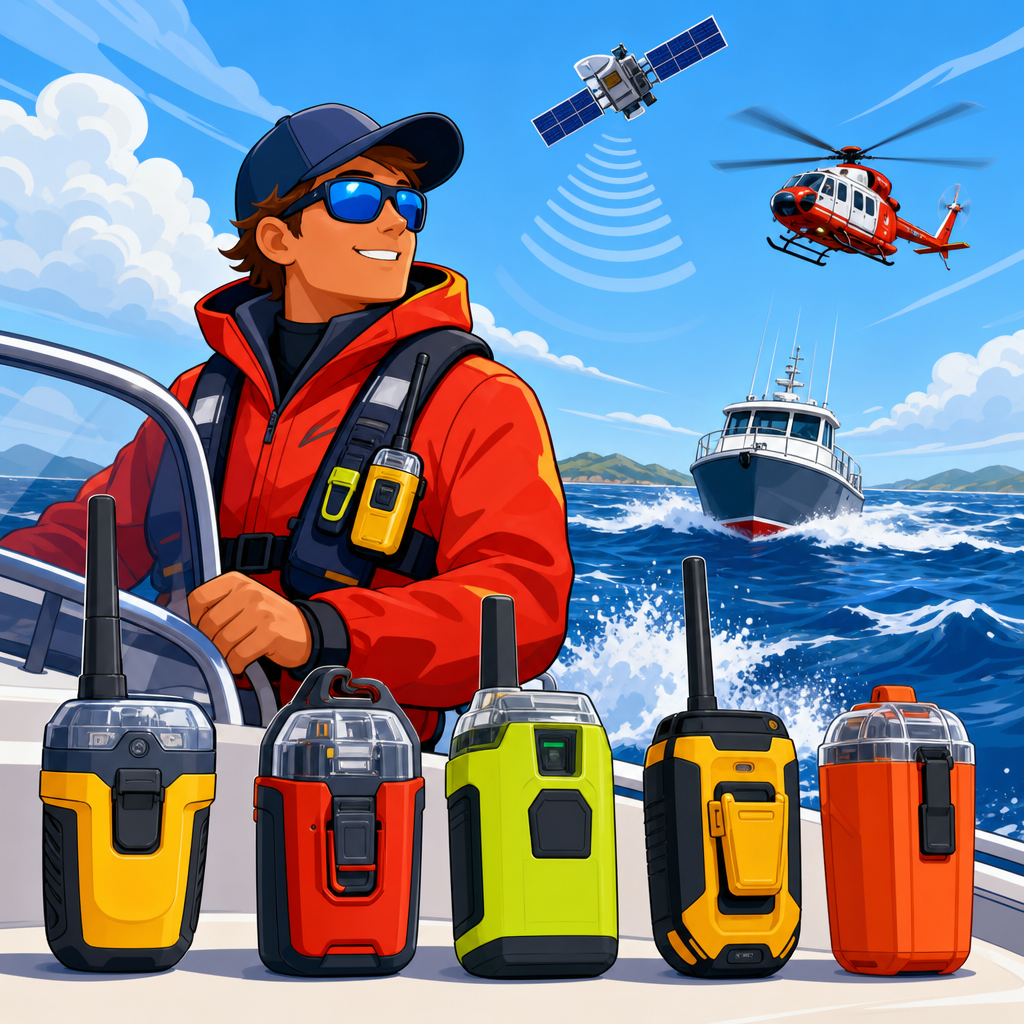
Offshore boating exposes crews to a simple reality: once land, cell coverage, and immediate rescue assets fall behind the horizon, survival depends on equipment that works independently and fast. The best personal locator beacons, or PLBs, are compact distress transmitters designed to summon professional search and rescue through the 406 MHz Cospas-Sarsat satellite network, making them one of the most important pieces of safety and emergency equipment a boater can carry. For skippers building a serious offshore kit, a PLB is not a gadget upgrade; it is a last-resort lifeline that complements life jackets, EPIRBs, VHF radios, AIS devices, flares, tethers, medical kits, and abandon-ship planning.
A PLB differs from an EPIRB in scale and intended user. An EPIRB is vessel-focused, often mounted for automatic deployment and designed to alert rescuers if the boat itself is in grave danger. A PLB is person-focused, small enough to clip to a life jacket or fit into a foul-weather pocket, so it stays with the individual if a crewmember goes overboard or becomes separated from the vessel. That distinction matters offshore, where the emergency is often not just “boat in trouble” but “person in water, drifting, injured, and hard to spot.” In my own safety gear audits for passage-making crews, PLBs consistently rank among the highest-value upgrades because they address the exact scenario that keeps captains awake at night: a man-overboard event beyond easy visual recovery.
Choosing the best personal locator beacons for offshore boating requires more than reading a feature list. Battery replacement intervals, buoyancy, antenna design, strobe visibility, GPS acquisition speed, registration requirements, and wearability all affect real-world performance. Offshore use also raises practical questions buyers ask immediately: Should every crewmember have a PLB? Is AIS enough? How does a PLB work without a subscription? Which models float? What should live on the life jacket versus in the ditch bag? This hub answers those questions while framing PLBs within the broader category of marine safety and emergency equipment, so boaters can build a layered system instead of relying on one device to solve every problem.
The most important takeaway is straightforward: for offshore boating, the best PLB is the one that is registered, worn on the person, easy to deploy with cold hands, and backed by a complete rescue plan. Price matters, but reliability, compatibility with your life jacket setup, and integration with the rest of your emergency gear matter more. A beacon buried in a locker is less useful than a slightly less elegant unit clipped correctly to a PFD and tested on schedule. With that baseline established, the rest of the decision comes down to matching beacon type and supporting equipment to your boat, crew, and operating range.
What a PLB does offshore and why it belongs in every serious safety system
A personal locator beacon sends a digitally encoded distress message on 406 MHz when manually activated. Modern units also transmit a 121.5 MHz homing signal that helps rescue aircraft or nearby responders locate the survivor precisely once the distress alert has been received. Many current marine-oriented PLBs include GNSS positioning, using GPS and sometimes Galileo or other constellations, so the alert contains coordinates rather than forcing rescuers to calculate a location purely from Doppler shift. In practical terms, that usually means faster detection, faster mission planning, and a smaller search area.
For offshore boating, that capability fills a specific gap. VHF DSC radios are excellent, but they depend on range and someone hearing the alert. AIS man-overboard beacons are extremely useful, but they are primarily local recovery tools that work best when your own vessel or nearby traffic remains within reception range. Satellite messengers can add tracking and texting, yet many rely on private networks and subscriptions rather than the internationally managed search-and-rescue architecture used by PLBs. When crews ask me what equipment deserves a permanent place on an inflatable life jacket, the shortlist is consistent: whistle, light, cutter, and a PLB, often paired with AIS if the budget allows.
A good offshore safety system is layered because emergencies unfold in stages. First, prevent the incident with jacklines, tethers, non-slip decks, watch routines, and weather judgment. Second, enable immediate local recovery with MOB procedures, throwable devices, searchlights, and AIS. Third, prepare for delayed or large-area rescue with VHF, EPIRB, flares, and PLBs. That layered approach is the central idea behind every strong “Safety & Emergency Equipment” plan, and PLBs sit squarely in the personal-survival layer.
Best personal locator beacons for offshore boating: key features that actually matter
Not every beacon marketed to paddlers, hikers, and pilots is equally suitable for offshore boating. The first requirement is approval under current standards and compatibility with 406 MHz satellite rescue services. The second is a marine-friendly design: water resistance suitable for immersion, a secure antenna deployment method, and controls protected against accidental activation. Floating capability is highly desirable, though some excellent PLBs require a buoyancy pouch. If a unit sinks when dropped during a chaotic abandonment, the specification sheet no longer matters.
Battery service life is another major criterion. Most quality PLBs use sealed long-life batteries with replacement intervals often around five to seven years, and they must still meet minimum transmission duration requirements after storage, typically at least 24 hours at specified temperatures. For offshore crews who may launch from warm climates into cold water, low-temperature performance deserves attention. Strobes and infrared signaling can improve visual acquisition, especially at night, but they do not replace a powerful distress signal.
Ergonomics are often underestimated. The best personal locator beacons for offshore boating can be activated while wearing gloves, after immersion, and under stress. A tiny latch hidden under a stiff cover may test well on a desk but frustrate a hypothermic survivor. I also look closely at where and how the beacon mounts. If it interferes with inflation of an automatic PFD, snags on harness hardware, or cannot be reached after inflation, it is the wrong setup no matter how advanced the electronics are. Always rehearse deployment with the actual life jacket you use offshore.
| Feature | Why it matters offshore | What to look for |
|---|---|---|
| 406 MHz distress signal | Triggers global professional search and rescue response | Cospas-Sarsat compliant beacon with current approvals |
| GNSS positioning | Reduces search area and speeds rescue planning | GPS or multi-constellation positioning built in |
| 121.5 MHz homing | Helps rescuers find the survivor in the final approach | Integrated homing transmitter |
| Buoyancy | Prevents loss if dropped during activation or abandonment | Floating case or approved flotation pouch |
| Wearability | Determines whether the beacon is actually on the person | Secure PFD attachment and one-handed access |
| Battery replacement cycle | Affects long-term ownership cost and reliability | Clear service interval from a recognized manufacturer |
Leading PLB options and how to choose between them
Among established marine and outdoor emergency brands, the ACR ResQLink series is frequently at the top of offshore shortlists because it combines a compact form factor, broad availability, and a long track record. Models in this family are popular with sailors, anglers, and delivery crews who want a beacon small enough to wear continuously. Ocean Signal’s rescueME PLB1 is another standout, especially for users prioritizing low bulk on an inflatable life jacket. It is one of the easiest units to integrate discreetly into a PFD setup, which is a decisive advantage because an unworn beacon cannot save anyone.
McMurdo and Kannad, both recognized names in distress alerting equipment, have also produced respected beacons in this category, though model availability varies by market and year. The exact “best” choice depends less on brand prestige than on fit-for-purpose details: Can your crew deploy it without reading labels? Does it float as configured? Is service support available in your country? Can you register it quickly with the correct authority, such as NOAA in the United States or the relevant national database elsewhere? These practical factors determine ownership success.
For most offshore boaters, there are three common buyer profiles. The first is the passagemaker equipping every life jacket with a dedicated PLB. Here, compactness and consistency across the fleet matter most; choose one model and mount it identically on all PFDs. The second is the owner-operator carrying a PLB personally while relying on an EPIRB as the primary vessel beacon. In that case, premium wearability and easy self-test functions become priorities. The third is the occasional offshore angler deciding between one beacon and several lower-cost devices. My advice is blunt: if multiple people may be on deck in offshore conditions, shared beacon logic breaks down fast. Individual carriage is the better standard.
PLB versus EPIRB, AIS MOB, satellite messenger, and VHF DSC
Boaters often ask which emergency device they really need, but offshore safety is not a one-device decision. A PLB and an EPIRB serve different rescue pathways. The EPIRB is the vessel’s primary catastrophic-distress beacon, especially for fire, sinking, collision, or abandonment. A PLB is the individual’s survival beacon if separated from the boat. If your budget allows only one major 406 MHz purchase initially, many bluewater boats should start with a properly registered EPIRB, then add wearable PLBs for regular offshore crew.
AIS MOB beacons address a different timeline: immediate nearby recovery. When activated, they transmit an AIS target and often a DSC alert to equipped plotters and radios. That can be faster than waiting for a satellite-distress chain, which is why many experienced sailors favor carrying both AIS and PLB on offshore life jackets. One helps your own vessel turn back and find you quickly; the other escalates to global rescue if local recovery fails. This combination is especially powerful during night watches, rough weather, or short-handed passagemaking.
Satellite messengers such as Garmin inReach or ZOLEO are useful communication tools, but they are not direct PLB substitutes. They can support two-way messaging, routine tracking, and non-emergency coordination, yet they usually depend on active subscriptions and consumer workflows. A registered PLB uses an internationally recognized distress system with no subscription for rescue alerting. VHF DSC handhelds also deserve a place in offshore planning, especially in grab bags and life rafts, but their effectiveness falls with distance from traffic and shore infrastructure. The safest answer is layered redundancy, not false equivalence.
Registration, testing, mounting, and maintenance
A PLB is only as effective as its registration record. In the United States, beacon owners register with NOAA and must keep emergency contacts, vessel details, and trip information current. Other countries maintain their own registries linked to the same rescue architecture. Accurate registration saves time because rescue coordinators can immediately connect the beacon hex ID to a real person, a real boat, and credible voyage plans. I have seen crews spend thousands on electronics and then leave registration incomplete, which undermines the one part of the system that rescuers will check first.
Routine self-testing matters, but over-testing can be harmful if it drains the battery or violates manufacturer instructions. Follow the manual precisely. Most reputable PLBs provide a built-in test function that confirms basic electronics and GNSS readiness without sending a false distress alert. Schedule checks before each offshore departure, after battery service, and after any hard impact or accidental immersion event that raises doubt about the housing integrity.
Mounting should be treated as a seamanship task, not an afterthought. Attach the beacon where it remains accessible after the life jacket inflates, clear of spray hoods, harness rings, and crotch straps. Use manufacturer-approved pouches and lanyards, and verify that manual inflation tubes and oral valves remain unobstructed. If the beacon requires a flotation pouch, install that exact configuration and test it in controlled conditions. Replace batteries only through approved service channels when required, inspect seals regularly, and log service dates with the same discipline you apply to raft inspections and flare expiry dates.
Building the full offshore safety and emergency equipment hub
As the central page for Safety & Emergency Equipment within Boating Gear & Equipment, this topic extends beyond the best personal locator beacons for offshore boating. A complete offshore safety inventory should include an EPIRB, properly fitted life jackets with harnesses, AIS MOB devices where appropriate, fixed and handheld VHF radios with DSC, SOLAS-grade or well-chosen coastal flares depending on operating area, radar reflectors, high-output waterproof lights, jacklines and tethers, a medical kit scaled to passage length, fire suppression equipment, bilge alarms, dewatering pumps, storm preparation gear, and a ditch bag organized for abandonment. Life raft selection, abandon-ship drills, and crew-overboard recovery plans belong in the same conversation because gear only works when procedures support it.
The benefit of using this page as your hub is simple: it helps you evaluate emergency equipment as a system. A PLB is strongest when paired with crew training, watch discipline, and complementary signaling tools. Review your current kit, identify what stays on the vessel versus on each person, and upgrade the weak link before your next offshore run. If you are refining your boating gear and equipment list, start with the beacons, registration, and PFD-mounted essentials, then build outward into the rest of your safety and emergency equipment stack with the same rigor.
Frequently Asked Questions
What is a personal locator beacon, and why is it so important for offshore boating?
A personal locator beacon, or PLB, is a compact emergency distress device designed to alert professional search and rescue services when someone is in grave and imminent danger. For offshore boating, that matters because help is often far away, cell service is unreliable or nonexistent, and conditions can deteriorate quickly after a fall overboard, capsize, fire, flooding event, or abandonment to a life raft. Unlike consumer messaging devices that may depend on private satellite networks or subscription plans, a true PLB transmits a 406 MHz distress signal through the international Cospas-Sarsat satellite system, which is specifically built to support global rescue operations. Many PLBs also include a 121.5 MHz homing signal that helps rescuers pinpoint the final location once they reach the search area.
For boaters, the key advantage is independence and reliability. A PLB is not meant to replace core vessel electronics such as a fixed-mount VHF radio with DSC, an EPIRB, AIS, radar, or a chartplotter. Instead, it serves as a personal last-resort rescue tool that stays with the individual. That is especially important in man-overboard situations, because the best emergency beacon in the world does little good if it remains on a sinking vessel while the person needing rescue is in the water. In practical terms, a PLB gives offshore crews a way to call for help that is highly credible, internationally recognized, and directly connected to rescue coordination systems. For anyone building a serious offshore safety kit, a PLB is one of the smartest and most consequential pieces of emergency equipment you can carry.
How is a PLB different from an EPIRB, AIS man overboard beacon, or satellite messenger?
These devices are often discussed together, but they serve different roles and should not be treated as interchangeable. A PLB is a personal distress beacon registered to an individual and intended to be carried on the body, often attached to a life jacket or integrated into a safety harness setup. It uses the 406 MHz Cospas-Sarsat network to send an official distress alert to rescue authorities. An EPIRB, by contrast, is generally vessel-specific, larger, and designed to alert rescuers when the entire boat is in distress. Many offshore boats should carry both: an EPIRB for abandoning ship and a PLB for individual crew survival and man-overboard risk.
An AIS man overboard beacon works differently. It transmits a local AIS distress message that can be seen by nearby AIS-equipped vessels and by the casualty’s own boat if its electronics are set up correctly. That makes AIS MOB beacons excellent for rapid local recovery, especially in crew-overboard incidents where the vessel is still operational and within range. However, AIS does not replace a PLB because it does not summon the same broad, official satellite-based rescue response. A satellite messenger, meanwhile, may allow texting, tracking, and SOS functions over a commercial satellite service, but it typically requires an active subscription and does not always offer the same purpose-built distress architecture as a 406 MHz PLB. For offshore boating, the best approach is layered safety: use a PLB for global rescue alerting, consider AIS MOB for fast local recovery, and rely on an EPIRB for vessel-level emergencies.
What features should boaters look for when choosing the best PLB for offshore use?
The most important feature is certification as a true 406 MHz personal locator beacon that works with the Cospas-Sarsat rescue system. That should be non-negotiable. From there, boaters should prioritize an integrated GPS or GNSS receiver, because location-enabled PLBs can provide rescuers with a much more accurate initial position than a non-GPS beacon. Accuracy matters offshore, where search areas can become enormous very quickly due to wind, waves, and current. A 121.5 MHz homing signal is also highly valuable because it helps aircraft and rescue crews home in on the final location once they are nearby.
Other major considerations include battery life, operating temperature range, buoyancy, waterproofing, ease of deployment, and attachment options. A PLB that is difficult to deploy with cold hands, in darkness, or while wearing a life jacket is not ideal for the marine environment. Many boaters prefer a unit that can be securely mounted to an inflatable PFD or harness without interfering with inflation or movement. Some PLBs float on their own, while others require a flotation pouch; that distinction matters in open water. Strobe lights or infrared signaling features can also improve visibility in low-light rescue scenarios. Finally, evaluate the beacon’s size, registration process, battery replacement interval, self-test functions, and brand reputation. The best PLB is not just the one with the strongest spec sheet. It is the one that is easy to carry every trip, simple to activate under stress, and clearly suited to saltwater, exposure, and real offshore emergencies.
Do PLBs require registration, maintenance, or subscription fees?
A true PLB does not usually require a recurring subscription fee to access the Cospas-Sarsat emergency alert network, and that is one of its biggest advantages. Once activated in a real emergency, the distress transmission is handled through the international search and rescue system rather than through a consumer messaging plan. However, PLBs do require registration, and that step is essential. Registration links the beacon’s unique identification code to the owner’s contact details, emergency contacts, and often relevant trip or vessel information. When a distress alert is received, rescue coordination centers can use that registration data to verify who may be in trouble, what kind of activity they were engaged in, and whether the activation is likely genuine. That can help speed and sharpen the rescue response.
Maintenance is straightforward but important. Owners should perform the manufacturer’s recommended self-tests, inspect the device regularly for corrosion or case damage, confirm that seals and lanyards are intact, and pay close attention to battery expiration dates. PLB batteries are long-life emergency batteries, not everyday rechargeables, and they must be replaced according to the manufacturer’s schedule or after activation. Registration records should also be updated whenever contact information changes or the unit is sold to someone else. In short, while PLBs are low-maintenance compared with many other electronics, they are not maintenance-free. A beacon that is unregistered, expired, or poorly mounted is not fully ready for the job offshore boaters depend on it to do.
Where should a PLB be carried on a boat, and when should it be activated?
The best place for a PLB is on the person, not in a ditch bag, locker, or helm drawer. Offshore boating emergencies often happen fast, and separation from the vessel is common in the exact scenarios where a PLB matters most. If someone goes overboard, abandons ship, or ends up in the water after a collision or capsize, a beacon stored elsewhere may be unreachable. For that reason, many experienced skippers attach PLBs directly to inflatable life jackets, foul-weather gear, or safety harness systems, making sure the unit remains accessible and does not interfere with inflation, tether use, or mobility. A secure carry setup should also prevent accidental activation while still allowing quick deployment with one hand if necessary.
Activation should be reserved for situations of grave and imminent danger, such as a true man-overboard emergency, abandonment at sea, life-threatening injury offshore, sinking, or any event where immediate professional rescue is required and other means of communication are unavailable, ineffective, or insufficient. A PLB is not a convenience tracker and should not be used for non-emergency position reporting. Before heading offshore, every crew member should know where their beacon is, how to deploy the antenna, how to trigger the unit, and what to expect after activation. Training matters because rescue timelines offshore can still be measured in hours, and survival during that window depends on flotation, exposure protection, signaling, and staying with available survival equipment. A PLB dramatically improves the chances of being found, but it works best as part of a disciplined offshore safety plan rather than as a stand-alone solution.