Choosing the best life rafts for offshore boaters and long voyages starts with understanding one simple fact: when a vessel is no longer survivable, the raft becomes your floating refuge, signaling platform, and weather shelter until rescue arrives. In practical seamanship, a life raft is not just an inflatable emergency device. It is a self-contained survival system designed to keep crew out of cold water, reduce exposure, improve visibility to rescuers, and buy time in conditions where a dinghy, tender, or personal flotation device cannot. For offshore passagemaking, bluewater cruising, sportfishing runs beyond easy rescue range, and commercial operations, life raft selection belongs at the center of safety planning, alongside EPIRBs, life jackets, AIS beacons, flares, ditch bags, jacklines, fire suppression, and damage-control gear.
I have helped owners review abandon-ship plans before ocean crossings, and the same mistake appears repeatedly: they shop by price and capacity first, then only later ask what the raft actually protects against. That order is backwards. The best life raft for offshore boaters depends on voyage profile, number of people, expected sea state, water temperature, service access, mounting location, and whether rescue is likely within hours or days. A four-person coastal raft and a six-person ISO ocean raft may look similar in brochures, yet their insulation, canopy design, ballast, boarding aids, equipment packs, and righting systems can be dramatically different. Those differences determine whether survivors stay stable, dry, and visible in breaking seas.
This hub article covers the core decisions behind offshore life raft buying and ownership while connecting the wider Safety and Emergency Equipment category into one practical framework. You will learn how raft standards work, which features matter most offshore, how valise and canister models compare, what should be in a survival pack, how maintenance affects reliability, and where life rafts fit in an abandon-ship system. The goal is direct: help you choose a raft that matches your route and crew, then support it with the equipment, training, and servicing that make it work when conditions are at their worst.
What offshore boaters should look for in a life raft
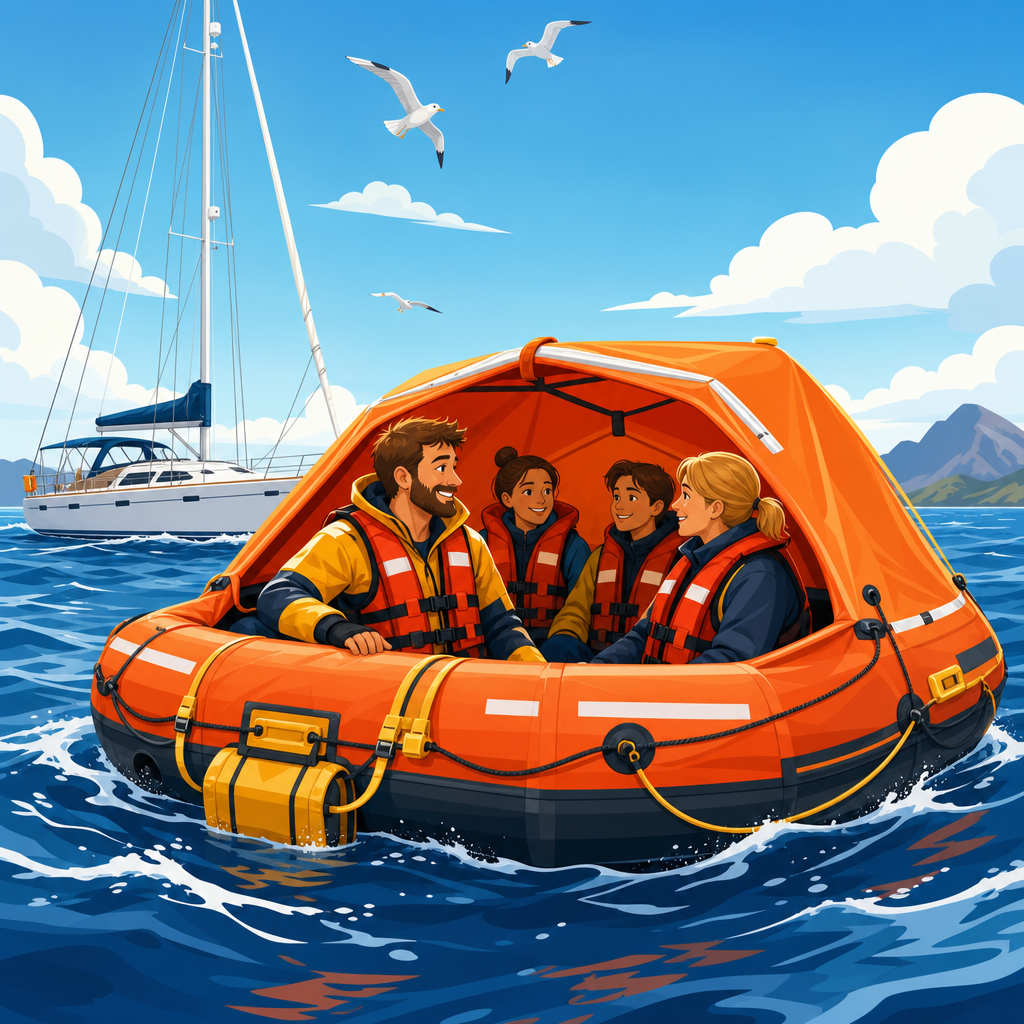
The best offshore life rafts share a few nonnegotiable traits. They deploy reliably, remain upright or can be righted quickly, stay attached by a strong painter line, resist capsize through ballast pockets, shield occupants with a high-visibility insulated canopy, and include boarding aids that an exhausted or injured person can actually use. Offshore models should also include a SOLAS-grade reflective exterior, internal and external lights, sea anchor, bailer, repair kit, pump, signaling gear, and enough emergency supplies to bridge the realistic rescue window for your cruising area. In cold water, insulated floors are not optional. Heat loss through the raft floor can become a survival-limiting factor well before dehydration does.
Capacity should be chosen conservatively. A six-person raft for six adults in foul-weather gear can be survivable, but it will be crowded, wet, and difficult if anyone is injured. Many experienced skippers size up one category because space improves morale, access to equipment, and survivability during a multi-day wait. Weight and stowage matter too. A canister mounted on deck near the companionway is easier to deploy in a flooding emergency than a heavy valise buried in a cockpit locker beneath fenders and spare line. The best raft is the one your crew can launch fast, in darkness, when the boat is rolling and someone is shouting incomplete information.
Understanding raft standards and offshore classifications
Life raft quality is easiest to compare by standard. ISO 9650 is the benchmark most recreational offshore boaters will encounter, with Type I intended for offshore use and Type II aimed more at coastal conditions. Within ISO 9650, Group A is generally specified for colder climates where rafts need stronger inflation systems and insulation support, while Group B is intended for warmer conditions. Commercial and regulated vessels may require SOLAS-approved rafts, which are built to stricter carriage and equipment requirements. In the United States, the Coast Guard may not mandate a raft for many recreational trips, but insurers, race organizers, and prudent voyage planning often make the decision for you.
Well-known manufacturers include Viking, Winslow, Revere, Switlik, Plastimo, and Zodiac. Product lines vary, but the critical point is to compare standard, equipment pack, and servicing network rather than relying on brand reputation alone. Some premium offshore rafts use vacuum-bagging inside the canister or valise to extend service intervals and protect materials from moisture contamination. Others offer double-tube construction for redundancy if one chamber is damaged. Those are meaningful engineering differences. A low-cost raft with limited ballast, weak boarding assistance, and minimal equipment may satisfy a checklist while performing poorly in actual breaking seas, which is exactly where offshore rafts earn their value.
Canister versus valise: stowage, deployment, and protection
Canister and valise life rafts each solve a different stowage problem. A canister raft is sealed inside a rigid fiberglass or composite shell and usually mounted on deck, coachroof, or a cradle near the transom. That placement protects access and supports hydrostatic release installation where appropriate. For offshore boats, canisters are often the best answer because they are visible, quickly deployable, and less likely to be trapped if the cabin floods or the vessel inverts. Their tradeoffs are greater exposure to sun and spray, higher weight aloft if mounted poorly, and the need for secure deck real estate.
A valise raft is packed in a heavy fabric case and stored below or in a dry locker. Valises are easier to protect from weather, often cost slightly less, and suit smaller sailboats or powerboats with limited deck space. The problem appears during a true emergency: below-decks access may be impossible after collision, fire, or rapid flooding. I have seen crews rehearse raft deployment and discover that their chosen locker required opening two latches, moving a gear bag, and lifting a sixty-pound package through a narrow hatch. That is not a deployment plan. If you choose a valise, assign a dedicated location, maintain a clear extraction path, and rehearse moving it topside while wearing life jackets.
Key offshore features that separate good rafts from marginal ones
Offshore life raft buying should focus on survival performance, not brochure language. The features below consistently matter most when comparing serious rafts for long voyages.
| Feature | Why it matters offshore | What to look for |
|---|---|---|
| Ballast pockets | Reduce drifting and capsize risk in wind and breaking seas | Large-capacity pockets that fill quickly |
| Insulated floor | Slows conductive heat loss, especially in cold water | Double or insulated floor construction |
| Boarding system | Exhausted survivors must reboard from the water | External ladder, ramp, and internal grab points |
| Canopy design | Protects from exposure, spray, and sun while improving visibility | High-visibility canopy with lights and vents |
| Equipment pack | Determines signaling, hydration, and first-response capability | Offshore pack with flares, water, repair items, and sea anchor |
| Service network | A raft is only as reliable as its inspection history | Authorized stations near your cruising region |
Righting arrangements deserve special attention. A raft that inflates upside down must be recoverable by one person in rough water. Premium models provide clearly marked righting straps and geometry that make inversion recovery realistic. Visibility features matter too: retroreflective tape, canopy lights, radar reflector options, and bright orange fabric all increase detectability. Finally, check painter length and inflation trigger design. The painter must be long enough for safe deployment from a drifting or sinking vessel without fouling the hull. These details are rarely glamorous, but they are exactly what rescue survivors remember.
Best life raft categories for different offshore missions
There is no single best life raft for every boat. For coastal passagemaking with regular traffic and expected rescue within hours, an ISO 9650 offshore-rated raft with a standard coastal or emergency pack may be sufficient, provided water temperatures are moderate and the crew carries robust signaling gear in a ditch bag. For serious bluewater passages, ocean rallies, and remote fishing grounds, a true offshore raft with insulated floor, oversized ballast, comprehensive emergency pack, and easy deck deployment is the better choice. Catamarans, passagemaking trawlers, and expedition sportfishers often benefit from larger-capacity rafts because crews may include guests with limited mobility.
Cold-water operators need to prioritize thermal protection over all else. In North Atlantic, Pacific Northwest, Alaska, or Southern Ocean conditions, survival time in the water can be measured in minutes, so boarding speed, insulated floor design, and canopy weather sealing become critical. Warm-water cruisers sometimes underbuy because they assume temperature is not a threat. In reality, sun exposure, dehydration, and delayed rescue can still turn an under-equipped raft into a severe hazard. Long-voyage buyers should also ask whether the equipment pack is customizable by region. A raft configured for Mediterranean summer cruising may not be appropriate for a Bermuda or transatlantic passage without additional water, medication, seasickness control, and locator tools.
Life raft servicing, inspection, and replacement schedules
A life raft is not buy-once gear. Fabrics age, seams degrade, inflation cylinders require verification, and packed emergency supplies expire. Most manufacturers specify service at authorized stations every one to three years depending on product line, container type, and vacuum-bagging method. Those intervals are not arbitrary. During service, technicians inspect the container, inflate the raft, pressure-test chambers, assess valves and seams, replace expired consumables, examine lights and batteries, verify cylinder charge, and repack the system to factory procedures. Skipping service turns the raft into speculative equipment.
Owners should also perform routine visual checks between services. Confirm cradle lashings are secure, hydrostatic release dates are current, mounting hardware is corrosion-free, and the canister or valise shows no UV cracking, abrasion, or water intrusion. Keep service certificates aboard and logged with ship documents. For long-range cruisers, servicing logistics deserve planning before departure because not every country has an authorized station for every brand. In practice, I advise owners to choose a manufacturer with service support in their intended cruising circuit. A respected raft that cannot be inspected for several years while voyaging may be less practical than a comparable model supported in major ports you will actually visit.
How life rafts fit with the wider Safety and Emergency Equipment system
This page is a hub for Safety and Emergency Equipment because a raft never works alone. The best abandon-ship setup links the life raft to properly fitted life jackets with crotch straps, tethers and jacklines that reduce the chance of going overboard, an EPIRB registered with current voyage details, personal AIS beacons for crew tracking, handheld VHF communication, SOLAS flares, waterproof lights, thermal protective aids, a first-aid kit, and a ditch bag packed for your route. Damage-control items such as collision mats, wooden plugs, emergency bilge pumps, fire blankets, extinguishers, and high-water alarms also matter because the safest life raft strategy is avoiding abandonment until absolutely necessary.
Training closes the gap between equipment and outcome. Every crew member should know where the raft is mounted, how the painter is secured, when to launch versus board directly from the vessel, and what comes off the boat first if time allows. Practice may reveal weak points, such as an inaccessible ditch bag, no knife near the raft station, or uncertainty about hydrostatic release operation. Review MOB recovery, mayday procedure, and EPIRB activation at the same time. If you are building out a complete safety inventory under Boating Gear and Equipment, start with the raft as the survival core, then connect every other purchase to the same question: does this improve the crew’s odds in the worst ten minutes of the voyage?
Choosing the right raft for your boat and next voyage
The best life rafts for offshore boaters and long voyages are the models that match real operating conditions, not optimistic assumptions. Buy to the coldest water, longest rescue window, and least capable crew member you may reasonably face. Prioritize offshore certification, insulated construction, effective ballast, credible boarding aids, and a service network you can actually use. Decide between canister and valise based on deployment reality, not storage convenience alone. Then integrate the raft with your EPIRB, ditch bag, life jackets, signaling tools, and abandon-ship drill so the entire safety system works under pressure.
For most serious offshore boaters, that means spending more upfront on a raft with proven standards and maintaining it on schedule. The return is not comfort or prestige. It is survivability. Review your route, crew size, mounting options, and service access before your next passage, and use that checklist to choose a raft you would trust on the worst night offshore. Then inspect the rest of your Safety and Emergency Equipment with the same discipline, because rescue favors crews who prepare before they ever need to abandon ship.
Frequently Asked Questions
What features matter most when choosing the best life raft for offshore boaters and long voyages?
The most important features are the ones that improve survival time, protection, and rescue visibility after abandoning ship. For offshore use, a life raft should have a fully enclosed canopy, an insulated floor, multiple buoyancy chambers, a stable boarding system, and enough internal space for the number of people it is rated to carry. The canopy is critical because it reduces wind chill, blocks spray, helps retain warmth, and creates a more survivable micro-environment in bad weather. An insulated floor matters because cold transfer from the water can drain body heat quickly, even when survivors are out of the sea.
Stability is another major consideration. Offshore life rafts should include ballast pockets or sea anchors that help prevent capsizing and reduce drifting speed. A raft that rides more steadily in waves is easier to board, safer for injured crew, and less likely to flip in rough conditions. Boarding aids such as ladders, weighted steps, internal grab lines, and external lifelines also deserve close attention, because climbing into a raft from the water is far harder than many people expect, especially when wearing foul-weather gear or dealing with fatigue, injury, or cold shock.
You should also look closely at the survival equipment pack. A true offshore raft is more than an inflatable chamber. It is a compact survival system that may include signaling devices, flares, a radar reflector, water, rations, sponges, bailers, seasickness medication, repair materials, a first-aid kit, and emergency instructions. The exact contents vary by manufacturer and service pack, but the principle is the same: the raft should help keep people alive, visible, and organized until rescuers arrive. In short, the best offshore life raft is not simply the lightest or least expensive model. It is the one built to keep your crew sheltered, stable, and easier to find in real offshore conditions.
How is an offshore life raft different from a coastal or nearshore life raft?
The difference comes down to expected rescue time, weather exposure, and the level of self-sufficiency the raft is designed to provide. A coastal or nearshore life raft is generally intended for waters where rescue is likely to happen sooner and conditions may be somewhat more manageable. These rafts can still be well made and safe, but they often have more limited equipment packs, lighter construction, and fewer insulation or weather-protection features than a true offshore model.
An offshore life raft is designed with the assumption that survivors may need to spend a much longer period waiting for rescue. That affects nearly every aspect of the design. Offshore rafts typically include a more robust canopy, better thermal protection, larger ballast systems for stability, and a more comprehensive emergency pack. They are built for heavy-weather survivability, prolonged exposure, and situations where the raft must function as a floating shelter rather than simply a short-term emergency platform.
For long voyages, that distinction matters a great deal. If you are crossing open water, running beyond quick helicopter range, or traveling in colder regions, a nearshore raft may not provide the same margin of safety as an offshore-rated one. Boat owners sometimes focus on size or price first, but voyage profile should lead the decision. A raft chosen for bay cruising is not automatically suitable for bluewater passages. Matching the raft to the conditions, distance from rescue resources, and duration of exposure is what separates a sound offshore safety plan from a minimal compliance purchase.
What size life raft should offshore boaters buy for their crew and voyage plans?
The right size is the one that realistically fits your crew count in an emergency without leaving the raft dangerously overcrowded or impractically oversized. Most buyers begin with the rated capacity, but that number should be treated as a starting point rather than the only decision point. In real offshore conditions, people may be wearing heavy clothing, life jackets, harnesses, and survival gear. Injured crew may need additional room. Space for movement, bailing, treating seasickness, and maintaining morale becomes more important the longer survivors remain in the raft.
Many experienced boaters prefer not to choose the absolute minimum rated size for the number of people aboard. A raft packed to maximum capacity may technically meet the label requirement, but it can become cramped, wet, stressful, and harder to manage during a prolonged wait for rescue. On the other hand, going too large can create deployment, stowage, and budget challenges, and larger canisters are often heavier and harder to mount properly. The best choice balances realistic occupancy, the physical size of your crew, the climate, the type of passage, and the storage options on the vessel.
It is also smart to think beyond average headcount. If you usually sail with four people but occasionally passage-make with six, buy for the actual offshore scenario, not the casual day-trip crew. Review the manufacturer’s interior dimensions, weight, boarding features, and recommended use category. A properly sized offshore raft should be accessible, launchable by the people who may need to deploy it, and livable enough to improve survival during the worst day your crew may ever face at sea.
How often does a life raft need servicing, and why is maintenance so important?
Regular servicing is essential because a life raft is stored for years with the expectation that it will perform instantly and flawlessly in a crisis. Most manufacturers specify service intervals based on time, usage, and regulatory standards, commonly every one to three years depending on the model and region. Owners should always follow the manufacturer’s schedule and use an approved service station, because the raft’s fabric, seams, inflation system, cylinder pressure, emergency pack, and survival accessories all need inspection and, when necessary, replacement.
Maintenance matters because the risks of neglect are largely invisible until the moment of deployment. A raft can look fine in its canister or valise while still suffering from aged components, degraded seals, expired flares, low gas pressure, moisture intrusion, or damaged packing. Service technicians unpack the raft, inflate it, inspect the structure, test systems, replace outdated supplies, and repack it to factory standards. That process not only preserves reliability but also helps confirm that the raft remains suited to your current cruising plans and crew requirements.
For offshore boaters, servicing should be viewed as part of the overall survival strategy, not as an optional expense. The best life raft in the world has little value if it fails to inflate properly, leaks, or contains expired emergency gear. It is equally important to inspect the mounting hardware, hydrostatic release if fitted, and storage location on the boat. A serviced raft that cannot be reached quickly or launched safely is still a weak link. In practical terms, maintenance protects the investment, preserves readiness, and gives the crew one less uncertainty in an already critical situation.
Where should a life raft be stored on an offshore boat, and what is the safest way to deploy it?
A life raft should be stored where it can be reached quickly, released easily, and launched under extreme conditions. On offshore boats, that usually means a dedicated deck cradle, pushpit mount, coachroof mount, or another exterior location that keeps the raft accessible if the vessel is taking on water, listing, or on fire. A raft stored deep in a locker may be protected from weather, but it can become impossible to retrieve when seconds matter. Accessibility is the guiding principle. If the boat must be abandoned in darkness, rough seas, or a rapidly deteriorating emergency, the crew should not have to move heavy gear or open multiple compartments to reach the raft.
Deployment should follow the manufacturer’s instructions and be practiced in theory by everyone aboard. In general, the raft is secured to the boat with its painter line, launched overboard on the safe side if possible, and then inflated by pulling the painter firmly once the canister or valise is clear of the vessel. The key point is that the raft should not be inflated on deck unless the manufacturer specifically allows it and conditions make that the safer choice. Inflating too early can create chaos, damage the raft, or trap it against rigging and deck hardware.
Just as important, the crew should understand that the life raft is normally a last resort after all reasonable damage-control efforts have failed and the vessel is no longer survivable. There is an old and often repeated seamanship principle that you step up into the life raft, not down into it, because the boat may remain afloat longer than expected. Still, once the decision to abandon ship is made, hesitation can be dangerous. A well-stowed, properly mounted, and well-understood life raft gives offshore boaters a much better chance of carrying out that transition quickly, deliberately, and with the essential survival equipment close at hand.