Choosing the best fishing accessories for your boat in 2025 is not about filling every locker with gadgets; it is about building a safer, more efficient, and more productive setup that matches how you actually fish. In practical terms, boating accessories are the tools, storage systems, electronics, safety items, and comfort upgrades that help you launch smoothly, find fish faster, protect gear, and stay on the water longer. Fishing accessories are a subset of must-have boating accessories, but they overlap with navigation, power management, organization, and maintenance in ways many buyers underestimate. After rigging center consoles, aluminum bass boats, skiffs, and family fish-and-ski rigs, I have seen the same pattern repeatedly: the right accessory saves time on every trip, while the wrong one takes space, drains batteries, or creates clutter. That is why this topic matters in 2025. Boat owners now have access to better lithium battery systems, smarter fish finders, cleaner wiring solutions, corrosion-resistant hardware, and modular storage than ever before. At the same time, rising equipment costs mean every purchase should earn its place. This guide covers the must-have boating accessories that belong on a modern fishing boat, explains what each item does, and shows how to choose gear that improves safety, fishability, and long-term value.
Core electronics that make a fishing boat more effective
If you ask what accessories deliver the biggest immediate improvement, the answer is marine electronics. A reliable fish finder or chartplotter is no longer a luxury on most fishing boats. In 2025, even midrange units from Garmin, Humminbird, Lowrance, and Raymarine offer high-definition sonar, side imaging, detailed lake maps, and waypoint management. For freshwater anglers, side imaging is especially valuable because it scans structure to both sides of the boat, revealing brush piles, rock transitions, and bait schools without driving directly over them. In saltwater, chartplotter detail, depth shading, and radar integration matter more when navigating inlets, fog, or unfamiliar coastal water.
A VHF radio remains one of the most important must-have boating accessories for any boat that leaves protected inland water. Cell phones are useful, but they are not a replacement for fixed-mount VHF with Digital Selective Calling. Pair the radio with a GPS source, program your MMSI number, and you have a direct safety tool for distress calling. Add an antenna sized correctly for your boat and mounting location. I strongly prefer fixed-mount units over handhelds for primary communication because transmit power and antenna height are better, although a waterproof handheld is an excellent backup.
Boat lighting also belongs in this electronics discussion. Upgrading to LED navigation lights, cockpit lights, and task lighting reduces power draw and improves reliability. Red or amber deck lighting helps preserve night vision. For anglers who launch before sunrise, a spreader light or low-glare deck light can make lure tying and tackle changes much easier without blinding everyone onboard.
Trolling motors, batteries, and power systems
For many freshwater anglers, the trolling motor is the single most important fishing accessory on the boat. Modern bow-mount trolling motors from Minn Kota, Lowrance Ghost, Garmin Force, and MotorGuide offer GPS anchor lock, route recording, spot holding, and highly responsive steering. Spot-lock style positioning is transformative for boat control. Instead of constantly correcting in wind or current, you can hold on a point, bridge piling, or ledge while rigging tackle or fighting fish. That means more casts in the strike zone and less fatigue over a full day.
The growth of lithium iron phosphate batteries has changed boat rigging in 2025. Compared with traditional lead-acid batteries, lithium batteries typically offer lower weight, more consistent voltage, faster charging, and greater usable capacity. Those advantages are real, but they come with caveats. The charging profile must match the battery chemistry, the battery management system needs to be reputable, and the boat owner should verify compatibility with outboards, chargers, and high-current electronics. Premium marine battery brands and onboard chargers with lithium profiles are worth the added cost because power issues are among the most common causes of accessory failure.
Power distribution matters just as much as battery choice. A clean rig uses marine-grade tinned wire, adhesive-lined heat shrink, proper circuit protection, labeled fuse blocks, and waterproof connectors where appropriate. Cheap wiring jobs create voltage drop, sonar interference, and corrosion. If you are building a hub page on must-have boating accessories, power management belongs near the top because every major upgrade depends on it.
Rod storage, tackle organization, and deck efficiency
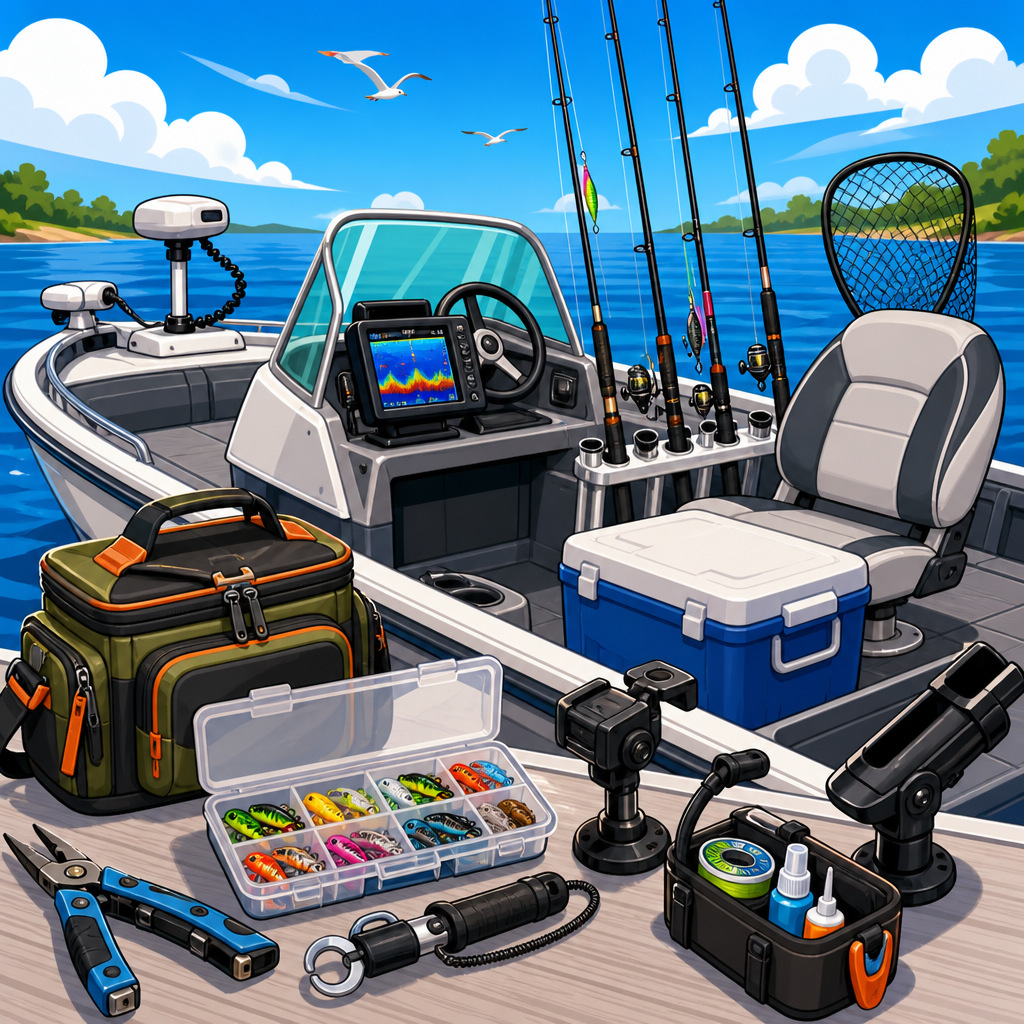
Organization is an accessory category that directly affects fishing success. On cramped decks, wasted motion costs opportunities. Well-designed rod holders, horizontal rod racks, tackle trays, under-gunnel storage, and sealed dry boxes turn a messy boat into an efficient platform. For trolling, rod holders from brands such as RAM Mounts, Cannon, and Scotty need to match rod length, line class, and technique. For casting-focused boats, secure storage that prevents guide damage and tip breakage matters more. Lockable rod lockers are ideal, but many owners improve smaller boats with aftermarket straps, tubes, and rack systems.
Tackle management should be built around access speed and protection from water intrusion. Clear 3600 and 3700 utility boxes remain the standard because they stack efficiently, make baits visible, and integrate with most marine tackle bags and drawer systems. Terminal tackle benefits from dedicated dividers and labeled compartments. Soft plastics, jigs, and hard baits each store best in different ways, especially in hot climates where warping and rust are common. I advise boat owners to separate frequently used confidence baits from overflow inventory so the main deck carries only what supports the day’s target species and pattern.
| Accessory Category | Best Use | Main Benefit | Common Mistake |
|---|---|---|---|
| Fish finder/chartplotter | Locating structure, navigation, waypoint tracking | Finds fish faster and improves route safety | Buying screen size too small for split views |
| Trolling motor with GPS hold | Boat control in wind or current | Keeps the boat positioned hands-free | Undersizing thrust for boat weight |
| Lithium battery system | Powering trolling motors and electronics | Lower weight and stable voltage | Using an incompatible charger |
| Rod and tackle storage | Deck organization and gear protection | Faster lure changes and fewer broken rods | Carrying too much tackle on deck |
| Livewell and fish-care tools | Keeping bait and fish healthy | Improves survival and tournament performance | Ignoring pump maintenance and oxygen levels |
Non-slip deck mats and marine cooler seats also deserve mention here. They are not glamorous, but they improve footing, reduce fatigue, and keep tools from sliding. The best boating accessories are often the ones that remove friction from normal tasks.
Livewell upgrades, bait systems, and fish handling tools
Serious anglers should treat fish care as part of boat setup, not an afterthought. A properly functioning livewell system with recirculation, aeration, and clean plumbing is essential for tournament anglers and useful for anyone keeping bait or harvesting fish responsibly. In hot weather, dissolved oxygen drops and water temperature rises, which increases fish stress. Accessories such as oxygenators, timer controls, insulated livewell lids, and treatment additives can help, but they do not compensate for poor pump performance or overcrowding.
For boats used in inshore or offshore fishing, a dedicated baitwell with rounded corners, strong flow, and species-appropriate circulation is a major advantage. Shrimp, pilchards, and menhaden are delicate; they do not survive long in cramped tanks with excessive turbulence. Matching the bait system to your fishery is one of the clearest examples of why accessory buying should be intentional.
Landing nets, lip grippers, dehookers, measuring boards, and fillet tools are also must-have boating accessories because they support efficient fish handling. Rubber-coated nets reduce slime loss and hook tangles compared with old knotted nylon designs. Long-reach pliers and hook cutters are safety items as much as fishing tools, especially when trebles are involved. A sharp, corrosion-resistant fillet knife with a secure sheath belongs on any boat that may process fish dockside.
Safety, navigation, and weather protection accessories
No fishing boat accessory list is complete without safety gear. Coast Guard compliant life jackets, throwable flotation, fire extinguishers, visual distress signals where required, and a first-aid kit are baseline equipment, not optional add-ons. The better question is which upgrades make safety gear more usable. Inflatable life jackets are more comfortable for all-day wear in many situations, though they are not ideal for every age group or activity. Emergency position-indicating beacons and personal locator beacons add another layer for offshore or remote-water anglers. These devices are especially valuable where VHF range is limited or cold water raises the stakes of a breakdown.
Anchoring equipment remains important even on boats with advanced GPS trolling motors. A properly sized anchor, sufficient rode, and quality cleats can stabilize a boat during engine trouble, shifting weather, or tidal current. For shallow-water anglers, a manual or hydraulic shallow-water anchor is one of the most useful boating accessories available. It allows quiet stops along grass lines, docks, and shorelines without repeated anchor deployment.
Weather protection matters more than many new owners realize. A strong bilge pump, backup pump or alarm, wiper systems on enclosed helms, spray shields, dry bags, and waterproof phone cases all reduce the impact of sudden conditions changes. I also recommend keeping a compact tool roll, spare fuses, prop hardware, electrical tape, and a jump pack on board. Those items solve common failures that would otherwise end a trip early.
Comfort, maintenance, and smart upgrades that add long-term value
The final layer of must-have boating accessories is the group that makes a boat easier to own over several seasons. Boarding ladders, upgraded seats, pedestal leaning posts, and shade solutions such as T-tops or bimini systems extend how long families and aging anglers can fish comfortably. USB-C charging ports, waterproof phone mounts, and marine audio can be worthwhile, but they should sit behind navigation, power, and safety in the budget order.
Maintenance accessories protect the boat’s value just as directly as electronics improve fishability. A quality washdown hose, corrosion inhibitor, trailer guide-ons, spare hub kit, transom saver where appropriate, keel protection, and fitted boat cover all reduce wear. In saltwater, galvanic corrosion and neglected rinsing destroy hardware quickly. In freshwater, UV exposure, carpet moisture, and trailer neglect are the common killers. The best boat owners I know treat post-trip cleanup as part of the day, not a separate chore they might get to later.
Smart upgrade planning is what turns this article from a shopping list into a true hub for boating gear and equipment. Start with safety and legal essentials. Then invest in core electronics, battery health, and boat control. Next, improve organization, fish care, and comfort. Finally, add specialized accessories for your fishery, whether that means outriggers, downriggers, shallow-water anchors, drift socks, planer boards, or camera systems. A well-rigged boat is not the one with the most gear; it is the one where every accessory supports a clear purpose.
The best fishing accessories for your boat in 2025 are the ones that improve control, safety, organization, and time on the water. For most owners, that means starting with a dependable fish finder or chartplotter, a properly matched trolling motor, a sound battery and wiring system, and storage that keeps rods and tackle protected but easy to reach. From there, livewell upgrades, fish handling tools, VHF communication, anchoring gear, and comfort improvements round out a setup that works in real conditions rather than just looking good at the dock. The larger lesson is simple: must-have boating accessories are not random extras. They are systems that help the boat perform its job. When you evaluate accessories by safety impact, frequency of use, compatibility, and maintenance burden, bad purchases become easier to avoid. Use this hub as your starting point for building a smarter boating gear and equipment plan, then prioritize the upgrades that fit your boat, your water, and the way you fish most often.
Frequently Asked Questions
What are the most important fishing accessories to put on a boat in 2025?
The best place to start is with accessories that improve safety, efficiency, and fishability before you spend money on niche gear. For most boat owners in 2025, the priority list should include quality rod storage, a dependable cooler or fish box, a modern marine GPS/fish finder, upgraded navigation and deck lighting, tackle organization, a landing net, and a well-stocked safety kit. If you fish early mornings, at night, or in changing weather, reliable onboard power management and battery monitoring are also near the top of the list.
What makes these accessories “best” is not how flashy they are, but how often they solve real problems on the water. Good storage keeps rods, pliers, leader spools, and tackle protected and easy to reach. Electronics help you run safer, mark productive structure, and spend less time searching. Non-slip deck mats, improved seating, and shade options increase comfort so you can fish longer without fatigue. A livewell upgrade or aeration accessory may be essential for some anglers, while it may be unnecessary for others. The smartest setup is one built around your species, your water, and your style of fishing rather than trends.
How do I choose fishing accessories that actually match the way I fish?
Start by looking at how you use your boat now, not how you imagine using it someday. A bass angler on inland lakes needs different accessories than an offshore angler, a coastal inshore fisherman, or a family boater who fishes occasionally on weekends. If you cast frequently, deck space, trolling motor integration, rod staging, and easy-access tackle storage matter more than luxury seating. If you troll or bottom fish, rod holders, electronics, bait prep space, and fish storage become bigger priorities. If you bring kids or non-anglers, comfort, shade, safety rails, and clutter control move way up the list.
A practical method is to identify your biggest pain points from your last several trips. Maybe rods get tangled, tackle takes too long to find, batteries run low, or you do not have enough light at launch time. Those frustrations point directly to the accessories that will deliver the most value. In 2025, the best boat setups are increasingly modular, which means you can add storage systems, electronics mounts, lighting, charging ports, and gear tracks in stages. That lets you build a boat that supports your fishing routine without overloading it with gear you rarely use.
Are electronics still one of the best fishing accessories for boats in 2025?
Yes, and for many anglers they are among the highest-impact upgrades you can make. Modern fish finders, chartplotters, GPS systems, transducers, and trolling motor integrations do much more than show depth. They help you navigate unfamiliar water safely, identify structure, track productive areas, follow contour lines, manage routes, and return to waypoints with precision. In a practical sense, good electronics shorten the learning curve on new lakes, bays, and coastal zones and help you spend more time fishing effectively.
That said, the right approach is to choose electronics that fit your actual needs and your boat’s size, power system, and layout. A compact skiff or aluminum fishing boat may benefit most from a clear, easy-to-read multifunction display and reliable mapping rather than an oversized screen packed with advanced features you will never use. Larger rigs may justify networking multiple displays, live sonar, radar, or advanced battery systems. In 2025, screen visibility, intuitive controls, software support, transducer compatibility, and dependable mounting matter just as much as raw feature lists. The best electronics package is the one you can operate quickly and confidently when conditions change.
What safety and comfort accessories should every fishing boat owner consider?
Safety accessories should never be treated as optional add-ons, because they support every trip regardless of target species or season. At a minimum, every fishing boat should have properly sized life jackets, a throwable flotation device if required, visual distress signaling where applicable, a first-aid kit, a fire extinguisher, reliable navigation lights, an anchor setup, and a basic emergency tool kit. In 2025, many boaters are also adding waterproof phone storage, backup charging options, VHF radios or emergency communication devices, and battery monitoring systems to reduce the risk of preventable problems on the water.
Comfort upgrades matter more than many anglers admit, especially on longer days. Supportive seating, better cooler access, anti-fatigue deck surfaces, shade systems, dry storage, and organized drink and gear placement all improve endurance and reduce distractions. A boat that is comfortable is usually a boat that stays tidier and safer, because loose gear is controlled and crew members move around more confidently. The ideal balance is to make the boat pleasant enough for long trips without giving up fishing efficiency. In other words, comfort accessories should support your time on the water, not compete with it.
Is it better to buy a lot of affordable boat fishing accessories or invest in a few premium ones?
In most cases, it is better to invest first in fewer, better accessories that address your biggest needs. Cheap rod holders, weak mounts, low-grade storage hardware, poor lighting, and unreliable electronics often create frustration, fail under load, or need to be replaced quickly. Premium does not always mean the most expensive option on the market, but it usually means better materials, stronger corrosion resistance, easier operation, and longer service life in a marine environment. On a boat, durability matters because gear is constantly exposed to vibration, moisture, sun, temperature swings, and salt or dirty freshwater conditions.
A smart buying strategy for 2025 is to prioritize upgrades in layers. First, cover essentials such as safety equipment, lighting, storage, and electronics you truly need. Next, improve efficiency with things like tackle systems, charging ports, net storage, and deck organization. After that, consider specialized accessories such as advanced sonar, bait station upgrades, extra livewell features, or comfort enhancements. This approach keeps you from overspending on gadgets while still building a capable, high-performing fishing platform. The best fishing accessories for your boat are the ones that hold up, get used often, and make every trip easier, safer, and more productive.