Boat electrical problems rarely start with dramatic failure; they usually begin as small warning signs such as dim cabin lights, a bilge pump that cycles slowly, electronics that reboot when the engine cranks, or a battery that never seems fully charged. Troubleshooting common boat electrical problems means finding the true cause instead of replacing parts at random. In practical terms, that requires understanding how marine batteries, charging sources, DC distribution, AC shore power, grounding, bonding, pumps, and corrosion interact in a wet, vibrating, salt-exposed environment. This matters because electrical faults can leave you stranded, disable navigation gear, spoil refrigeration, and in the worst cases create fire, shock, or flooding hazards.
On boats, electrical and plumbing systems overlap more than many owners expect. Freshwater pumps, sump pumps, bilge pumps, macerators, water heaters, and tank monitors all depend on reliable power, sound wiring, and protected connections. A weak negative return, corroded fuse holder, or undersized wire can look like a plumbing issue when the real fault is voltage drop. I have traced “bad pumps” to loose crimp terminals, nuisance breaker trips to failing chargers, and mystery corrosion to improper bonding between underwater metals and the DC system. A solid troubleshooting approach saves money, avoids unnecessary haul-outs, and helps owners speak clearly with marine electricians, mechanics, and surveyors.
Key terms are worth defining up front. Voltage is electrical pressure; current, measured in amps, is flow; resistance opposes flow; and voltage drop is the loss that occurs across wires, connections, switches, and devices. DC systems usually run at 12 or 24 volts and power lighting, pumps, electronics, and controls. AC systems, typically 120 or 230 volts from shore power or a generator, run battery chargers, outlets, air conditioning, and some water heaters. Grounding and bonding are not the same thing. Grounding provides a fault path for AC safety, while bonding connects metal components to control corrosion potential and reduce shock risk. Knowing those distinctions makes diagnostics faster and safer.
Start with safety, documentation, and the right tools
The safest way to troubleshoot boat electrical problems is to begin with isolation and verification. Turn off shore power before opening an AC panel. Switch off the battery charger and inverter when checking battery state. Ventilate battery compartments, especially around flooded lead-acid batteries that can emit hydrogen. Keep ignition sources away from fuel spaces, and never test unknown circuits with improvised jumpers. On every service call I start by identifying the system voltage, locating battery switches, confirming overcurrent protection, and finding the wiring diagram if one exists. Even a hand-drawn panel map from a previous owner can shorten diagnosis by an hour.
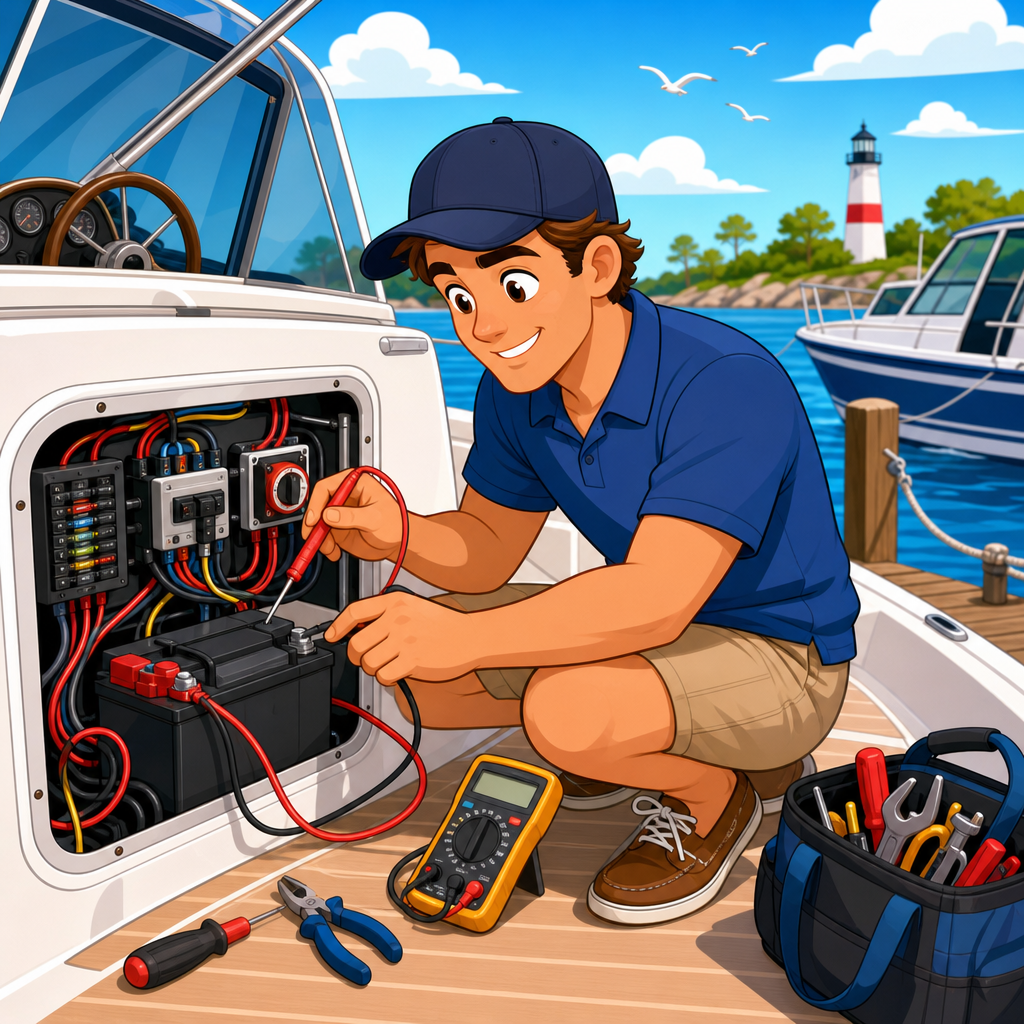
Your core tools should be a quality digital multimeter, a DC clamp meter, a test light rated for marine use, spare fuses, insulated screwdrivers, heat-shrink butt connectors, adhesive-lined terminals, a ratcheting crimper, and contact cleaner appropriate for electrical connections. If you troubleshoot often, add a battery conductance tester and an insulation resistance tester for AC faults. ABYC guidance is the reference standard most technicians use because it defines safe conductor sizing, overcurrent protection, color coding, and installation practices. Manufacturer manuals also matter. A Victron charger, a Blue Sea Systems panel, and a Rule bilge pump each publish voltage ranges and wiring requirements that directly affect diagnosis.
Diagnose batteries and charging before chasing downstream faults
Most recurring electrical complaints begin at the battery bank. If batteries are weak, sulfated, miswired, or inadequately charged, every connected system will behave erratically. Start by identifying battery chemistry: flooded lead-acid, AGM, gel, or lithium iron phosphate. Then confirm bank configuration, age, and use pattern. Resting voltage tells part of the story. A healthy fully charged 12-volt lead-acid battery typically rests around 12.6 to 12.8 volts after surface charge dissipates, while a charging alternator should usually produce roughly 13.8 to 14.6 volts depending on regulator strategy and battery type. Numbers outside those ranges require investigation, not assumptions.
Load testing is more useful than open-circuit voltage alone. I commonly see batteries that read acceptable voltage but collapse under a windlass, thruster, or house load because internal resistance has climbed. Check terminal cleanliness, torque, and cable condition first. White or green corrosion, swollen insulation, or blackened copper strands indicate resistance and heat damage. Then test charging sources one by one: engine alternator, shore charger, solar controller, and inverter-charger. A failed charger can cook batteries by overvoltage or leave them chronically undercharged. Smart charging profiles must match battery chemistry. Gel batteries in particular are damaged by aggressive settings intended for flooded cells.
| Symptom | Likely cause | What to test | Typical fix |
|---|---|---|---|
| Electronics reboot during engine start | Weak start battery or shared house/start wiring | Cranking voltage at battery and helm bus | Replace battery, separate critical loads, clean terminals |
| Battery always low after docking | Charger off, wrong profile, or parasitic draw | Charger output and overnight amp draw | Restore charger, correct settings, isolate drain |
| One battery hot while charging | Internal battery failure or bad cell | Temperature, voltage, conductance | Replace battery and verify charger operation |
| Bilge pump slow and dim lights | Voltage drop from corroded connections | Voltage at pump under load | Renew connectors, fuse holder, or cable run |
Find voltage drop, poor connections, and overloaded circuits
Once battery health is confirmed, move downstream through the distribution system. Voltage drop is the most common hidden cause of poor performance on boats because long cable runs, moisture, and vibration steadily degrade connections. The correct method is simple: test the circuit while it is operating. Measuring a bilge pump wire with no load can mislead you because a bad connection may still show full voltage until current flows. Place the multimeter across the suspect segment, from battery positive to load positive, then from load negative back to battery negative. Excessive loss on either side points to resistance in that path.
Pay close attention to fuse blocks, breaker terminals, battery switches, busbars, and crimped joints in lockers or bilges. Heat discoloration, melted fuse holders, and brittle insulation are direct evidence of high resistance. I also check wire gauge against current draw and run length; many owner-installed accessories fail because automotive wire or undersized speaker-type cable was used instead of tinned marine conductors. Overloaded circuits often announce themselves with nuisance trips, warm panels, or a plastic smell near a switch bank. The fix is not installing a bigger fuse. The fix is correcting the fault, resizing conductors if needed, and restoring proper overcurrent protection as close to the source as practical.
Troubleshoot pumps, plumbing devices, and tank systems methodically
Electrical and plumbing systems meet at pumps, valves, and controls, so this subtopic deserves special attention. Start with the symptom: pump dead, pump runs weakly, pump cycles when no fixture is open, breaker trips, or tank reading is wrong. For freshwater pumps, check supply voltage at the pump while it runs. If voltage is low, work backward through the switch, breaker, and negative return. If voltage is correct but flow is poor, inspect the strainer, air leaks on the suction side, clogged faucets, and pressure switch condition. Rapid cycling often indicates an accumulator problem, a small pressure leak, or a failing check valve rather than an electrical defect.
Bilge pumps demand even stricter diagnosis because they are safety equipment. Test both the manual switch circuit and the automatic float or electronic sensor circuit. A pump that works manually but not automatically usually has a failed float switch, poor splice in the auto feed, or a blown inline fuse near the battery. Also inspect discharge hose routing. A clogged line, stuck check valve, or high discharge loop can overload the motor and mimic electrical failure. Marine sanitation devices add another layer: macerators draw high current and are sensitive to voltage drop, while tank senders often fail from fouling or corroded connectors rather than defective gauges.
Check shore power, AC equipment, and corrosion risks carefully
AC problems on boats require more caution than DC issues because shock and fire risks are higher. Common warning signs include reverse polarity indicators, galvanic corrosion, tripping ELCI or GFCI devices, tingling sensations near the waterline or ladder, and chargers or water heaters that quit unexpectedly. Begin at the shore pedestal with a polarity and voltage check, then inspect the shore cord ends for discoloration or softened plastic. Burned plugs are common on boats with air conditioning or high charger loads because loose contacts create heat. A new cord end may fix the symptom, but you still need to verify pedestal condition and inlet integrity.
Inside the boat, confirm that the AC safety grounding conductor is continuous and isolated from DC negative except where equipment specifically requires an internal connection. Stray current corrosion and galvanic corrosion are related but different problems. Galvanic corrosion involves dissimilar metals and marina ground connections; a galvanic isolator can reduce that pathway if it meets safety standards. Stray current corrosion is more aggressive and usually results from an actual fault that leaks DC into the water or bonding system. If zincs disappear quickly, through-hulls pit, or shaft hardware corrodes unusually fast, inspect chargers, bilge wiring, and bonding conductors immediately.
Create a repeatable troubleshooting process and know when to escalate
The most effective boat electrical troubleshooting process is repeatable. Verify the complaint, isolate the circuit, inspect visually, test under load, compare readings to specifications, correct the root cause, and retest the full system. Document voltages, current draw, breaker ratings, wire sizes, and any changes you make. That record helps future maintenance and raises resale confidence because buyers and surveyors value orderly systems. For a sub-pillar hub on Electrical & Plumbing Systems, this page should connect owners to deeper topics such as battery maintenance, marine chargers and inverters, bilge pump wiring, freshwater pump repair, tank sender diagnostics, shore power safety, corrosion control, and marine wiring best practices.
There are clear limits to owner troubleshooting. If an AC fault trips protection repeatedly, if wiring insulation has charred, if lithium batteries lack proper battery management integration, or if you suspect stray current in the water, bring in a qualified ABYC-certified technician. The same applies when schematics do not match reality or multiple modifications from previous owners obscure the original design. The goal is not merely getting a device to run again. The goal is restoring a marine electrical system that is safe, reliable, and understandable.
When you troubleshoot common boat electrical problems with a disciplined approach, symptoms stop feeling random. Start with batteries and charging, move through voltage-drop testing, inspect connections and overcurrent protection, then evaluate pumps, plumbing devices, and shore power with the same method. Most faults come down to weak batteries, corrosion, poor crimps, undersized wire, or misconfigured charging equipment. Fixing those basics solves a remarkable percentage of onboard electrical and plumbing complaints.
The main benefit of this approach is confidence. You spend less on guesswork, catch safety issues earlier, and keep critical systems working when conditions are rough. Use this hub as your starting point for every Electrical & Plumbing Systems task under Boat Maintenance & Repairs, then drill into the specific component article you need next. Grab a multimeter, your wiring diagram, and a notepad, and troubleshoot the problem step by step before replacing anything.
Frequently Asked Questions
What are the first signs of a boat electrical problem, and where should I start troubleshooting?
The earliest signs of a boat electrical issue are usually subtle rather than dramatic. You might notice dim or flickering cabin lights, a bilge pump that runs slower than normal, electronics that shut off or reboot during engine cranking, blown fuses that seem to come back intermittently, or batteries that never appear to reach a full charge. These symptoms often point to voltage drop, poor connections, weak batteries, charging problems, or corrosion somewhere in the system. The key is to treat those small changes seriously before they turn into a no-start condition, dead batteries at anchor, or the loss of critical safety equipment.
A good starting point is always the battery bank, because every electrical system depends on stable battery voltage and clean, tight connections. Inspect the battery terminals for corrosion, looseness, damaged cable lugs, swelling, leaks, or heat discoloration. Then check the main battery switch, fuse blocks, bus bars, and grounding points. On boats, moisture, salt air, and vibration constantly work against electrical reliability, so a connection can look acceptable at first glance and still perform poorly under load. That is why a visual inspection should be followed by actual testing with a multimeter.
Next, work methodically instead of replacing parts at random. Confirm battery voltage at rest, then check voltage while a load is running, such as lights, pumps, or electronics. If voltage drops excessively, the problem may be a weak battery, a failing charger or alternator, undersized wiring, or resistance in the cables and connectors. Divide the system into sections: battery bank, charging source, distribution panel, individual circuits, and the device itself. That approach helps you isolate whether the problem begins at the source or farther downstream.
It is also important to understand whether you are dealing with DC or AC power. Most core boat systems such as pumps, lights, electronics, and engine starting are DC. Shore power, water heaters, battery chargers, and some outlets operate on AC. Problems can overlap because a charger running on AC shore power may affect battery health on the DC side. If you start with a basic inspection, verify voltage under load, and trace the circuit one section at a time, you will diagnose the real cause much faster and far more safely.
Why do my boat electronics reboot or shut off when I start the engine?
When chartplotters, radios, fish finders, or other electronics reboot during engine cranking, the most common cause is a temporary voltage drop. Starting an engine requires a very high current draw, and if the battery is weak, undersized, partially discharged, or connected through cables with too much resistance, system voltage can dip low enough to force sensitive electronics to reset. Many marine electronics are designed to tolerate normal fluctuations, but they still need stable power above a minimum threshold. If engine cranking pulls voltage below that threshold even for a moment, the unit may restart or shut off.
The battery itself is the first thing to evaluate. A battery can show acceptable voltage at rest and still fail under load if it has lost capacity or developed internal problems. Load testing is more useful than checking resting voltage alone. You should also inspect the starting battery cables, cable lugs, engine ground, battery switch, and any common negative bus connections. Corrosion, partially broken wire strands, loose terminals, and undersized cables can all create resistance that worsens voltage sag during cranking. In marine environments, this type of hidden resistance is extremely common.
Another frequent cause is poor circuit separation between engine starting and house electronics. If navigation equipment, stereos, and pumps are all sharing the same battery bank without proper system design, heavy starting loads can affect everything at once. Many boats benefit from dedicated start batteries, house banks, voltage-sensitive relays, automatic charging relays, or DC-to-DC charging arrangements that keep engine starting isolated from sensitive electronics. Even if the system is technically functional, it may not be optimized for modern electronic loads.
You should also consider the charging system and the condition of the alternator output wiring. If the battery is never fully recovering after each outing, electronics may be operating from a chronically low state of charge, which makes cranking voltage drop worse. The best troubleshooting method is to measure battery voltage before cranking, during cranking, and after the engine starts. Then compare that with voltage at the electronics power input. If there is a large difference between battery voltage and what the electronics actually receive, the issue may be in the wiring or distribution path rather than the battery alone.
How can I tell if the problem is the battery, the alternator, or the battery charger?
Distinguishing between a battery problem and a charging problem requires a few simple tests and a disciplined process. Start by checking battery voltage after the battery has been at rest with no charging source and no major load for a period of time. A healthy, fully charged 12-volt battery should typically read around 12.6 to 12.8 volts, depending on battery type. If resting voltage is low, that may indicate the battery is discharged, sulfated, aging, or simply not being charged properly. Resting voltage alone, however, does not confirm the root cause.
Next, test the charging voltage with the engine running. In many 12-volt systems, an alternator should produce charging voltage roughly in the mid-13 to mid-14 volt range, depending on battery chemistry, regulator settings, and operating conditions. If voltage remains near resting battery voltage with the engine running, the alternator, regulator, belt, wiring, or related fuse protection may be at fault. If alternator output appears normal at the alternator itself but not at the battery bank, suspect cable resistance, blown fuses, poor grounds, or connection issues between the charging source and the batteries.
To assess the shore-powered battery charger, connect the boat to shore power and measure voltage at the batteries while the charger is operating. A functioning marine charger should raise battery voltage according to its charging stage and battery type. If charger output is absent, inconsistent, or too low, check shore power input, AC breakers, polarity, charger fuses, and the charger’s settings. Many charger complaints are actually shore power problems, tripped breakers, corroded AC connections, or incorrect battery profile settings rather than charger failure.
Finally, remember that a bad battery can make a good alternator or charger look ineffective. If a battery has lost capacity, has an internal short, or cannot accept and hold a charge, the charging system may run continuously without solving the problem. That is why the most reliable approach is to test all three elements together: battery condition, charging voltage, and voltage drop through the wiring. On a boat, true diagnosis comes from looking at the whole charging circuit, not just one component in isolation.
What causes dim lights, slow pumps, or equipment that works intermittently on a boat?
Dim lights, sluggish pumps, and intermittent accessories are classic signs of low voltage or excessive resistance in the circuit. In marine systems, those conditions are often caused by corroded terminals, loose crimps, failing switches, worn breaker contacts, deteriorated fuse holders, or negative return problems. Salt, humidity, and vibration accelerate all of this. A light or pump may still work, but not at full performance, because the device is receiving less voltage than it needs. That reduced voltage can make motors run hot, electronics behave unpredictably, and wiring components fail sooner than expected.
One of the most common mistakes is checking only the positive side of the circuit. The negative side is equally important. A weak or corroded ground connection can produce exactly the same symptoms as a bad positive feed. On many boats, multiple circuits rely on common negative bus bars or engine grounding points, so one compromised connection can create strange problems across several systems at once. If multiple unrelated devices appear weak or intermittent, look for a shared supply or ground issue before assuming each device has failed individually.
The best way to confirm voltage drop is to test the circuit while the equipment is operating. Measure voltage at the battery, then at the panel, then at the device input. If the numbers fall significantly along the path, you know there is resistance somewhere between the source and the load. You can narrow it down further by testing across individual connections, switches, fuse holders, and wire runs. Any connection showing a measurable voltage loss under load deserves attention. This is much more effective than just checking continuity with the power off.
In practical terms, troubleshooting should include cleaning and tightening terminals, replacing corroded connectors, inspecting wire insulation for heat damage or stiffness, confirming proper fuse sizing, and verifying that wire gauge matches the load and run length. Boats often accumulate add-on equipment over time, and not all installations use marine-grade wire, sealed terminals, or proper overcurrent protection. If you find household wire nuts, automotive connectors, or badly spliced wiring, there is a strong chance those shortcuts are contributing to the problem. Reliable marine electrical performance depends on low-resistance connections and proper materials throughout the system.
How should I safely troubleshoot AC shore power and grounding issues on a boat?
AC shore power deserves a higher level of caution than standard 12-volt DC troubleshooting because the consequences are more serious. Faults in AC wiring can damage equipment, trip breakers, corrode