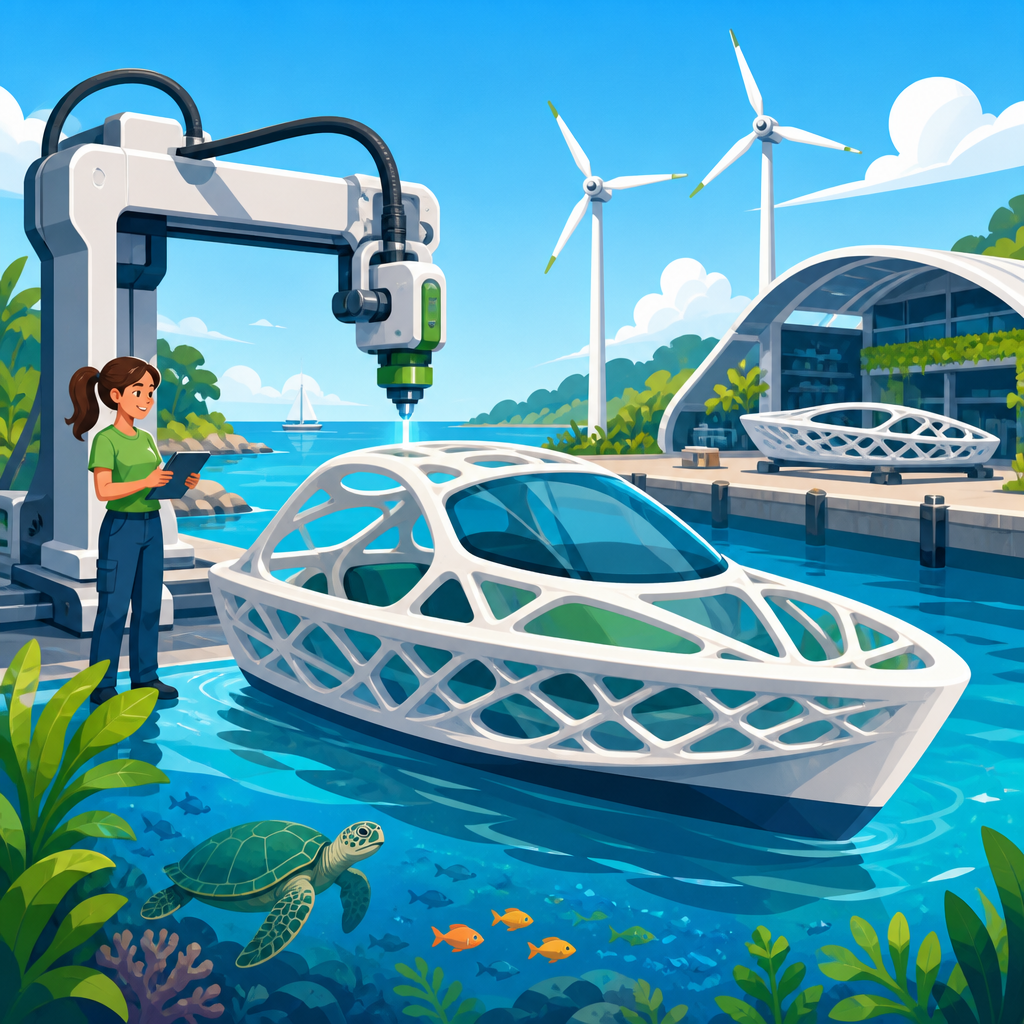
3D printing is reshaping sustainable boat design by changing how hulls, components, molds, and replacement parts are conceived, manufactured, repaired, and eventually recycled. In boating, sustainability means reducing lifetime environmental impact across material sourcing, energy use, emissions, maintenance, and end-of-life disposal. Additive manufacturing, the industrial term for 3D printing, builds parts layer by layer from digital files rather than cutting them from larger stock. That difference matters because conventional boatbuilding often generates heavy waste through trimming, sanding, molding, and tooling. After working around composite fabrication projects and marine retrofit planning, I have seen how quickly offcuts, excess resin, failed molds, and obsolete fittings accumulate. 3D printing does not solve every problem, but it directly addresses material efficiency, localized production, design optimization, and repairability in ways traditional methods rarely can. For a subtopic as central as sustainable boat design and materials, it deserves hub-level attention.
The environmental stakes are high because recreational and commercial boats rely heavily on fiberglass composites, petrochemical resins, aluminum, tropical hardwoods, and long international supply chains. Fiberglass remains popular because it is strong, affordable, and easy to shape, yet it is difficult to recycle at scale and labor-intensive to manufacture cleanly. Marine-grade aluminum offers durability and corrosion resistance but carries significant embodied energy from smelting. Teak decking is beautiful and resilient, yet sourcing concerns remain unless certification is robust. Sustainable boat design therefore asks a practical question: how can builders maintain seaworthiness, safety, and performance while using fewer virgin inputs and creating less waste? 3D printing enters that discussion not as a novelty gadget, but as a manufacturing method that can pair recycled polymers, bio-based feedstocks, topology-optimized structures, and on-demand production with real marine use cases.
This article serves as a hub for sustainable boat design and materials by explaining where 3D printing fits, where it already works, and where limits remain. The most important terms are straightforward. Large-format additive manufacturing refers to printers capable of producing boat sections, molds, or sizable deck components. Recycled feedstock means polymers reclaimed from bottles, nets, packaging, or industrial scrap and reprocessed into pellets or filament. Bio-composites combine fibers such as flax, hemp, or wood flour with polymer matrices to reduce reliance on pure fossil-based materials. Circular design means designing parts so they can be repaired, disassembled, and reused instead of discarded. For boat owners, designers, and yard managers, the value is clear: lower waste, shorter supply chains, lighter structures, and parts made when needed instead of warehoused indefinitely.
Understanding this topic also helps separate realistic progress from marketing claims. Not every printed boat is greener than a well-built conventional one, and not every sustainable material is suitable below the waterline. Marine environments punish weak assumptions through UV exposure, cyclic loading, saltwater intrusion, impact, and heat. The future belongs to designs that balance lifecycle thinking with classification standards, repair logistics, and actual operating conditions. The sections below cover materials, manufacturing methods, performance considerations, regulatory realities, and the best near-term applications, giving you a practical map of how 3D printing is creating sustainable boats of the future.
Why 3D Printing Changes Sustainable Boat Design
The biggest sustainability advantage of 3D printing is material efficiency. Traditional subtractive manufacturing removes material from sheets, billets, or molded panels, often leaving a meaningful percentage as waste. Composite hand layup also produces trim waste, peel ply, vacuum bagging film, mixing containers, and resin losses. Additive manufacturing deposits material only where the design requires it. That allows designers to reduce scrap while creating forms that would be expensive or impossible with standard molds. In practice, this means ribs, brackets, ducts, seating bases, and instrument housings can be printed with internal lattice structures, variable wall thickness, and integrated fastening points, using less material while preserving stiffness.
The second advantage is design freedom tied to weight reduction. Every kilogram saved on a boat can improve efficiency, range, or payload, particularly for electric boats where battery mass is already substantial. I have seen this most clearly in nonstructural and semi-structural components: cable routing channels, ventilation manifolds, locker inserts, and helm consoles can be printed as one optimized piece rather than assembled from multiple parts with fasteners and adhesives. Fewer joints mean fewer leak paths and less labor. Weight reduction matters because lower displacement generally reduces propulsion energy demand, especially at displacement and semi-planing speeds. Even small savings across many components compound over the vessel’s life.
The third advantage is distributed manufacturing. Marine supply chains are notoriously fragmented. A broken vent cover, pump bracket, hatch latch spacer, or electronics mount can sideline a boat while owners wait weeks for a discontinued part to ship internationally. Printing replacements near the point of use cuts transport emissions and extends the life of existing vessels. This is sustainability in its most practical form: keeping boats operational longer so owners do not replace serviceable systems prematurely. Digital inventories also reduce overproduction. Instead of manufacturing thousands of low-demand parts for storage, companies can maintain validated design files and produce parts on demand through certified service bureaus or local yards.
Materials Powering the Next Generation of Printed Boats
Materials determine whether a printed marine part is genuinely sustainable and fit for purpose. Common marine 3D printing polymers include PETG, ABS, ASA, nylon, polypropylene, and high-performance thermoplastics such as PEI and PEEK for specialized uses. Among these, recycled PET and recycled polypropylene are especially interesting because both can originate from established waste streams, including packaging and industrial scrap. PETG prints predictably and resists moisture better than PLA, which is easy to print but often unsuitable for demanding marine environments due to heat sensitivity and long-term durability limits. ASA performs better outdoors than ABS because it offers improved UV stability, making it useful for exposed housings and trim.
For higher-strength applications, fiber-reinforced thermoplastics are increasingly important. Chopped carbon fiber nylon can improve stiffness, while glass-filled polymers may offer a balance between cost and performance. However, reinforcement complicates recycling because mixed material streams are harder to reprocess cleanly. That tradeoff matters. In sustainability reviews, I usually compare a slightly heavier monomaterial part that can be recycled more realistically against a lighter multi-material part that may become waste at end of life. There is no universal answer, but the decision should be explicit. Some builders are also exploring natural fiber composites, including flax-reinforced thermoplastics, for interior panels, furniture, and cosmetic elements where moisture management and finish quality can be controlled.
Resins and feedstock provenance matter as much as mechanical properties. Several suppliers now offer filament and pellet feedstock made partly or wholly from recycled ocean-bound plastic, post-consumer PET, or reclaimed fishing gear. The strongest sustainability case appears when the feedstock source, manufacturing process, and recovery path are documented. A printed seat base from recycled polypropylene is more credible if the builder can also explain UV stabilization, fire performance, and how the part will be recovered and reprocessed later. Bio-based polymers are promising too, but they should not be treated as automatically green. Some bioplastics perform poorly in hot, wet conditions, and industrial compostability does not help if no marine disposal pathway exists.
| Material | Typical Marine Use | Sustainability Benefit | Main Limitation |
|---|---|---|---|
| Recycled PETG | Interior fittings, covers, housings | Uses post-consumer waste, low scrap | Moderate heat resistance |
| ASA | Exterior trim, instrument pods | Longer outdoor life reduces replacement frequency | Usually fossil-based feedstock |
| Recycled Polypropylene | Storage bins, ducts, liners | Recyclable and chemically resistant | Warping can complicate printing |
| Carbon-Fiber Nylon | Brackets, mounts, functional parts | Lightweight, strong parts reduce overall mass | Harder to recycle |
| Flax Composite | Panels, cabinetry, nonstructural surfaces | Lower fossil input, renewable fiber | Moisture and finish constraints |
Where 3D Printing Works Best on Boats Today
The most practical current applications are not always full printed hulls. They are high-value parts, custom tooling, and molds. Large-format printers can produce molds for composite layup much faster than conventional plug-and-mold methods, reducing waste from foam shaping and manual fairing. A yard building low-volume electric dayboats, for example, can print a mold section, machine the final surface, and use it for composite hull or deck production with less tooling labor. This hybrid approach is often more realistic than printing the final hull itself. It combines the geometric flexibility of additive manufacturing with the proven structural performance of marine composites.
Boat interiors are another strong use case. Printed cabinetry modules, ventilation ducts, switch panels, cup holders, drawer systems, and berth supports allow high customization without bespoke carpentry waste. Because each boat owner wants slightly different layouts, digital manufacturing aligns naturally with semi-custom production. A builder can tweak dimensions in CAD, print the revised component, and avoid ordering oversized stock material. Printed jigs and drill guides also improve accuracy during assembly, lowering rework rates. Less rework means fewer discarded panels, fewer labor hours, and a cleaner production line.
For maintenance and retrofits, 3D printing is already transformative. Older boats often need replacement bezels, clips, vents, escutcheons, and pump adapters no supplier stocks anymore. Instead of replacing entire systems, owners can reverse engineer the failed part and print a direct substitute, often improving it by adding thicker stress points or better drainage. I have watched repair timelines shrink dramatically when a yard scanned a broken locker latch housing, printed a reinforced version in ASA, and had the boat back in service the same day. That is not futuristic theory; it is operational sustainability because it extends asset life with minimal material input.
Can 3D Printed Hulls Be Strong, Safe, and Truly Sustainable?
Yes, but only under specific conditions. Hulls face slamming loads, torsion, abrasion, osmosis risks, UV attack, and impact from docking or debris. A monolithic printed polymer hull may be suitable for small craft, prototypes, tenders, autonomous surface vessels, or canal boats operating in protected waters, but broader marine adoption depends on engineering validation. Layer adhesion, anisotropy, infill strategy, print orientation, and thermal history all affect strength. In marine design reviews, the question is never simply whether a part can be printed. The question is whether it can be printed repeatably, inspected effectively, repaired safely, and certified for the service environment.
The strongest near-term path is hybrid construction. A printed hull shell can act as a form, core, or sacrificial mold combined with glass, basalt, or carbon reinforcement where needed. Builders are also experimenting with segmented hull printing, where sections are printed, joined, and over-laminated. This reduces tooling and can enable local production, but it adds interfaces that must be engineered carefully. Sustainability improves when the process reduces waste and uses recyclable thermoplastics, yet gains can disappear if the final assembly relies on incompatible adhesives and unrecoverable laminates. The best designs plan disassembly from the start.
Energy source also matters. A printed boat made from recycled polymer using renewable electricity may compare favorably to a conventionally molded equivalent, while the same boat made with coal-powered electricity and virgin feedstock may not. Lifecycle assessment is therefore essential. It should include feedstock origin, print energy, post-processing, transport, use-phase efficiency, maintenance frequency, and disposal pathways. A lighter hull that lowers propulsion energy for years can justify a more energy-intensive build process, but only if the durability is there. Sustainable boats of the future will be judged on full lifecycle performance, not on whether a printer was involved.
Regulation, Repair, and the Real Road Ahead
No sustainable material story in boating is complete without standards and repair realities. Classification societies and marine regulators move cautiously for good reason: boats operate in safety-critical environments. Organizations such as ABS, DNV, Lloyd’s Register, and ISO committees increasingly address additive manufacturing, material qualification, and polymer testing, but acceptance varies by vessel type and component criticality. For now, printed parts are easiest to approve in noncritical roles or when they serve as tooling rather than final structure. Builders aiming higher need documented quality control, repeatable process parameters, traceable feedstock, and mechanical testing under relevant marine conditions, including salt spray, UV exposure, fatigue, and impact.
Repairability is where 3D printing may deliver its most durable sustainability benefit. Thermoplastic parts can often be reprinted, welded, or remanufactured more simply than thermoset fiberglass parts. Digital part libraries let yards support boats for longer, reducing obsolescence. For fleet operators, this changes maintenance economics. Instead of stocking slow-moving spares for a decade, they can keep validated files and print replacements as needed. Ports and remote islands may eventually operate marine microfactories that produce standard fittings, pump brackets, cable glands, and fairleads locally. That reduces downtime, shipping costs, and unnecessary replacement of larger assemblies.
The road ahead is practical rather than speculative. Expect continued growth in printed molds, interior modules, custom retrofits, electric boat components, and small-vessel hull experiments. Expect slower progress in heavily loaded primary structures until testing, standards, and recycling systems mature further. The main takeaway is simple: 3D printing expands the sustainable boat design toolkit. It reduces waste, supports recycled and bio-based materials, enables lightweight geometries, and keeps boats in service longer through on-demand repair parts. If you design, build, refit, or manage boats, start by identifying one component, mold, or spare-part workflow that additive manufacturing can improve, then measure the material savings and lifecycle impact for yourself.
Frequently Asked Questions
What makes 3D printing more sustainable than traditional boat manufacturing?
3D printing can improve sustainability in boatbuilding because it changes how parts are designed, produced, and used over the vessel’s lifetime. Traditional manufacturing often starts with large sheets, blocks, or molds and removes material through cutting, trimming, sanding, and shaping. That process can create significant scrap and usually requires multiple production steps, specialized tooling, and energy-intensive transport between suppliers. Additive manufacturing works differently by building components layer by layer from a digital design, which means material is placed only where it is needed. In many cases, that reduces waste, shortens production chains, and makes it easier to optimize a part for strength, weight, and performance.
For boats, sustainability is not only about using less material at the factory. It also includes how a hull or component affects fuel use, maintenance, emissions, durability, and disposal at end of life. A 3D-printed part can be engineered with internal lattice structures, reinforcement patterns, or geometry that would be difficult or impossible to make conventionally. That can lower weight without sacrificing performance, and lighter boats generally require less energy to move through the water. In powerboats, that may reduce fuel consumption and operating emissions. In electric vessels, lower weight can extend range and improve battery efficiency.
Another major advantage is local and on-demand production. Instead of manufacturing large inventories of spare parts and shipping them globally, boatbuilders and marine service providers can print parts closer to where they are needed. This can reduce transportation emissions and prevent obsolete parts from being discarded. While 3D printing is not automatically sustainable in every case, it creates a strong foundation for lower-waste production, smarter material use, easier repair, and more circular marine manufacturing when combined with responsible material choices and energy-efficient processes.
How is 3D printing used in the construction of sustainable boats?
3D printing is being used across multiple stages of boat construction, not just for small accessories. One of the most important applications is in molds and tooling. Boatbuilding has long depended on expensive molds for hull sections, decks, consoles, and interior components. Those molds can take considerable time, material, and labor to produce. Additive manufacturing allows builders to print mold sections or tooling patterns much faster, often with less waste and greater precision. That helps speed up development and reduces the environmental burden of repeated prototyping and redesign.
It is also increasingly used for end-use parts such as air ducts, seating structures, hatches, brackets, instrument housings, piping connectors, cable guides, and custom interior components. Because the process is digital, each part can be tailored to a specific vessel without requiring an entirely new manufacturing setup. This is especially valuable in marine applications where customization is common and production runs are relatively small. Instead of forcing designers to use standardized parts that may be heavier or less efficient, 3D printing allows them to create purpose-built components that better match the boat’s performance and sustainability goals.
In more advanced projects, entire hull sections or full hulls are being printed using large-format additive manufacturing systems. These systems can use thermoplastics, composite-reinforced materials, or other engineered feedstocks to create structural forms at a much larger scale than desktop 3D printing. Once printed, the sections can be assembled, reinforced, finished, and integrated with propulsion and onboard systems. This approach opens the door to lighter structures, fewer joined parts, and designs optimized for hydrodynamics and material efficiency. While large-scale printed boats are still an evolving field, they show how additive manufacturing can support a more streamlined, lower-impact approach to marine construction.
What materials are used in 3D-printed boats, and are they environmentally friendly?
The materials used in 3D-printed boats vary depending on whether the application is a prototype, a mold, a non-structural part, or a structural marine component. Common materials include thermoplastics such as ABS, PETG, nylon, and polypropylene, along with fiber-reinforced composites that add stiffness and strength. For larger marine applications, some manufacturers use recycled polymers, bio-based feedstocks, or composite blends designed specifically for outdoor durability and water resistance. The best material choice depends on the part’s structural demands, UV exposure, saltwater contact, temperature range, and expected service life.
From a sustainability perspective, no material is universally green, but some options are clearly better than others. Recycled thermoplastics can lower demand for virgin raw materials and help divert waste from landfills. Bio-based polymers may reduce reliance on fossil-derived inputs, although their real environmental benefit depends on how the raw materials are grown, processed, and transported. Some advanced 3D-printing systems can also reprocess waste material or failed prints into new feedstock, which supports a more circular manufacturing model. In contrast, some composite materials provide excellent strength but are harder to recycle, so they may improve boat efficiency during use while creating challenges at end of life.
What matters most is the full lifecycle of the material, not just its label. A durable printed component that lasts longer, requires fewer replacements, and reduces vessel weight may be more sustainable overall than a supposedly eco-friendly material that degrades quickly in harsh marine conditions. That is why serious marine manufacturers evaluate environmental performance across sourcing, production energy, part longevity, maintenance requirements, and recyclability. As material science improves, 3D printing is becoming more aligned with sustainable boating because it gives designers more flexibility to choose lower-impact materials while still meeting demanding marine performance standards.
Can 3D printing help with boat repairs, maintenance, and replacement parts?
Yes, and this is one of the most practical sustainability benefits of additive manufacturing in the marine industry. Boats often remain in service for decades, but sourcing replacement parts for older models can be difficult, slow, and expensive. In many cases, a small broken bracket, vent, latch housing, or connector can sideline a vessel simply because the original part is no longer manufactured. With 3D printing, that part can often be recreated from a digital model or reverse-engineered from the original. This extends the useful life of the boat and avoids unnecessary replacement of larger assemblies.
On-demand printing also reduces the need to maintain large inventories of rarely used parts. Instead of warehousing thousands of components that may never be sold, manufacturers and repair facilities can store digital files and print parts when needed. That cuts storage requirements, limits overproduction, and reduces the environmental impact tied to manufacturing excess inventory. For remote marinas, commercial fleets, patrol vessels, and research craft, the ability to produce parts locally can also minimize downtime and reduce emissions from urgent shipping or long-distance transport.
Beyond convenience, repairability is central to sustainability. A boat that can be repaired efficiently has a lower lifetime environmental footprint than one that is routinely discarded or stripped for salvage because a single part failed. 3D printing supports this repair-first mindset by making custom fixes, obsolete replacements, and low-volume specialty parts much more accessible. Not every marine component should be printed, especially highly loaded safety-critical parts that require strict certification, but for a wide range of maintenance applications, additive manufacturing helps keep vessels operating longer and with less waste.
Will 3D-printed boats become common in the future of sustainable marine design?
3D-printed boats are likely to become increasingly common, although the transition will happen in stages rather than all at once. In the near term, the biggest growth will probably continue in printed tooling, molds, replacement parts, and customized onboard components because these uses already offer clear economic and environmental benefits. They reduce waste, shorten lead times, improve design flexibility, and support local production. As these advantages become more familiar to boatbuilders, additive manufacturing will continue moving deeper into mainstream marine production.
Wider adoption of fully or partially 3D-printed hulls will depend on material performance, regulatory approval, production speed, and long-term durability data. Marine environments are unforgiving. Saltwater, UV radiation, impact loads, vibration, fatigue, and temperature changes all place serious demands on a vessel’s structure. For 3D-printed boats to become standard, manufacturers must prove that printed materials and printed joints can perform reliably over many years. Classification societies, insurers, and commercial buyers will also expect robust testing and certification before embracing the technology at scale.
Even so, the long-term outlook is strong because 3D printing aligns well with the broader direction of sustainable marine design. The future of boating is likely to emphasize lighter structures, smarter use of materials, lower-emission propulsion, modular repair, digital manufacturing, and better end-of-life recovery. Additive manufacturing supports all of those trends. It gives designers freedom to create efficient shapes, helps builders avoid unnecessary waste, and makes it easier to repair and upgrade boats over time. Rather than replacing every traditional process, 3D printing is poised to become a core tool in building cleaner, more resource-efficient boats for the future.