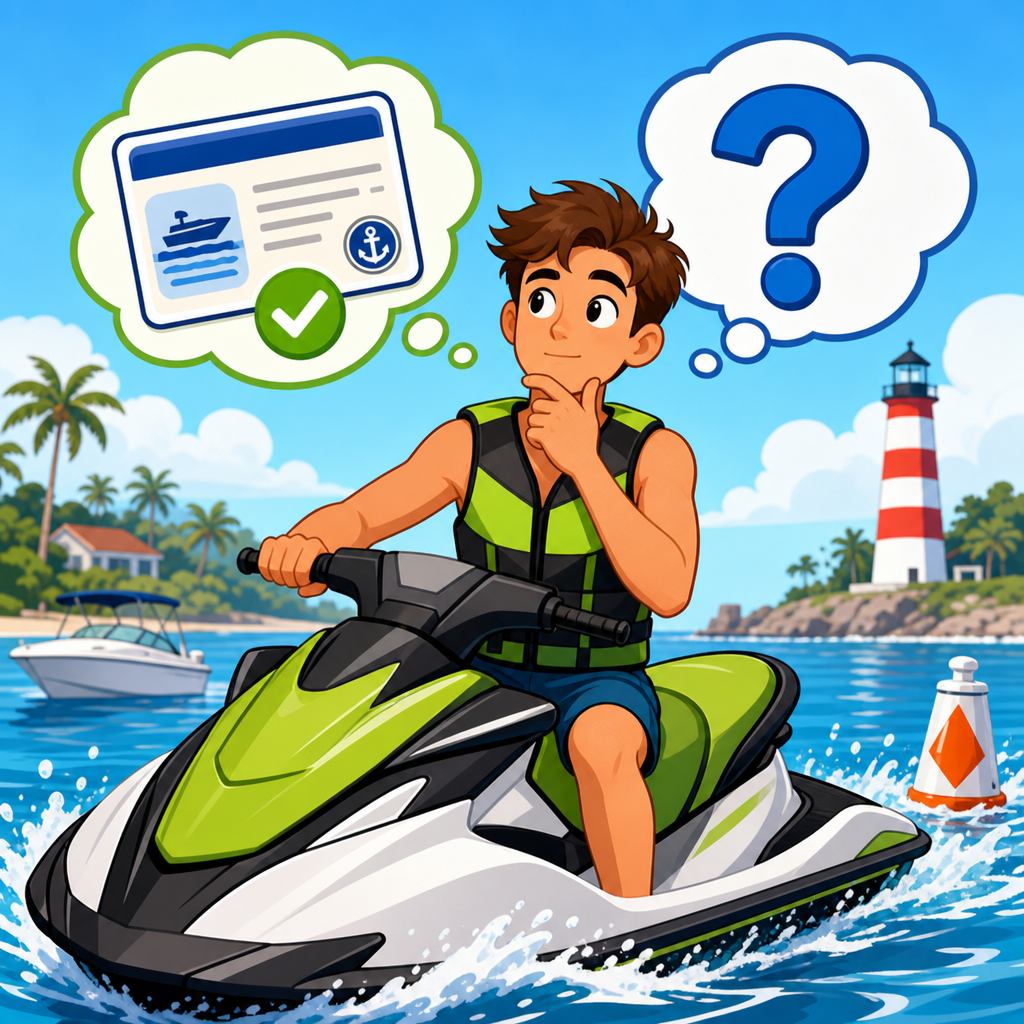
Do you need a boating license to drive a Jet Ski? In many places, the answer is yes, or at least something very close to it. A true boating license may not exist in your state, but operators of personal watercraft, often called PWCs or Jet Skis, frequently must carry a boater education certificate, complete a safety course, meet a minimum age requirement, and follow special operating rules that do not apply to larger boats in the same way. Because the laws vary by state and country, the only accurate answer is that you must check the rules where you ride before launching.
That distinction matters because people use the term boating license loosely. In practice, most U.S. jurisdictions regulate Jet Ski use through mandatory boater education rather than a motor vehicle style license. A personal watercraft is a small vessel powered by an inboard motor driving a water jet pump, designed for riders to sit, stand, or kneel on rather than inside. Jet Ski is a Kawasaki brand name, but many riders use it to describe all PWCs, including Sea-Doo and WaveRunner models. Legally, however, the relevant category is personal watercraft, and those vessels are usually subject to stricter safety rules than runabouts, pontoons, or fishing boats.
I have worked with boating compliance checklists, rental operator requirements, and launch site signage, and PWCs are where confusion shows up most often. New riders assume a car driver’s license is enough. It usually is not. Parents assume teenagers can operate a Jet Ski if they can handle the throttle. Many states say otherwise. Visitors assume one state’s boating card automatically covers every destination. Sometimes it does, sometimes a local age or temporary certificate rule changes the answer. That is why this topic matters: the wrong assumption can lead to citations, denied rentals, insurance problems, and preventable injuries.
This hub article explains the core rules behind personal watercraft and Jet Ski regulations, including licensing, age limits, rental requirements, safety equipment, speed and distance restrictions, registration, and enforcement. It also points to the practical questions riders ask most: How old do you have to be? Can passengers ride? Do you need insurance? Can you operate at night? What happens if you tow a tube or violate no-wake zones? By the end, you will know how to determine whether you need a boating license to drive a Jet Ski and what other legal requirements usually apply before you get on the water.
What Counts as a Boating License for a Jet Ski
For Jet Skis, the phrase boating license usually means a state-approved boater education credential. Most states do not issue a plastic operator license that works like a driver’s license. Instead, they require proof that you completed an approved boating safety course, often one recognized by the National Association of State Boating Law Administrators or accepted by the state wildlife, parks, or marine patrol agency. Once you pass, you receive a boater education card, boater safety certificate, or endorsement, and that document is what enforcement officers will ask to see.
There are three common models. First, some states require all PWC operators to complete a safety course regardless of age. Second, some require education only for operators born after a certain date, a rule common in broad recreational boating laws. Third, a few states exempt older operators using their own craft but require temporary education for renters. Florida is a widely cited example of the rental model: many operators born on or after January 1, 1988 need a boater education card or temporary certificate to operate a motorboat of 10 horsepower or more, including a Jet Ski. The legal trigger is not the brand; it is the vessel class and engine threshold.
If you ride outside the United States, the terminology changes again. Canada uses the Pleasure Craft Operator Card for many motorized vessels. Some European destinations require local permits, supervised rentals, or coastal navigation credentials depending on horsepower and shoreline distance. The practical lesson is simple: treat boating license as shorthand, then verify the exact credential your destination recognizes.
State-by-State Rules: Why the Answer Changes by Location
Jet Ski laws are highly local because boating regulation in the United States is shared among state legislatures, state boating agencies, and on-water enforcement divisions, while federal rules set baseline equipment and navigation standards. That means the answer in Texas can differ from the answer in New York, and both can differ from rules on a reservoir managed by a local authority or on waters with special environmental restrictions. The U.S. Coast Guard regulates vessel manufacturing, carriage requirements, navigation rules, and accident reporting standards, but states decide many operator qualifications.
When I review state PWC law summaries, the biggest differences usually involve minimum age, education triggers, and time-of-day restrictions. Some states prohibit children below a certain age from operating any PWC, even under supervision. Others allow operation at a younger age if the rider completed a course. Many states ban nighttime PWC operation because these craft are agile, fast, and harder for other boaters to track in low visibility. Several also impose higher penalties for reckless operation, wake jumping near traffic, or following another vessel too closely.
Because rules change, avoid relying on forum posts or rental desk hearsay. Check the current state boating handbook, wildlife agency website, or marine law enforcement page before riding. If you are building out your compliance research, this hub should connect with deeper guides on state boating license requirements, reciprocal recognition of boater cards, and local lake-specific regulations.
Minimum Age, Supervision, and Rental Requirements
Age rules are one of the most important parts of personal watercraft regulation. A state may let a younger teenager steer a small family boat under adult supervision yet still bar that same teen from operating a Jet Ski alone. Legislators treat PWCs differently because they accelerate quickly, turn by thrust, and are often used closer to swimmers, beaches, docks, and congested recreation areas. As a result, minimum operator ages commonly range from 12 to 16, with separate rules for rental use.
Rental businesses usually face stricter standards than private owners. Their insurers, local permits, and franchise policies often require documented safety briefings, signed waivers, spotter procedures, and age verification. In tourist markets, I routinely see rental operators require government identification, a boater safety card or temporary certificate, and a minimum age of 18 to rent, even if a younger person can legally operate with education under state law. That is a business rule layered on top of the statute, and it is entirely common.
| Requirement Area | Common Rule for PWCs | Why It Exists |
|---|---|---|
| Boater education | Mandatory card or course for many operators | Reduces crashes caused by inexperience |
| Minimum age | Often 12 to 16 to operate alone | Limits high-risk operation by children |
| Rental age | Often 18 or older to rent | Insurance and contract liability concerns |
| Night operation | Frequently prohibited | Lower visibility and collision risk |
| Life jacket use | Required for each rider, usually worn | Immediate flotation after ejection |
| Lanyard cutoff switch | Operator must attach and use it | Stops runaway craft after a fall |
If you are a parent, do not stop at the posted age number. Check whether your child must carry the education card, whether an adult must be on board, and whether your state prohibits anyone from towing skiers or tubers without an additional observer. Those details are where citations happen.
Safety Equipment and Operating Rules Unique to Jet Skis
Jet Ski regulations go beyond licensing. Nearly every jurisdiction requires a U.S. Coast Guard approved life jacket for each person on board, and many require each rider to wear it on a PWC rather than merely carry it. That is a major difference from some boats, where wearable life jackets can stay stowed. PWCs also require an engine cutoff switch, usually attached to the operator by a lanyard. If the rider falls off, the engine should shut down to prevent the craft from circling or continuing unmanned.
Many owners miss another point: steering on most PWCs depends on throttle. If you release the throttle completely, steering response can diminish because the jet pump is no longer pushing water. Modern brake and reverse systems improve control, but they do not erase the need for training. That mechanical reality is one reason states and rental operators emphasize education. Riders who panic and chop the throttle while heading toward a dock often discover too late that the craft will not turn the way they expected.
Operating rules are also stricter. Common prohibitions include wake jumping close behind another vessel, weaving through traffic, operating within swim areas, creating hazards near docks, and exceeding no-wake speed inside marked zones. Most states also prohibit riding from sunset to sunrise or outside the hours specifically listed in the statute. On enforcement patrols and marina incident reviews, these are the violations that come up repeatedly because riders think of a Jet Ski as a toy. The law treats it as a vessel with elevated risk.
Registration, Titling, Insurance, and Accident Liability
In most states, a Jet Ski must be registered just like a motorboat. The registration numbers and validation decals must be displayed in the prescribed format, and some states also require title documents for ownership transfers. If you buy used, confirm the hull identification number matches the paperwork and that there are no unresolved liens. Registration rules may sound administrative, but they matter during theft investigations, on-water stops, and post-accident claims.
Insurance is not universally required by statute for privately owned PWCs, but it is strongly recommended and often mandatory for marinas, storage facilities, and lenders. Liability coverage matters because PWC accidents can produce expensive injuries, especially when another vessel, swimmer, or shoreline structure is involved. Medical payments, uninsured boater coverage, and physical damage coverage are worth comparing. A low-cost policy with weak liability limits can be a bad bargain if a collision results in surgery, lost wages, or a lawsuit.
Accident liability turns on negligence, rule violations, and facts such as speed, lookout, impairment, and compliance with navigation rules. If an operator lacks the required boater education credential, that can complicate both citations and insurance handling. In serious incidents, officers may review registration, proof of training, intoxication evidence, and whether the lanyard, life jackets, and observer requirements were met. Good paperwork will not prevent an accident, but missing paperwork can make the aftermath worse.
Common Questions Riders Ask Before Launching
Can you drive a Jet Ski with a driver’s license? Usually no. A driver’s license proves road driving privilege, not boating education. Can visitors use an out-of-state boater card? Often yes, if the host state recognizes equivalent education, but local age or rental rules may still apply. Can you ride at night? In many states, no. Can a passenger bring a small child? Only if the child can wear an appropriate life jacket and the craft is rated for the load; even then, it may be a poor safety choice in rough water.
Another frequent question is whether you can tow a tube or wakeboard with a Jet Ski. Often yes, but only if the PWC is designed and rated for towing, has enough seating for the operator and an observer when required, and complies with tow-sport equipment rules. Many three-seat models are built for this purpose. A two-seat recreational craft may not meet the observer requirement unless your state allows a wide-angle mirror instead. This is exactly why the owner’s manual and state handbook both matter.
Riders also ask whether alcohol laws are the same as on a boat. They generally are. Boating under the influence laws apply to PWCs, and enforcement can be aggressive around holiday weekends. Sun, heat, vibration, and dehydration can intensify impairment. If you are responsible for the throttle, skip alcohol entirely.
How to Stay Legal and Safe Every Time You Ride
The easiest compliance process is consistent. Before each trip, verify registration is current, required documents are on board, life jackets fit every rider, the lanyard works, fuel and battery condition are sound, and local restrictions are understood. Review the launch area’s no-wake boundaries, swim zones, and environmental closures. If you are traveling, confirm reciprocity rules for your education card and any invasive species, sound, or shoreline buffer requirements. This routine takes minutes and prevents most avoidable problems.
For new riders, the best first step is a recognized boater safety course followed by hands-on practice in open water away from traffic. Learn throttle steering, stopping distance, reboarding, docking approach, and recovery after a fall. If you own the craft, read the manufacturer’s manual cover to cover. Kawasaki, Yamaha, and BRP include model-specific limits, towing guidance, passenger rules, and maintenance checks that directly affect legal and safe operation.
The bottom line is clear: yes, you may need a boating license to drive a Jet Ski, but the legal document is usually a boater education card or safety certificate rather than a conventional license. Beyond that credential, personal watercraft operators must pay attention to age rules, rental policies, registration, life jacket requirements, cutoff lanyards, daylight-only operation, and safe-distance restrictions. These laws exist because PWCs are fast, maneuverable, and often used in crowded recreation areas where mistakes escalate quickly.
As the hub for personal watercraft and Jet Ski regulations within boating laws and regulations, this page gives you the framework to evaluate any riding situation: identify the jurisdiction, confirm the operator qualification, check age and rental limits, verify equipment, and follow local operating rules. Do that every time, and you will reduce legal risk, protect passengers, and enjoy the water with much more confidence. Before your next ride, check your state boating agency’s current PWC rules and complete an approved safety course if you have not already.
Frequently Asked Questions
Do you need a boating license to drive a Jet Ski?
In many places, yes, you need some form of legal authorization to operate a Jet Ski, even if it is not officially called a “boating license.” States and countries often regulate personal watercraft separately from larger boats because Jet Skis are fast, highly maneuverable, and involved in a significant number of recreational boating accidents. In practice, the requirement is commonly a boater education certificate, boating safety card, or proof that you completed an approved safety course. Some jurisdictions also require operators to carry that proof while riding.
The most important thing to understand is that the exact rule depends on where you plan to ride. One state may require anyone born after a certain date to complete a course, while another may apply the rule only to younger riders or renters. Some places have no traditional boating license system at all, but they still require education and age compliance before someone can legally operate a Jet Ski. That is why the safest answer is: assume you may need training or certification, and verify the rule with the state boating agency, marine patrol, or rental company before getting on the water.
What is the difference between a boating license, a boater education certificate, and a safety course for Jet Skis?
These terms are often used interchangeably in everyday conversation, but they do not always mean the same thing legally. A “boating license” usually refers to a government-issued authorization that allows someone to operate a vessel. In many U.S. states, however, there is no standalone boating license in the same way there is a driver’s license. Instead, the law may require completion of an approved boater safety course, after which you receive a boater education card or certificate. That certificate then serves as proof that you met the legal requirement to operate a boat or personal watercraft.
For Jet Ski operators, this distinction matters because personal watercraft laws are often stricter than general boating rules. A state may let adults operate certain boats without formal training, yet require anyone on a Jet Ski to have completed a safety course. Some jurisdictions also impose separate requirements for rental operators, temporary certificates, or on-water supervision for minors. So while people commonly ask whether they “need a license,” what they often really need is approved boater education, documentation showing they passed the course, and compliance with all PWC-specific rules in that location.
Are Jet Ski rules different from regular boat rules?
Yes, in many places Jet Skis are subject to special rules that go beyond the basic laws for ordinary motorboats. Personal watercraft are typically treated as a unique category because they are operated differently: the rider usually sits, stands, or kneels on the craft rather than inside it, and the vessel can accelerate, turn, and stop in ways that create distinct safety concerns. As a result, lawmakers often impose extra restrictions related to age, education, time of day, passenger use, towing, distance from shore or swimmers, and reckless maneuvering.
For example, a state may prohibit Jet Ski operation after sunset even if other boats can legally be on the water at night with proper navigation lights. Some areas ban wake jumping near other vessels, require a lanyard-style engine cutoff switch, or enforce stricter no-wake and speed-zone requirements for PWCs. There may also be separate rules for renters, including orientation briefings and temporary safety certifications. Because of these differences, someone who has experience driving a boat should not assume the same rules automatically apply to a Jet Ski. Checking the local personal watercraft regulations is essential before riding.
How old do you have to be to legally drive a Jet Ski?
The minimum age to operate a Jet Ski varies widely depending on the state, province, or country, and in some places the rules differ for ownership, solo operation, and rental use. Many jurisdictions set a minimum operating age for personal watercraft that is higher than the age allowed for other small boats. It is also common for the law to require younger operators to complete a boater safety course before they can ride legally. In some states, minors may be allowed to operate only if a qualified adult is onboard or directly supervising from another vessel.
Rental companies may impose even stricter age limits than the law requires. For instance, a state might allow a teenager with boater education to operate a PWC, but a rental business may still require the driver to be 18 or older, or even 21, due to insurance and liability policies. That means there are really two questions you need answered: what is the legal minimum age in that location, and what is the rental company’s policy if you are not using your own Jet Ski? Reviewing both in advance can prevent delays, denied rentals, or fines for noncompliance.
How can you find out the exact Jet Ski license and safety requirements where you live or travel?
The best way to confirm Jet Ski requirements is to go directly to the official source responsible for boating laws in the place where you will operate. That may be the state boating agency, department of natural resources, parks and wildlife department, marine police unit, or a national boating authority if you are outside the United States. Look specifically for information on personal watercraft or PWC laws, not just general boating rules. The most accurate guidance will tell you whether you need a boater education certificate, whether age restrictions apply, what documents you must carry, and whether there are local restrictions on where and when Jet Skis can be used.
If you are traveling or renting, contact the rental operator as well. Rental companies are often familiar with local requirements and can tell you whether they provide a temporary safety briefing, require prior certification, or enforce their own age and experience rules. It is also smart to verify whether your certificate from one state is recognized in another location, since reciprocity rules can vary. Because boating laws change over time, relying on old blog posts, forum comments, or secondhand advice can be risky. A quick check with the official authority before your trip is the most reliable way to stay legal and safe on the water.