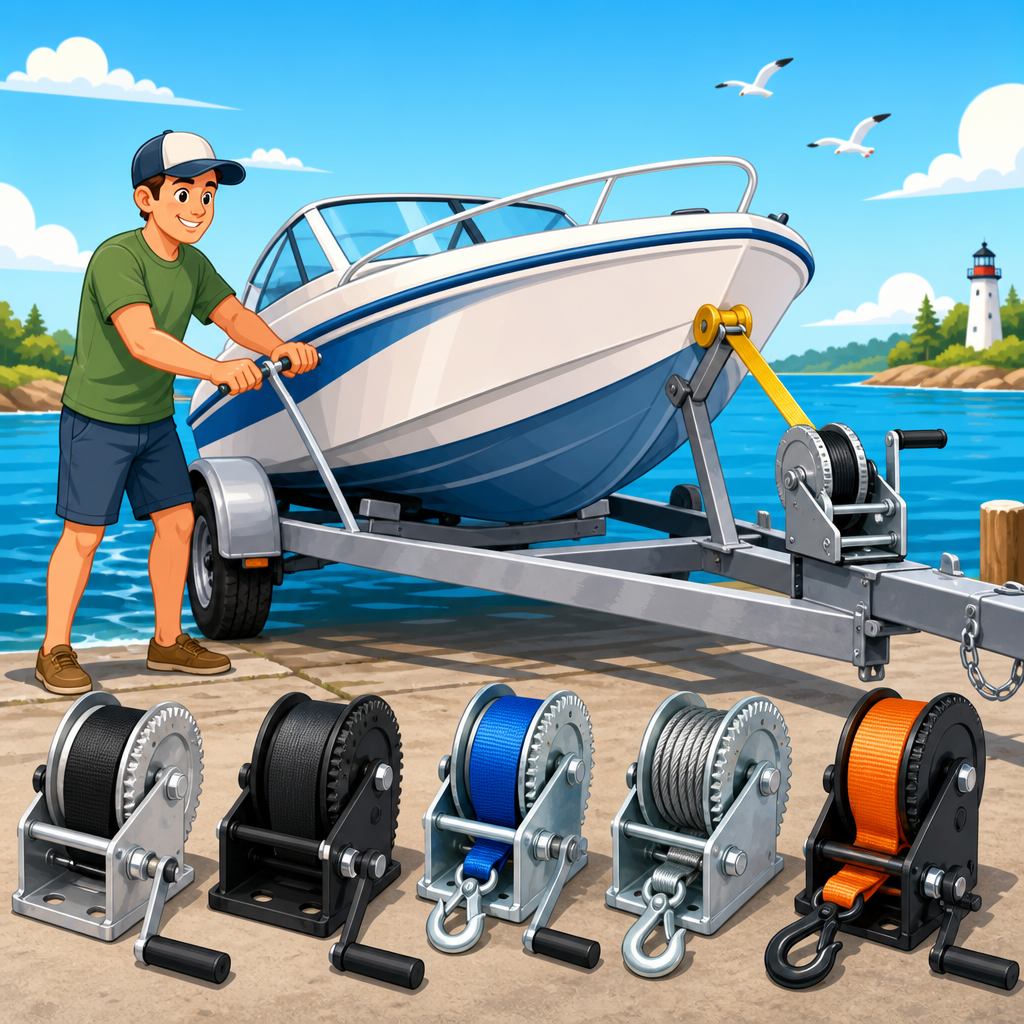
Choosing the right boat trailer winch makes loading safer, faster, and far less stressful, especially on steep ramps, windy days, or when a hull refuses to center cleanly on bunks or rollers. A boat trailer winch is the geared device mounted at the trailer bow stand that pulls the boat forward onto the trailer and holds it against the bow stop during transport. In practical terms, it is one of the most important parts of any boat trailers and towing equipment setup because it affects launch recovery, tie-down security, and towing confidence. I have replaced enough stripped gears, sun-rotted straps, and undersized hand winches to know that the wrong choice creates real problems: bent handles, jerky loading, frayed webbing, and dangerous rollback at the ramp. This guide covers the top 5 boat trailer winches for easy loading while also serving as a hub for the wider subject of boat trailers and towing equipment, including capacity matching, strap versus cable choices, corrosion resistance, mounting fit, maintenance, and safe towing practices. If you are comparing manual and electric options, wondering how much winch capacity you need, or trying to understand how the winch fits with bunks, rollers, couplers, safety chains, lights, brakes, and tie-downs, this article gives direct answers. The goal is simple: help you choose a winch that loads your boat smoothly, protects your hull and trailer, and supports a safer, more reliable towing system.
What makes a boat trailer winch easy to load with
Easy loading starts with mechanical advantage, not marketing claims. A good boat trailer winch gives you enough pull to move the boat the final distance onto the trailer without violent surges or excessive handle force. For most setups, that means a two-speed or well-geared single-speed unit, a reliable ratchet pawl, and a strap or cable that feeds evenly across the drum. Capacity should not be matched to full boat weight. In real use, the winch is overcoming rolling resistance, bunk friction, ramp angle, wind, and current during the last part of recovery. Even so, buying too close to the minimum is a mistake. I generally advise a healthy safety margin, especially for heavier fiberglass boats on bunk trailers, because wet carpeted bunks can still create substantial drag.
Material choice matters just as much. In saltwater, zinc-plated hardware degrades quickly, while galvanized steel and especially stainless components hold up better. The handle grip should remain secure when wet. The frame should resist flex under load. The drum needs clean alignment so the strap does not bunch on one side. A proper bow roller or bow stop reduces side loading on the winch post, and a quality winch stand spreads stress into the trailer tongue rather than concentrating it at flimsy brackets. Easy loading is therefore a system outcome: winch, strap, bow eye, roller angle, trailer depth, bunk setup, and driver technique all work together.
This is why the boat trailer winch belongs in the broader boat trailers and towing equipment conversation. A strong winch cannot compensate for an overloaded trailer, seized roller brackets, bad tongue weight, weak transom tie-downs, corroded wiring, or poorly adjusted surge or electric-over-hydraulic brakes. As the hub page for this subtopic, this article should point you toward related decisions as well: selecting the right trailer type for hull shape, checking wheel bearings and hubs before long trips, sizing tires by load range rather than appearance, confirming your hitch class and ball size, and using a trailer jack, guide-ons, and keel support correctly. If your loading experience has become difficult, the fix may be the winch, but it may also be trailer geometry or maintenance.
Top 5 boat trailer winches for easy loading
After working with freshwater fishing rigs, center consoles, and heavier family runabouts, I look for five traits before recommending any model: honest load rating, dependable gears and pawl engagement, corrosion resistance, smooth strap retrieval, and easy parts availability. The following five winches consistently fit those criteria and cover the most common trailer applications.
| Winch | Best for | Type | Key strength | Main tradeoff |
|---|---|---|---|---|
| Fulton F2 Two-Speed | Frequent ramp use on midsize to larger boats | Manual strap winch | Excellent ergonomics and fast or powerful gearing | Premium price |
| Dutton-Lainson DL Series | Heavy-duty reliability | Manual strap or cable winch | Proven brake and gear durability | More utilitarian finish |
| CURT Two-Speed Marine Winch | Value-focused trailer upgrades | Manual strap winch | Strong feature set for the cost | Less refined handle feel |
| Powerwinch 915 | Heavier boats or reduced manual effort | Electric trailer winch | Push-button loading convenience | Needs battery wiring and care |
| Fulton XLT | Small to midsize boats in mixed conditions | Manual strap winch | Solid corrosion resistance and easy operation | Fewer premium touches than F2 |
The Fulton F2 Two-Speed is one of the best choices for owners who launch often and want a clear upgrade in comfort. Its enclosed design helps shield internals, the handle geometry is comfortable under load, and the two-speed operation gives a useful low gear for the last few feet. On windy ramps, that lower gear makes a noticeable difference because you can keep steady pressure without fighting the boat. It is particularly good on bunk trailers carrying 20- to 24-foot boats where friction is the main issue.
The Dutton-Lainson DL Series has long been a benchmark in trailer hardware. Many owners choose it because replacement parts, straps, and technical information are easy to find. The gear train is robust, and the company has a strong reputation for brake winch designs in other applications, which reflects solid engineering discipline across the range. If you prioritize proven reliability over styling, this is a smart pick.
CURT’s two-speed marine winch earns its place by offering practical performance without a premium price. For many aluminum fishing boats, bay boats, and utility trailers, it delivers the gearing and marine-oriented finish needed for regular service. The Powerwinch 915 is the electric option worth serious consideration when the boat is heavy, the owner loads alone, or shoulder strain is a real concern. It can transform recovery on difficult ramps, but installation quality matters. The Fulton XLT rounds out the list as a dependable middle-ground model with marine corrosion protection and straightforward use for common trailer sizes.
How to choose the right winch capacity, strap, and mounting setup
If you want the short answer, choose a winch with enough reserve capacity that loading feels controlled rather than near the limit. For manual winches on bunk trailers, more capacity usually means easier cranking and longer gear life. Manufacturers publish load ratings, but those ratings are not interchangeable across all conditions. A 3,200-pound rated winch may feel effortless with a lightweight aluminum boat on rollers and strained with a heavier fiberglass hull on bunks. Trailer setup changes the actual pulling force dramatically.
Strap versus cable is another common question. Polyester web straps are usually the better choice for recreational boat trailers because they are easier on hands and hull finishes, less likely to develop fishhooks like damaged wire rope, and simple to inspect for cuts, UV damage, and edge wear. Cable still has a place in some heavy-duty setups, but most recreational owners are better served by a high-quality strap with a forged hook and safety latch. Inspect the bow eye too. A strong winch attached to a corroded or poorly backed bow eye is not a safe system.
Mounting fit is often overlooked. Confirm bolt pattern compatibility with the winch stand, handle clearance through a full rotation, and drum alignment with the bow eye path. If the strap feeds upward or downward at an extreme angle, it can stack unevenly and wear prematurely. The bow roller should support straight-line loading and sit at the right height to guide the stem without forcing the boat downward. On upgrades, I often find that moving the winch stand slightly or replacing a worn bow roller improves loading as much as changing the winch itself. Related pages in this subtopic should also cover trailer bunks versus rollers, proper trailer fit for hull design, and how guide posts help center the boat before the winch takes over.
Manual versus electric winches and where each works best
Manual winches remain the standard because they are affordable, dependable, and simple to maintain. For most small and midsize boats, a quality two-speed manual winch is the best balance of cost and control. You feel the load directly, which helps prevent overcranking against the bow stop or pulling a misaligned hull sideways. Manual models also avoid wiring complexity, battery draw, and the failure points that come with switches, relays, and connectors.
Electric winches solve a different problem: reducing physical effort and improving control on heavier recoveries. They are especially useful for pontoons, larger runabouts, and situations where one person regularly loads in current or crosswind. A good electric model should be paired with appropriate circuit protection, marine-grade wiring, sealed connectors, and a battery with enough reserve. It should never replace proper trailer depth or safe ramp procedure. If the trailer is too shallow and the boat is dragging hard onto dry bunks, an electric winch may simply hide a setup problem while increasing stress on the bow eye and winch stand.
As a rule, use the winch for the final controlled pull, not as a substitute for power-loading where prohibited. Many marinas and state facilities restrict power-loading because prop wash erodes ramp ends and basin bottoms. The right approach is to float or drive the boat onto the trailer as local rules allow, shut down at the proper point, and let the winch finish the alignment and snugging process. That method protects ramps, reduces trailer wear, and gives the cleanest bow-to-stop contact before attaching safety chains and transom straps.
Maintenance, towing safety, and the rest of the trailer system
The best boat trailer winch still needs inspection. Before each trip, check the strap for fraying, melted spots, or cut edges; confirm the hook latch closes; test ratchet engagement; and look for loose mounting bolts or elongating holes in the stand. At seasonal service, lubricate where the manufacturer specifies, rinse thoroughly after saltwater use, and replace damaged straps immediately rather than stretching another season out of them. Corrosion usually starts at fasteners, pawl springs, and drum edges, so pay attention there.
Because this page is the hub for boat trailers and towing equipment, it is worth emphasizing that winch performance depends on the whole towing package. Trailer tires should be inflated to the sidewall-listed cold pressure for their rated use, wheel bearings should be greased or oil-bath hubs monitored for contamination, and brakes should be tested before highway trips. Safety chains must cross under the coupler, the hitch ball must match the coupler size exactly, and tongue weight generally needs to stay in the recommended range, often around 5 to 7 percent for many boat trailers, to reduce sway. Lighting faults, weak grounds, and corroded connectors are among the most common trailer problems I see, and all of them are easier to fix at home than at the ramp before sunrise.
The core takeaway is simple: the top 5 boat trailer winches for easy loading are not just good products; they are solutions within a larger system that includes trailer fit, recovery technique, and towing safety. Fulton F2 stands out for premium manual performance, Dutton-Lainson for long-term durability, CURT for value, Powerwinch 915 for electric convenience, and Fulton XLT for balanced everyday use. Match capacity conservatively, choose a quality strap, align the mounting setup properly, and maintain the winch like any other critical marine component. If you are building out a reliable towing setup, use this page as your starting point, then review the related guides in the boat trailers and towing equipment section to dial in your trailer, hitch, brakes, lights, and tie-downs before your next trip.
Frequently Asked Questions
1. How do I choose the right boat trailer winch size for my boat?
Choosing the right boat trailer winch starts with your boat’s actual loaded weight, not just the dry hull weight listed by the manufacturer. You need to account for the motor, fuel, batteries, gear, coolers, anchors, and anything else that stays in the boat during loading and transport. In general, the winch should be rated to comfortably handle the portion of the boat’s weight being pulled onto the trailer, especially when you are loading on a steep ramp, dealing with current, or recovering a boat that is not perfectly aligned. A winch that is too small will make loading frustrating and can wear out quickly, while one that is properly matched gives you smoother cranking, better control, and more confidence at the ramp.
A good rule is to choose a winch with more capacity than the minimum you think you need. Gear ratio, drum size, strap or cable strength, and trailer setup all matter. Boats on rollers typically require less pulling force than boats on carpeted bunks, and shallow launch conditions can increase resistance significantly. If your boat is near the upper edge of a winch’s advertised rating, it is smarter to step up in capacity rather than run at the limit. For easy loading, look for a winch that offers a comfortable crank effort, a reliable locking mechanism, and enough reserve power for less-than-ideal conditions. Matching the winch to the boat and trailer as a system is the best way to improve safety and recovery performance.
2. Is a winch strap better than a steel cable for a boat trailer winch?
For many boat owners, a winch strap is the more practical and user-friendly option. Polyester straps are easier to handle, less likely to fray your hands, and generally simpler to inspect for visible wear. They also tend to lay flatter on the drum and are less intimidating for casual users at the launch ramp. On modern recreational boat trailers, straps are extremely common because they are strong, convenient, and well suited to frequent launching and retrieval. They are especially popular when ease of use and reduced maintenance are priorities.
Steel cable still has advantages in certain heavy-duty situations. It can offer excellent durability under harsh conditions and may be preferred for very heavy boats or applications where abrasion is a bigger concern than convenience. However, cable can develop broken strands, kink if handled poorly, and require more care to keep in good condition. For most everyday trailer boat setups, a high-quality marine-grade strap paired with a secure hook and safety latch is the better choice for easy loading. No matter which you choose, regular inspection is essential. Look for cuts, fading, fraying, rust, flattened sections, hook deformation, and any signs that the attachment hardware is loosening. The best material is the one that matches your boat’s weight, your trailer use, and your willingness to maintain it consistently.
3. What features make a boat trailer winch easier and safer to use?
The easiest boat trailer winches to use combine sufficient pulling power with smooth operation and reliable load control. One of the most important features is an appropriate gear ratio. A lower gear ratio can pull faster, while a higher mechanical advantage reduces cranking effort. For heavier boats, a two-speed winch can be especially helpful because it lets you retrieve line quickly at first and then shift to more controlled, higher-torque cranking as the boat reaches the bow stop. This makes loading less physically demanding and gives you better control when the final few feet require more force.
Other valuable features include a strong ratchet or brake system, a comfortable handle grip, corrosion-resistant construction, and a durable strap or cable with a secure hook. Galvanized or powder-coated finishes help resist rust, while stainless hardware in key areas can improve long-term reliability in marine environments. A well-designed winch should also spool evenly, resist slipping under load, and hold the boat firmly once positioned. Some boaters also prefer self-locking or brake winches because they offer additional security and reduce the chance of accidental rollback during loading. The safest setup is one where the winch, bow eye, safety chain, mounting plate, and trailer frame all work together. Even the best winch cannot compensate for weak mounting hardware or an improperly adjusted bow stop.
4. How important is corrosion resistance in a boat trailer winch?
Corrosion resistance is extremely important because boat trailer winches are repeatedly exposed to water, road spray, humidity, and, in many cases, salt. A winch that looks solid in the store can deteriorate surprisingly fast if its finish, gears, fasteners, and internal components are not designed for marine use. Rust does more than affect appearance. It can weaken the frame, reduce gear performance, damage the ratchet mechanism, and shorten the life of the strap or cable attachment points. If the winch is hard to crank, sticks, or fails to lock properly, loading becomes less safe and more stressful.
For freshwater boaters, galvanized or quality powder-coated winches often provide good durability with routine care. For saltwater use, corrosion protection becomes even more critical. Look for marine-rated materials, sealed or protected components where possible, and hardware that can withstand repeated exposure without seizing. Rinsing the winch with fresh water after use, allowing it to dry, and lubricating moving parts according to the manufacturer’s guidance can make a major difference in service life. Regular maintenance also gives you a chance to catch early signs of rust, pitting, strap wear, or fastener loosening before they become a launch-ramp problem. In short, corrosion resistance is not a bonus feature. It is a core requirement for dependable boat trailer winch performance.
5. Can a boat trailer winch hold the boat securely during towing by itself?
No, a boat trailer winch should not be the only thing securing your boat during transport. The winch’s job is to pull the boat into position and help hold the bow snug against the bow stop, but safe towing requires multiple securement points. At a minimum, the boat should be attached at the bow with the winch strap or cable and a separate safety chain, and it should also be secured at the stern with properly rated transom tie-down straps. This layered approach reduces the risk of movement if one component loosens, stretches, or fails during travel.
This is especially important because road vibration, sudden braking, potholes, and ramp angles can all place shifting loads on the trailer setup. A winch strap alone is not designed to absorb every force encountered on the road. The safest practice is to tighten the boat firmly to the trailer, confirm the bow eye is seated correctly, attach the safety chain, and use stern tie-downs to limit bounce and side-to-side movement. It is also wise to recheck everything after driving a short distance, particularly on longer trips. When the winch is treated as one part of a complete securement system, it helps protect the boat, the trailer, and everyone else on the road.