Choosing the best boat trailers for small, medium, and large boats starts with understanding that a trailer is not just a transport accessory; it is a critical piece of boating gear and equipment that affects safety, launch efficiency, hull protection, storage, and total ownership cost. In practical terms, a boat trailer is a purpose-built frame, suspension, axle, wheel, brake, and support system designed to carry a specific hull weight and shape from home to ramp and back again. Towing equipment includes couplers, hitches, safety chains, tie-downs, trailer jacks, winches, wiring, lights, brake controllers, and spare-tire setups that make the entire system road legal and manageable.
This topic matters because trailer mismatch is one of the most common and expensive mistakes boat owners make. I have seen small aluminum fishing boats bounce on oversized bunk trailers, heavy center consoles overload single axles, and owners discover at the ramp that their lights failed, their tongue weight was wrong, or their rollers were denting the hull. A good trailer supports the boat evenly, keeps gross trailer weight within the tow vehicle’s limits, and reduces stress on bearings, tires, brakes, and transom structures. It also shortens launch time, improves highway stability, and protects resale value.
For buyers building out a complete boating gear and equipment plan, this hub on boat trailers and towing equipment should answer the core questions directly: what trailer type fits each boat size, what materials last longest, what axle and brake setup is appropriate, and which towing accessories are essential rather than optional. The best boat trailers are matched by loaded boat weight, hull style, use frequency, ramp conditions, and storage environment. That means a trailer for a 14-foot jon boat should not be evaluated by the same standards as one carrying a 30-foot cabin cruiser. The right choice balances capacity, support geometry, corrosion resistance, serviceability, and compatibility with the tow vehicle.
A practical rule is to calculate total trailering weight before shopping. Add dry boat weight, outboard or sterndrive weight, batteries, full fuel, water where applicable, gear, electronics, anchors, coolers, and the trailer itself. Then select a trailer with enough gross vehicle weight rating to carry that real-world load with margin, not just brochure numbers. Most experienced owners target a cushion rather than loading a trailer to its limit every trip. From there, the buying process becomes clearer: choose bunk or roller support, decide between galvanized steel or aluminum construction, confirm axle count and brake requirements, and make sure your hitch class, tongue weight, and tow rating all align.
Best boat trailers for small boats
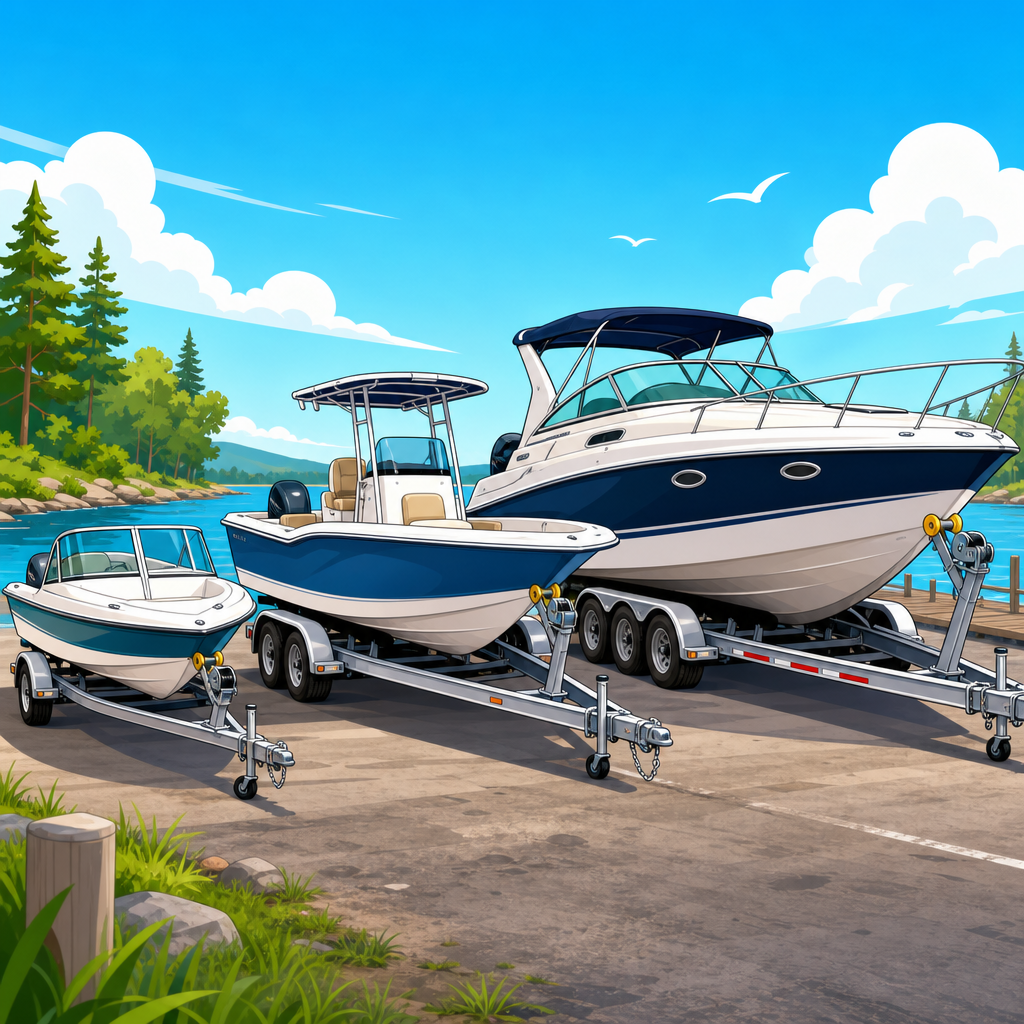
Small boats usually include jon boats, inflatable RIBs, skiffs, compact aluminum fishing boats, and personal watercraft. In this class, simplicity and fit matter more than heavy-duty complexity. The best boat trailers for small boats are often single-axle bunk trailers with leaf springs, compact tires, submersible LED lights, and a hand winch rated above the boat’s loaded weight. For lightweight aluminum hulls, carpeted bunks spread the load gently and are easier on riveted or thin-gauge construction than poorly adjusted rollers. For PWCs, shaped bunks and frame geometry that centers the hull during retrieval are more important than extra capacity.
Typical loaded weights in this category range from roughly 800 to 2,500 pounds, though some bay boats and heavily rigged multispecies boats exceed that. A single-axle trailer is usually the best value because it costs less, is easier to maneuver by hand, and has fewer tires, hubs, and brake components to maintain. Galvanized steel is a strong choice for owners who launch in freshwater and saltwater, while painted steel is acceptable for freshwater-only use if the frame is washed regularly and chips are touched up. Aluminum trailers save weight and resist corrosion well, but hardware, axles, and fasteners still need inspection because no trailer is completely maintenance free.
For small boats, common buying mistakes include choosing tiny tires that run hot at highway speed, using inadequate transom tie-downs, and ignoring tongue weight. A properly loaded trailer should place enough weight on the hitch for stability without exceeding the receiver or vehicle limits. In most setups, around 5 to 7 percent of total trailer weight on the tongue is a useful target, though some towing guides specify slightly higher ranges. If the boat sits too far aft, sway becomes more likely; too far forward and the rear suspension of the vehicle squats excessively. Adjustable winch stands and axle position help fine-tune this balance.
Best boat trailers for medium boats
Medium boats cover a broad group: fiberglass runabouts, bass boats, dual consoles, fish-and-ski models, and many center consoles from roughly 18 to 24 feet. This is where trailer selection becomes less forgiving, because loaded package weights often land between 3,000 and 7,000 pounds. At this point, tandem-axle trailers become common because they improve stability, spread the load, and provide better control if a tire fails. The best boat trailers for medium boats are usually custom-fit or semi-custom bunk trailers with disc brakes on at least one axle, torsion or leaf-spring suspension matched to the boat’s weight, and a frame material selected for the owner’s water type and storage conditions.
Bunk trailers remain the default recommendation for many fiberglass and aluminum boats because they support the hull over longer contact areas. Roller trailers are useful in shallow ramps and for easier launching, but they must be adjusted carefully to avoid point loading. Bass boat owners often prefer low-slung painted or powder-coated steel trailers that match the boat, tow cleanly, and sit low enough for easy loading in wind. Coastal anglers tend to favor aluminum I-beam or galvanized steel trailers because repeated saltwater immersion punishes painted finishes fast, especially around crossmembers, welds, brake hardware, and spring hangers.
Braking is nonnegotiable in this class. Surge brakes are common and self-contained, making them popular for boat trailers, while electric-over-hydraulic systems offer stronger, more controllable braking for heavier rigs and frequent towing. Disc brakes are better than drums for marine use because they shed water faster and are easier to inspect and service. If you tow long distances through hills or stop-and-go traffic, disc brakes on both axles are worth the added cost. Medium boats also benefit from radial trailer tires with adequate load range, bearing protectors or oil-bath hubs where appropriate, and a swing tongue only if storage space truly requires it and the mechanism is rated and maintained properly.
Best boat trailers for large boats
Large boats include offshore center consoles, walkarounds, larger wake boats, pilothouse boats, and cruisers commonly ranging from 24 feet upward. In this category, the best boat trailers for large boats are engineered around high loads, long wheelbases, and controlled braking. Triple-axle trailers become common once total trailer weight climbs well beyond what a tandem setup can comfortably support, though exact thresholds depend on axle ratings and local regulations. These trailers should have strong main rails, heavy-duty crossmembers, stainless or corrosion-resistant hardware where possible, load-rated winches, robust bow stops, and full brake systems designed for repeated high-energy stops.
Large-boat owners should think like commercial operators. Every component needs margin: tires by load range, wheels by pressure rating, couplers by gross trailer weight, and straps by working load limit. Trailer capacity should never be selected by dry hull weight alone because fuel can add hundreds of pounds, twin outboards add substantial transom mass, and onboard equipment such as generators, hardtops, tackle, and batteries compounds quickly. I routinely advise buyers to weigh the fully loaded rig on a certified scale after purchase because actual numbers often surprise them. That scale ticket is one of the most useful documents you can keep for tow-vehicle setup and maintenance planning.
For large boats, adjustability matters. Hydraulic or screw-adjustable bunks help accommodate deadrise and strakes, while guide-ons and centering systems reduce loading stress at steep or windy ramps. Triple-axle trailers track well but scrub tires in tight turns, so tire wear is normal and should be budgeted. If your boating involves long interstate runs, mountain grades, or frequent travel to service yards, electric-over-hydraulic disc brakes are often the best solution. They provide stronger feel, smoother modulation, and better integration with in-cab brake controllers than surge systems. For oversized beams or weights, legal requirements may include permits, wider mirrors, route restrictions, or commercial-grade tie-down practices.
How to match trailer type, material, and features
Most buyers can narrow options quickly by comparing four variables: boat size, launch environment, travel distance, and maintenance tolerance. The table below summarizes what usually works best.
| Boat size | Typical loaded weight | Best trailer style | Best frame material | Key towing equipment |
|---|---|---|---|---|
| Small | 800-2,500 lbs | Single-axle bunk | Galvanized steel or aluminum | Hand winch, transom straps, spare tire |
| Medium | 3,000-7,000 lbs | Tandem-axle bunk | Aluminum for salt, painted steel for fresh | Disc brakes, bearing protection, hitch lock |
| Large | 7,500 lbs and up | Tandem or triple-axle custom bunk | Aluminum I-beam or heavy galvanized steel | Electric-over-hydraulic brakes, weight-rated straps, brake controller |
Bunk versus roller is the first major decision. Bunks are better for most modern hulls because they distribute weight across longer surfaces and generally require less fine adjustment after setup. Rollers reduce launch resistance and can help at shallow ramps, but they introduce more moving parts and greater risk of hull pressure points if poorly aligned. Material choice comes next. Galvanized steel offers excellent corrosion resistance and value, painted steel looks good and can be very durable in freshwater, and aluminum reduces trailer weight while resisting rust, though it can cost more upfront.
Feature selection should be driven by use, not marketing checklists. Submersible LED lights, sealed connectors, radial trailer tires, a matching spare mounted on the frame, and a reliable tongue jack are baseline items. Side guides, boarding steps, diamond-plate fenders, and ladder-style steps improve usability. Vault-style hybrid lubrication hubs, oil-bath hubs, and bearing protectors each have supporters; what matters most is regular inspection, temperature checks after towing, and scheduled service. For a sub-pillar hub on boat trailers and towing equipment, related topics worth exploring next include trailer tire load ratings, brake maintenance intervals, bearing replacement, hitch setup, launch ramp technique, and saltwater corrosion prevention.
Essential towing equipment, maintenance, and buying advice
The best boat trailer can still underperform if the towing equipment is weak. Start with a receiver hitch and ball mount rated above the trailer’s gross weight, then confirm the ball size matches the coupler exactly, usually 2 inches or 2-5/16 inches. Safety chains should cross under the coupler, the breakaway cable should be independent of the chains, and trailer wiring should be tested before every trip. If the trailer uses electric-over-hydraulic brakes, the in-cab controller should be adjusted with the trailer loaded, not empty. Extended mirrors, a torque wrench for lug nuts, wheel chocks, a spare hub or bearing kit, and a bottle jack sized for the loaded axle are smart additions.
Maintenance is where long-term trailer value is won or lost. Before each trip, check tire pressure cold, inspect sidewalls for age cracking, verify lights, feel the winch strap for wear, and confirm transom straps are not frayed. During the season, rinse thoroughly after saltwater use, flush brakes when practical, inspect brake pads and rotors, look for uneven tire wear that suggests alignment or bent-axle issues, and spin each wheel listening for rough bearings. Annually, service hubs, inspect suspension hardware, replace corroded U-bolts, and examine bunks for rotten wood or loose brackets. Most trailer failures give warning signs first; owners get stranded when they ignore them.
When buying, prioritize fit and service support over cosmetics. A trailer built by a reputable manufacturer with available parts, standard brake components, and local dealer support is more valuable than a flashy frame with proprietary pieces you cannot source in July. Ask for axle ratings, brake type, tire date codes, frame warranty terms, and whether the trailer setup was adjusted to your exact hull. If buying used, inspect for rust scale inside boxed sections, brake line corrosion, patched wiring, uneven bunk loading marks, and tire age regardless of tread depth. Match the trailer to the real boat, match the towing equipment to the real load, and you will tow safer, launch faster, and spend less over time.
The best boat trailers for small, medium, and large boats are the ones engineered for the actual hull, the actual load, and the actual way you use your boating gear and equipment. Small boats do best on simple single-axle trailers with good bunk support, correct tongue weight, and basic but dependable hardware. Medium boats usually need tandem axles, marine-grade disc brakes, and more careful attention to suspension, tire load range, and corrosion resistance. Large boats demand heavy-duty construction, advanced braking, adjustability, and strict respect for tow ratings, legal limits, and service intervals.
Across every size, the same principles hold. Calculate loaded weight honestly, buy capacity with margin, choose materials for your water conditions, and never treat brakes, tires, bearings, or tie-downs as secondary details. Trailer quality shows up on the highway, at the ramp, and in maintenance costs over years of ownership. This hub gives you the framework to evaluate boat trailers and towing equipment confidently and to connect the rest of your research, from hitch setup to brake service and trailer tire selection. Use these guidelines to compare options carefully, ask better questions at the dealer, and choose a trailer that protects your boat every mile.
Frequently Asked Questions
How do I choose the best boat trailer for a small, medium, or large boat?
The best way to choose a boat trailer is to match the trailer to the boat’s actual size, loaded weight, and hull design rather than relying on a generic “fits this length” label. Start by calculating the total trailering weight, which includes the boat, engine, fuel, batteries, water gear, anchors, coolers, safety equipment, and any accessories stored onboard. Many owners underestimate this number, and that can lead to overloaded axles, poor braking performance, premature tire wear, and unsafe towing. Once you know the real weight, choose a trailer with enough capacity to support it comfortably without being oversized to the point that the boat sits poorly or is difficult to balance.
Boat size also affects the ideal trailer configuration. Small boats often do well on lighter single-axle trailers that are easier to maneuver, store, and maintain. Medium boats commonly benefit from tandem-axle trailers for improved stability, smoother towing, and better load distribution. Large boats usually require heavier-duty tandem or triple-axle trailers, stronger frames, integrated braking systems, and more precise support at key hull contact points. Just as important is matching the trailer style to the hull. Bunk trailers are often preferred for better hull support and are common for fiberglass and many V-hull boats, while roller trailers can make launching easier in some conditions but may not be ideal for every hull type.
You should also evaluate frame material, braking requirements, tire and wheel ratings, suspension type, tongue weight balance, and the towing limits of your vehicle. The right trailer should allow safe highway travel, straightforward launching at your local ramp, proper hull protection during transport, and manageable long-term maintenance. In short, the best boat trailer is the one engineered for your specific boat and the way you actually use it, not just the one with the lowest price or broadest fit range.
What size and weight capacity should a boat trailer have?
A boat trailer should have a weight capacity that exceeds your boat’s fully loaded trailering weight, not just the dry hull weight listed by the manufacturer. Dry weight numbers are helpful as a starting point, but they usually do not include the outboard or sterndrive, fuel, batteries, electronics, trolling motor, fishing gear, life jackets, anchors, ice chests, or other onboard items that quickly add hundreds or even thousands of pounds. A properly sized trailer gives you a margin of safety so the suspension, axle, tires, hubs, and brakes are not operating at their limits every time you tow.
As a general principle, small boats such as jon boats, skiffs, small aluminum fishing boats, and compact personal watercraft setups can often be carried on single-axle trailers with modest capacity ratings. Medium boats, including larger fishing boats, runabouts, bay boats, and many center consoles, often require tandem-axle trailers with significantly higher gross trailer weight ratings for better stability and control. Large boats, such as offshore center consoles, cruisers, and substantial wake or sport boats, usually demand heavy-duty trailers with higher-capacity axles, reinforced frames, brakes on multiple axles, and tires specifically rated for the total load.
Length matters too, but support geometry matters just as much. The trailer must properly support the hull along its structural strength points and keep the boat balanced so tongue weight remains in a safe range for the tow vehicle. A trailer that is technically strong enough but too short, too narrow, or poorly configured can still create launching problems, stress the hull, and tow unpredictably. For that reason, capacity, fit, and balance should always be evaluated together. If there is any uncertainty, use the loaded weight plus a reasonable safety buffer and confirm the final setup against both the trailer manufacturer’s rating and your tow vehicle’s towing and hitch limits.
Is a bunk trailer or a roller trailer better for my boat?
For many boat owners, a bunk trailer is the better all-around choice because it provides broad, even support along more of the hull and tends to be gentler on fiberglass and painted surfaces during transport. Bunks are especially popular for small to large fishing boats, bass boats, bay boats, and many recreational fiberglass hulls because they help distribute weight more naturally. They also tend to hold the boat more securely during highway travel. If your priorities are hull protection, long-distance towing confidence, and a trailer setup designed around a specific boat shape, bunk trailers are often the preferred solution.
Roller trailers, on the other hand, are designed to reduce friction and make launching and loading easier, particularly at shallower ramps or in places where conditions are less ideal. Because the boat moves more freely, a roller setup can be convenient for some owners who frequently launch solo or use variable ramp conditions. However, that ease of movement also means setup and adjustment are critical. Poorly positioned rollers can create pressure points, and not every hull design responds equally well to roller support. For heavier boats, hull-specific compatibility becomes even more important.
In practice, the better trailer is the one that matches your hull design, launch environment, and towing habits. If you launch at well-designed ramps and want strong hull support for regular transport, bunk trailers are often the safest long-term bet. If you need easier launching in difficult conditions and your boat is well suited to roller contact points, a roller trailer may make sense. Some owners also choose hybrid configurations that combine support and loading convenience. The key is not choosing by category alone, but by how well the trailer supports the boat’s structure and performs in real-world towing and ramp use.
What trailer features matter most for towing safety and boat protection?
The most important trailer features are the ones that directly affect stability, braking, hull support, and reliability on the road. Start with the frame and running gear. A strong, properly rated frame, quality axles, marine-capable suspension components, dependable hubs, and trailer-rated tires are foundational. If any of these are undersized or poorly maintained, towing safety drops quickly. Brakes are another major consideration, especially as boat size increases. A trailer carrying a medium or large boat should have brakes appropriate to the load and legal requirements in your area, and those brakes should be inspected regularly for corrosion, wear, and proper function.
Hull protection depends heavily on fit and support. Adjustable bunks or rollers should align with the boat’s structure, the winch stand should position the bow securely without forcing the hull unnaturally, and the boat should sit level with balanced tongue weight. Good transom tie-downs, a reliable winch strap, and a properly fitted bow stop help keep the boat stable during acceleration, braking, and uneven road conditions. Lighting matters too. Bright, sealed lights and secure wiring are essential for visibility and compliance, especially when the trailer is frequently submerged during launch and retrieval.
Other high-value features include corrosion-resistant materials such as galvanized steel or aluminum, especially in saltwater environments; radial trailer tires with the correct load rating; swing tongues or storage-friendly dimensions if space is limited; guide-ons for easier loading; and steps or fenders designed for safer boarding access at the ramp. For larger boats, torsion axles, upgraded couplers, spare tire mounts, and more advanced brake setups can significantly improve the ownership experience. The best trailer is not just one that carries the boat, but one that protects the hull, behaves predictably at speed, and remains dependable over years of launching, towing, and storage.
How can I make a boat trailer last longer and reduce ownership costs?
Extending boat trailer life comes down to consistent maintenance, proper loading, and early attention to small problems before they become expensive failures. One of the most important habits is rinsing the trailer thoroughly after each use, especially after saltwater exposure. Salt accelerates corrosion in frames, brakes, wiring connections, hubs, springs, and fasteners. Even galvanized and aluminum trailers benefit from regular cleaning. Wheel bearings should be inspected and serviced on schedule, tires should be kept inflated to the correct pressure and replaced when age or wear becomes a concern, and brakes should be checked routinely for performance and corrosion-related damage.
Proper storage also reduces long-term cost. Whenever possible, store the trailer on a firm surface, avoid leaving tires under constant stress on soft ground, and protect the setup from prolonged weather exposure. Check the bunks, carpet, roller assemblies, winch strap, safety chains, lights, and harness connections regularly. If the boat does not sit correctly on the trailer, fix the adjustment rather than continuing to tow with poor balance or uneven support. Over time, misalignment can damage both trailer components and the boat hull. It is also smart to keep a spare tire, basic tools, bearing service supplies, and replacement light parts on hand so minor issues do not turn into trip-ending problems.
Reducing ownership costs also starts with buying the right trailer in the first place. A trailer that is correctly sized for the boat, built with suitable materials for your freshwater or saltwater environment, and equipped with adequate brakes and running gear will usually cost less over time than a cheaper trailer that is constantly overloaded or corroding prematurely. In other words, the lowest purchase price is rarely the lowest total cost. Smart trailer ownership means treating the trailer as essential boating equipment: maintain it proactively, match it properly to the boat, and inspect it before every trip.