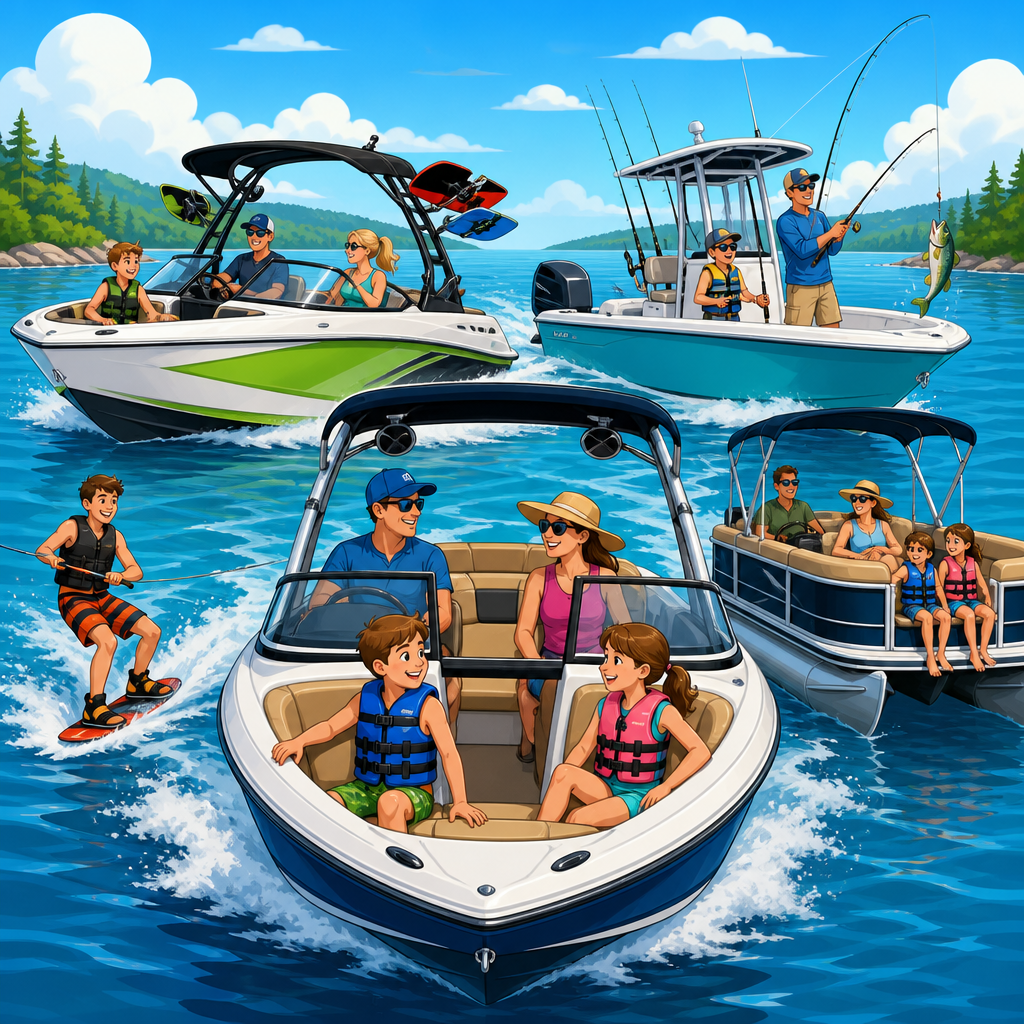
Choosing the best family boats for watersports and angling starts with one practical question: how well can one boat handle tubing in the morning, casting at noon, and a relaxed cruise home at sunset? A true multi-purpose boat blends fishability, towing performance, comfort, storage, and safety without forcing families to specialize too early. In the boating market, “family boat” usually means versatile seating, predictable handling, and easy boarding, while “watersports” points to enough horsepower, tow points, swim access, and stable tracking for skiing, wakeboarding, and tubing. “Angling” adds rod storage, livewell options, trolling capability, casting space, and layouts that still work when kids and guests come along.
I have spent years walking buyers through this exact compromise, and the right answer is rarely the flashiest hull on a showroom floor. It is the model that matches how your family actually uses the water. A dedicated bass boat is excellent for tournament mornings but weak for entertaining. A pure wake boat throws beautiful surf waves but sacrifices open deck space, fishing features, and often fuel efficiency at cruising speeds. Multi-purpose boats sit in the middle, and that middle matters because most families do not want separate rigs for every activity.
This guide covers the top 5 best family boats for watersports and angling, with a focus on real-world usability, not brochure claims. The five categories here are fish and ski boats, dual console boats, deck boats, center console boats, and pontoon boats with sport packages. These are the designs I most often see succeed as all-around platforms because they solve the core family problem: keeping different users happy on the same day. Along the way, this hub article explains what makes multi-purpose boats for fishing and watersports work, what tradeoffs come with each style, and which features deserve priority before you buy.
What Makes a Multi-Purpose Family Boat Work
The best multi-purpose family boat does four things well. First, it carries enough power for towing. For most families, that means an engine package capable of pulling a tube or skier cleanly out of the water, usually starting around 150 horsepower for midsize boats, though hull weight and prop setup matter as much as the raw number. Second, it preserves fishable space. Anglers need uncluttered corners, rod holders, electronics mounting points, and ideally a livewell or removable fishing package. Third, it protects passengers with high freeboard, secure handholds, boarding ladders, and stable low-speed manners. Fourth, it stores gear intelligently, because watersports equipment and tackle consume space fast.
Hull design is central. Deep-V hulls soften chop and inspire confidence on larger lakes and coastal bays, but they often draft more water and can reduce at-rest stability. Modified-V and tri-toon platforms are easier for casual family use and can create broader usable deck space. Layout also matters. Bow seating is excellent for cruising and socializing but can interfere with dedicated casting room. Removable cushions, filler panels, and convertible seating are the difference between a boat that claims versatility and one that actually delivers it.
Before looking at specific boat types, families should define their dominant use case. If your weekends revolve around towing kids and occasional panfish trips, your requirements differ from a household that trolls for walleye at dawn and wakeboards later. The best family boats for watersports and angling are not universally identical. They are purpose-balanced, and the balance point should follow your water conditions, passenger count, tow vehicle capacity, storage limits, and budget for fuel, maintenance, and insurance.
1. Fish and Ski Boats: The Classic Crossover Choice
Fish and ski boats remain one of the strongest answers for families who want one trailerable rig to cover both fishing and watersports. These boats evolved from fiberglass bass and multispecies platforms but added rear bench seating, ski pylons, boarding ladders, and more passenger-friendly cockpit layouts. In practice, they deliver one of the cleanest compromises available. You still get elevated casting decks, lockable rod storage, aerated livewells, and fishfinder-friendly helm space, yet the boat can pivot quickly into tow-sports mode by stowing rods, installing cushions, and using the designated tow point.
Brands such as Ranger, Lowe, and Skeeter have all offered fish and ski concepts that appeal to inland lake families. Typical lengths run from about 18 to 21 feet, making them easy to tow and store compared with larger dual consoles. Most ride on outboards, which simplify service access and free cockpit room. For anglers, outboards also allow clean trolling setups and easier shallow-water operation. For families, the performance benefit is immediate acceleration, useful when pulling a skier up or moving between spots on a busy weekend.
The tradeoff is seating capacity and walkaround comfort. Fish and ski boats are still more boat for anglers than for loungers. If your family routinely carries eight or nine people, this category feels tight. In rougher water, some models can also feel lower and more performance oriented than casual boaters expect. Still, for families that split time fairly evenly between fishing and watersports, the fish and ski design often provides the sharpest blend of speed, fishability, and storage.
2. Dual Console Boats: Best Overall Balance for Mixed Use
If one boat type consistently fits the broadest range of families, it is the dual console. These boats pair a deep-V hull with a windshield-protected helm, a companion console, open bow seating, and a versatile cockpit that can be configured for fishing or watersports. They are especially strong for larger lakes where wind chop can turn a casual afternoon into an uncomfortable ride. Compared with deck boats, dual consoles usually offer a softer, drier ride. Compared with center consoles, they provide better family weather protection and more comfortable seating.
Manufacturers like Grady-White, Scout, Boston Whaler, and Lund have shown how broad this category can be. Some dual consoles lean upscale and coastal, while others target freshwater families who want a ski tow bar, snap-in carpet, trolling motor compatibility, and optional fishing packages. In many layouts, the aft bench folds away to create casting room, and bow cushions remove to uncover fishable platforms. That conversion speed matters. A boat that changes modes in five minutes gets used more fully than one requiring major rearrangement.
| Boat Type | Best For | Main Strength | Main Tradeoff |
|---|---|---|---|
| Fish and Ski | Balanced freshwater use | Strong fishing features with tow capability | Less seating space |
| Dual Console | Families on larger lakes | Best all-around comfort and versatility | Higher price than simpler layouts |
| Deck Boat | Big crews and easy recreation | Exceptional passenger space | Usually lighter on fishing features |
| Center Console | Serious anglers with active families | 360-degree fishability and offshore confidence | Less lounge comfort |
| Pontoon or Tri-toon | Comfort-first lake families | Space, stability, and easy boarding | Fishing and tow performance depend on package |
For watersports, a dual console benefits from longer running surfaces and stable tracking. With the right engine, commonly 200 to 300 horsepower in the 21- to 24-foot range, these boats can tow tubes, skiers, and wakeboarders confidently. For angling, they work best when rigged intentionally: add pedestal seat bases, a trolling motor, quality sonar from Garmin, Humminbird, or Lowrance, and rod storage that keeps gear away from passenger traffic. If your family wants one of the top 5 best family boats for watersports and angling with the fewest compromises, the dual console is the benchmark.
3. Deck Boats: Maximum Family Space with Surprising Flexibility
Deck boats are often underestimated in fishing conversations because they are usually marketed around entertaining, swimming, and watersports. That is only half the story. A well-designed deck boat offers enormous usable interior space, wide bow sections, easy movement, and enough horsepower to make tubing and skiing simple. For families with young children, grandparents, or frequent guests, the open layout is a major advantage. Boarding is easier, sightlines are better, and people are less likely to feel cramped than on more specialized hulls.
Brands such as Hurricane and Bayliner have long dominated this segment, and many models now include fishing packages with pedestal seat mounts, livewells, trolling motor plugs, and removable casting chairs. These setups are not tournament grade, but they are more than adequate for casual bass fishing, crappie trips, and inshore casting on protected water. Because deck boats often carry broad beam widths, they feel stable at rest, which is useful when several family members are moving around or when kids are learning to cast.
The limitation is in rough-water handling and dedicated angling ergonomics. Deck boats can pound more than a deeper dual console in chop, and open seating consumes space that serious anglers would rather devote to clear decks and storage lockers. Yet for families whose boating life centers on people first and fishing second, they make sense. In many households, the best boat is the one everyone agrees to board, and deck boats routinely win that vote because they feel welcoming and simple from the first outing.
4. Center Console Boats: Best for Anglers Who Still Want Family Fun
Center console boats are often viewed as fishing machines, but many modern models are legitimate family platforms, especially in saltwater markets and larger freshwater systems. Their core advantage is 360-degree access around the boat. That means cleaner casting lines, easier fish fighting, and better movement when multiple anglers are aboard. Add a forward seating package, removable backrests, a stern bench, and a tow point, and a center console becomes more family-friendly than many buyers expect.
Builders like Boston Whaler, Key West, Robalo, and Sea Hunt have invested heavily in family-ready center console layouts. It is common now to see insulated fish boxes that double as storage, freshwater washdowns, enclosed head compartments in the console, and aft seating that folds away when it is time to fish. On larger models, hardtops provide meaningful sun protection, and high freeboard adds security for children. For coastal families who split time between sandbar days and serious inshore or nearshore angling, this category is hard to beat.
The tradeoff is comfort underway for passengers who want windshield protection and softer seating. Center consoles expose more of the crew to wind and spray than dual consoles. They also tend to prioritize deck utility over lounging space. Watersports are certainly possible, especially tubing, but the experience is usually more utilitarian than on boats designed first around tow sports. Even so, for families where fishing drives the purchase and recreation follows closely behind, the center console deserves a place among the top 5 best family boats for watersports and angling.
5. Pontoon and Tri-toon Boats with Sport Packages
Pontoons have changed dramatically over the past decade. The old assumption that they are slow party platforms is outdated. Modern tri-toons with lifting strakes, underskinning, hydraulic steering, and 200- to 400-horsepower ratings can tow skiers, pull tubes aggressively, and cruise efficiently with a full crew. For families, the appeal is obvious: unmatched seating capacity, flat and stable decks, easy entry through wide gates, and enough furniture-like comfort to keep non-anglers happy for hours.
For fishing, many manufacturers offer dedicated fish-n-cruise layouts with livewells, rod holders, swivel fishing seats, and sonar mounts. Bennington, Sun Tracker, Harris, and Manitou all have versions aimed at buyers who want a little of everything. A pontoon will never mimic the casting precision or rough-water cut of a deep-V fishing hull, but on inland lakes and calm reservoirs, it covers an enormous range of family use. It is especially effective for mixed-age groups where one person wants to cast, two kids want to swim, and others simply want shade and space.
The key is choosing the right toon configuration. A two-tube pontoon may be fine for relaxed cruising and light fishing, but families serious about watersports should look closely at tri-toons, tow bars, performance logs, and transom ratings. Storage planning is also essential because tow ropes, life jackets, tubes, tackle, and coolers can clutter a pontoon quickly. When equipped correctly, however, a tri-toon is one of the most practical multi-purpose boats for fishing and watersports available today.
How to Choose the Right One for Your Family
The smartest way to choose among these multi-purpose boats is to rank your top three activities and buy for the first two, not all ten things a salesperson can imagine. If fishing and towing are equally important, start with a fish and ski or dual console. If entertaining and tubing dominate, narrow to a deck boat or tri-toon. If angling comes first and family recreation must still fit comfortably, a center console deserves serious attention. Then confirm the basics: capacity plate, maximum horsepower, dry weight with trailer, fuel burn at cruise, storage dimensions at home, and local dealer support for warranty and service.
Sea trials matter more than showroom impressions. Bring the family, sit in every seat, test boarding from the swim platform, and inspect how fast the layout converts from cruising to fishing. Check whether rods can be secured safely, whether wet gear has a place to drain, and whether a child can move around without stepping over tackle. Those details decide long-term satisfaction. The top 5 best family boats for watersports and angling all work, but the best one for you is the model that fits your water, your crew, and your habits with the least friction.
Families shopping for multi-purpose boats for fishing and watersports should think in terms of use balance, not marketing labels. Fish and ski boats favor active freshwater crossover use. Dual consoles offer the strongest all-around mix. Deck boats maximize social space. Center consoles reward serious anglers. Pontoon and tri-toon boats deliver comfort, stability, and surprising sport performance when properly equipped. Each can succeed if matched to the right household.
The lasting benefit of buying the right family boat is simple: more days on the water with fewer compromises and fewer regrets. Define your priorities, compare layouts carefully, and test real boats in real conditions before signing. If you are building out your Fishing & Water Sports plan, use this hub as your starting point and move next into the specific boat style that best matches your family’s routine.
Frequently Asked Questions
What makes a boat a good choice for both watersports and angling?
A great family boat for both watersports and angling succeeds because it balances two very different jobs without feeling compromised in either role. For watersports, the boat needs enough horsepower for quick hole shot, steady acceleration, predictable tracking, and seating that keeps passengers secure while towing a tube, wakeboard, or skier. For angling, it needs practical deck space, smart rod and tackle storage, stable handling at rest, and enough open room to cast without constantly working around furniture. The best all-around family models usually combine a comfortable cockpit with convertible seating, a boarding-friendly layout, and a hull design that can cruise smoothly, tow confidently, and still feel manageable when slowing down to fish.
Families should also pay close attention to how easily the boat transitions between activities. Features like removable cushions, fold-away seating, livewells, ski tow pylons, swim platforms, in-floor storage, and easy-to-clean flooring make a major difference in daily use. Safety and comfort matter just as much as performance, especially with children on board. High freeboard, secure handholds, easy water re-entry, and good visibility from the helm all help create a more family-friendly experience. In practice, the best family boats for watersports and angling are often fish-and-ski boats, dual consoles, deck boats, and certain center consoles with family seating, because these designs offer the versatility needed for active mornings, relaxed afternoons, and casual evening cruising.
Which boat styles are usually considered the best family boats for watersports and angling?
The strongest candidates are usually fish-and-ski boats, dual console boats, deck boats, and hybrid center consoles. Fish-and-ski boats are purpose-built for families who want to split time between towing riders and chasing fish. They often include elevated casting platforms, pedestal seat locations, livewells, rod storage, and trolling motor capability, while still offering a ski pylon, rear swim access, and enough power for tubing or skiing. For buyers who want a true crossover layout, this category is often the most obvious starting point.
Dual console boats are another excellent option because they blend comfort and function especially well. Their windshield design adds weather protection for family outings, while the bow seating, cockpit space, and stern access support cruising and watersports. Many dual consoles can be rigged with ski tow bars, upgraded engines, fishing packages, and removable gear that lets owners adapt the boat to the day’s plans. Deck boats lean more toward social seating, open layouts, and watersports-friendly performance, but some offer fishing packages that include pedestal mounts, livewells, and trolling motor prep. Hybrid center consoles can also work for active families who prioritize fishing but still want family seating, swim ladders, and enough power for tow sports. The best style depends on whether the family places slightly more value on fishing efficiency, towing performance, passenger comfort, or all-day versatility.
How much horsepower does a family boat need for tubing, skiing, and wake-style activities?
Horsepower needs depend on boat size, passenger load, and the type of watersports your family actually plans to do. For casual tubing with a few people on board, many family boats in the 18- to 22-foot range perform well with moderate power. However, if you expect to carry a full crew, pull older kids or adults, and maintain strong acceleration throughout the day, a higher horsepower engine will make the experience easier and more enjoyable. Watersports place very real demands on a boat, especially when pulling from deep water starts, so families should avoid underpowering a versatile boat just to save money up front.
In practical terms, enough horsepower means the boat can get on plane quickly, hold speed steadily, and respond well when loaded with passengers, gear, and fuel. For skiing and wake-style activities, stronger torque and cleaner acceleration matter more than simple top speed. An engine package that feels fine during a light demo ride may struggle when the boat is full and the tube is dragging behind. That is why many experienced buyers choose the upper-middle or maximum recommended horsepower range for multipurpose family boats. It provides better towing confidence, helps with resale value, and reduces the sense that the boat is working too hard during active use. The right setup is not just about speed; it is about control, safety, and making sure the boat can comfortably support the family’s favorite activities as kids grow and demands increase.
What features should families prioritize when comparing multi-purpose boats?
Families should start with layout efficiency, storage, and safety before getting distracted by cosmetic upgrades. A smart layout makes a boat easier to use every time it leaves the dock. Look for comfortable seating that does not interfere with casting space, a wide and stable boarding area, a reliable swim ladder, non-slip flooring, and storage compartments large enough for tow ropes, life jackets, fishing tackle, and water toys. In-floor ski lockers, insulated coolers, rod storage, and convertible seating are especially valuable because they reduce clutter and help the boat feel organized during transitions between activities.
Beyond layout, hull performance and family comfort deserve close attention. A boat that handles chop smoothly, stays predictable in turns, and remains stable while people move around on board will feel much more usable over the long term. High-quality shade options, an easy-to-use bimini top, comfortable helm seating, USB charging, and practical cup holder placement may sound secondary, but they significantly improve family day trips. Anglers should look for livewells, trolling motor compatibility, fishfinder mounting space, and cleaning-friendly surfaces. Watersports-focused buyers should check for a tow pylon or tower option, stern seating that keeps observers comfortable, and a swim platform that makes re-boarding simple. The best multi-purpose boat is one that supports real family routines, not just one that looks versatile in a brochure.
Is it better to buy a specialized fishing boat or a versatile family boat if you want to do a little of everything?
For most families, a versatile family boat is the smarter long-term choice if the goal is to enjoy a mix of watersports, angling, and casual cruising. A specialized fishing boat may offer better deck space, more dedicated storage for rods and tackle, and features that serious anglers appreciate, but it can feel less comfortable for passengers and less refined for tow sports or all-day family outings. On the other hand, a highly specialized wake boat may excel at creating the ideal wake and offering premium tow features, yet leave anglers frustrated by limited fishability and reduced open space. Families who are still exploring their habits often benefit most from a boat that does many things well instead of one thing exceptionally.
That said, the right decision depends on how the boat will actually be used 80 percent of the time. If your family fishes seriously every weekend and only tubes occasionally, a fishing-first crossover may be ideal. If watersports dominate and fishing is mostly casual, a dual console or deck boat with a fishing package may be the better fit. The key is to buy for your real routine, not an imaginary one. A well-chosen versatile boat usually preserves flexibility as children’s interests change, guests come and go, and weekend plans shift with the season. That adaptability is exactly why the best family boats for watersports and angling are so appealing: they allow one boat to support multiple hobbies without forcing the family into a narrow ownership experience.