Fireboats are purpose-built marine emergency vessels designed to fight waterfront, shipboard, and industrial fires while supporting rescue, towing, evacuation, and incident command. Within the broader category of work and utility boats, they occupy a specialized position because they combine the pumping power of a land-based fire engine with the maneuverability and endurance of a commercial harbor craft. That combination matters more today than ever. Global ports handle enormous volumes of fuel, chemicals, containers, and passengers, while waterfront development has expanded marinas, cruise terminals, bridges, and residential shorelines. When a fire starts on a vessel, pier, refinery dock, or riverside structure, road access is often limited, hydrants may be distant, and flames can spread rapidly through wind, fuel, and confined spaces. In those moments, the fireboat is not just helpful; it is the primary life-safety asset.
I have worked around commercial fleets and emergency planning long enough to see a consistent pattern: marine incidents escalate faster than most land-based responders expect. A small engine-room fire can become a multi-vessel emergency in minutes. A marina blaze can leap from fiberglass hull to fuel dock to shore infrastructure. Fireboats are built to interrupt that chain. They deliver high-capacity water streams, foam for flammable-liquid fires, thermal imaging support, medical evacuation capability, and command-and-control functions where the incident actually exists: on the water. As a hub within work and utility boats, this article explains how fireboats evolved, how they operate, how they compare with related service craft, and why they remain indispensable to marine safety planning.
From Steam-Powered Harbor Defenders to Modern Multi-Mission Craft
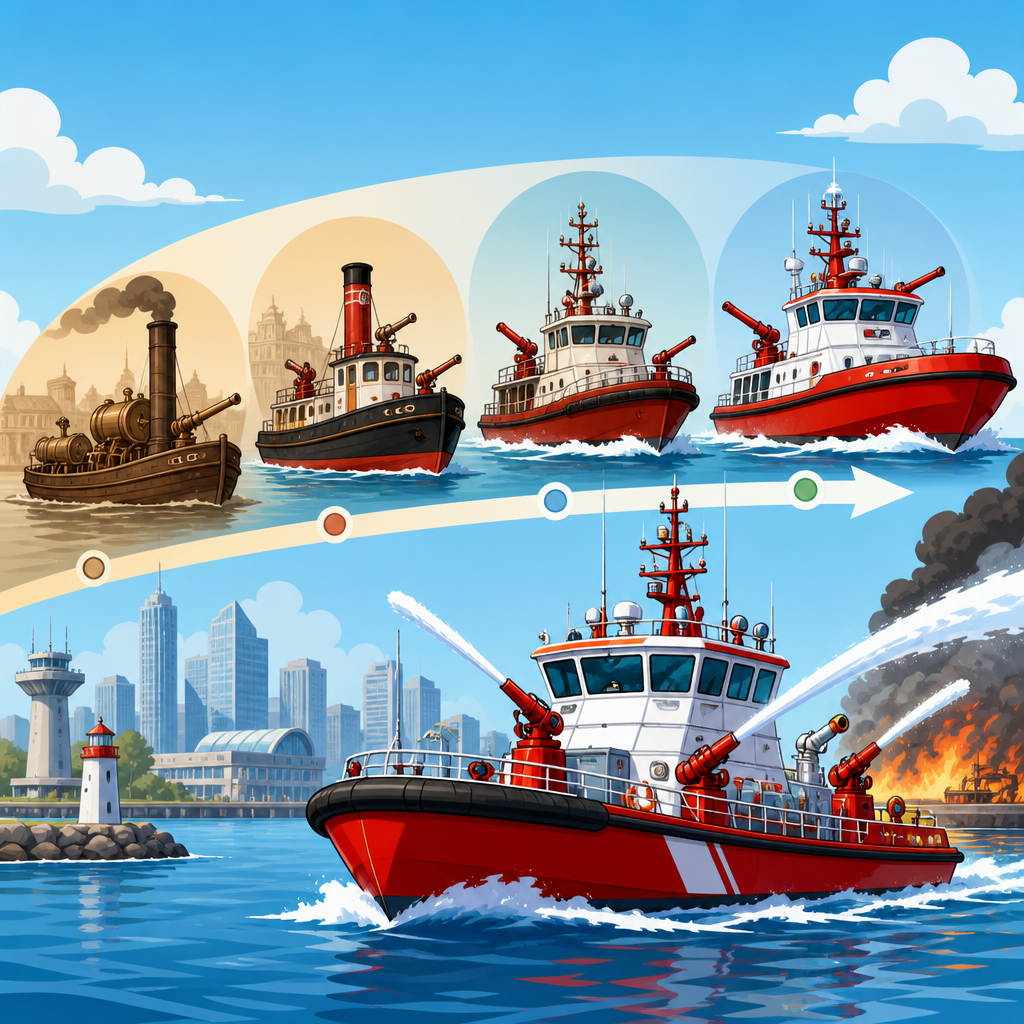
The history of fireboats closely follows the industrialization of ports. As cities expanded in the nineteenth century, wharves grew denser, ships carried more combustible cargo, and municipal leaders realized that conventional firefighting methods could not adequately reach waterfront incidents. Early fireboats were often steam-powered vessels equipped with large pumps driven by dedicated engines. Their mission was straightforward: draw water directly from the river or harbor and project it onto burning piers, warehouses, and ships. In major port cities such as New York, Boston, London, and Hamburg, these vessels became critical because they bypassed the water-supply limitations that constrained shore crews.
One of the defining advantages of the fireboat has always been unlimited access to its extinguishing medium. Unlike a fire engine reliant on hydrants, a fireboat can draft from the body of water it is floating on. That simple fact drove rapid technological improvement. By the late nineteenth and early twentieth centuries, many fireboats carried more powerful monitors, improved maneuvering arrangements, and stronger hulls for all-weather service. Famous examples such as New York’s John J. Harvey, launched in 1931, demonstrate the maturity of the type: multiple high-capacity pumps, robust firefighting systems, and the ability to support major urban incidents.
Modern fireboats evolved further as ports became more complex. Diesel propulsion replaced steam, aluminum and advanced steel construction reduced maintenance while preserving strength, and electronics transformed navigation and firefighting coordination. Today’s vessels often include dynamic positioning aids, radar, AIS, FLIR thermal cameras, foam proportioning systems, self-protection water spray curtains, enclosed cabins, and medical treatment spaces. Many are no longer single-purpose assets. They serve as rescue boats, hazardous materials response platforms, patrol vessels, and command centers. This shift mirrors a broader trend across work and utility boats: agencies invest in platforms that can solve multiple operational problems without sacrificing core performance in an emergency.
How Fireboats Work and What Makes Them Different
A fireboat’s defining system is its fire pump arrangement. Most units use powerful centrifugal pumps driven either by the main engines through power takeoffs, by separate diesel engines, or by integrated pump engines dedicated to firefighting. Water is drawn through sea chests and expelled through monitors mounted on the bow, mast, cabin top, or aft deck. These monitors can be manually controlled or remotely operated from the wheelhouse, and larger boats may throw tens of thousands of liters per minute. For petroleum or chemical incidents, onboard foam tanks and proportioners mix concentrate with water to create a blanket that suppresses vapors and reduces re-ignition risk.
Hull design also sets fireboats apart from other utility craft. They need exceptional stability because monitor reaction forces are substantial, especially when several streams operate simultaneously. They need maneuverability because incidents often occur in crowded slips, around anchored ships, or beneath bridges. Twin-screw propulsion, Z-drive azimuth thrusters, and bow thrusters are common solutions. Fenders are heavy-duty, decks are arranged for line handling and casualty transfer, and superstructures are built to preserve visibility while protecting crews from heat and smoke. On advanced models, deluge systems spray the vessel itself so it can approach higher-heat environments more safely.
Operationally, fireboats differ from tugboats, pilot boats, patrol boats, and general-purpose rescue craft in one crucial respect: their firefighting output is engineered as the primary mission, not an added feature. Some tugboats carry FiFi ratings under classification standards and can perform external firefighting, especially offshore or in terminal support roles. However, a dedicated municipal or port fireboat is usually configured around rapid response, crew access, victim recovery, medical support, and close-quarters incident management in urban waterways. That distinction matters when choosing fleet assets for a harbor authority or fire department.
| Work & Utility Boat Type | Primary Mission | Typical Equipment | Where It Overlaps With Fireboats |
|---|---|---|---|
| Fireboat | Marine firefighting and rescue | High-capacity pumps, monitors, foam systems, thermal imaging | Core platform for ship, dock, marina, and shoreline fire response |
| Tugboat | Towing and ship assist | Winches, tow gear, heavy fendering, sometimes FiFi systems | Can support external firefighting and move endangered vessels |
| Rescue boat | Life-saving and casualty retrieval | Rescue platforms, medical gear, dive support | Handles water rescue during fire incidents but usually lacks pump capacity |
| Patrol boat | Law enforcement and harbor security | Navigation electronics, communications, boarding equipment | Secures perimeters and assists evacuation during marine emergencies |
| Utility workboat | Maintenance and service tasks | Cranes, open decks, cargo handling gear | Supports logistics but is not optimized for active firefighting |
Core Roles in Marine Safety and Emergency Response
Fireboats protect life first, property second, and continuity of port operations third, though all three are tightly linked. In practice, their most visible role is direct suppression. A burning ferry, yacht, fishing vessel, or container ship can be attacked from angles unavailable to shore crews. Streams can cool hull plating, protect exposures, and create safe corridors for evacuation. On riverfront fires, a fireboat can feed water to land companies through large-diameter hose when municipal water pressure is insufficient. This relay role is often overlooked, but it is one of the most valuable functions in older industrial districts.
Rescue operations are equally important. Fireboats routinely recover people from the water, evacuate crews from smoke-filled ships, transport firefighters to inaccessible scenes, and support dive teams. During passenger vessel incidents, they can serve as triage and transfer platforms until ambulances or shore-based medical units take over. In my experience observing joint exercises, agencies that train rescue and firefighting together perform far better than those that treat them as separate missions. Marine emergencies rarely remain neatly categorized; a fire, collision, man-overboard event, and fuel spill can develop within the same operational period.
They also play a strategic role in hazardous materials incidents. Many ports handle liquefied gases, bunker fuel, solvents, and bulk chemicals. A fireboat equipped with gas detection, foam, decontamination capability, and interoperable communications gives incident commanders flexible options. It can cool tanks, monitor vapor behavior, maintain exclusion zones, and support evacuation decisions. During wildland-urban interface events near waterways, fireboats have even been used to defend shoreline properties and provide sustained water supply where road networks are compromised. That adaptability is exactly why they remain central to comprehensive marine safety doctrine.
Technology, Standards, and Crew Training
Modern fireboats are shaped by both operational lessons and formal standards. Designers consider National Fire Protection Association guidance, U.S. Coast Guard requirements where applicable, local municipal standards, and classification society rules from organizations such as ABS or DNV for larger vessels. Pump output, monitor placement, redundancy, survivability, and stability under firefighting loads are not arbitrary design choices. They are engineering decisions tied directly to mission profiles. A harbor with cruise ships and petrochemical terminals needs different specifications from a river city focused on bridge access, industrial waterfronts, and flood rescue.
Electronics have changed response quality dramatically. AIS improves situational awareness around commercial traffic. Radar remains essential in fog, darkness, and heavy precipitation. Forward-looking infrared cameras help crews find hotspots and victims. Integrated chartplotters and digital incident mapping support safer navigation in congested channels. Portable and fixed gas detectors inform decisions around volatile cargoes. Remote monitor controls reduce firefighter exposure on open decks. Increasingly, builders are also incorporating hybrid propulsion or advanced emissions-control technologies to meet stricter environmental requirements without sacrificing standby readiness.
Training is where a fireboat becomes an effective safety asset rather than an expensive harbor ornament. Crews need competence in vessel handling, pump operations, foam application, shipboard fire behavior, marine radio procedures, rescue swimmer coordination, towing basics, and unified command. They also need repetition under realistic conditions. Live-fire drills, nighttime navigation exercises, casualty transfer rehearsals, and interagency communications tests reveal weaknesses before a real emergency does. The best departments train not only on their own vessel but with tug operators, terminal staff, pilots, police marine units, and shore firefighters. Waterfront incidents punish organizational silos quickly.
Why Fireboats Still Matter in a Changing Port Environment
Some decision-makers question whether dedicated fireboats are still necessary when cities already fund fire engines, rescue units, and mutual-aid agreements. The answer is yes, especially in dense ports and waterfront communities. Larger ships, battery systems aboard modern vessels, increased marina congestion, and mixed-use shoreline development have made marine incidents more complicated, not less. Electric propulsion introduces new suppression and cooling challenges. Mega-yachts and passenger vessels concentrate people and property values in tight spaces. Container terminals and energy facilities create high-consequence scenarios where delayed response can disrupt regional supply chains.
Fireboats also offer resilience beyond headline disasters. They are valuable during storms, bridge closures, floods, and mass-gathering events on the water. A well-designed marine firefighting program supports routine patrol, prevention outreach, pre-incident planning, and inspections alongside emergency response. That preventive role pays dividends. When crews know berth layouts, hydrant connections, standpipe arrangements, fuel shutoffs, and vessel traffic patterns in advance, they arrive with a plan instead of guesses. For readers exploring work and utility boats as a category, this is the broader lesson: the most effective specialized craft are integrated into daily operations, not kept waiting for a rare crisis.
Fireboats have evolved from steam-powered waterfront protectors into highly capable multi-mission emergency vessels, and their relevance to marine safety has only increased. They deliver something no other work and utility boat provides in the same combination: sustained firefighting power, waterborne rescue access, incident command capability, and operational reach across ships, docks, shorelines, and industrial terminals. Their history shows continuous adaptation to changing fuels, ship designs, port layouts, and public safety expectations. Their modern form reflects hard-earned lessons in engineering, training, and interagency coordination.
For port authorities, municipalities, and anyone studying work and utility boats, the key takeaway is simple. Fireboats are not niche curiosities. They are essential infrastructure for any community where people, cargo, fuel, and buildings meet the water. Choosing the right vessel means matching pump capacity, maneuverability, crew size, electronics, foam capability, and rescue features to the actual risks of the harbor or river system. Maintaining readiness means drilling often, planning jointly, and treating marine response as a discipline with its own demands. If you are building out knowledge of boat types or evaluating emergency marine assets, use fireboats as a benchmark for how specialized workboats protect lives and keep waterfront economies moving.
Frequently Asked Questions
1. How have fireboats evolved from simple harbor craft into highly specialized marine emergency vessels?
Fireboats have changed dramatically over time, evolving from relatively basic steam- or diesel-powered vessels with limited firefighting capability into sophisticated, multi-mission emergency platforms. Early fireboats were primarily built to pump water onto dock fires or burning ships near shore. Their main value came from mobility: they could approach a waterfront fire from the water side, where land crews often had limited access. As ports grew larger and industrialized, however, the demands placed on these vessels expanded. Modern harbors now handle dense traffic, hazardous cargo, fuel transfers, container operations, chemical storage, cruise terminals, and waterfront infrastructure that requires a much more capable response asset.
Today’s fireboats are purpose-built to combine the high-volume pumping capacity of a municipal fire engine with the endurance, stability, and maneuverability of a commercial workboat. They are equipped with powerful monitors, advanced foam systems, thermal imaging, navigation electronics, dynamic positioning features on some models, enclosed cabs for crew protection, and integrated communications that link marine responders with shore-based fire departments, coast guards, port authorities, and emergency management teams. Many also support rescue operations, mass evacuation, towing, salvage support, and incident command. In practical terms, that means the modern fireboat is no longer just a “boat that sprays water.” It is a specialized marine safety platform designed to operate in complex, high-risk environments where speed, coordination, and sustained firefighting capability are essential.
2. Why do fireboats remain so important to marine safety in modern ports and industrial waterfronts?
Fireboats remain essential because many marine and waterfront emergencies cannot be handled effectively by land units alone. Ports are complex environments with limited road access, long piers, congested terminals, stacked cargo, tank farms, ship berths, bridges, ferries, marinas, and industrial facilities located directly along the shoreline. If a fire breaks out aboard a vessel, under a pier, or at a waterfront fuel terminal, access from land may be delayed, obstructed, or tactically limited. A fireboat can often attack the incident from the water side immediately, cool adjacent exposures, support evacuation, and maintain a continuous water supply without relying on hydrants or long hose lays.
Their importance has only increased as global trade volumes and port activity have expanded. Modern ports process enormous quantities of fuel, chemicals, manufactured goods, vehicles, and containerized cargo, all of which create unique fire risks. Larger commercial ships and passenger vessels also mean that incidents can involve more people, greater heat release, and more complex response requirements. Fireboats provide a critical layer of resilience in this environment. They can deliver high-capacity streams over long distances, protect infrastructure from radiant heat, assist in rescue and recovery, and function as command and coordination assets during multi-agency incidents. In short, they are not redundant to land firefighting resources; they fill operational gaps that only a marine-based platform can address.
3. What capabilities set a fireboat apart from other workboats and utility vessels?
What distinguishes a fireboat is the integration of marine handling performance with dedicated emergency response systems. While many workboats are rugged, maneuverable, and built for harbor duty, fireboats are specifically engineered to perform under emergency conditions involving heat, smoke, limited visibility, unstable vessels, hazardous materials, and urgent life safety needs. Their most obvious feature is their firefighting system: high-capacity pumps, deck-mounted monitors, hose outlets, foam proportioning systems, and the ability to apply large volumes of water or foam to vessel fires, terminal fires, and industrial incidents. These systems are designed for sustained output and rapid deployment, often far beyond what a standard utility craft could support.
But the difference goes well beyond pumps and nozzles. Fireboats typically have reinforced construction, excellent low-speed maneuverability, robust fendering for operating alongside damaged or burning vessels, and pilothouse visibility optimized for close-quarters work. Many include thermal cameras, radar, GPS, sonar, scene lighting, public address systems, medical equipment, rescue gear, towing fittings, and spaces for firefighting crews or evacuees. Some can also supply water to shore through large-diameter connections, essentially acting as floating pump stations during waterfront emergencies. This combination of firefighting power, marine access, rescue support, and operational endurance is what places fireboats in a specialized category within the broader world of utility and work boats.
4. What types of emergencies do fireboats respond to besides ship and dock fires?
Although firefighting is central to their mission, fireboats are often used in a much wider range of marine safety operations. Search and rescue is one of the most common. They may recover people from the water, assist disabled ferries or recreational vessels, evacuate passengers from ships or waterfront structures, and provide immediate support during collisions or groundings. Because they are designed for emergency response and rapid deployment, fireboats are also valuable during severe weather, bridge incidents, industrial accidents, and mass-casualty events along the shoreline.
In addition, many fireboats support towing, perimeter control, exposure protection, and incident command during large-scale emergencies. At hazardous materials incidents, they may help establish safety zones, cool nearby assets, and provide a stable communications platform for interagency coordination. During waterfront industrial fires, they can protect adjacent ships, piers, storage tanks, or critical port infrastructure from extension. In some regions, they also contribute to homeland security patrols and contingency planning for high-value maritime assets. Their versatility is one of the main reasons they continue to justify investment: a well-equipped fireboat is not a single-purpose vessel, but a flexible emergency tool that strengthens overall marine and port resilience.
5. How do fireboats work alongside shore-based firefighters and other maritime agencies during major incidents?
Fireboats are most effective when they operate as part of a coordinated response system rather than in isolation. During a major waterfront or shipboard incident, shore-based fire departments, port authorities, coast guards, law enforcement, emergency medical services, tug operators, and facility personnel may all have active roles. The fireboat often becomes a critical marine component of that larger operation. It can attack the fire from an angle unavailable to land crews, cool the hull or surrounding structures, maintain defensive streams on exposed assets, transport personnel or equipment, and relay real-time observations from the water. This marine perspective can significantly improve overall situational awareness and tactical decision-making.
Coordination is especially important because marine incidents are rarely straightforward. Vessel construction, tides, wind, currents, berth configurations, cargo hazards, and access limitations all influence strategy. Fireboats support unified command by giving incident leaders more options: offensive water application, rescue from the waterside, movement of specialized teams, and emergency water supply in areas where hydrant systems may be inadequate or inaccessible. Modern communications and training have made this integration much stronger than in earlier eras. The best outcomes typically come from pre-incident planning, joint drills, and shared operational protocols between marine and land responders. That collaborative model reflects the modern role of the fireboat: not just as a standalone firefighting vessel, but as a vital part of a comprehensive marine safety network.