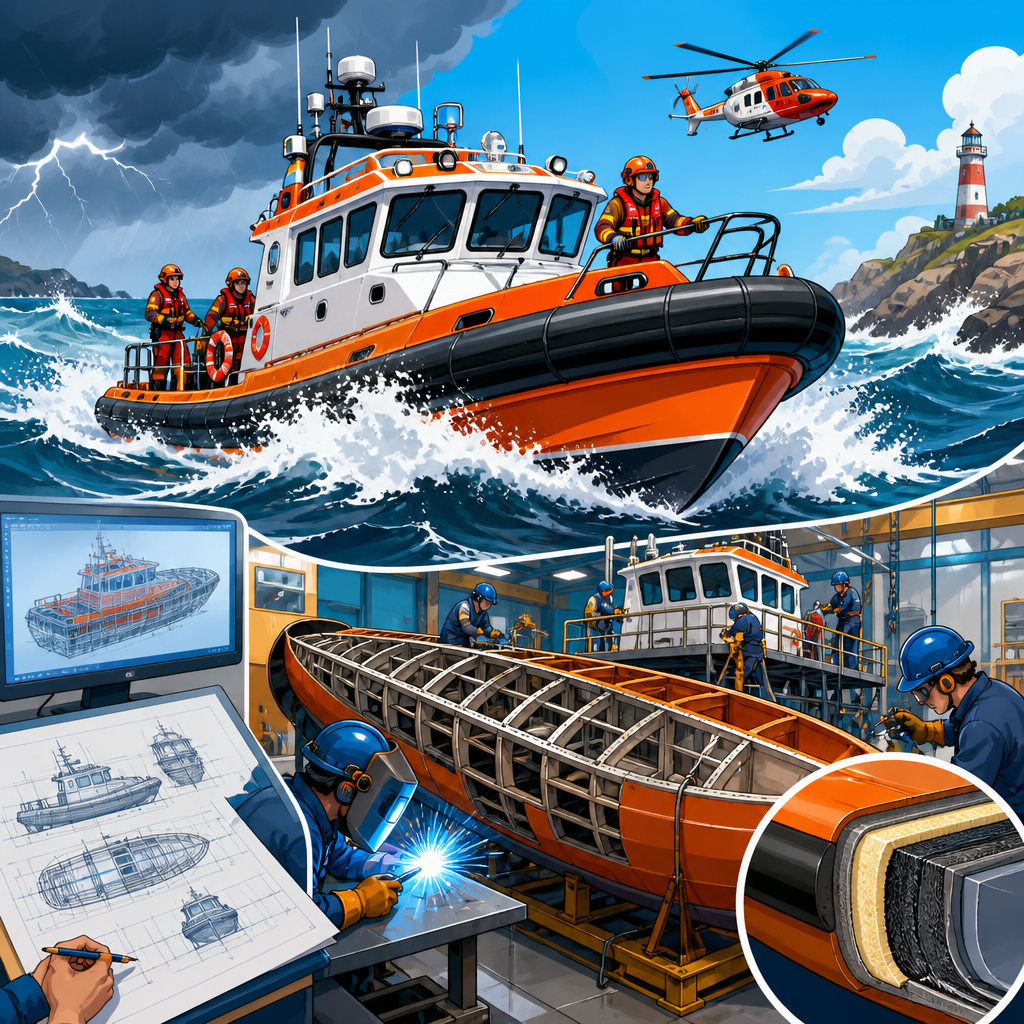
Search and rescue boats are engineered to survive the worst water conditions while giving crews the speed, stability, protection, and control needed to save lives. Within the broader world of work and utility boats, they occupy a demanding niche: every design choice must support mission success in rough seas, strong currents, darkness, cold, impact zones, and debris-filled water. A search and rescue boat is not simply a fast patrol craft with emergency lights. It is a purpose-built platform that combines hull engineering, propulsion, structural reinforcement, communications, navigation electronics, deck layout, and medical readiness into one integrated system. This matters because rescue crews often launch when everyone else is heading back to shore. In my experience evaluating commercial and government workboats, the difference between an ordinary utility vessel and a rescue-capable platform comes down to predictable handling under stress, dependable redundancy, and the ability to recover people safely without disabling the boat. As a hub topic within work and utility boats, search and rescue boats connect to pilot boats, fireboats, patrol boats, tow boats, rigid inflatable boats, rescue airboats, and offshore response craft. Understanding how they are built also helps explain the wider design logic behind utility vessels: function leads, aesthetics follow. The extreme conditions these boats face include breaking surf, icy spray, floodwater contamination, low-visibility operations, and collisions with floating objects, so builders use proven standards, specialized materials, and tested layouts to reduce risk for both crew and survivors.
Mission profile drives every major design decision
The first question a builder or fleet operator answers is simple: what kind of rescue work will this boat perform? Coastal surf rescue, offshore recovery, swiftwater flood response, harbor search operations, and ice-edge rescue all require different compromises. A surf rescue craft needs rapid acceleration, self-draining decks, high maneuverability, and the ability to punch through breaking waves. An offshore rescue boat needs greater range, higher freeboard, enclosed shelter, larger fuel capacity, and heavier communications equipment. Flood rescue boats may prioritize shallow draft, impact resistance, and easy casualty loading from unstable banks or submerged streets. Because work and utility boats are tools, naval architects begin with the operating environment, expected crew size, rescue load, endurance requirement, launch method, and maintenance capability. Those criteria shape displacement, beam, deadrise, collar design, structural scantlings, engine configuration, and even handrail placement.
Rescue agencies commonly formalize this process through a statement of operational requirements. That document defines speed thresholds, sea-state capability, survivor capacity, towing expectations, electronics suite, and recovery methods. For example, a harbor authority may need a 7-meter rigid inflatable boat that can launch within five minutes, carry six survivors, and maintain control alongside commercial ships. A coast guard station may require a self-righting response boat with enclosed cabin, twin outboards, radar, thermal imaging, and all-weather capability. In both cases, the mission profile limits guesswork. The best search and rescue boats are not general-purpose compromises; they are deliberately optimized workboats designed around foreseeable emergencies and the ugly surprises that accompany them.
Hull forms, structure, and materials for punishment
The hull is the foundation of extreme-condition performance. Most search and rescue boats use one of three core formats: rigid inflatable boats, aluminum monohulls, or composite deep-V craft. Rigid inflatable boats, often called RIBs, pair a rigid hull with inflatable tubes or foam collars. The collar adds buoyancy, improves stability at rest, softens contact during alongside recovery, and creates a forgiving platform when operating near rocks, piers, or another vessel. That is why RIBs are common in lifeboat services, harbor police fleets, and military rescue units. Aluminum monohulls dominate where impact resistance, easy repair, and long service life matter most. Welded marine-grade aluminum alloys such as 5083 and 5086 are widely used because they resist corrosion and handle repeated slamming loads well. Composite rescue boats can be lighter and highly optimized, but they demand careful layup quality and disciplined inspection after heavy impacts.
Deep-V hull geometry remains a standard choice because it cuts through chop and improves ride quality at speed. The tradeoff is reduced initial stability compared with flatter shapes, so builders balance deadrise with beam, collar volume, spray rails, chines, and weight distribution. Structural reinforcement is extensive. Frames, stringers, watertight compartments, collision bulkheads, and reinforced transoms are sized for repeated shock loads, not occasional weekend use. In rescue boats that beach launch or operate in debris fields, keel protection and bottom plating are often increased. Self-bailing decks are essential because green water on deck must leave the boat quickly. Non-slip surfaces, rounded internal edges, heavy cleats, and recessed fittings all reduce injury risk during violent motion. Standards from classification societies and national maritime regulators guide these choices, but the harshest test is operational reality: if a boat pounds hard for an hour and the crew still retains control, visibility, and confidence, the structure is doing its job.
Propulsion, redundancy, and control in dangerous water
Search and rescue boats need propulsion systems that start reliably, accelerate immediately, and remain controllable when water conditions deteriorate. Twin outboard engines are common on smaller rescue craft because they provide redundancy, simplify maintenance, and allow aggressive low-speed maneuvering through differential thrust. If one engine fails, the boat can usually continue the mission or return safely. Larger rescue boats may use waterjets, sterndrives, or inboard shaft systems depending on draft limits and operational hazards. Waterjets are especially valuable in shallow or debris-laden water because there is no exposed propeller, reducing strike risk and allowing maneuverability in flood zones and river environments. Outboards, however, are easier to replace quickly and are often favored by agencies that need high availability with limited yard time.
Control systems matter as much as raw horsepower. Modern throttles, electronic engine monitoring, trim control, joystick interfaces on some platforms, and responsive hydraulic steering reduce operator workload when seconds matter. Rescue crews frequently approach piers, cliffs, overturned boats, and people in the water while wind and current push the vessel off line. Predictable throttle response and precise helm feel are safety features. Builders also account for fuel management and electrical redundancy. Separate battery banks, protected wiring runs, corrosion-resistant connectors, and backup bilge pumps are standard because a dead radio, dark plotter, or failed dewatering system can turn a rescue mission into a second emergency. The broader work and utility boat sector shares these priorities, but rescue craft feel every system failure more intensely because they operate at the edge of conditions that stop ordinary boats.
Electronics, communications, and situational awareness
Extreme-condition rescue depends on seeing, hearing, and understanding the environment before it overwhelms the crew. That is why professional search and rescue boats carry a layered electronics suite rather than a single chartplotter and VHF radio. Core equipment usually includes fixed-mount VHF with digital selective calling, AIS, radar, GNSS chartplotting, depth sounder, searchlights, and public-address capability. Many agencies also specify thermal imaging cameras because a person in the water can disappear visually at night or in spray, while a thermal sensor may still pick up contrast. Radar remains indispensable in fog, rain, and darkness, especially around harbor traffic or rocky shorelines. AIS improves awareness of nearby commercial vessels, which is critical when a small rescue boat operates close to ships with limited ability to alter course.
Human factors shape good electronics integration. Displays must remain readable in sun, rain, and vibration. Controls must be reachable while the operator braces in rough water. Antennas, sirens, light bars, and camera mounts cannot obstruct sightlines. In enclosed cabins, demisting and wiper performance directly affect mission safety. Communications redundancy is equally important. A typical professional setup may include primary and secondary VHF sets, handheld waterproof radios, cellular data capability near shore, and interoperability with dispatch or emergency command systems. Search patterns, position marking, digital chart overlays, and man-overboard functions help crews work methodically under pressure. In work and utility boats more broadly, electronics support efficiency. In rescue boats, they support survival.
Deck layout, survivor recovery, and crew protection
A rescue boat succeeds or fails at the point of contact with the person being saved. Deck layout therefore focuses on safe movement, fast access, and controlled recovery. Open aft working areas are common because crews need space to handle lines, lifting gear, baskets, and survivors. Low or purpose-shaped boarding points near the waterline help bring exhausted people aboard. Some boats use rescue doors, transom platforms, dive ladders, Jason’s cradles, parbuckling systems, or side recovery arrangements designed to minimize the lifting force required from crew members. Handholds are continuous, deck hardware is positioned to avoid snagging clothing or medical gear, and seating often uses shock-mitigating designs to reduce spinal fatigue during high-speed transits.
Crew protection is built into the boat from the start. Consoles and cabins shield operators from wind chill, spray, and impact. Enclosed wheelhouses with suspension seating are common on all-weather rescue craft because cold, fatigue, and repeated shock quickly degrade decision-making. Heating, defrosting, ventilation, and dry storage may sound secondary, but they matter when crews operate in freezing rain or return hypothermic survivors to shore. Medical storage is also part of the layout. Oxygen, trauma kits, automated external defibrillators, stretchers, blankets, and hypothermia protection gear need secure, immediately accessible locations. A rescue boat is a moving workspace, and the best builders think through body movement, line handling, casualty transfer, and fatigue reduction in practical detail.
| Rescue boat type | Best operating environment | Key build advantages | Main tradeoff |
|---|---|---|---|
| Rigid inflatable boat | Harbors, coastal zones, ship transfers | High stability, soft contact, quick acceleration | Less shelter and range than larger cabin craft |
| Aluminum deep-V cabin boat | Offshore, all-weather response | Strength, enclosed protection, durability | Higher weight and cost |
| Waterjet rescue boat | Rivers, floodwater, shallow debris fields | Shallow draft, no exposed propeller | Can be less efficient at some speeds |
| Airboat | Marsh, ice, extreme shallow water | Runs where prop-driven boats cannot | Noisy, wind-sensitive, limited in open rough water |
Testing, standards, and maintenance discipline
No serious search and rescue boat enters service on reputation alone. It must be tested, documented, and maintained to a standard that reflects its life-saving role. Builders and agencies commonly use sea trials to verify speed, acceleration, turning behavior, stopping distance, noise levels, and performance under load. Recovery drills with weighted dummies or trained personnel reveal design flaws that look minor on paper but become dangerous at sea. Self-righting capability, reserve buoyancy, bilge capacity, electromagnetic compatibility, and fuel-system integrity may all be assessed depending on vessel class and jurisdiction. Organizations such as the International Maritime Organization, national coast guards, SOLAS-related equipment frameworks, ABYC guidance in some markets, and classification societies influence design and outfitting decisions even when a small rescue craft is not formally classed.
Maintenance is not a back-office function for rescue fleets; it is part of operational readiness. Tubes on RIBs need pressure checks and abrasion inspection. Aluminum welds need regular visual examination, especially in high-load zones near chines, transoms, and lifting points. Engines require disciplined service intervals, clean fuel, corrosion control, and software diagnostics where applicable. Electronics need updates and waterproofing checks. Trailers, davits, and launch systems matter too, because a boat that cannot be launched rapidly is failing before the mission begins. I have seen agencies extend service life successfully by standardizing components across fleets, carrying spare radios and propulsors, and logging even minor defects immediately after each sortie. In extreme conditions, small maintenance lapses multiply fast. Reliability is designed into the boat, but it is preserved through routine, training, and honest post-mission inspection.
How search and rescue boats fit the wider work and utility boat sector
As the hub for work and utility boats, this topic helps readers see how specialized craft share common engineering DNA. Patrol boats prioritize authority presence, interception speed, and surveillance integration. Fireboats add pumps, monitors, foam systems, and high-capacity stability management. Pilot boats focus on safe personnel transfer in close quarters around ships. Tow boats emphasize bollard pull, deck gear, and hull robustness. Rescue boats borrow from all of them: the speed of patrol craft, the deck practicality of utility boats, the alongside handling of pilot boats, and the rugged build philosophy of towing platforms. Yet their defining priority remains casualty recovery under adverse conditions.
That wider context matters for buyers, operators, and researchers. A municipality choosing between a rescue RIB, an aluminum cabin responder, or a multi-role patrol-rescue boat must understand how mission creep affects design. A boat that tries to do everything often gives away rescue efficiency through excess weight, poor deck access, or compromised survivor handling. The strongest procurement outcomes come from matching platform type to geography, staffing, budget, and response model, then linking related craft where needed. If your broader interest is in types of boats, work and utility boats are where marine design becomes most visibly purpose-driven. Search and rescue boats are the clearest example of that principle, because every weld, rail, tube, pump, seat, and screen exists for one reason: helping crews reach people in danger and bring them home safely. For agencies reviewing fleets or readers exploring related utility vessel categories, the next step is straightforward: compare mission profiles first, then evaluate hull, propulsion, electronics, and recovery design against the worst conditions you actually expect to face.
Frequently Asked Questions
What makes a search and rescue boat different from a standard patrol or recreational boat?
A search and rescue boat is built around one priority: performing reliably when conditions are dangerous, visibility is poor, and every second matters. Unlike a recreational vessel, which is typically designed for comfort, speed, or leisure use in relatively predictable environments, a rescue boat must keep operating in heavy seas, strong currents, cold weather, impact-prone shorelines, and debris-filled water. It also differs from many patrol boats because the mission is not only to reach a scene quickly, but to maneuver precisely alongside people in the water, distressed vessels, docks, rocks, or surf zones without losing stability or crew control.
That mission changes nearly every design decision. Hull forms are selected for seaworthiness, recovery performance, and predictable handling in confused water. Structures are reinforced to withstand repeated pounding, side impacts, and hard operational use. Deck layouts are designed to support rescue workflows, including victim recovery, medical access, diver operations, towing, and equipment deployment. Cabin protection, shock-mitigating seating, handholds, and visibility systems are built to reduce crew fatigue and improve safety over long, high-stress operations.
Search and rescue boats also carry specialized electronics and mission systems that ordinary boats do not. These often include advanced radar, thermal imaging, searchlights, communications suites, GPS-integrated navigation, AIS, sonar, and rescue-specific equipment such as recovery platforms, lifting points, baskets, trauma gear, and dewatering pumps. In short, a rescue boat is a purpose-built emergency platform engineered to keep its crew effective and protected while operating where other boats may be forced to slow down, turn back, or avoid the area entirely.
How are search and rescue boat hulls designed to handle extreme water and weather conditions?
The hull is the foundation of rescue boat performance, and it is engineered to balance speed, stability, strength, buoyancy, and control in some of the toughest marine environments imaginable. Designers begin by considering the boat’s operating profile: offshore response, surf rescue, river rescue, harbor work, flood response, or nearshore emergency operations. Each environment creates different demands, but all require a hull that can remain predictable in rough water and recover quickly from wave impact, turning forces, and shifting loads.
Deep-V hulls are often used for rough offshore conditions because they cut through waves more effectively and help soften impacts at speed. In other applications, modified-V, catamaran, or rigid inflatable configurations may be selected to improve shallow-water capability, lateral stability, boarding access, or low-speed maneuverability. Catamaran rescue boats, for example, can offer excellent deck space and stability during victim recovery, while rigid inflatable boats are valued for their buoyant collars, impact tolerance, and ability to come alongside people or vessels more safely.
Materials and structural reinforcement are equally important. Aluminum is commonly chosen because it offers an excellent strength-to-weight ratio, corrosion resistance, repairability, and durability under hard use. In some cases, advanced composites or foam-collar systems are incorporated for weight savings and added buoyancy. Hull plating, framing, welds, collision zones, and keels are strengthened to tolerate repeated slamming loads, grounding risks, and contact with floating debris. Designers also pay close attention to drainage, compartmentalization, and reserve buoyancy so the boat can maintain survivability even if damaged.
Extreme-condition performance also depends on how the hull interacts with water dynamically. Spray rails, chines, lifting surfaces, and weight distribution all affect dryness, roll behavior, acceleration, fuel efficiency, and turning response. A rescue hull must not only survive rough conditions but allow the crew to work in them. That means reducing excessive pounding, minimizing unpredictable motions, and maintaining enough stability for stretcher handling, rescue swimmer deployment, or recovering a casualty over the side or stern.
What safety and crew-protection features are built into search and rescue boats?
Crew protection is one of the most important aspects of a search and rescue boat because the people on board must remain capable, alert, and physically secure while operating in dangerous conditions. The boat itself acts as a protective system. Enclosed or partially enclosed cabins shield crews from wind, freezing spray, rain, and impact from breaking water. Strong glazing, weather-tight doors, anti-slip decks, and strategically placed grab rails help crews move safely even when the vessel is pitching or taking spray over the bow.
Shock mitigation is another major design focus. High-speed operations in rough water can expose crews to repeated impact loads that cause fatigue, injury, and reduced decision-making ability. To manage this, many rescue boats use shock-mitigating seats, suspended helm stations, energy-absorbing deck structures, and ergonomic control layouts. These features may sound secondary, but in real-world operations they can dramatically improve endurance and reduce the cumulative strain of operating in heavy weather.
Redundancy and survivability are also central to safety. Search and rescue boats often incorporate multiple bilge pumps, isolated electrical systems, redundant communications, backup navigation devices, and compartmentalized flotation or watertight sections. Fire suppression, emergency lighting, life rafts, immersion suits, recovery slings, and trauma equipment are frequently integrated as standard operational gear. Many rescue craft are also designed with self-righting or high-reserve-buoyancy characteristics so that, even in severe upset scenarios, the platform has a better chance of protecting lives and returning to an operable state.
Visibility and situational awareness matter just as much as physical protection. Pilothouse sightlines, night-vision compatibility, thermal cameras, radar, loudhailers, deck lighting, and remote searchlights help crews operate effectively in darkness, fog, or storm conditions. Together, these systems create a boat that is not just tough, but deliberately engineered to keep rescuers functional, protected, and mission-ready when conditions are at their worst.
Why are propulsion, maneuverability, and control systems so critical on rescue boats?
In rescue work, arriving quickly is only part of the equation. The real challenge often begins when the boat reaches the casualty and must hold position, turn tightly, approach safely, or operate in surf, current, wind, or confined spaces. That is why propulsion and control systems on search and rescue boats are designed for more than top speed. They are engineered to deliver acceleration, reliability, low-speed precision, and confident handling under heavy operational loads.
Depending on the mission profile, rescue boats may use outboard engines, inboard diesel systems, waterjets, sterndrives, or other specialized propulsion arrangements. Outboards can offer speed, easier replacement, and shallow draft advantages. Inboard diesels are often valued for torque, durability, and long-service commercial use. Waterjets are especially useful in shallow or debris-prone environments because they reduce exposed appendages and improve maneuverability, which is important in rivers, flood zones, and areas where propeller strikes are a serious concern.
Control systems are equally specialized. Rescue craft may feature joystick maneuvering, dynamic positioning assistance, advanced throttles, interceptor or trim systems, and highly responsive steering geometry to maintain command in difficult seas. Twin or triple engine configurations provide both power and redundancy, allowing the boat to continue operating if one engine is compromised. Designers also carefully match propulsion output to hull form so the boat remains predictable during hard turns, following seas, and sudden stops or reversals near people in the water.
For rescue crews, precision handling can mean the difference between a successful recovery and a secondary accident. A boat may need to come alongside a capsized vessel, hold station near rocks, back down in surf, tow a disabled craft, or recover a person from cold water without exposing them to propellers or impact. That level of control does not happen by chance. It is the result of integrated engineering that combines propulsion, steering, hull dynamics, helm ergonomics, and operator feedback into a platform capable of making exact movements in highly unstable conditions.
How do builders test and equip search and rescue boats before they go into service?
Before a search and rescue boat enters operational duty, it typically goes through a rigorous process of engineering review, outfitting, and performance validation. Builders do not simply launch the vessel and confirm that it floats and reaches speed. They test whether it can carry the required crew and equipment load, maintain handling balance, accelerate effectively, stop predictably, and operate safely in the kinds of sea states and mission scenarios it is expected to face. This includes checking hull integrity, propulsion performance, electrical reliability, drainage, watertightness, and system integration under realistic working conditions.
Sea trials are a major part of this process. During trials, builders and operators evaluate speed, turning behavior, backing performance, station-keeping, visibility, ride quality, and control response. If the boat is intended for heavy weather or surf work, testing may include operation in rough water to observe how the hull lands, sheds spray, and maintains directional stability. Recovery equipment, tow points, rescue doors, ladders, davits, and deck arrangements may also be tested to ensure they support actual rescue procedures instead of only looking correct on a specification sheet.
Outfitting is highly mission-specific. A rescue boat may be equipped with radar, thermal imaging, sonar, chart systems, AIS, encrypted communications, floodlights, deck cranes, diver support systems, medical lockers, casualty recovery platforms, and firefighting or dewatering gear