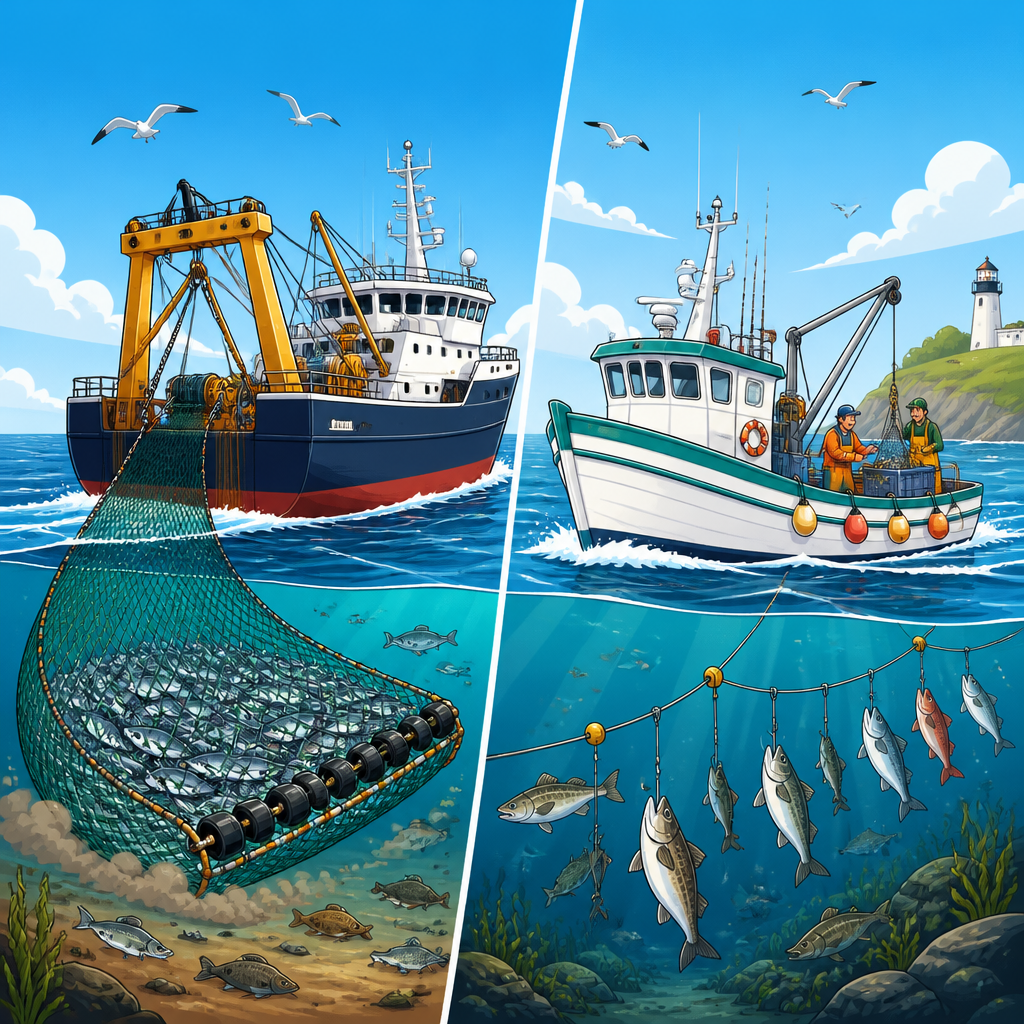
Fishing trawlers and commercial fishing boats are often treated as interchangeable terms, but on the water they describe different designs, operating methods, and business roles. A fishing trawler is a commercial fishing vessel built or adapted to tow a trawl net through the water or along the seabed. A commercial fishing boat is the broader category that includes trawlers, longliners, purse seiners, gillnetters, crab boats, lobster boats, fish tender vessels, and many other work platforms used to harvest or support seafood operations. Understanding the distinction matters because hull form, deck layout, propulsion, gear handling systems, storage capacity, and legal requirements all change with the fishing method. Buyers, operators, crew members, and marine businesses make better decisions when they compare vessel purpose rather than relying on a catchall label.
In day-to-day marine work, these differences affect safety, profit margins, maintenance schedules, crew training, and the waters a vessel can fish efficiently. I have seen owners shop for a “commercial fishing boat” when what they really needed was either a stern trawler with heavy winches and net drums or, just as often, a multipurpose workboat better suited to pots, lines, and nearshore deliveries. The wrong choice raises fuel burn, complicates regulatory compliance, and limits catch quality. This hub article explains how fishing trawlers compare with the wider class of commercial fishing boats, then places both within the larger world of work and utility boats. It is designed to answer the basic question quickly while also giving enough technical depth to support vessel selection, research, and internal navigation to more specialized boat guides.
What Is a Fishing Trawler?
A fishing trawler is a commercial fishing vessel designed around trawling, a method that captures fish or shellfish by towing a large net. Trawlers may tow midwater trawls for species such as herring, pollock, and mackerel, or bottom trawls for species such as cod, haddock, shrimp, and flatfish. The vessel’s key equipment usually includes powerful main engines, reduction gears sized for towing loads, trawl winches, otter boards or doors that hold the net open, warps, gallows, net drums, and a working deck arranged for net shooting and hauling. The hull is generally fuller and more load-carrying than a fast patrol-style workboat because towing power, stability, and fish hold capacity matter more than speed alone.
Trawler configurations vary. Side trawlers set and retrieve gear over the side, an older arrangement still seen in some fleets. Stern trawlers work over the transom and are now more common because they improve deck workflow and heavy-weather handling. Freezer trawlers process and freeze catch onboard for long voyages, while wet-fish trawlers ice and land catch more frequently. Some modern factory trawlers include filleting lines, plate freezers, refrigerated seawater systems, meal plants, and sophisticated acoustic fish-finding electronics. In short, a trawler is not defined by size alone; it is defined by the trawl method and the vessel systems built to support that method safely and efficiently.
What Counts as a Commercial Fishing Boat?
A commercial fishing boat is any vessel used to catch, collect, transport, or support the harvest of seafood for sale. That definition is intentionally broad. It includes trawlers, but also tuna longliners that set baited hooks over many miles, purse seiners that encircle schooling fish with a large net, gillnetters that catch fish by entanglement, dredgers that harvest scallops, pot and trap boats used for crab or lobster, and specialized support vessels such as fish tenders. In the wider “Work & Utility Boats” category, commercial fishing boats sit beside pilot boats, tugboats, crew transfer vessels, landing craft, offshore supply vessels, research boats, patrol boats, and harbor service craft. All of these are purpose-built tools, but their mission profiles differ sharply.
The practical takeaway is simple: every trawler is a commercial fishing boat, but not every commercial fishing boat is a trawler. This distinction affects classification, capital costs, onboard machinery, and crew competencies. A lobster boat may prioritize trap hauling hydraulics, open deck space, and quick access to nearshore grounds. A tuna longliner may emphasize bait freezing, line-setting gear, and freezer storage for higher-value catch. A purse seiner needs skiff support, a power block, and strong maneuverability around schools. Buyers using the phrase commercial fishing boat should always narrow the conversation to fishing method, target species, trip duration, and landing requirements before evaluating vessel design.
Core Design Differences Between Trawlers and Other Fishing Boats
The clearest difference lies in how the vessel earns revenue. A trawler makes money by towing a net effectively, so its design centers on bollard pull, deck machinery, and the safe handling of heavy gear under load. That usually means a robust hull structure, high-capacity hydraulic systems, towing winches, stern ramps or side gallows, and substantial fuel capacity to support long towing hours. Stability calculations are critical because wet nets, shifting catches, and elevated gear loads can compromise righting moments. Trawlers also need fish holds sized for bulk volume, often supported by ice systems, refrigerated seawater tanks, or freezer plants, depending on the fishery.
Other commercial fishing boats are optimized differently. Longliners need deck length for line bins and hook handling, but not trawl doors or net drums. Purse seiners favor open deck space, net storage, a power block, and auxiliary skiffs. Crab boats need trap stacking stability, pot launch and retrieval gear, and reinforced working rails. Gillnetters require net rollers and careful deck organization for net repair and fish sorting. In each case, propulsion, layout, and superstructure are driven by the gear. This is why “commercial fishing boat” is a business category, while “trawler” is a more exact technical category tied to a harvesting system.
| Vessel type | Primary fishing method | Typical deck equipment | Main design priority |
|---|---|---|---|
| Fishing trawler | Towed net | Trawl winches, doors, warps, net drum, stern ramp | Towing power and gear handling |
| Longliner | Baited hooks on long lines | Line setter, hauler, hook bins, bait freezer | Efficient line deployment and catch quality |
| Purse seiner | Encircling net around schools | Power block, skiff, net drum | Maneuverability and net retrieval speed |
| Crab or lobster boat | Pots and traps | Pot hauler, sorting table, stacked trap deck | Deck space and hauling stability |
Operations, Catch Handling, and Economics
Trawlers often operate on trip patterns shaped by towing duration, hold capacity, and product form. A small coastal trawler may make day trips and land iced fish through local auctions. A larger offshore freezer trawler can stay out for weeks, process catch continuously, and maximize value by preserving quality at sea. Fuel is a major cost because towing creates sustained drag. Net maintenance, door wear, wire replacement, and hydraulic servicing are also significant. However, trawlers can produce high catch volumes when stocks, quotas, and market conditions align, which is why they remain central to many industrial fisheries.
Other commercial fishing boats can have very different economic models. A longliner may land lower volumes but target premium species where quality and handling command higher dock prices. A lobster boat may run frequent trips close to shore with lower fuel consumption but high labor intensity. A purse seiner may have short, intense fishing windows linked to migratory schools and seasonal openings. These differences matter when comparing acquisition cost and return on investment. The “best” commercial fishing boat is not the largest or most rugged; it is the one whose operating profile matches the fishery, permit structure, harbor infrastructure, and available crew skill.
Regulations, Safety, and Environmental Tradeoffs
Commercial fishing vessels face a dense regulatory environment that can include flag-state rules, U.S. Coast Guard commercial fishing vessel safety requirements, International Maritime Organization conventions for larger ships, fisheries quotas, observer programs, electronic monitoring, bycatch mitigation rules, and gear-specific area closures. Trawlers often receive extra scrutiny because bottom trawling can interact with seabed habitats and non-target species if gear is poorly managed. Modern fisheries management responds with seasonal closures, mesh rules, bycatch caps, turtle excluder devices in some shrimp fisheries, vessel monitoring systems, and real-time area management based on stock data.
Safety is equally method-specific. Trawlers manage high towing loads, snapped wires, stern deck hazards, and stability risks caused by gear, weather, and catch movement. Pot boats face crush hazards and deck icing from stacked gear. Longliners handle hooks, line recoil, and entanglement dangers. Across all work and utility boats, the fundamentals remain non-negotiable: stability guidance, watertight integrity, emergency drills, EPIRBs, immersion suits, firefighting systems, and disciplined maintenance. The industry has improved through better training and equipment, but commercial fishing remains one of the most hazardous maritime sectors, so vessel selection must account for crew safety as seriously as earning potential.
How Fishing Boats Fit Into the Wider Work and Utility Boat Category
As a hub within the Types of Boats topic, this page should also frame where fishing vessels sit among work and utility boats. Workboats are built to perform jobs, not leisure cruising. Utility boats prioritize function, carrying capacity, deck access, and durable systems. Commercial fishing boats are one branch of that family. Others include tugboats that provide towing and ship assist, landing craft that move cargo and vehicles ashore, crew boats that transfer personnel, pilot boats that board harbor pilots, offshore supply vessels that support rigs and wind farms, research vessels that collect scientific data, and patrol boats used by law enforcement or harbor authorities.
The common thread is specialization. A trawler’s stern ramp is as mission-specific as a tug’s towing winch or a pilot boat’s boarding platform. That is why buyers exploring work and utility boats should compare mission profile first, then hull design, then machinery and lifecycle cost. If you are building a content cluster for this subtopic, the most useful related articles branch into specific vessel classes: trawlers, longliners, seiners, crab boats, lobster boats, tenders, tugboats, landing craft, pilot boats, and offshore support vessels. Readers looking for “types of commercial fishing boats” usually want exactly that breakdown, not a single generic definition.
Choosing the Right Vessel for the Job
When evaluating fishing trawlers versus other commercial fishing boats, start with five filters: target species, fishing method, operating range, product handling, and regulatory access. If the permit and quota support trawling, your grounds are suitable, and you need bulk harvest capability, a trawler may be the right platform. If your business depends on premium-grade tuna, live shellfish, or trap fisheries near shore, another commercial fishing boat type will likely outperform a trawler. After that, examine age, hull condition, engine hours, hydraulic system health, refrigeration plant reliability, deck ergonomics, and stability documentation. On used vessels, poorly modified deck layouts can create more problems than old engines.
Practical due diligence should include a marine survey, machinery inspection, oil analysis, haul-out, and review of maintenance logs, catch history, permits, and insurance requirements. Ask how the boat performs in weather, how quickly it can reset gear, how catch is chilled, and what a typical trip costs in fuel, ice, bait, labor, and repairs. Those questions reveal whether a vessel is truly fit for purpose. The key difference to remember is straightforward: fishing trawlers are one specialized kind of commercial fishing boat, built around towing nets, while commercial fishing boats as a whole include many vessel designs across the broader work and utility boat sector.
For owners, crew, marine brokers, and readers comparing boat types, that clarity saves time and money. It leads to better purchase decisions, more accurate search results, and stronger understanding of how vessel design shapes safety and profitability. As you continue exploring work and utility boats, use this article as your starting point, then dive into the specific vessel classes that match your fishery or marine business. The closer the boat fits the job, the better it performs.
Frequently Asked Questions
What is the main difference between a fishing trawler and a commercial fishing boat?
The simplest way to understand the difference is that a fishing trawler is one specific type of commercial fishing boat. “Commercial fishing boat” is a broad umbrella term for vessels used to catch, handle, transport, or support the harvest of seafood for sale. That category includes trawlers, but it also includes longliners, purse seiners, gillnetters, crab boats, lobster boats, fish tender vessels, and many other specialized craft. A trawler, by contrast, is defined by how it fishes: it tows a trawl net through the water column or along the seabed to target species such as shrimp, cod, pollock, or flatfish.
That distinction matters because vessel design follows fishing method. A trawler is typically built with deck machinery, winches, net drums, gallows, doors, and towing gear suited for pulling heavy nets under load. Other commercial fishing boats are designed around entirely different systems. A longliner needs gear handling space for miles of baited hooks, a purse seiner needs equipment to set and close a large surrounding net, and a lobster boat is arranged around hauling traps efficiently. So while every trawler is a commercial fishing boat, not every commercial fishing boat is a trawler. Using the terms interchangeably can blur major differences in equipment, catch strategy, operating cost, and regulatory requirements.
How does a trawler’s fishing method differ from other commercial fishing boats?
A trawler catches fish by towing a specially shaped net behind or alongside the vessel. Depending on the target species, that net may be pulled midwater to catch schooling fish or dragged near the seabed to catch bottom-dwelling species. The mouth of the net is held open by otter boards or other spreader gear, and the catch is funneled into the codend, where fish or shellfish are retained until the gear is hauled back aboard. This is a highly mechanized method that relies on towing power, gear control, and continuous monitoring of depth, bottom conditions, and catch volume.
Other commercial fishing boats use very different capture methods. Longliners set lines with hundreds or thousands of baited hooks and retrieve them later. Purse seiners encircle schools of fish with a large net and then close the bottom like a drawstring. Gillnetters deploy vertical walls of net that catch fish by the gills as they try to swim through. Crab and lobster boats work fixed gear, repeatedly setting and hauling traps or pots. Tender vessels may not fish at all; instead, they receive catch from fishing boats and transport it to processors. Because the harvesting method changes from one vessel type to another, everything from crew workflow to fuel consumption, storage systems, and fishing grounds can change as well. That is why the term “commercial fishing boat” describes an industry category, while “trawler” identifies a specific operational model within it.
Are fishing trawlers usually larger than other commercial fishing boats?
Not necessarily. Size alone does not define whether a vessel is a trawler or another type of commercial fishing boat. Some trawlers are large offshore vessels with powerful engines, spacious working decks, refrigerated fish holds, and onboard processing capability. Others are smaller inshore trawlers built for shrimping or short-duration trips close to port. In the same way, the broader commercial fishing category includes everything from relatively small day boats to very large industrial vessels designed for extended operations at sea.
What often creates the impression that trawlers are larger is the amount of gear and power required for towing. A vessel that must pull heavy nets, doors, cables, and catch through the water often needs a strong hull, robust deck equipment, and a propulsion system matched to sustained towing loads. However, some non-trawler commercial boats can be equally large or even larger, especially purse seiners, factory longliners, or processing and tender vessels. The more accurate comparison is not size but purpose-built layout. Trawlers are arranged around towing operations and net handling, while other commercial fishing boats are arranged around hooks, seines, pots, gillnets, or support functions. In practice, vessel size depends more on target species, fishing region, trip length, and business model than on the simple label attached to the boat.
Do fishing trawlers and other commercial fishing boats follow different regulations?
Yes, and this is one of the most important practical differences. All commercial fishing boats are subject to licensing, safety, labor, environmental, and fisheries management rules, but the exact regulations often vary by vessel type, fishery, gear, target species, and operating area. Trawlers may face gear-specific rules such as net mesh requirements, bycatch reduction devices, turtle excluder devices in certain fisheries, seasonal closures, seabed protection measures, observer coverage, and restrictions on where bottom trawling can occur. Because trawling can interact with both target species and habitat in distinctive ways, it is often regulated with detailed technical standards.
Other commercial fishing boats face their own specialized regulatory frameworks. Longliners may be subject to hook type rules, seabird mitigation requirements, and line-setting restrictions. Purse seiners can encounter limits tied to school type, net usage, and protected species interactions. Trap fisheries often regulate pot numbers, escape vents, buoy markings, and trap placement. Beyond fisheries law, vessel inspections, stability standards, crew certifications, electronic monitoring, and catch reporting can also differ depending on vessel size and operational profile. So while trawlers and other commercial fishing boats share the same commercial purpose, the legal and compliance environment can be quite different. For vessel owners and operators, understanding those differences is essential for lawful, efficient, and safe operations.
Why does it matter whether a vessel is called a trawler or just a commercial fishing boat?
It matters because the terminology affects accuracy in design, operations, purchasing, regulation, insurance, and industry communication. If someone says they are looking at a “commercial fishing boat,” that description is still very general. It does not tell you whether the vessel is meant for towing nets, setting hooks, hauling pots, or transporting fish from other vessels. If they say the boat is a trawler, that immediately communicates a narrower set of expectations about deck layout, towing gear, engine demands, catch handling systems, likely fisheries, and even maintenance requirements.
The distinction also matters when comparing economics and business roles. A trawler’s revenue model, fuel burn, crew needs, and repair costs can differ significantly from those of a gillnetter, lobster boat, or tender vessel. The same is true for financing and insurance, where underwriters and lenders often care about vessel type because risk exposure varies by fishery and gear. For readers, buyers, and industry professionals, precise language prevents misunderstanding. Calling every workboat a trawler oversimplifies a very diverse sector. Calling every trawler merely a commercial fishing boat is technically correct, but it leaves out the operational detail that often matters most. In short, the label is not just semantics; it helps identify what the vessel is built to do and how it functions within the commercial fishing industry.