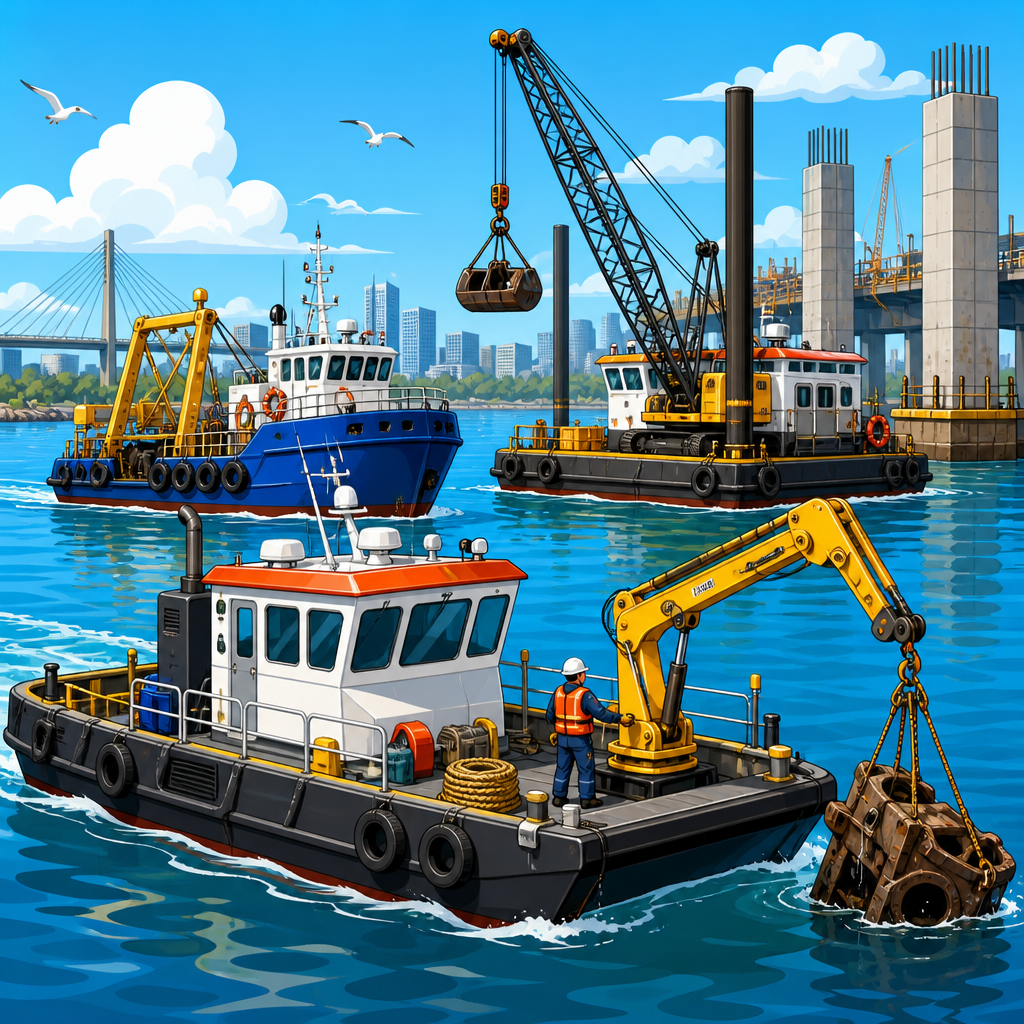
Marine construction and salvage depend on work boats that can carry heavy loads, hold position in current, support diving or crane operations, and keep crews safe in difficult conditions. In this hub guide to the best work boats for marine construction and salvage, “work & utility boats” refers to the broad family of commercial vessels built for tasks rather than recreation, including tugboats, barges, landing craft, crew boats, utility skiffs, multipurpose service vessels, and specialized salvage platforms. I have worked around marine contractors planning pier repairs, dredging support, bridge jobs, and recovery operations, and the same lesson comes up every time: the right hull and deck layout save time, reduce risk, and often determine whether a project stays profitable. Choosing among work boats matters because marine jobs are exposed to tide, wind, overhead load limits, draft restrictions, and regulatory requirements from agencies such as OSHA, the U.S. Coast Guard, and class societies like ABS or DNV. A boat that performs well in one role can be inefficient or unsafe in another. A shallow aluminum landing craft may be ideal for moving excavators to shoreline sites, while a steel spud barge is better for stable crane lifts. This article explains the main types of work and utility boats used in construction and salvage, what each does best, and how operators match vessel capabilities to real project demands.
Tugboats and push boats: the force behind heavy marine moves
Tugboats are among the most important work boats in marine construction and salvage because they provide controlled power for towing, pushing, stationing, and emergency response. In construction, tugs move crane barges, material barges, pile-driving spreads, and dredges between job sites. In salvage, they control a casualty’s heading, assist refloating, tow disabled vessels, and deliver pumps, anchors, and response crews. The best tug for the job is defined less by appearance than by bollard pull, propulsion type, deck equipment, and maneuverability. Twin-screw tugs remain common because they are robust and relatively simple to maintain, while azimuth stern drive tugs offer exceptional maneuvering in confined work zones around bridge piers, docks, and grounded vessels.
Push boats deserve separate attention because inland and nearshore construction often depends on them to move barges efficiently. A push boat with proper fendering and coupling gear can reposition deck barges carrying riprap, steel, or precast components far faster than a tow arrangement in narrow channels. On river projects, I have seen contractors favor shallow-draft push boats because they maintain schedule when water levels fluctuate and because they can work where conventional deep-draft tugs lose efficiency. For salvage, escort and response tugs with firefighting pumps, towing winches, and hydraulic deck gear are especially valuable. Their utility comes from combining propulsion power with onboard systems that support complex operations, not from horsepower alone.
Barges and floating platforms: the stable backbone of construction and recovery
If tugboats supply force, barges supply working space. For many marine construction and salvage jobs, the barge is the primary platform, and vessel selection starts with deck area, load rating, stability, freeboard, and method of station keeping. Flat deck barges carry materials, vehicles, and containers. Crane barges support heavy lifts such as sheet piles, dolphins, bridge beams, and wreck sections. Spud barges use vertical steel piles dropped to the seabed to reduce movement, making them useful for pile driving, cofferdam work, and shoreline stabilization. Jack-up barges go further by elevating above the water surface on legs, creating an extremely stable platform in shallow areas for drilling, bridge inspection, and repair work.
For salvage operations, sheerleg barges and heavy-lift crane barges can recover sunken equipment, raise sections of a wreck, or place patching systems on damaged hulls. Deck strength is critical here because lifting appliances transfer concentrated loads through the structure. Operators review load charts, intact and damage stability, and the effect of crane outreach before approving a lift plan. Barges also need practical features: clear deck lanes for forklifts, secure lashing points, fuel transfer arrangements, and power for welding, pumps, or compressors. In real projects, the most productive barges are rarely the biggest ones; they are the barges sized correctly for access constraints, transport cost, and the exact sequence of work.
Landing craft and utility boats: access, transport, and rapid deployment
Landing craft are some of the best work boats for marine construction because they solve a basic but expensive problem: moving people, machines, and materials onto undeveloped shorelines. Their defining feature is the bow ramp, which allows direct beach or bank access without a pier. Contractors use landing craft to transport mini excavators, skid steers, ATVs, pumps, geotextiles, and small crews to revetment repairs, wetland restoration sites, and remote utility corridors. Aluminum landing craft are especially popular because they combine shallow draft, corrosion resistance, and lower operating weight with respectable payload. Their open deck and simple systems also make them easy to adapt with racks, bins, or temporary fuel tanks.
Smaller utility boats fill the gaps that larger vessels cannot. A center-console work skiff, rigid inflatable boat, or shallow-draft jon-style utility hull may handle survey runs, line tending, personnel transfer, debris checks, and dive support in confined waters. During salvage operations, these boats deploy containment boom, ferry rigging, monitor anchor lines, and move dewatering hoses between platforms. Their value is speed and flexibility, but they still require commercial-grade features: non-slip deck surfaces, reinforced tow bits, lifting eyes, VHF and AIS equipment where required, and enough freeboard for the sea state. For many contractors, the utility boat is the first vessel launched each morning because it extends the reach and awareness of every larger asset on site.
Crew boats, dive boats, and multipurpose service vessels
Personnel movement is a major cost center in marine construction, which is why crew boats deserve a central place in any discussion of work and utility boats. Dedicated crew boats are designed for safe, repeatable transport of workers, inspectors, engineers, and light tools between shore and offshore or nearshore job sites. Their priorities are predictable seakeeping, protected seating, boarding arrangements, and speed. In harbor work, a simple enclosed launch may be enough. In offshore wind support, pipeline inspection, or platform demolition, higher-speed catamaran crew transfer vessels are preferred because they offer better deck area, stability, and passenger comfort over longer transits.
Dive boats and multipurpose service vessels add another layer of capability. A proper dive support boat includes diver ladders, stage handling gear, compressor space, emergency oxygen, clear communications, and deck layouts that separate umbilicals from general traffic. In salvage, that organization matters because cluttered decks create entanglement and trip hazards during time-sensitive operations. Multipurpose service vessels are often the most efficient choice for medium-scale contractors because one hull can support survey work, personnel transfer, light cargo, towing, spill response, and inspection tasks. The tradeoff is specialization. A multipurpose boat may do many jobs well enough, but it will not outperform a dedicated crane barge, dedicated dive vessel, or ASD tug in their core missions.
| Work boat type | Best use in marine construction | Best use in salvage | Main advantage | Main limitation |
|---|---|---|---|---|
| Tugboat or push boat | Moving barges, dredges, and equipment spreads | Towing casualties, controlling position, emergency response | High maneuvering power | Limited deck workspace |
| Deck or crane barge | Heavy lifts, material staging, pile driving support | Wreck recovery, pump staging, lift platform | Stable working area | Needs support vessel for movement |
| Landing craft | Beach and shoreline equipment delivery | Rapid deployment of gear to remote sites | Bow-ramp access | Less suitable for offshore sea states |
| Utility boat or skiff | Surveys, line handling, inspections | Boom deployment, hose tending, diver support | Fast and flexible | Low payload and limited endurance |
| Crew or service vessel | Transporting workers and tools | Moving response teams and technicians | Efficient personnel transfer | Not designed for heavy cargo |
How to choose the best work boat for a specific job
The best work boat for marine construction and salvage is the one that matches mission profile, site conditions, and support requirements with the fewest compromises. Start with the task. Is the job transporting equipment, lifting loads, holding station, carrying divers, or recovering a vessel? Then review the operating environment: water depth, current velocity, wave climate, bridge clearance, berth limitations, and distance from fuel or repair support. Draft and air draft are often the first hard limits. I have seen well-priced vessels rejected immediately because a barge could not pass under utility crossings at high water or because a tug’s draft was too deep for a back-bay dredging project.
Payload is the next decision point, but payload alone is not enough. Contractors must evaluate deck loading in pounds per square foot, axle loads for tracked machines, crane foundation requirements, and safe working load of bitts, winches, and lifting points. Propulsion and maneuvering need the same discipline. A vessel that must maintain position near a bridge pier may require bow thrusters or spuds rather than raw engine power. Safety and compliance close the loop. USCG inspection status, stability documentation, firefighting equipment, crew certifications, and maintenance history all affect insurance, schedule, and risk. Smart buyers and charterers inspect weld quality, corrosion condition, machinery access, and parts support before focusing on cosmetic appearance.
Materials, propulsion, and outfitting that improve performance
Construction material influences lifecycle cost and suitability. Aluminum work boats dominate small utility, patrol, and landing craft segments because they are light, durable, and efficient. Steel remains the default for tugs, barges, and heavy-duty salvage platforms because it tolerates concentrated loads, repeated contact, and structural modification better than lighter alloys. Fiberglass appears in some crew boats and launches, but it is less common in hard-use commercial applications where abrasion, impact, and welding modifications are routine. Coatings matter as much as base material. Commercial epoxy systems, sacrificial anodes, and disciplined corrosion control programs extend service life dramatically in brackish and salt water.
Propulsion choices affect operating economics and task capability. Conventional inboard diesel engines are still standard because they provide torque, range, and serviceability in remote areas. Waterjets can be useful for shallow, debris-prone environments, but they are not universally better; they can lose efficiency under heavy load and demand careful intake management. Outboards are common on smaller utility craft due to simplicity and easy replacement, while hybrid and electric systems are beginning to appear in harbor launches where emissions rules and short duty cycles align. Outfitting is where a generic hull becomes a productive work boat. Crane pedestals, capstans, hydraulic power packs, moonpools, A-frames, fender systems, towing staples, and modular deck containers let owners configure one vessel for multiple contracts without permanent redesign.
Safety, maintenance, and the economics of ownership or charter
Marine construction and salvage are unforgiving sectors, so the best work boats are not just capable; they are maintainable and safe under pressure. Basic design features have outsized effects on incident prevention: wide side decks, strong handholds, clear sightlines from the helm, redundant bilge pumping, protected fuel systems, and deck layouts that keep personnel separated from suspended loads. Operators should expect written lockout procedures, lifting plans, man-overboard drills, and preventive maintenance records. Standards from OSHA, ABYC for certain systems, and class or flag requirements provide structure, but safe performance still depends on culture. In my experience, projects run smoother when vessel crews join construction planning meetings instead of being treated as transportation only.
The ownership-versus-charter decision comes down to utilization, specialization, and capital discipline. Buying can make sense for frequently used utility boats, landing craft, and support skiffs because owners control availability and outfitting. Chartering is often smarter for crane barges, large tugs, and specialized salvage vessels because those assets are expensive, maintenance-intensive, and not needed continuously. Total cost should include crew, insurance, haul-outs, engine rebuild intervals, consumables, survey compliance, and downtime risk. A cheap vessel with poor reliability is rarely cheap by the end of a project. The strongest fleets are built around a clear operating profile: own the boats used every week, charter the uncommon heavy assets, and keep each vessel configured for work rather than appearances.
The best work boats for marine construction and salvage are the vessels that align capability with task, water conditions, and safety requirements. Tugboats and push boats deliver control and power. Barges provide stable platforms for lifting, staging, and recovery. Landing craft solve shoreline access. Utility boats extend flexibility for surveys, inspections, and support. Crew boats and service vessels move personnel efficiently and keep projects on schedule. Across all categories, the same selection principles apply: match draft, deck strength, payload, propulsion, and outfitting to the real job rather than the broad label on the vessel.
As a hub within the broader Types of Boats topic, this work and utility boats guide should help you narrow the field before diving into more specialized vessel pages on tugs, barges, landing craft, crew boats, and salvage boats. The practical benefit is straightforward: better vessel selection lowers risk, improves productivity, and protects margins on difficult marine jobs. Review your project profile, list the operational constraints, and compare boats by function first. Then speak with builders, charter providers, and marine operators who understand commercial duty cycles. The right work boat is not just a platform; it is a tool that determines how effectively the job gets done.
Frequently Asked Questions
What types of work boats are best suited for marine construction and salvage projects?
The best work boats for marine construction and salvage are usually the ones that match the job site, load requirements, water conditions, and onboard equipment needs. In practice, that means there is rarely a single “best” vessel for every project. Tugboats are essential when heavy towing, pushing barges, or maneuvering large floating equipment is required. Barges are widely used as stable platforms for cranes, excavators, pile-driving rigs, material staging, and recovered debris. Landing craft are especially valuable when equipment, vehicles, or personnel need to be moved directly onto shorelines, beaches, or undeveloped waterfront job sites without dock access.
Crew boats and utility boats are ideal for transporting technicians, divers, inspectors, and small tools quickly between ports and offshore or nearshore work zones. Multipurpose service vessels are often favored on more complex jobs because they can support several functions at once, such as deck cargo handling, dive support, towing, and light lifting. Utility skiffs and smaller support boats also play an important role in moving lines, performing inspections, assisting with mooring operations, and accessing tight or shallow areas where larger vessels cannot safely operate.
For salvage specifically, vessel selection often depends on whether the task involves recovery, stabilization, dewatering, diving support, debris removal, or refloating. A salvage team may use a barge as a work platform, a tug for positioning and towing, and smaller boats for diver deployment and close-in support. The strongest fleets are usually mixed fleets, where each boat fills a clear operational role. Choosing the right combination improves safety, shortens project timelines, and reduces the risk of costly delays caused by using a vessel that is underpowered, undersized, or not designed for the conditions.
What features should operators look for when choosing a work boat for heavy-duty marine jobs?
For heavy-duty marine construction and salvage, the most important features are stability, deck strength, load capacity, maneuverability, and the ability to safely support specialized operations. A vessel’s hull design matters a great deal because it affects how well the boat performs in chop, current, shallow water, and tight working areas. Operators also need to consider freeboard, draft, and beam, since these characteristics influence access, deck working height, and overall platform steadiness when lifting, towing, or staging equipment.
Deck layout is another major consideration. Marine construction boats often need open, reinforced deck space for materials, pumps, compressors, welding gear, rigging, dive systems, or cranes. Strong deck fittings, secure tie-down points, and accessible work areas make operations safer and more efficient. On salvage projects, a boat may need towing bitts, winches, hydraulic systems, A-frames, lifting points, or integrated crane support. If diving is part of the mission, safe diver entry and recovery arrangements, equipment storage, and communication support become essential. If the vessel will serve as a mobile job platform, operators should also look at generator capacity, lighting, fuel endurance, and accommodations for longer deployments.
Position-keeping capability is especially important. Boats that can hold station reliably in current or wind offer major advantages during crane work, inspection, underwater construction, and diver operations. Depending on the project, that may mean twin-screw propulsion, bow thrusters, spud systems, anchors, or dynamic positioning capability on more advanced vessels. Safety features should never be treated as secondary. Proper railings, non-slip surfaces, firefighting systems, bilge management, emergency equipment, and strong visibility from the helm all contribute to safe operation. In short, the best work boat is not just powerful; it is purpose-built, predictable under load, and equipped for the exact demands of the job.
Why are barges and tugboats so important in marine construction and salvage operations?
Barges and tugboats are foundational to many marine construction and salvage projects because together they provide lifting support, cargo capacity, mobility, and control. Barges act as floating work platforms that can carry heavy machinery, construction materials, recovered wreckage, containers, fuel tanks, and specialized equipment that would overwhelm smaller vessels. Their wide, stable decks make them ideal for cranes, excavators, pile drivers, welding stations, and dive support systems. In many cases, a barge becomes the central operating platform for the entire project.
Tugboats bring the force and maneuverability needed to move and position those barges safely. On crowded waterways, in rivers with strong current, or at exposed coastal sites, simply getting a work platform into place can be a demanding operation. Tugs are designed with high bollard pull, rugged construction, and responsive handling, allowing crews to push, tow, or hold larger floating assets in position. In salvage work, tugboats are also critical for controlling distressed vessels, assisting refloating efforts, towing damaged hulls, and maintaining safe separation between work areas and navigation channels.
The combination is especially valuable because it is flexible. A crane barge can be mobilized for heavy lifts, a material barge can support staging, and a tug can shift those platforms as the work evolves. That modular approach helps contractors adapt quickly to changing site conditions or salvage requirements without needing a single ultra-specialized vessel to do everything. It is also often more cost-effective, since companies can match the barge size, deck configuration, and tug power to the scope of each job. For marine construction and salvage, few vessel pairings are as proven or as operationally important as barges and tugs.
How do work boats support diver, crane, and salvage recovery operations safely?
Safe support for diver, crane, and recovery operations starts with using a vessel designed for controlled, predictable performance under demanding conditions. For dive work, boats must provide stable access to the water, dependable station-keeping, secure storage for hoses and gear, and enough deck organization to keep personnel clear of hazards. Good communication systems between the helm, deck crew, and dive team are essential, as is clear emergency planning. Even smaller utility boats used for dive support need practical boarding arrangements, non-slip decks, and enough space to avoid entanglement and trip hazards.
Crane operations place a different kind of demand on a work boat or barge. The platform must be structurally capable of handling point loads, changing weight distribution, and dynamic forces created during lifting. Stability calculations, proper ballast management, and careful load planning are central to safe execution. Crews also need clear deck zones, strong rigging practices, and reliable positioning systems to prevent drift during picks. In current or wind, even small movements can create serious risk when lifting heavy piles, machinery, sections of wreckage, or submerged objects. That is why the most effective crane-support vessels are those that combine stability with excellent positional control.
In salvage recovery, safety depends on preparation as much as vessel type. Work boats support recovery by transporting pumps, air bags, dewatering systems, cutting tools, containment gear, and recovered materials. They may also establish exclusion zones, tend lines, relocate debris, or transfer personnel between platforms. The safest operations rely on boats that have the right deck capacity, towing capability, and redundancy for rough conditions. Just as important, they rely on trained crews who understand marine hazards such as shifting loads, fouled propellers, unstable wreckage, changing weather, and reduced visibility. A properly selected work boat reduces exposure to these risks by giving the crew a dependable platform from which to perform technical tasks methodically and safely.
How should a contractor choose between a landing craft, crew boat, utility boat, or multipurpose service vessel?
The right choice depends on what the vessel needs to carry, how often it will shuttle, what kind of site access is available, and whether the project involves a single task or several overlapping functions. A landing craft is often the strongest option when the job requires moving vehicles, palletized materials, pumps, compact excavators, or crews onto shorelines and undeveloped sites. Its bow ramp allows direct loading and unloading without relying on docks or cranes, which can save time and simplify logistics on remote or damaged waterfronts.
Crew boats are best when fast, repeated personnel transfers are the priority. They are commonly used to move supervisors, inspectors, divers, engineers, and technicians along with hand tools and lighter supplies. On projects where time matters and job sites are spread out, a crew boat can keep people moving efficiently while larger vessels focus on lifting, towing, or staging equipment. Utility boats and utility skiffs are better for close-support tasks, short-range transport, line handling, inspections, sounding, and access to confined or shallow areas. They are often the practical choice for day-to-day support around barges, docks, bridge work, and salvage spreads.
A multipurpose service vessel is usually the better investment when the scope is complex and changing. These boats can combine cargo space, towing capability, deck equipment support, and personnel transport in one platform. That versatility is useful for contractors who need one vessel to perform several roles during a project rather than mobilizing separate boats for each task. However, versatility should not be confused with suitability for every mission. If the job involves very heavy loads, major lifts, or large-scale salvage, a specialized barge-and-tug setup may still outperform a single multipurpose vessel. The smartest approach is to evaluate payload, sea conditions, access limitations, required equipment, crew size, and daily task flow, then choose the boat or mix