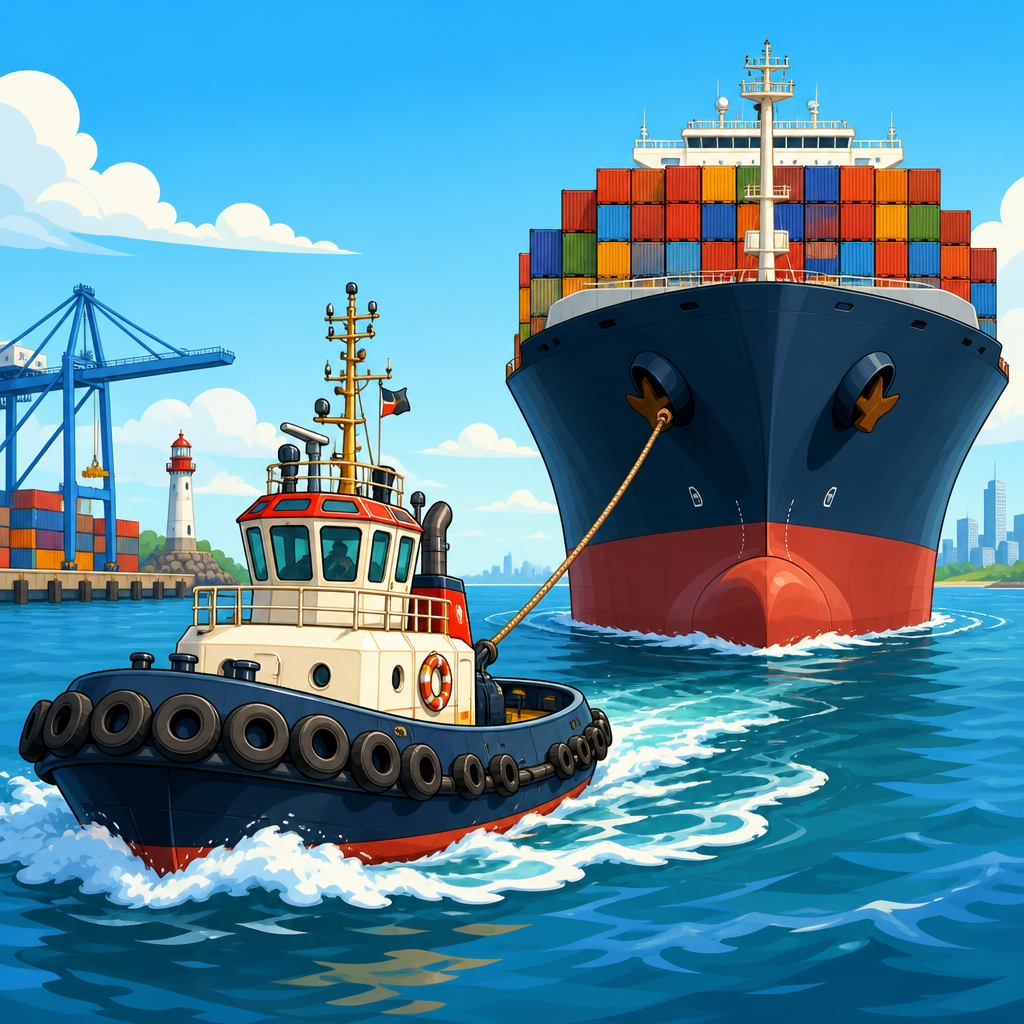
Tugboats are the compact, high-power workhorses of the marine industry, and understanding how tugboats work is essential to understanding modern maritime operations. A tugboat is a specialized vessel designed to maneuver, push, tow, or escort larger ships and floating structures that cannot safely move on their own in confined, crowded, or hazardous waters. Although many people notice their short hulls and oversized engines, the real significance of tugboats lies in the control they provide: they add steering force, braking force, and positional accuracy where mass alone makes larger vessels slow to respond. In ports, rivers, canals, offshore fields, and salvage sites, tugboats are the difference between orderly shiphandling and costly delay or collision.
Within the broader category of work and utility boats, tugboats sit alongside pilot boats, towboats, patrol craft, supply boats, dredgers, work barges, and firefighting vessels. What separates tugs from other utility craft is bollard pull, the static pulling force measured in tons, and the ability to transfer that force through towlines, winches, fenders, and high-thrust propulsion systems. In practical terms, a harbor tug may help a container ship turn onto berth in a crosswind, while an ocean-going tug may tow a disabled vessel hundreds of miles. Some tugs are built for escort work, using hydrodynamic hull forces and indirect towing techniques to control fast-moving ships in narrow channels.
This subject matters because global trade depends on precision marine logistics. The United Nations Conference on Trade and Development regularly reports that around 80 percent of world trade by volume moves by sea, and every major port relies on tug assistance for safety and efficiency. As ships have grown wider, longer, and deeper, tugboat design has evolved from simple line-hauling craft to advanced azimuth stern drive, tractor, and escort tugs with sophisticated winches, electronic controls, and firefighting systems. I have seen firsthand that a well-matched tug assignment can save hours during berthing and prevent incidents that would shut down a terminal. For anyone exploring types of boats, this hub explains not only what tugboats are, but how they fit into the wider work and utility boat ecosystem.
How Tugboats Generate So Much Power
Tugboats work by concentrating exceptional propulsion power into a small, stable hull. Unlike cargo ships, which are optimized for carrying capacity and fuel efficiency over distance, tugs are optimized for thrust at low speed. Their engines are typically medium-speed or high-speed marine diesels connected to reduction gearboxes and propulsion units designed to move large volumes of water with strong directional control. Power output varies widely, but modern harbor tugs commonly carry several thousand horsepower, and escort or offshore units may exceed 10,000 horsepower depending on duty.
The most important performance measure is bollard pull. During a bollard pull test, the tug is secured to a fixed point and applies full power while static; the measured pull indicates how much force it can exert. A harbor assist tug might deliver 40 to 80 tons of bollard pull, while larger terminal or escort tugs can exceed 100 tons. That force allows the tug to push against a ship’s hull using heavy rubber fenders or pull through a towline managed by a render-recover winch. In service, safe towing force is affected by weather, current, line angle, sea state, and whether the tug is working direct or indirect.
Propulsion layout determines maneuverability. Conventional twin-screw tugs use propellers and rudders, but most modern ship-assist fleets prefer azimuth stern drive units or tractor configurations with Voith Schneider propellers or forward-mounted azimuthing thrusters. These systems rotate thrust through 360 degrees, letting a tug move sideways, pivot in place, or apply force in changing directions without needing headway. That responsiveness is why today’s tugs can control ultra large container vessels and LNG carriers inside narrow harbor approaches where older designs would struggle.
Main Types of Tugboats and Where They Operate
Not all tugboats do the same job. Harbor tugs are the most familiar type, working inside ports to berth and unberth ships, shift barges, and provide standby support. They are compact, heavily fendered, and built for immediate response. River towboats, often grouped with towing vessels, are designed to push barge strings on inland waterways; in North America they differ operationally from harbor tugs because they usually push rather than tow astern. Coastal and ocean-going tugs are larger, with more fuel, better seakeeping, and accommodations for long voyages. Anchor handling tug supply vessels support offshore energy work by towing rigs, moving anchors, and carrying deck cargo.
Escort tugs are a highly specialized class developed for high-consequence ports handling tankers and gas carriers. Their role is not merely to assist at the berth but to control a ship during transit, especially if steering or propulsion fails. Using escort winches, skegs, and indirect towing techniques, they generate lateral forces by holding an angle to the water flow as the escorted vessel moves ahead. That capability became especially important after major tanker accidents prompted stricter risk management in environmentally sensitive waterways.
Salvage tugs and emergency towing vessels fill another crucial niche. They respond to disabled ships, groundings, drifting vessels, and post-casualty stabilization. These boats may carry portable pumps, diving support gear, towing bridles, and firefighting equipment. In rough weather, simply passing a towline is a major operation requiring deck crews, line launchers, and careful coordination. Across the wider work and utility boat category, this division of labor matters: pilot boats transfer navigators, supply vessels transport cargo and crew, and tugboats apply controlled force. That makes them the central muscle of marine support operations.
How Tugboats Assist Ships During Berthing, Towing, and Escort Operations
When a large vessel approaches port, tug use starts with planning. The pilot, master, and tug dispatcher consider wind, current, draft, berth layout, traffic density, and the ship’s own thrusters or rudder effectiveness. Tug positions are assigned accordingly. One tug may connect forward and another aft, or a single tug may work on the shoulder of a smaller ship. Communication is usually by VHF radio using standardized commands for push, pull, stop, slack, and reposition. Timing is critical because a ship moving even a few knots carries enormous momentum.
During berthing, a tug may push directly on the hull with its fendering system or pull via a towline from a ship’s fairlead. Pushing is simple and immediate, but pulling offers more range and leverage. I have watched ship-assist jobs where the stern tug acted like a movable brake, checking swing while the bow tug walked the ship sideways toward the quay. On windy days, tugs counteract lateral drift that a vessel’s rudder cannot correct at low speed. For ships with high sides, such as car carriers, windage can dominate handling, making tug power indispensable.
Towing operations vary by distance and purpose. Short harbor tows may involve moving barges, dredges, or pontoons across a port. Offshore tows use stronger gear, longer catenary towlines, emergency release systems, and route planning that accounts for weather windows and safe havens. Escort operations are different again: the tug stays connected while the ship transits, ready to steer, brake, or arrest yaw instantly. Ports such as those handling LNG commonly require escort tugs under formal risk assessments because a single loss-of-control event can threaten terminals, channels, and nearby communities.
Equipment, Safety Systems, and Crew Skills That Make Tugboats Effective
A tugboat’s effectiveness depends as much on deck machinery and crew competence as on engine power. Core equipment includes towing winches, tow hooks, capstans, staple or gob arrangements, shark jaws on some offshore vessels, and heavy synthetic or wire towing lines selected for load, elasticity, and handling characteristics. Render-recover winches are especially important on modern escort tugs because they automatically pay out and recover line under controlled tension, reducing shock loads and capsize risk. Tire fenders were common historically, but purpose-built cylindrical, block, and W-type rubber fenders now dominate professional fleets.
Navigation and control systems are equally important. Most tugs carry radar, AIS, ECDIS or electronic charting, DGPS, echo sounders, engine monitoring, and sometimes load cells integrated with towing winches. Firefighting tugs may be classed FiFi 1 or higher, with monitors capable of delivering large water volumes for ship or terminal incidents. Classification societies such as ABS, DNV, Lloyd’s Register, and Bureau Veritas set standards for construction and equipment, while operators build procedures around local port authority rules, International Safety Management requirements, and company risk assessments.
| Component | What It Does | Why It Matters in Operations |
|---|---|---|
| Azimuth thrusters | Rotate thrust 360 degrees | Enable rapid lateral movement and precise positioning |
| Escort winch | Controls towline tension dynamically | Reduces shock loading and improves ship control at speed |
| Fendering | Absorbs contact forces against ship hulls | Allows safe pushing without structural damage |
| Bollard pull rating | Measures static pulling force | Helps match tug capability to vessel size and conditions |
| FiFi system | Pumps and monitors for firefighting | Adds emergency response capability in ports and terminals |
Crewing is specialized. Tug masters must understand hydrodynamics, towline behavior, interaction forces near ship hulls, and the limits of stability. Deckhands need disciplined line handling because snap-back zones can kill in seconds. Engineers maintain engines that cycle hard between idle and maximum load. Training increasingly uses bridge simulators for escort work and emergency scenarios, but sea time remains decisive. In tug operations, small mistakes compound quickly, so skill, communication, and procedural discipline are as valuable as raw horsepower.
Why Tugboats Matter Across the Work and Utility Boat Sector
As the hub for work and utility boats, this topic is best understood through relationships. Tugboats rarely work alone in a port ecosystem. Pilot boats deliver pilots to inbound ships before tug assistance begins. Mooring boats may help run lines ashore. Work barges support construction, dredging, or heavy lifts that tugs reposition. Patrol and harbor service craft maintain exclusion zones during tanker or naval movements. Offshore, anchor handlers, crew transfer vessels, and supply boats coordinate around drilling or wind installation campaigns, with tug-capable vessels often providing the force needed to move floating assets into exact position.
Economically, tugboats protect throughput. A delayed berthing window can ripple through terminal labor schedules, crane utilization, trucking appointments, and berth occupancy. Safe, efficient tug assistance lowers that risk. Environmentally, tugs are frontline prevention assets because they reduce the chance of allision, grounding, and fuel spills. That preventive role is one reason ports and regulators increasingly scrutinize tug allocation, escort rules, and emergency towing readiness. In many jurisdictions, minimum tug requirements are tied to vessel class, deadweight, draft, cargo type, and weather thresholds.
Tugboat technology is also changing the wider utility boat market. Hybrid tugs using battery packs with diesel-electric systems are entering service in ports seeking lower emissions and less noise during standby and transit. Some operators are evaluating methanol-ready designs and shore-power integration. Digital fleet management platforms now track fuel burn, engine hours, and job performance with much greater precision than paper logs allowed. Even with these advances, the mission remains constant: put controlled force exactly where maritime operations need it. For readers exploring work and utility boats in depth, tugboats are the essential starting point because they connect safety, logistics, and vessel handling better than any other subcategory.
Tugboats work by combining high power, exceptional maneuverability, specialized towing gear, and experienced crews to move vessels that are too large, too awkward, or too vulnerable to operate safely without assistance. They berth container ships, escort tankers, tow barges, reposition dredges, support offshore energy projects, and respond when ships lose propulsion or steering. Their defining concepts are straightforward: bollard pull measures available force, propulsion systems determine responsiveness, and operating method changes with the job, whether pushing on the hull, towing astern, or controlling a ship at transit speed.
As part of the broader work and utility boats category, tugboats also explain how marine support systems function as a whole. Pilot boats, supply vessels, patrol craft, barges, and dredgers all have distinct roles, but tugboats provide the controlled muscle that lets those roles connect safely inside ports, rivers, coastal routes, and offshore fields. The best tug operations are not dramatic from the dock; they are calm, precise, and almost invisible because risks were anticipated early, equipment was matched correctly, and the crew executed a practiced plan.
If you are building a deeper understanding of types of boats, start with tugboats and then branch into the other work and utility vessels they support. That approach makes the entire marine sector easier to read, from harbor operations to offshore logistics. Use this page as your hub, and continue exploring related boat types with the same question in mind: what specific job is the vessel designed to do, and what design choices make that job possible?
Frequently Asked Questions
What does a tugboat do in maritime operations?
A tugboat is a specialized support vessel built to help larger ships and floating structures move safely when they cannot easily maneuver on their own. In everyday maritime operations, tugboats push, pull, guide, tow, and escort vessels such as cargo ships, tankers, cruise ships, barges, offshore platforms, and even disabled boats. Their most important role is providing precise control in places where there is little room for error, including harbors, narrow channels, river bends, docks, terminals, and areas with heavy traffic, strong currents, or high winds.
Even though tugboats are relatively small, they are designed with powerful engines, strong hulls, and specialized towing gear that allow them to apply significant force. This force can be used to nudge a ship away from a berth, hold it steady while it turns, pull it into alignment, or escort it through hazardous waters in case steering or braking assistance is needed. In many ports, tugboats are a critical part of vessel arrival and departure procedures because large ships often have limited visibility, long stopping distances, and reduced maneuverability at slow speeds.
In simple terms, tugboats act as the control specialists of the marine industry. They make ship movements safer, more efficient, and more predictable, which is why they are essential to modern maritime logistics and port safety.
How do tugboats work if they are so much smaller than the ships they assist?
Tugboats are able to move and control much larger vessels because their effectiveness is not based on size alone. It comes from a combination of high engine power, excellent traction in the water, specialized propulsion systems, and smart positioning by highly trained crews. Tugboats are designed with a high power-to-size ratio, meaning they generate an impressive amount of thrust for their compact dimensions. That is why they are often described as small but extremely powerful workhorses.
When assisting a ship, a tugboat does not usually “drag” the full weight of that vessel through the water in the way many people imagine. Instead, it applies controlled force at key points to influence the vessel’s direction, speed, and position. For example, a tug may push at the bow to help a ship pivot, pull from the stern to control its backward movement, or work alongside the hull to keep the vessel aligned while docking. In towing operations, the tug uses heavy-duty winches and towing lines to transfer force safely and steadily.
Modern tugboats often use advanced propulsion systems such as azimuth thrusters or Voith Schneider propellers, which allow them to direct thrust quickly in different directions. This gives them exceptional maneuverability and lets them respond almost instantly to changing conditions. Combined with the skill of the crew, that maneuverability allows a tugboat to control vessels many times its own size, especially in situations where precision matters more than raw speed.
Why are tugboats necessary when large ships already have their own engines and crews?
Large ships are built primarily for carrying cargo, passengers, or specialized loads across long distances, not for making sharp, precise movements in tight or congested waters. While they do have powerful engines and professional bridge teams, their size creates major limitations. A fully loaded tanker, container ship, or cruise vessel may take a long distance to stop, turn slowly, and respond less effectively at low speeds. In ports and channels, those limitations can create serious risks without external assistance.
Tugboats solve this problem by adding localized control exactly where it is needed. They can apply force directly to the bow, stern, or side of a ship, helping it rotate, brake, hold position, or move sideways in ways the ship itself may not be able to do efficiently. This is especially important during docking and undocking, when a vessel may be operating near piers, cranes, other ships, shallow areas, or sensitive infrastructure. A small error in these situations can lead to costly damage, environmental harm, or operational delays.
Tugboats are also essential during difficult weather and water conditions. Strong winds, currents, tides, and restricted visibility can all reduce a ship’s ability to maneuver safely. In addition, escort tugboats provide an extra layer of protection for high-risk vessels such as LNG carriers or large oil tankers by staying close enough to intervene quickly if steering or propulsion fails. So while large ships are capable at sea, tugboats provide the fine-control support that makes safe port and nearshore operations possible.
What are the main types of tugboat operations?
Tugboat work generally falls into several main categories, each serving a distinct purpose in maritime operations. One of the most common is harbor assist work, where tugboats help ships arrive at and depart from docks, terminals, and berths. In these situations, tugs may push directly against the hull or connect towing lines to guide the vessel through tight turns and narrow spaces. This is the type of operation most people see in busy commercial ports.
Another major category is towing. In towing operations, a tugboat pulls or pushes barges, dredges, construction platforms, floating cranes, or disabled vessels from one location to another. Some towing is done inland on rivers and canals, while other jobs involve long-distance ocean towing. These operations require careful route planning, secure towing arrangements, and constant monitoring of weather and sea conditions.
Escort operations are also extremely important, particularly for large ships carrying hazardous cargo or operating in environmentally sensitive areas. An escort tug stays with the vessel during transit and is prepared to assist immediately if the ship experiences mechanical trouble, steering failure, or loss of control. In some cases, the tug can provide emergency braking or directional force to reduce the risk of grounding or collision.
There are also specialized tug services for salvage, firefighting, ice operations, offshore support, and emergency response. Some tugboats are equipped with fire monitors to fight shipboard or waterfront fires, while others assist with oil and gas infrastructure or support vessels in harsh operating environments. Together, these roles show that tugboats are far more than simple towing vessels; they are versatile operational assets across the maritime industry.
What features make tugboats so powerful and maneuverable?
Tugboats are built around function, and nearly every design feature is intended to maximize control, strength, and safety. One of the most important features is their propulsion system. Unlike conventional ships that are optimized for forward travel over long distances, many modern tugboats use highly maneuverable propulsion arrangements that let them change direction quickly and deliver thrust at precise angles. This allows them to work effectively in close quarters and respond rapidly to pilot commands or changing water conditions.
The hull design also plays a major role. Tugboats typically have compact, sturdy hulls that provide stability and allow them to operate close to much larger vessels. Their structure is reinforced to withstand pushing forces, towing strain, and repeated contact during harbor work. Heavy fendering along the sides and bow helps absorb impact and protects both the tug and the ship it is assisting.
On deck, tugboats are equipped with towing winches, strong bitts, tow hooks, and towing pins that help crews manage heavy lines safely. Many also include advanced navigation, communication, and engine control systems so the captain and crew can coordinate closely with harbor pilots, ship masters, and port authorities. Power is another defining trait: tugboats often have very high bollard pull, which is a measure of pulling force. That combination of engine strength, controllable thrust, rugged construction, and specialized equipment is what makes tugboats uniquely capable of handling demanding maritime tasks with impressive precision.