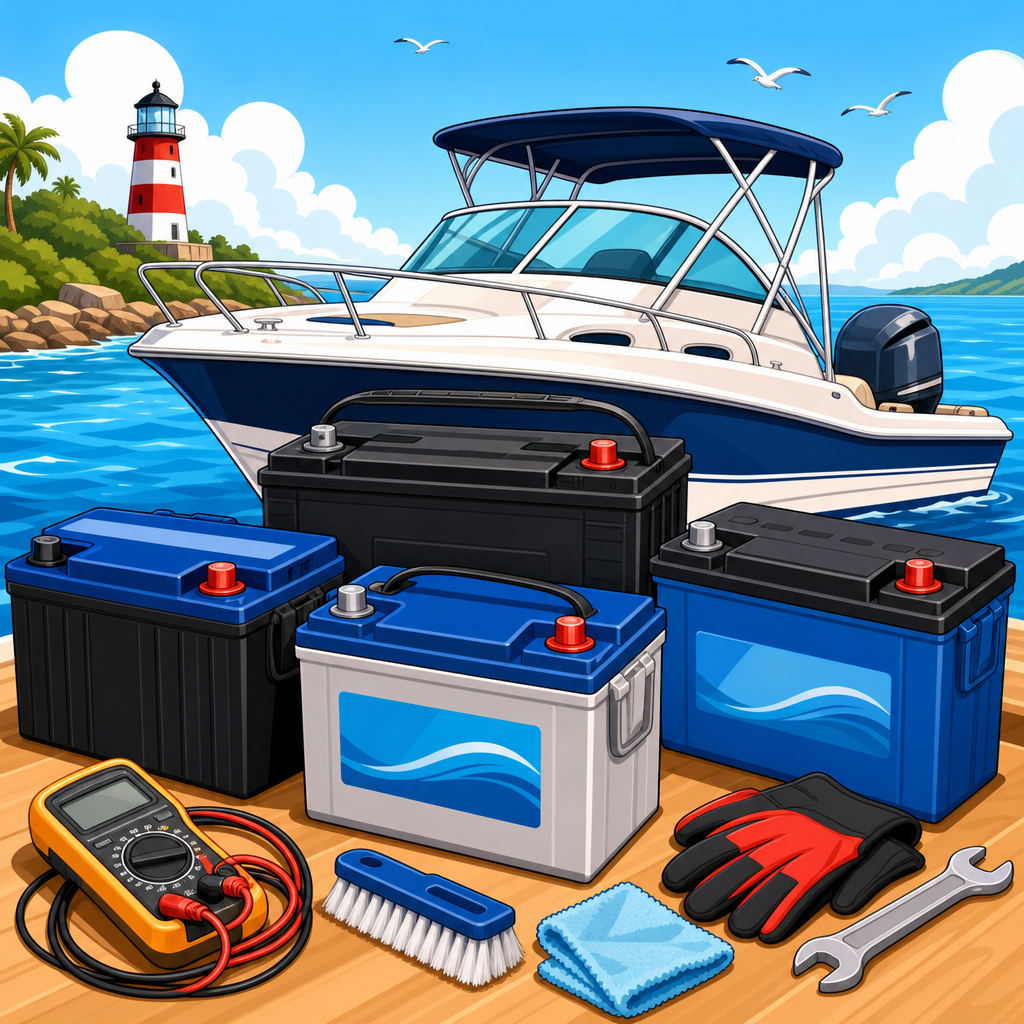
Marine batteries are the foundation of every reliable boat electrical system, yet many owners treat them as simple boxes that store power until a no-start morning proves otherwise. In boats, the battery bank does far more than crank an engine. It powers navigation electronics, bilge pumps, lighting, livewells, inverters, freshwater pumps, and safety gear, often in a wet, high-vibration environment that is harsher than automotive use. Choosing the best marine batteries for boats and maintaining them correctly is therefore not a narrow purchasing decision; it is central to electrical and plumbing systems performance across the entire vessel.
A marine battery is built to resist vibration, withstand repeated charging and discharging, and deliver either short bursts of high current or steady power over time. The key battery categories are starting batteries, which provide high cranking amps for engine ignition; deep-cycle batteries, which are designed for repeated discharge and recharge; and dual-purpose batteries, which try to do both jobs in a single case. Chemistry matters too. Flooded lead-acid batteries remain common because they are affordable and widely available. AGM, or absorbed glass mat, batteries are sealed, spill-resistant, and charge faster. Gel batteries are less common today but still used in some specialty applications. Lithium iron phosphate, usually abbreviated LiFePO4, has rapidly expanded because it is lighter, lasts longer, and offers more usable capacity.
This topic matters because battery selection affects every downstream maintenance decision in electrical and plumbing systems. The wrong battery can underpower a trolling motor, shorten alternator life, trip low-voltage alarms on chartplotters, or leave an automatic bilge pump without reserve capacity when a float switch sticks on. I have seen owners replace pumps, switches, and even alternators when the root issue was a weak battery bank, poor cable sizing, or an incompatible charger profile. Good battery practice also improves safety. The American Boat and Yacht Council, especially standards such as ABYC E-10 and E-11, sets practical guidance for DC electrical systems, battery installation, overcurrent protection, and ventilation. Following those principles reduces the risk of fire, corrosion, nuisance failures, and stranded departures.
As a hub within Boat Maintenance & Repairs, this guide connects battery choice to the broader care of onboard systems. Electrical and plumbing systems meet at pressure pumps, shower sump boxes, macerators, baitwell pumps, washdown pumps, tank monitors, and automatic bilge setups, all of which depend on stable DC voltage and clean wiring. If your battery bank is undersized, poorly maintained, or incorrectly charged, those systems become unreliable long before they fail completely. The best approach is to match battery type to your loads, install it correctly, and maintain it on a schedule that fits how the boat is actually used.
Choosing the best marine battery type for your boat
The best marine battery for boats depends on how the boat is used, not on a single brand or chemistry. For a small center console with one outboard and modest electronics, a starting battery plus a separate house battery is often the most dependable setup. For a bass boat, multiple deep-cycle batteries may be required for a 24-volt or 36-volt trolling motor bank, with another dedicated starting battery for the outboard and sonar units. For a cruising sailboat or trawler, a large house bank is usually the priority because refrigeration, lighting, pumps, and inverters dominate the load profile. The correct question is not “Which battery is best?” but “Which battery profile fits my current draw, recharge sources, and downtime between trips?”
Flooded lead-acid batteries are still practical for many owners. They cost less up front, tolerate moderate charging abuse better than some sealed options, and are easy to source in common group sizes such as 24, 27, 31, and 4D. Their weaknesses are equally clear: they need ventilation, can spill acid, require electrolyte checks, and generally offer fewer deep discharge cycles than premium AGM or lithium. AGM batteries are a strong upgrade for many trailer boats and offshore fishing boats because they resist vibration, self-discharge more slowly in storage, and can deliver high current with lower internal resistance. They do, however, cost more and still suffer shortened life if repeatedly discharged too deeply. Gel batteries require very specific charge voltages and are often a poor match for chargers not designed for them.
Lithium iron phosphate is increasingly the performance leader for house loads and trolling motor banks. A quality LiFePO4 battery can often provide 80 to 100 percent of its rated capacity without the severe cycle-life penalty seen with lead-acid batteries. It also maintains voltage more consistently under load, which helps electronics stay happy. Weight savings are dramatic. Replacing three group-31 lead-acid trolling batteries with lithium can remove more than 100 pounds from the bow of a bass boat, improving hole shot and draft. The tradeoffs are important: lithium costs far more initially, requires a battery management system, may need alternator protection or a DC-to-DC charger, and must be integrated carefully with existing chargers and engine charging circuits.
| Battery type | Best use | Main advantages | Main limitations |
|---|---|---|---|
| Flooded lead-acid | Budget starting and house banks | Low cost, common sizes, easy sourcing | Needs maintenance, venting, lower cycle life |
| AGM | Offshore boats, electronics-heavy setups | Sealed, vibration resistant, faster charging | Higher cost, sensitive to chronic overcharging |
| Gel | Specialty legacy systems | Good deep-cycle behavior when charged correctly | Requires precise charge profile, less common |
| LiFePO4 | House banks and trolling motors | Light weight, long cycle life, high usable capacity | High upfront cost, integration complexity |
Within each chemistry, sizing matters as much as type. Starting batteries are commonly judged by marine cranking amps. Deep-cycle batteries are better evaluated by amp-hours, reserve capacity, and expected depth of discharge. If a boat draws 12 amps on average for electronics, pumps, and lighting during a six-hour trip, that is roughly 72 amp-hours before accounting for inverter losses or reserve margin. A lead-acid battery bank should not usually be drawn down beyond about 50 percent if you want decent service life, so that example realistically needs at least 144 amp-hours of rated capacity, and more if the boat may sit at anchor with pumps cycling overnight.
How marine batteries support electrical and plumbing systems
Battery performance is inseparable from the rest of the boat’s electrical and plumbing systems. Bilge pumps are the most obvious example. A 1500 GPH pump may draw several amps continuously when activated, and a poorly charged battery can cause low voltage at the pump motor, reducing actual pumping output just when water ingress is most serious. Automatic float switches and electronic switches also depend on stable power. A weak or sulfated battery can make a pump seem intermittent even when the wiring and switch are sound. The same pattern appears in freshwater pumps, shower sump pumps, macerators, and livewell pumps, all of which become less efficient as voltage sags.
Modern marine electronics are similarly voltage-sensitive. Multifunction displays, AIS transceivers, radar, VHF radios, and sonar modules often alarm or shut down when supply voltage drops below their operating threshold. On many boats, this happens during engine cranking because the house and start loads are mixed on one aging battery. Separating banks with an automatic charging relay, voltage-sensitive relay, or DC-to-DC charger can solve the problem. I have corrected many “electronics glitch” complaints by isolating the starting circuit, cleaning grounds, and replacing undersized battery cables rather than replacing the displays themselves.
Plumbing systems deserve special attention because they are often ignored until a trip is underway. A freshwater pressure pump that cycles rapidly may indicate an accumulator issue or a leak, but it can also reveal a battery bank that is chronically undercharged, causing poor motor performance. Toilet discharge pumps and macerators draw heavy current on startup; if voltage drops too far, they may stall and overheat. Tank level sensors, water heaters with electronic ignition, and sump boxes all rely on clean DC power. In practical terms, the battery bank is not only an engine-starting asset. It is the reserve energy source that keeps critical water movement and waste handling functioning safely.
Installation basics that prevent battery failure
The best battery will underperform if the installation is wrong. Every battery should be secured against movement in rough water, protected from direct spray, and connected with marine-grade tinned copper cable sized for both amperage and distance. Voltage drop is a silent killer in boat systems. A bilge pump at the stern supplied through undersized wire from a battery under the console may see far less than nominal voltage under load. ABYC guidance on conductor sizing and overcurrent protection exists for this reason. Heat, corrosion, and low voltage all rise when wires are too small or terminations are poor.
Terminal care matters more on boats than in cars because salt, humidity, and dissimilar metals accelerate corrosion. Use adhesive-lined heat shrink on crimped lugs, support cables so vibration does not flex the terminals, and avoid stacking too many ring terminals on one post. Battery switches should be clearly labeled and mounted where they can be reached quickly. Overcurrent protection should be installed as close to the battery as practical, especially for house circuits feeding distribution panels, inverters, and pump systems. A fuse does not protect the battery; it protects the boat from a shorted cable turning into a heating element.
Charging system compatibility is another installation point often missed. Outboard alternators, shore chargers, solar controllers, and inverter/chargers must all use the correct charge profile for the battery chemistry. AGM and flooded batteries need different absorption targets. Lithium systems may require charger replacement, alternator current limiting, or external regulators. If a charger lacks temperature compensation for lead-acid batteries in a hot engine room, service life drops quickly. Good installation means viewing the battery, cables, chargers, and loads as one system.
Maintenance practices that extend marine battery life
Routine maintenance is what separates a battery that lasts two seasons from one that lasts five to ten, depending on chemistry. For flooded lead-acid batteries, check electrolyte levels regularly and top up only with distilled water after charging unless the plates are exposed. Keep case tops clean and dry because grime can promote self-discharge. For AGM batteries, inspect terminals and hold-downs but do not pry at sealed vents or assume “maintenance-free” means ignore it. For lithium, maintenance is mostly about monitoring the battery management system, updating charger settings, and storing the battery within the manufacturer’s recommended state-of-charge window.
Testing should be scheduled, not improvised. A digital multimeter gives useful resting voltage data, but voltage alone is not a health report. Use a conductance tester or a proper load tester for starting batteries, and monitor amp-hour usage with a battery monitor such as a Victron SmartShunt, Xantrex monitor, or Mastervolt system for house banks. Specific gravity remains the most telling check for flooded batteries. If one cell reads significantly lower than the others, the battery is on borrowed time. I advise owners to record date, voltage, test result, and charger behavior at least several times per season so gradual decline is visible before failure becomes abrupt.
Storage habits are equally important. Lead-acid batteries should never be left partially discharged for long periods because sulfation hardens and reduces capacity. During layup, disconnect parasitic loads or maintain the bank with a quality smart charger. In freezing climates, a fully charged lead-acid battery resists freezing far better than a discharged one. Lithium batteries usually prefer partial-charge storage rather than being held at 100 percent for months. Manufacturers differ, so the correct maintenance plan always follows the battery’s published charging and storage parameters, not dockside folklore.
Common battery mistakes and how to avoid them
The most common mistake is mixing old and new batteries in the same bank. When batteries of different ages or capacities are wired together, the weaker unit drags the stronger one down, and charging becomes uneven. The second mistake is choosing a battery by physical fit alone. Group size matters, but so do reserve capacity, cycle life, discharge rate, and charge acceptance. Another frequent error is running sensitive electronics and engine starting loads from a single compromised battery, then blaming the electronics for resetting. Separate critical loads whenever possible.
Owners also underestimate parasitic draws. Stereo memory, GPS antennas, bilge counters, LPG detectors, and charger displays can slowly flatten a battery over weeks. Corrosion is another repeated offender, especially at negative bus bars and engine grounds where problems are less visible. Finally, many boats carry chargers that are years behind current battery technology. If you upgrade from flooded batteries to AGM or lithium without upgrading the charger and reviewing alternator behavior, you have not completed the job. Inspect your system, test it under load, and build a battery plan that matches how your boat actually operates.
The best marine batteries for boats are the batteries that match your vessel’s load profile, charging equipment, and operating style, then receive consistent care. For many owners, that means a dedicated starting battery and a properly sized house bank, with AGM as the practical premium choice and LiFePO4 as the high-performance option when the charging system is designed around it. Flooded lead-acid still has a place where budget matters and maintenance is realistic. No chemistry, however, can overcome poor wiring, wrong charger settings, corroded terminals, or chronic deep discharge.
Battery decisions also shape the reliability of the entire electrical and plumbing systems package. Bilge pumps, freshwater pumps, sump boxes, electronics, lighting, and safety equipment all depend on stable voltage and adequate reserve capacity. When owners troubleshoot those systems in isolation, they often spend more and solve less. Start with the battery bank, cable sizing, charging profile, and overcurrent protection, then move outward to pumps, switches, and fixtures. That systems-first approach prevents repeat failures and makes every other maintenance task easier.
If you want a dependable boat, treat battery care as core maintenance, not an accessory purchase. Audit your loads, verify charger compatibility, test your batteries on a schedule, and replace weak links before they strand you or disable critical pumps. Then continue through the rest of your Boat Maintenance & Repairs checklist by reviewing wiring, bilge components, freshwater pumps, and onboard plumbing circuits with the same discipline. A well-maintained battery system is the starting point for a safer, more reliable day on the water.
Frequently Asked Questions
What type of marine battery is best for my boat: starting, deep-cycle, or dual-purpose?
The best marine battery for your boat depends on how the electrical system is used, not just on the size of the engine. A starting battery is designed to deliver a short burst of high current so the engine can crank quickly and reliably. These batteries are ideal when the motor is the main electrical load and onboard accessories are limited. A deep-cycle marine battery is built differently. It is meant to provide steady power over longer periods and to withstand repeated discharge and recharge cycles. That makes it the better choice for trolling motors, fish finders, lighting, refrigerators, pumps, and electronics that may run for hours. A dual-purpose battery sits in the middle and can handle engine starting while also supporting moderate accessory use, which can work well for smaller boats with limited space.
In real-world boating, many owners benefit most from a battery bank setup rather than relying on one battery to do everything. For example, a dedicated starting battery for the engine and one or more deep-cycle batteries for the house loads is often the most dependable arrangement. This helps protect your ability to start the boat even after running electronics all day. When choosing, pay attention to marine-specific construction, reserve capacity, amp-hour rating, cold cranking amps, and whether the battery chemistry fits your charging system. Matching the battery type to your actual boating habits is the smartest way to improve reliability and battery life.
Are AGM, flooded, or lithium marine batteries better for boats?
Each battery chemistry has strengths, and the right one depends on budget, charging equipment, and how demanding your onboard power needs are. Flooded lead-acid batteries are the traditional option and are often the most affordable. They can perform well for many boats, but they require more maintenance, including checking electrolyte levels when applicable, keeping terminals clean, and making sure they remain properly charged. They also need good ventilation and are more vulnerable to damage if deeply discharged on a regular basis.
AGM, or absorbed glass mat, batteries are a popular upgrade because they are sealed, spill-resistant, and generally better suited to vibration and rough marine conditions. They also tend to charge faster than flooded batteries and usually require less routine maintenance. For many recreational boaters, AGM strikes an excellent balance between performance, durability, and simplicity. Lithium marine batteries, especially lithium iron phosphate models, offer major advantages in weight savings, usable capacity, charge efficiency, and long cycle life. They are especially attractive for serious anglers, cruisers with heavy house loads, and owners looking to reduce weight while increasing available power.
That said, lithium is not always the automatic best choice. It costs more upfront, may require charging system upgrades, and needs compatibility with the boat’s alternator, charger, and battery management system. The safest approach is to choose a chemistry that fits both your boating style and your electrical system. For many owners, AGM remains one of the most practical all-around marine battery options, while lithium is often the premium solution for high-performance and high-demand setups.
How do I choose the right size and capacity marine battery for my boat?
Choosing the right size marine battery means looking beyond physical dimensions and focusing on electrical demand. Start by identifying what the battery needs to do. If it is only for engine starting, the most important number may be marine cranking amps or cold cranking amps, depending on the engine and climate. If it powers house systems, focus more on amp-hour capacity and reserve capacity. Add up the power requirements of your electronics, pumps, lights, trolling motor, stereo, and other devices, then estimate how long they typically run between charges. This gives you a much better idea of the battery bank size needed for dependable use.
Physical fit still matters, of course. The battery must match the available tray space, be properly secured, and comply with marine safety standards. Weight distribution can also affect smaller boats, which is one reason some owners consider lithium. When evaluating capacity, avoid sizing too close to the minimum. A battery that is regularly pushed to its limit will wear out faster and leave less margin for emergencies. It is usually better to build in extra reserve for unexpected loads, bad weather, longer trips, or a forgotten switch that drains power overnight.
Also make sure the charger and alternator are capable of properly charging the battery bank you choose. An oversized battery bank with an undersized charging system can lead to chronic undercharging, which shortens battery life. In short, the right battery size is the one that physically fits, meets the engine’s starting needs, supports the boat’s accessory loads, and works with the charging equipment already onboard or planned for installation.
What maintenance helps marine batteries last longer and perform reliably?
Consistent maintenance is one of the biggest factors in getting long life from marine batteries. The first rule is to keep batteries properly charged. Letting a marine battery sit partially discharged, especially for extended periods, is one of the fastest ways to reduce capacity and shorten its service life. Use a quality marine battery charger with the correct charging profile for the battery chemistry, and recharge as soon as practical after use. During storage, a smart maintainer or onboard charger can help prevent self-discharge and sulfation in lead-acid batteries.
Terminal care is equally important. Corroded terminals create resistance, reduce charging efficiency, and can lead to hard starts or electronics issues. Inspect battery terminals regularly, clean away corrosion, and make sure all cable connections are tight and protected. For flooded batteries, check electrolyte levels according to manufacturer guidance and top off only with distilled water when needed. Keep the battery case clean and dry, and make sure hold-downs are secure so vibration does not damage internal components. In a marine environment, where pounding waves and moisture are constant concerns, a loose battery can fail long before its expected lifespan.
Routine inspection should also include looking for swelling, cracks, leaks, heat damage, and signs of overcharging or undercharging. If your boat has multiple batteries, verify that the charging system, switch, and isolator or combiner are functioning correctly so one weak battery does not drag down the whole bank. Maintenance is not complicated, but it needs to be regular. A few minutes of inspection and charging discipline can prevent many of the no-start situations and premature replacements that frustrate boat owners.
How should marine batteries be stored in the off-season or during long periods without use?
Off-season storage is where many marine batteries lose a large part of their life, so it pays to do it correctly. Before storage, fully charge the batteries and inspect them for any damage, corrosion, or loose connections. If the batteries are flooded lead-acid, confirm electrolyte levels are correct. Clean the terminals and battery tops, because dirt and moisture can contribute to slow discharge. If practical, disconnect the batteries from the boat or isolate them so small parasitic loads from electronics, detectors, or switches do not drain them over time.
The ideal storage location is cool, dry, and protected from extreme temperatures. A battery left discharged in freezing conditions is especially vulnerable to damage. During storage, use a smart charger or maintainer that is designed for marine batteries and matched to the battery chemistry. This is particularly important for lead-acid batteries, which suffer if left sitting at a low state of charge. Lithium batteries also benefit from proper storage procedures, though manufacturer recommendations may differ regarding ideal charge level for long-term storage. Always follow the battery maker’s guidance.
When the boating season returns, do not assume the batteries are ready just because they look fine. Check voltage, inspect cables, confirm the charger is working properly, and test battery performance under load if there is any doubt. Off-season care is not just about preserving battery life. It is also about making sure the electrical system is dependable the first day you launch. Proper storage can mean the difference between years of reliable service and replacing expensive batteries far earlier than expected.