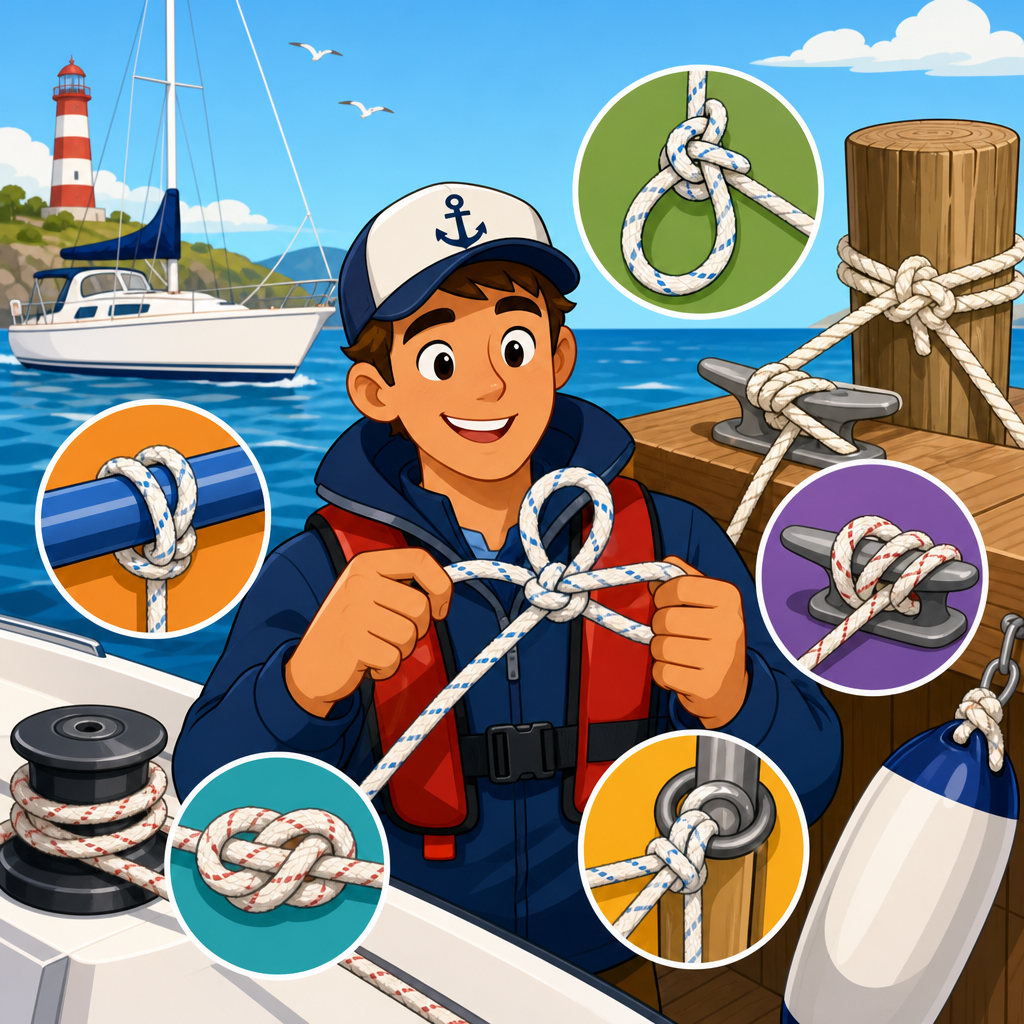
Boating knots are not decorative skills or campfire tricks; they are practical safety tools that determine whether a boat stays secured, an anchor holds, a fender protects gelcoat, or a tow line fails at the worst moment. In the context of anchors, ropes, and docking essentials, the most important boating knots are the cleat hitch, bowline, round turn with two half hitches, clove hitch, figure-eight stopper, anchor bend, and rolling hitch. Together, these knots form the working vocabulary of everyday seamanship.
I have taught new boat owners how to dock, anchor, and rig lines, and the same pattern appears every season: people spend thousands on electronics, anchors, and premium dock lines, then lose control of simple line handling at the cleat. Good knots matter because rope systems only work when the termination is reliable. A correctly tied knot improves security, protects hardware, reduces chafe, and can be untied after loading. A poor knot slips, jams, weakens the line unnecessarily, or creates confusion under pressure.
Before learning the individual knots, it helps to define a few terms. The standing part is the inactive length of rope carrying most of the load. The working end, sometimes called the bitter end, is the free end used to form the knot. A bight is a U-shaped bend in the rope without crossing the ends. A loop crosses the rope back over itself. Understanding those terms makes instruction clearer and prevents mistakes when someone on deck tells you to “take a bight” or “pass the working end through the loop.”
Rope selection also affects knot performance. Three-strand nylon remains common for dock lines and anchor rodes because it stretches under load and absorbs shock. Double-braid nylon is smoother, stronger, and easier on the hands, making it popular for dock lines on larger boats. Polyester stretches less and is often used where low elongation is preferred. Polypropylene floats, which can be useful for ski tow lines but is generally less durable for permanent docking. Every knot changes rope strength, often reducing it by 30 to 50 percent, so choosing the right line and the right knot is inseparable.
This hub page covers the foundational knots and the gear situations where they belong: tying to cleats, joining anchor line to chain or shackles, controlling fenders, securing spring lines, and managing temporary loads. If you master the knots below and match them to the right rope, hardware, and docking technique, you will handle most small-boat and cruising scenarios with more confidence, less damage, and better seamanship.
Why knot choice matters for anchors, dock lines, and fenders
The best boating knot is always the one suited to the load, the hardware, and the need to release it later. A cleat hitch is ideal on a dock cleat because it locks cleanly without creating a jammed mass. That same knot is not how you secure an anchor rode to chain. A bowline makes a fixed loop that is excellent around a piling or through a ring, but it is not the first choice when constant motion may cause cyclical loosening unless it is properly set and sized. Knot choice is functional, not personal.
Consider a common docking scenario with wind pushing the boat off the pier. You step onto the dock with a stern line and need immediate control. A fast, correct cleat hitch turns one line into leverage. If instead you throw random half hitches around the cleat, the line may surge, cross badly, and lock in a way that wastes critical seconds. The result is not just inconvenience; it can mean bent rails, hull damage, or injury.
At anchor, the connection between rope and anchor system deserves equal attention. Most modern setups use anchor chain attached to nylon rode with a splice, because a splice is stronger and smoother through a windlass than a knot. Still, many small boats, spare anchors, and emergency kits rely on knots such as the anchor bend to secure line to an anchor ring, shackle, or chain when a proper splice is unavailable. Knowing that knot is practical redundancy.
Fender rigging is another overlooked area. A clove hitch tied around a rail or stanchion can be adjusted quickly for height, while a round turn with two half hitches gives more security when fenders will rub all day against a rough dock. On boats that raft up often, poor fender knots are easy to spot because fenders creep downward or fall free after repeated wake action. Good knots keep gear where you set it.
These are the line jobs every boater performs repeatedly, which is why they belong at the center of any guide to anchors, ropes, and docking essentials.
The cleat hitch: the first knot every boater should master
If I could teach only one knot to a new skipper, it would be the cleat hitch. It is the standard method for securing a dock line to a horn cleat, whether on the boat or on the dock. It is fast, strong, easy to inspect visually, and easy to release after heavy loading when tied correctly. Most docking control problems I see come down to people not trusting or not understanding this hitch.
To tie it, take a full turn around the base of the cleat, crossing from one horn to the other in a figure pattern. Then make one more crossing turn. Finish with a locking half hitch formed as an inverted loop, often called the “twist” or “lock,” dropped over the far horn. The key is that the final hitch should lock the previous turns, not pile on unnecessary wraps. Two full figure-eight crossings and one locking hitch are enough for most recreational boats.
The cleat hitch works because the initial turn takes the load and the crossed turns create friction without cinching into a jam. On a 25-foot center console with 1/2-inch double-braid nylon dock lines, a proper cleat hitch will hold securely in normal marina conditions and still release without tools. By contrast, repeated underhand wraps around the horns may seem secure, but once a boat surges in wake, that bundle can bind so tightly that crew members resort to prying it loose with a boat hook.
Common mistakes include skipping the base turn, making too many wraps, and leaving the locking hitch upside down. Teach crew to recognize the clean X pattern on top of the cleat. If it does not look orderly, retie it. In real docking situations, visual simplicity is a safety feature.
The bowline, round turn, and anchor bend for secure attachment
The bowline creates a fixed loop that does not slip under load, which makes it one of the most useful boating knots for docking and mooring. Use it to place a loop over a piling, create an eye in the end of a line, or connect a line to a ring when you want easy release later. A well-dressed bowline is stable, but it should be snugged firmly and left with adequate tail. In slippery modern line, a backup stopper can add security for long-term use.
On a tidal dock with pilings, for example, I prefer a bowline in the bitter end of a spring line because the fixed loop drops over the piling quickly and can be retrieved without wrestling with soaked turns. The knot also preserves a predictable loop size, which matters when crew need consistency during repeated docking practice.
The round turn with two half hitches is better when the line must grip a post, ring, or rail under sustained load. The round turn takes friction first; the two half hitches secure the standing part. This knot excels for fender lines, temporary tie-ups, and utility jobs around the boat. If a line will see jerking or shock load, the round turn reduces stress concentration better than simpler hitches.
The anchor bend, despite its name, is technically a hitch used to attach rope to an anchor ring, chain, or shackle. Pass the line through the ring twice, then take the working end around the standing part and finish with a half hitch, ideally seized or backed up for security. It grips well under constant pull and has long been trusted in small-craft anchor systems, especially where line is attached directly to a lunch hook or secondary anchor.
| Knot | Best use | Main advantage | Main caution |
|---|---|---|---|
| Bowline | Fixed loop for pilings, rings, mooring points | Easy to untie after load | Can loosen if poorly dressed in slick line |
| Round turn and two half hitches | Posts, rails, fenders, temporary attachments | Excellent friction and load control | Needs neat half hitches to avoid rolling |
| Anchor bend | Anchor rings, shackles, chain connections | Secure under steady pull | Not ideal for passing through a windlass |
Clove hitch, rolling hitch, and figure-eight stopper in daily seamanship
The clove hitch is one of the fastest knots on a boat and one of the easiest to misuse. It is excellent for temporarily hanging fenders from rails, lifelines, or stanchion bases because it can be adjusted quickly. That speed matters when approaching a dock and needing fenders repositioned within seconds. However, the clove hitch is less reliable on its own when the load is intermittent or the surface is smooth, so many boaters finish it with an additional half hitch for insurance.
I use the clove hitch constantly during docking drills because it lets students adjust fender height without retieing a full knot every time. On stainless rails, though, repeated wake action can cause creep. If the boat will remain alongside for hours, I switch to a round turn with two half hitches or add a stopper hitch below the clove hitch.
The rolling hitch is a more specialized but valuable knot used to attach a rope to another rope or spar so that it resists movement in one direction. In boating, it is useful for load transfer, relieving tension on a jammed line, or rigging an emergency grip on an anchor rode. For example, if a windlass is carrying too much load, a rolling hitch on the rode connected to a cleated snubber line can shift the strain safely away from the windlass.
The figure-eight stopper is simple, but it prevents expensive mistakes. Tied near the end of a line, it stops the rope from running out through a fairlead, block, or clutch. It is cleaner and more secure than a simple overhand knot, and it is easier to untie after load. Sheets, control lines, dinghy painters, and utility cords all benefit from a visible stopper knot. On active decks, that small detail prevents lost lines and frantic recoveries.
These knots do not receive as much attention as the bowline or cleat hitch, yet they solve the small, frequent problems that define competent line handling.
Best practices for rope care, docking setup, and knot reliability
A knot is only as dependable as the rope and hardware around it. Start with line sizing. Many boats under 30 feet use 3/8-inch to 1/2-inch dock lines, while heavier cruisers may use 5/8-inch or larger depending on displacement, freeboard, and exposure. Oversized rope can be hard to handle and may not fit cleats or chocks correctly; undersized rope lacks abrasion margin and shock capacity. Manufacturers such as New England Ropes and Samson publish selection guidance by vessel length and use, and those charts are worth consulting rather than guessing.
Material matters just as much. Nylon remains the benchmark for dock lines and anchor snubbers because of stretch and energy absorption. That elasticity reduces shock loading on cleats and deck hardware in surge. Polyester resists UV and abrasion well but gives less shock absorption. For anchor rodes, many cruisers combine chain and nylon so the chain improves catenary and seabed abrasion resistance while the nylon line softens dynamic loads. In higher winds, however, wind force can straighten catenary, which is why nylon stretch remains essential even with substantial chain.
Inspect lines regularly for glazing, stiffness, flattened sections, cut fibers, and abrasion at chocks. Salt crystals and grit accelerate internal wear, so rinse heavily used lines and allow them to dry before storage. Chafe gear at rub points is not optional in exposed slips. I have seen brand-new dock lines fail early not because the rope was weak, but because one unprotected edge sawed through the cover during a weekend blow.
Finally, practice knots where you actually use them: at the dock, on moving decks, with wet hands, and in low light. A boating knot is only mastered when you can tie it correctly under mild stress, inspect it instantly, and explain to crew why it belongs in that exact situation. Build that habit, then expand into splices, snubbers, bridles, and advanced docking systems. Start with these core knots, use them deliberately, and every part of your boating setup—from anchor rode to fender line—will work better.
The most important boating knots are the ones that solve real jobs on the water safely and repeatedly. For most boat owners, that means mastering the cleat hitch for docking, the bowline for fixed loops, the round turn with two half hitches for secure attachments, the anchor bend for anchor connections, the clove hitch for quick fender rigging, the rolling hitch for load transfer, and the figure-eight stopper for line control. These knots cover the majority of everyday tasks involving anchors, ropes, and docking essentials.
The larger lesson is that knots are part of a complete system. Rope material, diameter, hardware compatibility, chafe protection, and correct setup all influence whether a knot performs well. A premium anchor or dock line cannot compensate for poor line handling, and a simple knot tied correctly often outperforms a complicated knot tied badly. Good seamanship is usually quiet, orderly, and methodical.
If this page is your starting point for the wider boating gear and equipment category, use it as your foundation. Practice each knot until you can tie it without hesitation, then apply that knowledge to anchoring technique, dock line layout, fender placement, and rope care. Strong knot skills make every arrival calmer, every overnight more secure, and every piece of line on board more useful. Start with one cleat, one line, and ten minutes of practice today.
Frequently Asked Questions
What are the most important boating knots every boater should learn first?
The core boating knots every boater should know are the cleat hitch, bowline, round turn with two half hitches, clove hitch, figure-eight stopper, anchor bend, and rolling hitch. These are not specialty knots meant only for advanced sailors; they are practical, everyday tools used for docking, anchoring, securing fenders, preventing lines from running out, and managing strain on working rope. If you are building a solid foundation, start with the cleat hitch for tying off to a dock cleat, the bowline for creating a reliable fixed loop, and the figure-eight stopper for keeping the end of a line from slipping through hardware. From there, learn the round turn with two half hitches for attaching a line to a post or ring under load, the clove hitch for quick temporary fastening, the anchor bend for connecting rode to an anchor, and the rolling hitch for gripping another line or relieving tension.
What makes these knots so important is that each solves a specific onboard problem. A cleat hitch holds securely yet can be released without a fight. A bowline gives you a loop that will not tighten dangerously under strain. A round turn with two half hitches spreads load and holds well around rails, rings, and pilings. A clove hitch is fast and useful for fender lines, though it is best treated as a temporary hitch unless backed up. A figure-eight stopper provides a simple but critical safety stop. An anchor bend is specifically trusted for anchor connections, and a rolling hitch helps control or transfer load on a taut line. Together, these knots form the practical working vocabulary of safe line handling on a boat.
Why is the cleat hitch considered one of the most essential docking knots?
The cleat hitch is essential because it is the standard knot for securing a boat to a cleat quickly, safely, and in a way that is easy to release when it is time to leave the dock. A properly tied cleat hitch holds well under normal docking loads without requiring excessive wraps or complicated finishing. It also prevents one of the most common mistakes among beginners: creating a jammed mess of turns that becomes difficult to untie after the line has been under strain. On a dock, speed and reliability matter, especially in wind, current, or crowded marina conditions, and the cleat hitch delivers both.
To tie it, take a full turn around the base of the cleat, then cross the line in a figure-eight pattern over the horns of the cleat. Finish with a locking half hitch, often called a “twist” or “lock,” laid neatly over one horn. The key is control and neatness. The line should lie flat, the turns should not overlap carelessly, and you generally do not need a stack of extra wraps. When tied correctly, the hitch grips securely because the cleat shape and crossing turns distribute the load effectively. When released, it comes free far more easily than an overwrapped line that has been piled on in panic.
Another reason the cleat hitch matters is that docking lines are safety gear, not just tie-downs. A poor tie-off can let a boat surge, chafe lines, damage gelcoat, or even break free. A proper cleat hitch reduces those risks and promotes good seamanship. It is also the knot most likely to be used repeatedly on any outing, whether you are making a short stop at a fuel dock or securing the boat overnight. For that reason alone, it is often the first boating knot people should practice until they can tie it confidently without hesitation.
When should you use a bowline instead of another loop knot on a boat?
The bowline is the go-to knot when you need a fixed loop that will not slip tighter under load. That makes it especially useful in boating, where you may need to place a loop over a piling, create a secure attachment point, rig a line around a ring, or form a rescue loop. Unlike knots that cinch down and become difficult to untie, a bowline keeps its loop size stable and is usually easier to release after bearing a moderate load. That combination of security, predictability, and releasability is why it has remained one of the most respected knots in seamanship for generations.
You should choose a bowline when loop size matters and when tightening would be a disadvantage. For example, if you are looping a dock line over a piling, you do not want a knot that closes unpredictably and binds hard against the structure. The bowline is also useful when attaching a line temporarily to an object without hardware, because the loop can be sized precisely before loading it. It is less ideal when the line will be subjected to repeated shaking and unloading without backup, especially in slippery modern rope, because under some conditions a poorly tied or poorly dressed bowline can work loose. In those cases, some boaters add a backup knot or use a variation suited to the rope type and application.
The real value of the bowline is not just that it forms a loop, but that it does so cleanly and dependably. In practical boating terms, that means fewer jams, less frustration, and better control of how a line behaves under tension. It is one of those knots that earns its reputation because it solves a common problem elegantly. If you learn only a few boating knots at first, the bowline deserves to be near the top of the list.
What knot should you use for anchoring, and how do you know it is secure?
For anchoring, the anchor bend is one of the most widely recommended knots for fastening a rope rode to an anchor ring or shackle. Despite the name, it is technically a hitch, and it is valued because it grips well under sustained load and is specifically associated with anchor work. To tie it, the line is passed twice through the anchor ring or around the shackle, then brought around the standing part and secured with additional turns or half hitches, depending on the exact method being used. The double turn at the attachment point helps distribute load and increase holding power, which is important because anchor loads can rise sharply with wind, current, wave action, and boat movement.
You know it is secure when it is tied correctly, dressed neatly, and inspected carefully before use. The turns should lie flat and snug, the finishing hitches should be in the proper place, and the knot should be set by pulling firmly so everything seats correctly. It also helps to remember that knot security is not just about the knot itself. The condition of the rope, the size and shape of the anchor connection point, chafe protection, and overall anchor setup all matter. Even the best knot can be compromised by worn line, poor scope, or constant abrasion at the hardware.
Many boaters today also use shackles, chain, and rope-to-chain splices as part of their anchoring systems, so the exact connection method depends on the boat and ground tackle setup. But if you are attaching rope directly to an anchor, the anchor bend remains a classic and dependable choice. As with every critical boating knot, practice it ahead of time, not while drifting in wind and current. Anchoring is one of the situations where knot failure has immediate consequences, so confidence and consistency are essential.
Are some boating knots better for temporary use while others are better for heavy load or long-term security?
Yes, and understanding that distinction is a major part of safe seamanship. Some knots are excellent for quick, temporary jobs, while others are better suited for sustained load, critical attachments, or situations where failure would create immediate risk. For example, a clove hitch is fast to tie and adjust, which makes it popular for temporarily hanging fenders or making a quick attachment to a rail. However, it can slip or shift in some conditions, especially if the load changes direction or the line is slick, so it is not usually the best choice for long-term or heavily loaded critical connections unless backed up.
By contrast, the round turn with two half hitches is much better for secure attachment to a ring, rail, or post when a line will be under steady strain. The round turn helps absorb and distribute the load before the securing hitches take hold, making it a stronger and more trustworthy option in many practical situations. The cleat hitch is purpose-built for cleats and should be your standard for docking tie-offs. The figure-eight stopper is not a load-bearing attachment knot, but it is crucial for preventing a bitter end from running out of a fairlead, block, or hand. The rolling hitch is specialized for gripping another line, often to relieve strain or gain purchase on a loaded line. Each knot has a job, and using the right one matters.
This is why experienced boaters do not think in terms of a single “best” knot. They think in terms of function: temporary or permanent, loaded or unloaded, fixed loop or gripping hitch, quick release or maximum hold. Good knot choice reduces wear, improves safety, and makes line handling more efficient. The smartest approach is to master a small set of proven boating knots and understand what each is designed to do. That knowledge is far more valuable than knowing dozens of knots you rarely use.