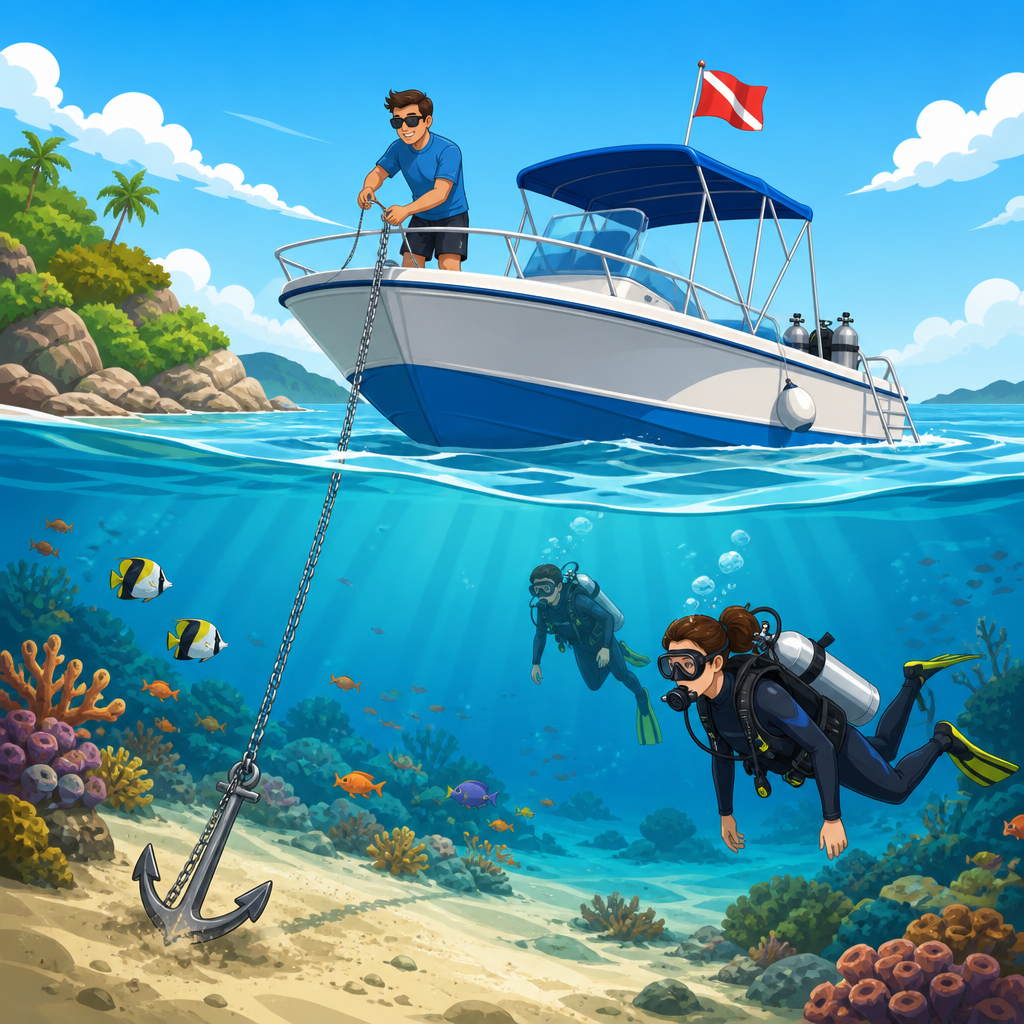
Anchoring a boat for a scuba diving trip sounds simple until you factor in wind, current, bottom type, diver safety, local regulations, and the need to return every diver to the ladder without damaging reefs or creating a drifting hazard. In practice, safe boat anchoring for scuba diving is a seamanship skill that sits at the center of successful scuba diving and snorkeling from a boat. It determines whether divers enter the water calmly, whether the vessel stays clear of hazards, and whether fragile marine habitat remains intact after the day is over.
For this subtopic hub, it helps to define a few terms clearly. The anchor is the weighted device that grips the seabed. Rode is the complete anchor line system, usually rope, chain, or a combination of both. Scope is the ratio between rode deployed and the vertical distance from bow chock to seabed; a common starting point is 5:1 for lunch stops and 7:1 for stronger holding conditions, though current, wave action, and bottom composition change the real requirement. Swing radius is the circle the boat may travel around the anchor as wind or tide shifts. Understanding those terms is essential because scuba diving from a boat is less forgiving than casual day anchoring: tanks are heavy, entries happen in sequence, and surfacing divers need predictable pickup points.
This matters for more than convenience. Poor anchoring can drag a boat into coral, place divers under the hull, foul propellers with lines, or leave snorkelers too far from the stern. In many popular dive areas, mooring use is preferred or legally required because anchors can scar seagrass and coral heads. Even where anchoring is allowed, captains are expected to know the seabed, choose an approach based on wind versus current, and maintain a watch while people are in the water. I have anchored for shore-adjacent reef dives, offshore wreck drops, and beginner snorkeling drifts, and the pattern is always the same: the best trips start with planning before the anchor ever leaves the bow roller.
Start with site selection, charts, and local rules
The first anchoring decision for scuba diving and snorkeling from a boat is whether you should anchor at all. Many established dive sites provide fixed moorings maintained by parks, harbormasters, or charter associations. If a mooring is present and rated for your boat length and displacement, use it. It reduces habitat damage and usually places the vessel in the safest orientation for the site. Florida Keys National Marine Sanctuary, Bonaire National Marine Park, and many Red Sea reefs all rely heavily on dive moorings for exactly this reason.
When no mooring exists, evaluate charts, depth sounder readings, tide tables, and current forecasts together. Electronic charts show depth contours and hazards, but they do not tell you whether the bottom is hard sand, mud, coral rubble, grass, or live reef. Local knowledge fills that gap. Dive briefings, marina staff, and guidebooks often identify sand patches specifically because those are the safe anchor targets near reefs. For wreck diving, many captains avoid anchoring directly on the structure and instead use a shot line or drift procedures to prevent damage and entanglement.
Approach every site with a diver’s perspective, not only a boater’s. Ask: where will divers descend, what route will they swim, where will they surface if current increases, and can the boat remain clear of that path? On snorkeling trips, beginners often stay close to the stern, so a short swim distance and a stable ladder side matter more than proximity to a drop-off. On scuba trips, especially with newer divers, the ideal anchor position is often slightly up-current from the intended descent point so the crew can control entries and lines stay clear.
Choose the right anchoring system for diving operations
Not every recreational anchoring setup is suitable for dive operations. A small fluke anchor with all-rope rode may hold a runabout in a calm cove, but a dive boat carrying multiple tanks, coolers, and six moving people needs more predictable holding power. In most coastal diving conditions, a modern scoop-style anchor such as a Rocna or Mantus, or a well-sized plow like a Delta, gives better reset performance than older lightweight designs. Bruce-style claws can work well on mixed bottoms but are less consistent in some soft muds.
Chain matters because it keeps the pull on the anchor more horizontal, improving holding and shock absorption. As a working baseline, many operators use at least a short all-chain leader even on smaller boats, then nylon rode for stretch. Nylon remains standard because it handles shock loads better than low-stretch lines. For dive use, rode length should exceed what you need for the charted depth alone. If the spot is 40 feet deep and the bow roller sits 3 feet above the waterline, your vertical depth is closer to 43 feet before tide increase or wave trough is considered.
| Bottom type | Best practice for dive boats | Main risk |
|---|---|---|
| Clean sand | Preferred anchoring target; set with moderate reverse power | Dragging if scope is too short |
| Mud | Use extra scope and confirm set carefully | False set and slow dragging |
| Seagrass | Avoid if possible; use mooring or sand patch nearby | Habitat damage and weak holding |
| Coral or live reef | Do not anchor; use mooring or drift plan | Severe environmental damage |
| Rock or rubble | Anchor only with local knowledge and retrieval plan | Snagged anchor and line abrasion |
A complete system also includes a buoyed trip line only when local conditions and traffic make it safe and useful. Trip lines can help recover snagged anchors on rocky bottoms, but they also create line hazards for divers and passing boats. For that reason, many dive captains skip them in favor of precise site choice and conservative anchoring.
Set the anchor so divers enter and exit safely
The practical sequence is straightforward. Idle to the intended drop area from downwind or down-current, depending on which force is dominant. Stop the boat just beyond the point where you want the anchor to land, then lower, not throw, the anchor. Throwing can foul the rode over the flukes and reduces control. As the boat drifts back, pay out rode steadily until you reach your planned scope. Snub the line gently, let the anchor dig, then apply measured reverse power to confirm it is set.
For scuba diving, I prefer to verify the set twice: once immediately from the helm using transits or GPS anchor alarm, and again visually by watching whether the bow hunts back to the same heading after reverse thrust. If the boat continues sliding, reset before anyone gears up. Divers should never be entering while the crew is still “seeing if it holds.” A dragging vessel creates the worst kind of confusion because people may already be seated with fins on and masks in hand.
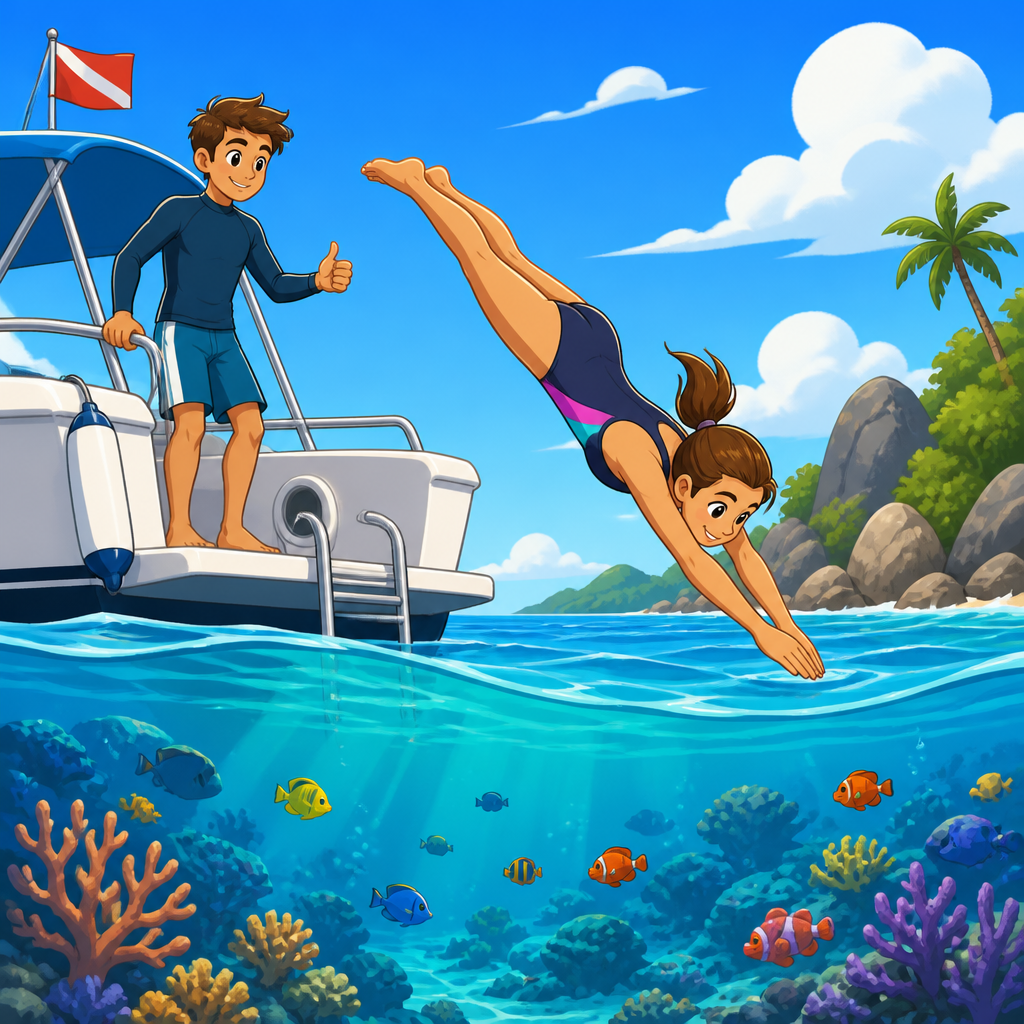
Positioning around current is site-specific. On a reef with a clear sand patch, anchor in sand far enough away that the boat’s swing radius cannot reach coral even if wind shifts ninety degrees. On a wall dive, stay outside the drop line so surfacing divers are not directly under the hull. On a snorkeling stop, angle the stern ladder on the lee side if possible because children and novice swimmers reboard more safely out of chop. If the current is too strong for easy ladder returns, anchoring may be the wrong tactic; a live boat drift with a dedicated skipper is often safer.
Manage divers, lines, and boat systems once anchored
Anchoring is only half the job. The moment the hook is set, the vessel becomes a small dive platform with new hazards. Conduct a brief that covers entry side, descent line if used, maximum distance from boat, recall signal, and reboarding order. Confirm that no one enters near the rode. Anchor lines can look stationary from the surface, but they tighten, vibrate, and change angle with surge. Gloves do not make grabbing a tensioned rode safe.
Secure all loose lines before entry. Towing bridles, spare dock lines, drift socks, and fishing gear have no place overboard during scuba operations. Engines should remain off when divers are close to the stern unless propulsion is absolutely necessary to avoid danger, and every person on board should know where the divers are before any restart. Many incidents in recreational boating come not from the anchor itself but from poor propeller discipline around swimmers and divers.
Use a float line or tag line only with a clear purpose. In some conditions, a stern tag line gives snorkelers a handhold during surface rests. In others, it becomes an entanglement risk as people cluster at the ladder. Dive flags are mandatory or strongly recommended in many jurisdictions, but they do not replace lookout procedures. A competent topside watch tracks bubbles, notes drift direction, and keeps a count of everyone in the water. On larger private boats, that role should be assigned explicitly rather than assumed.
Protect reefs, wrecks, and sensitive bottoms
The environmental side of anchoring deserves equal weight because dive trips often visit the most fragile places on the water. One badly placed anchor can break branching coral that took decades to grow. Chain sweep is often worse than the initial drop; as the boat swings, chain can mow through coral heads and sponge fields. Seagrass beds are also high-value habitat, serving as nursery grounds for fish and stabilizing sediment. In many regions, anchoring in seagrass can expose boaters to fines as well as ecological harm.
The solution is disciplined site choice. Aim for bare sand patches with enough clearance for full swing. If the patch is too small for your vessel, it is not a suitable anchoring site, regardless of how attractive the dive looks on the fish finder. On wrecks, avoid anchoring into historical structure unless the site specifically provides anchor points. Many well-known wreck destinations use permanent moorings because anchors can collapse plating, damage artifacts, and create dangerous snags for divers.
Good environmental practice also improves safety. A boat secured on sand is easier to predict than one hung up on coral or rubble. Divers descending over healthy reef rather than through a cloud of disturbed sediment use less gas and maintain better buddy contact. In other words, protecting the site is not separate from running a competent dive day; it is part of it.
Know when not to anchor and what to do instead
Some dive conditions make anchoring a poor choice no matter how skilled the captain is. Strong current over a wreck, deep blue-water pelagic encounters, crowded channels, and surge-prone rocky coves often call for alternatives. The most common is live boating, where the skipper remains at the helm and follows bubbles or float markers while divers conduct a drift. This method is standard for many drift dives in Cozumel because current is the feature, not the problem.
Another option is a shot line or weighted descent line deployed temporarily without trying to hold the entire vessel on the bottom. Technical and wreck divers use this when they need a reference for descent but do not want anchor hardware on the site. For snorkel groups, a protected mooring or even a beach-supported swim may be more practical than forcing a boat to hold in marginal conditions.
Call off the anchor plan if any critical factor is wrong: insufficient room to swing, uncertain bottom, approaching weather, unreliable windlass, or too few crew to supervise divers and the vessel at the same time. Conservative decisions are not lost opportunities. They are how experienced operators keep a dive trip routine instead of memorable for the wrong reasons.
The best way to anchor your boat for a scuba diving trip is to treat anchoring as part navigation, part dive planning, and part environmental stewardship. Choose a mooring whenever one is available and appropriate. If you must anchor, verify local rules, identify a sandy bottom with room to swing, calculate enough scope, set the anchor deliberately, and confirm holding before the first mask goes on. Then run the boat like a dive platform: control lines, brief entries and exits, maintain a topside watch, and keep propellers out of the equation.
For anyone building confidence in scuba diving and snorkeling from a boat, this hub principle should guide every related skill, from ladder reboarding to current management: the boat must stay predictable so the people in the water can stay focused on the dive. Master that, and your trips become safer, easier on marine habitats, and far more enjoyable for new snorkelers, certified divers, and the crew. Before your next outing, inspect your anchor system, review the site chart, and make a written anchoring plan before leaving the dock.
Frequently Asked Questions
What is the safest way to anchor a boat before a scuba diving trip?
The safest way to anchor a boat for scuba diving starts well before the anchor goes overboard. First, assess the full picture at the site: wind direction, current strength, water depth, bottom composition, nearby hazards, other boats, and where divers are likely to surface. A good skipper plans the boat’s final resting position so the vessel will lie securely without drifting over reefs, swim areas, mooring fields, or navigation channels. In many dive locations, the best option is to use a designated mooring buoy rather than anchoring at all, especially in environmentally sensitive areas.
If anchoring is allowed and necessary, approach the spot slowly from downwind or down-current so you maintain control and can stop the boat without overshooting. Lower the anchor; do not throw it, because tossing it can foul the rode, damage the seabed, or cause poor set. Once the anchor reaches bottom, pay out enough scope for the depth and conditions. In calm conditions, a scope of about 5:1 may work, while stronger wind, current, chop, or overnight holding often calls for 7:1 or more. After the rode is out, gently reverse to set the anchor and confirm it is digging in rather than dragging.
For scuba operations, safety means more than just whether the anchor holds. The boat should be positioned so divers can enter and exit without fighting the hull, propeller area, or a taut anchor line. The stern ladder should remain accessible, and the vessel should not swing unpredictably into rocks, coral, or kelp. Once set, take visual bearings or check the GPS anchor alarm to verify the boat remains in place. The safest anchoring setup is one that holds securely, keeps the boat clear of underwater habitat and surface traffic, and supports an organized pickup for every diver returning to the ladder.
How do wind, current, and bottom type affect anchoring for dive boats?
Wind, current, and bottom type are the three biggest environmental factors that determine whether your anchor will hold and whether the boat will sit in a useful, diver-friendly position. Wind pushes on the boat’s topsides and superstructure, while current acts on the hull below the surface. In some locations, current has more influence than wind; in others, especially shallow protected bays, wind may dominate. A skipper needs to judge which force is stronger because the boat will usually settle according to the greater influence, and that determines where the anchor should be dropped.
Bottom type matters because anchors hold by digging in or catching appropriately for the seabed. Sand and mud often provide the most reliable holding for common recreational anchors, provided the anchor is matched to the boat and set properly. Grass can be inconsistent because some anchors may skate across it before biting. Rock can be difficult because the anchor may snag without truly setting, creating false confidence and making retrieval hard. Coral or reef should generally be avoided entirely, both because holding can be poor and because dropping an anchor there can cause serious environmental damage.
For dive operations, these factors also affect diver safety. A boat anchored in a strong wind-against-current situation may swing sharply or lie awkwardly, making entries and exits harder. If the bottom is poor and the anchor drags, the vessel can move away from divers or drift into hazards while people are underwater. That is why experienced operators do not just ask, “Will the anchor hold?” They also ask, “Will this boat stay where divers expect it to be?” Reading the conditions correctly helps you choose the right position, proper scope, and appropriate anchor type for the site.
How can you anchor without damaging reefs, seagrass, or other underwater habitats?
The best way to avoid damaging underwater habitat is to avoid anchoring on it in the first place. If a mooring buoy is available, use it. Many popular scuba and snorkeling sites provide moorings specifically to protect reefs and seafloor ecosystems from anchor damage. If no mooring is available, identify a patch of clean sand or another durable bottom area away from coral heads, seagrass beds, archaeological sites, and fragile marine life. It is not enough to avoid dropping the anchor directly on a reef; you also have to consider the full swing radius of the boat and the path of the anchor rode, which can drag across habitat as the boat shifts.
Controlled deployment is essential. Lower the anchor vertically and deliberately so you know exactly where it lands. Do not motor around while the anchor is dragging in hopes that it will catch somewhere acceptable. That practice can scar the bottom over a wide area. In clear water, some skippers visually confirm the anchor’s placement before fully setting it. In sensitive sites, a diver may inspect the anchor only if conditions, local rules, and operational safety allow it, but this should never substitute for good surface seamanship.
When retrieving the anchor, bring the boat forward carefully to reduce dragging along the bottom. The goal is to lift the anchor as vertically as possible. If it is fouled, avoid yanking blindly, which can break coral or uproot habitat. Environmental responsibility is a core part of dive boating. Protecting reefs and seagrass not only preserves the site for future divers, but also reduces legal risk and reflects the standard of care expected from responsible boat operators in dive areas.
What local rules or dive-site regulations should you check before anchoring?
Before anchoring for a scuba diving trip, always verify whether anchoring is even permitted at the site. Many marine parks, protected reefs, harbors, and managed dive areas prohibit anchoring outright or restrict it to designated sandy zones. Some locations require boats to use mooring buoys, display diver-down flags, maintain minimum distances from swim beaches, or stay outside marked no-anchor and no-entry zones. These rules may come from national park authorities, coast guards, port agencies, marine sanctuary managers, or local municipalities.
You should also check navigation rules and operational requirements that affect diver safety. For example, there may be regulations on how close other vessels can pass when divers are in the water, whether engines must be in neutral during recovery, or what signaling equipment must be displayed. Commercial operators may face additional requirements involving passenger briefings, float plans, emergency equipment, and crew procedures. In some places, anchoring near channels, ferry routes, fishing gear, or underwater cables is restricted even if the site looks physically suitable.
Do not rely on memory or assumption, especially in a destination you do not visit often. Consult current charts, cruising guides, local notices to mariners, dive operator guidance, and posted signage at ramps or marinas. If in doubt, ask the harbor master, marina staff, park office, or local dive shop. Regulations exist not only to protect resources, but also to reduce collisions, entanglement risks, and dangerous congestion at popular dive sites. A legally compliant anchoring plan is part of a safe diving plan, not a separate issue.
How do you make sure divers can return safely to the boat after it is anchored?
Safe diver recovery begins with anchoring the boat in a position that supports an easy, predictable return path. Before anyone enters the water, brief divers on where the boat is expected to lie, what side to approach, how current may affect their swim back, and what to do if they surface away from the vessel. The ladder should be clear, deployed if appropriate, and located where divers can approach without drifting under the stern. Engines should remain off or in neutral during recovery according to the situation and your operating procedures, and everyone onboard should understand who is watching the divers at all times.
The anchor position should account for real-world diver behavior. Even skilled divers may surface slightly off target because of current, navigation error, swell, or task loading. That means the boat should not be anchored so close to rocks, surf zones, or heavy traffic that a small miss becomes an emergency. Use a float, tag line, current line, or descent/ascent line when conditions call for it. These tools can make entries and exits much easier, especially in moving water, but they should be rigged so they do not create entanglement hazards.
Good recovery practice also includes constant monitoring. Keep a headcount, note diver pairs, watch bubbles when visible, and be ready with a throwable flotation device. If the boat begins to drag, treat it as an urgent problem because divers underwater are counting on the vessel to remain where briefed. Once divers are back at the ladder, assist them in a controlled sequence so nobody crowds the stern or struggles in full gear longer than necessary. In short, a well-anchored dive boat does more than stay put; it creates a stable, understandable platform that helps every diver leave the water safely and calmly.