The best rod holders for fishing boats do more than store tackle; they shape how safely, efficiently, and comfortably you fish. A rod holder is any fixed, adjustable, flush-mounted, rail-mounted, clamp-on, or track-based device that supports a fishing rod while trolling, drifting, bottom fishing, rigging baits, or moving between spots. When anglers ask how to choose the right fishing gear for your boat, rod holders belong near the top of the list because they affect deck layout, presentation angles, line management, crew workflow, and even hull integrity. I learned that early while outfitting center consoles, aluminum tiller boats, and small bay boats for everything from striper trolling to live-baiting for kingfish. A poor holder placement creates crossed lines, bent reels, tripping hazards, and stress cracks around mounting points. A good system turns limited deck space into an organized fishing platform.
Choosing among stainless steel, polymer, and anodized aluminum options can feel simple until you match holders to your boat, target species, and fishing style. Freshwater crappie spider rigging, offshore trolling, catfishing on anchor, and inshore drifting all demand different rod angles, drag loads, and access patterns. The right holder for a pontoon is not automatically right for a deep-V multispecies boat, and a kayak-style clamp system is not a substitute for through-bolted gunwale hardware on a bigger hull. This guide explains what matters most, where each holder style works best, and how rod holders fit into the broader question of selecting boat fishing gear that performs reliably on the water.
Why Rod Holders Matter in a Complete Boat Gear Setup
Rod holders are a hub decision because many other equipment choices depend on them. Trolling spreads, planer boards, downriggers, livewell access, net storage, fishfinder placement, and casting lanes all interact with holder location. On most boats I rig, I start by identifying the primary techniques used during a normal season. If the boat trolls crankbaits on inland lakes, the owner usually needs stern and gunwale holders with moderate adjustability, room for multiple rods, and clean line separation. If the same boat anchor-fishes for catfish, upward-angled holders with secure locking collars become more important than wide spread. For offshore boats, heavier-gauge stainless models with reinforced backing plates are standard because drag pressure, wave shock, and big-fish surges expose weak hardware immediately.
Good rod holder selection also protects expensive combos. Modern reels with machined frames, sealed drags, and braided line represent a real investment. Cheap plastic holders can twist under load, expose reel seats to impact, or allow rods to bounce free when running chop. Better holders secure butt sections, distribute force, and let anglers monitor rod tips without hovering over them. From a safety standpoint, organized rods reduce hooks swinging around the cockpit and keep decks clear when multiple people are moving during a hookup. For family boats that split time between cruising and fishing, removable or low-profile holders preserve comfort without sacrificing fishability. That balance is the foundation of choosing the right fishing gear for your boat: every item should support your fishing style while respecting space, structure, and safety.
Types of Rod Holders and Where Each One Fits Best
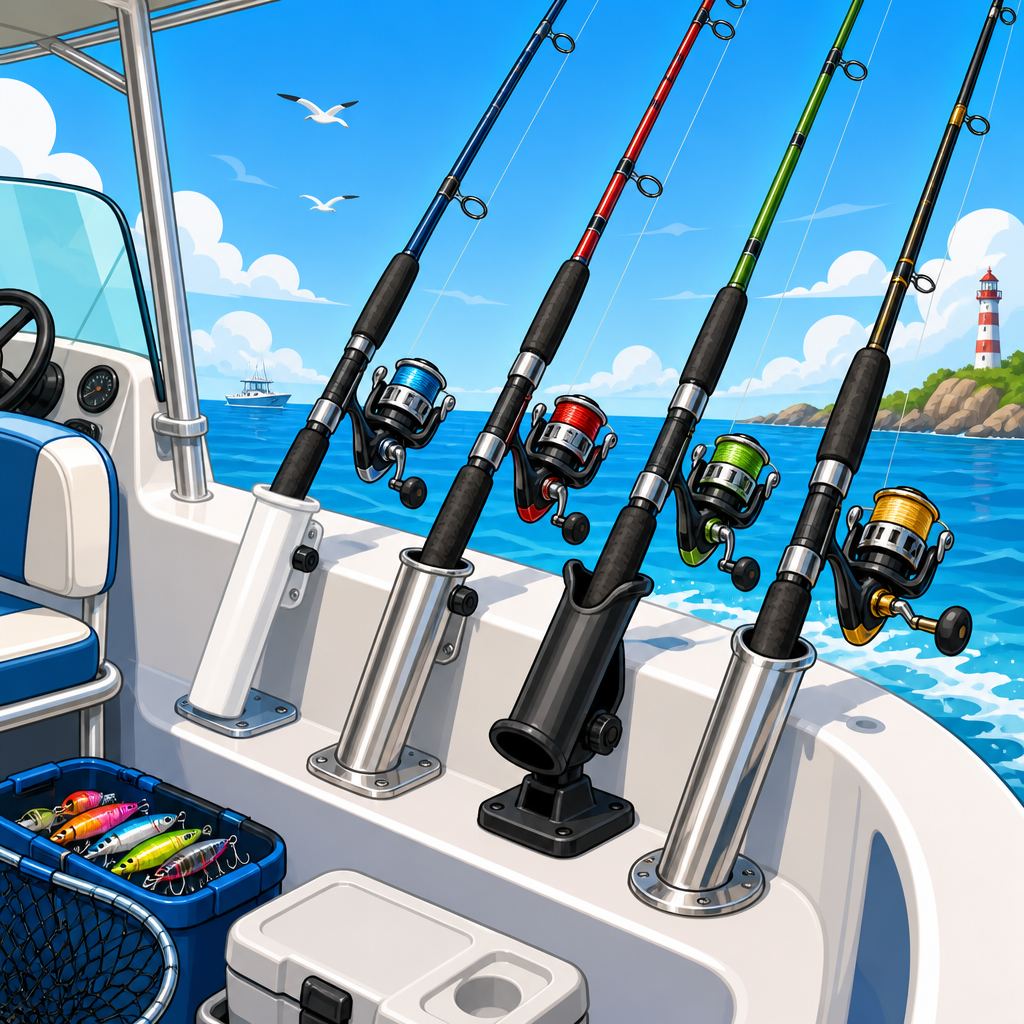
Flush-mount rod holders are the standard choice for many saltwater and larger freshwater boats because they look clean, drain well, and stay out of the way. They install through the gunwale or transom cap, usually at fixed angles such as 0, 15, or 30 degrees. I prefer them on center consoles and walkarounds where permanent trolling positions are known in advance. Stainless steel flush mounts from brands like Gemlux and Lee’s are durable, corrosion resistant, and proven offshore, but they require precise cutting and access below the mounting surface. If there is no room for backing hardware or plumbing runs interfere, another style is safer.
Adjustable surface-mount holders are more flexible. Products from Scotty, Cannon, and RAM Mounts let you change vertical and horizontal angle quickly, which is valuable for mixed-technique boats. They work well on aluminum fishing boats, skiffs, and pontoons where owners change from trolling to still-fishing regularly. Their weakness is leverage: the more extension and adjustment points you add, the more carefully you must match the holder to rod load. Heavy planer-board trolling and offshore big-game use can overwhelm lighter adjustable units.
Clamp-on, rail-mount, and track-system rod holders shine when owners want modularity without cutting the boat. Traxstech, YakAttack, and Tite-Lok systems are popular because they slide, reposition, and remove easily. For boats with accessory tracks or square rails, these systems let you test setups before committing. I often recommend them for multispecies anglers who fish walleye one month and salmon the next. The tradeoff is cost, since a full track ecosystem with mounts, risers, and accessories can exceed the price of simple fixed holders. Still, the ability to fine-tune placement is worth it on premium rigs.
| Rod holder type | Best use | Main advantage | Main limitation |
|---|---|---|---|
| Flush-mount | Offshore trolling, permanent layouts | Strong, clean, low profile | Requires cutting and fixed placement |
| Adjustable surface-mount | Inshore, freshwater, mixed techniques | Easy angle changes | Less ideal for extreme loads |
| Rail or clamp-on | Pontoons, removable setups | No major drilling | Dependent on rail strength |
| Track-system | Multispecies and modular rigs | Maximum repositioning flexibility | Higher total system cost |
How to Match Rod Holders to Boat Type, Fishing Style, and Species
The best rod holders for fishing boats are always matched to hull design and technique. On a center console, stern corners and gunwale tops usually provide the best trolling geometry because lines clear the outboard and spread naturally. On pontoon boats, rails are often the only practical mounting points, so heavy-duty rail bases matter more than flush aesthetics. Aluminum tiller boats benefit from track systems because anglers can shift holders to keep the cockpit open. Bass boats are a special case: most owners prioritize casting decks and rod lockers, so holders should be low-profile, removable, and mounted where they do not snag line during repetitive casting.
Species matter because fish create different loading patterns. Kokanee and crappie setups can use lighter holders because drag settings are modest and rods are often soft. Lake trout, salmon, musky, striped bass, and offshore pelagics demand stronger collars, deeper cradles, and through-bolted hardware. Bottom fishing for grouper or catfish produces a different stress profile from trolling because rods may sit under steady pressure for long periods, then load violently on the strike. In those cases, holders with positive-locking rotation and reinforced mounts are not optional. I have seen undersized mounts loosen after a single season when paired with braided line, heavy sinkers, and hard hooksets.
Technique should guide angle choice. Trolling usually benefits from outward splay to separate lines. Drift fishing often uses moderate angles that keep tips visible while avoiding line rub on the hull. Bottom fishing commonly favors higher rod-tip elevation, especially in current. If you use planer boards, downriggers, or lead-core line, holder spacing becomes part of your spread strategy. That is why rod holders are not an isolated accessory purchase. They are infrastructure for everything else you fish with.
Materials, Build Quality, and Mounting Hardware That Actually Last
Material quality separates rod holders that survive seasons from those that fail at the worst time. Marine-grade stainless steel, especially 316 stainless, remains the benchmark for corrosion resistance in saltwater environments. It is strong, polished, and suitable for permanent flush mounts, though it costs more and can become hot in direct sun. Anodized aluminum offers an excellent strength-to-weight ratio and is common in premium adjustable systems. Its durability depends on the quality of the anodizing and whether dissimilar metals are isolated properly. UV-stabilized polymers from reputable brands work well in freshwater and light-to-medium saltwater use, but not all plastics are equal. Cheap resin becomes brittle, fades, and loosens around pivots.
Build details matter just as much as the headline material. Look for smooth welds, thick mounting flanges, reinforced pivot joints, drain openings, protective liners, and hardware compatible with the marine environment. A strong holder mounted with undersized screws is still a weak system. Through-bolting with backing plates, fender washers, and marine sealant is the standard whenever the load justifies it. On fiberglass, I prefer backing plates that spread force across a broader area to reduce gelcoat cracking and core compression. On aluminum boats, use corrosion-conscious hardware and avoid sloppy installation that allows vibration to oval out holes over time.
Mounting location must consider structure below the surface. Before drilling, confirm fuel lines, wiring harnesses, steering components, and flotation cavities are clear. Check whether the mounting plane is cored fiberglass, thin sheet aluminum, or reinforced composite. Structural context determines what hardware is safe. This is where many rushed installations fail: buyers focus on holder brand but ignore the surface carrying the load.
Practical Buying Tips, Layout Planning, and Common Mistakes to Avoid
Start with a deck plan, not a product page. Count how many rods are realistically in use at once, where anglers stand during a fight, where nets and coolers sit, and whether children or nonfishing passengers need clear movement paths. On most small boats, four well-placed holders outperform eight badly placed ones. I typically mock up positions with tape and spare rods before drilling anything. This quickly reveals whether reel handles collide, rod tips block casting lanes, or a transom door becomes unusable.
Buy for your heaviest realistic load, not your easiest day. Many anglers say they only troll small spoons, then later add diving planers, wire line, or live-bait rigs. If the holder cannot grow with the boat’s fishing style, replacement comes quickly. Match holder tube diameter and trigger clearance to your actual rod handles, especially with long rear grips, bent-butt rods, or oversized conventional reels. Verify that spinning rods sit correctly too; some holders fit conventional tackle better than spinning setups.
Common mistakes are predictable. Mounting too low can bury rod tips near waves and reduce visibility. Mounting too far aft can crowd the motor and create line contact during turns. Mixing metals without isolation invites galvanic corrosion. Using self-tapping screws where through-bolts are required leads to looseness. Ignoring ergonomics creates fatigue, especially for older anglers who do not want to reach awkwardly around a leaning post or rail. If possible, test holder adjustment with one hand. On the water, quick and secure operation matters more than showroom complexity.
How Rod Holders Connect to the Rest of Your Boat Fishing Gear
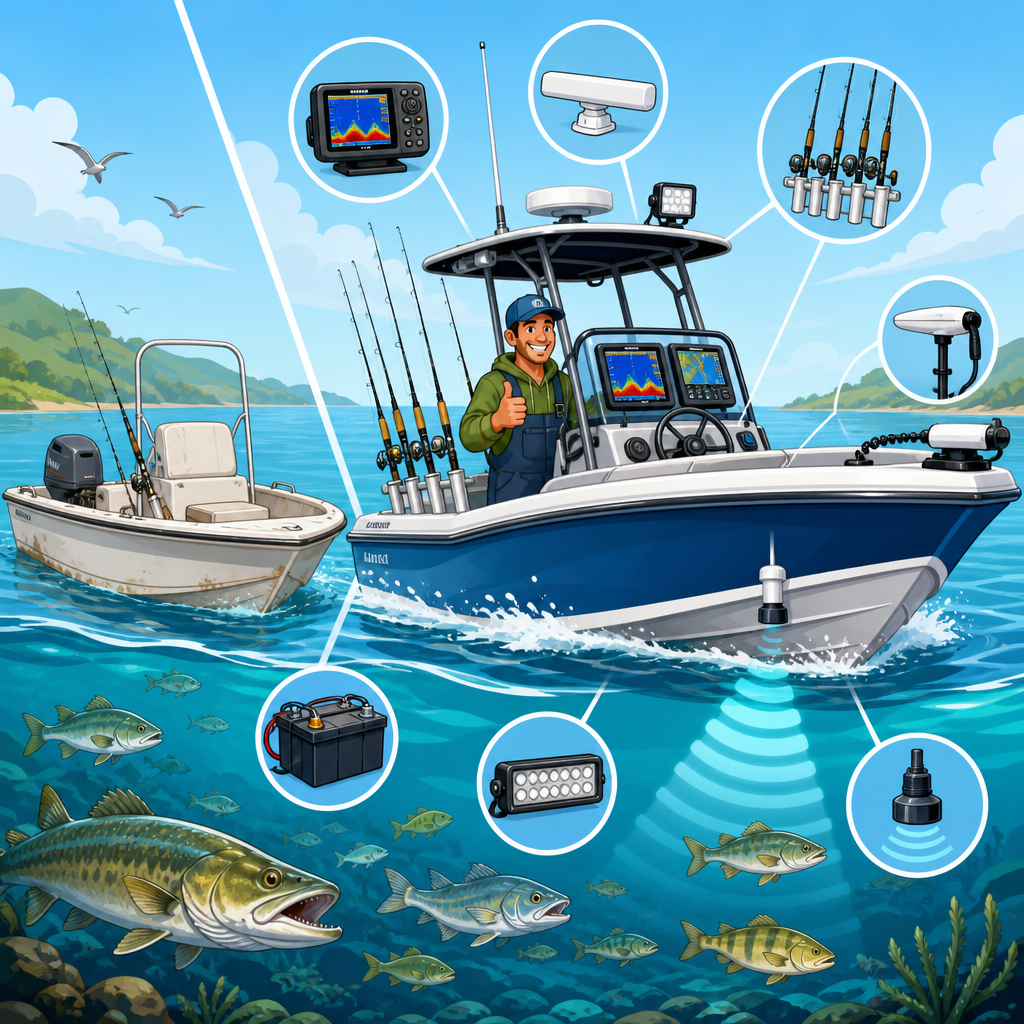
If this page is your starting point for choosing the right fishing gear for your boat, use rod holders as the anchor decision for the rest of the setup. Their placement influences where tackle storage should go, whether a fishfinder can be seen while monitoring trolling rods, how landing nets are staged, and where a bait table or cutting board can fit. Rod holders also interact with electronics and propulsion. Trolling motor users need clear bow access and should avoid positions that snag line on shafts or transducers. Boats running kicker motors need stern holder angles that complement the kicker’s thrust line and steering sweep.
Think in systems. A salmon boat may pair track-mounted holders with downriggers, planer reels, and a dedicated net station. An inshore bay boat may use two flush mounts for drifting and two removable holders near the console for bait-soaking. A family pontoon may rely on rail-mounted holders that come off after the trip, preserving social space. The best setup is not the one with the most hardware; it is the one that supports your actual days on the water with minimal clutter and maximum control.
Choose holders that fit your boat, your species, and your future plans, then install them to a structural standard you trust. When you build from that foundation, every other gear choice becomes easier, from rods and reels to electronics and storage. Review your current layout, identify your primary techniques, and upgrade the weak points first. A well-planned rod holder system is one of the smartest investments you can make in a fishing boat.
Frequently Asked Questions
What should I look for when choosing the best rod holders for a fishing boat?
The best rod holders for fishing boats should match the way you actually fish, not just the way they look on the gunwale. Start by considering your fishing style. If you troll frequently, you need rod holders that can handle steady drag pressure, keep rods secure under load, and allow angle adjustments for better lure spread and line management. If you bottom fish, drift, or anchor fish, strong fixed or adjustable holders that keep rods stable and accessible may be the better fit. For anglers who rig baits often or switch techniques throughout the day, placement and ease of access become just as important as raw strength.
Boat layout is the next major factor. Flush-mounted rod holders work well on many center consoles and larger fishing boats because they create a clean, permanent installation without taking up extra deck space. Rail-mounted, clamp-on, and track-based holders are especially useful if you want flexibility or do not want to drill into the boat. They are popular on aluminum boats, smaller skiffs, and multi-purpose boats where the layout changes depending on the trip. Adjustable holders can be a smart choice when you want to fine-tune rod angle for trolling patterns, spread multiple lines safely, or keep rods pointed away from motors and passengers.
Material quality matters more than many buyers expect. Marine-grade stainless steel is known for strength and corrosion resistance, especially in saltwater, while reinforced polymers and composites can be lightweight, durable, and more budget-friendly. The right material depends on your environment, rod size, and expected load. A holder that works fine for light inshore spinning setups may not be enough for heavy conventional tackle, deep-drop rigs, or hard-pulling trolling applications. Always check whether the holder is rated for the type of rod and reel setup you use.
Finally, think about safety and comfort. A well-chosen rod holder helps keep rods out of walkways, reduces clutter, protects expensive gear from being stepped on or knocked overboard, and allows hands-free fishing when needed. It also makes the boat easier to fish from by improving spacing between anglers and reducing line tangles. In practical terms, the best rod holder is one that fits your boat, your target species, your fishing technique, and your mounting preferences while staying reliable in rough water and repeated use.
Are flush-mounted, rail-mounted, clamp-on, or track-based rod holders better for most boats?
Each style has clear advantages, and the better choice depends on your boat design and how permanent you want the setup to be. Flush-mounted rod holders are a favorite on many dedicated fishing boats because they offer a clean, professional look and strong support. They are installed directly into the gunwale or another flat surface, which makes them excellent for trolling, storing rods while running, and keeping the cockpit uncluttered. Because they require cutting and mounting into the boat, they are usually best for owners who are confident in the layout and want a long-term solution.
Rail-mounted rod holders are ideal for boats with sturdy rails and for anglers who want solid performance without cutting into the structure. They are common on boats where rail systems are already part of the design and can provide a very secure option when properly installed. Clamp-on holders offer similar flexibility and are useful for temporary or movable setups, especially on smaller boats, jon boats, pontoon boats, and utility-style fishing rigs. They are convenient for anglers who need a simple installation or who want to test different positions before making permanent changes.
Track-based rod holders stand out for versatility. They allow you to slide and reposition holders along a mounting track, which is valuable for anglers who fish in different ways on different days. A track system can support a highly modular setup, letting you adjust for trolling, drifting, live bait fishing, or family cruising with less hassle. This can be especially helpful on compact boats where every inch of space matters and hardware needs to serve more than one purpose.
In general, flush-mounted holders are often best for larger or purpose-built fishing boats, while rail-mounted, clamp-on, and track-based options are often better for flexibility, easier installation, and evolving layouts. There is no universal winner. The right answer is the one that gives you secure rod support, proper positioning, and a mounting method that fits your boat structure without compromising strength or safety.
How many rod holders does a fishing boat really need, and where should they be placed?
The right number of rod holders depends on boat size, crew size, and fishing method, but most anglers benefit from having more than the bare minimum. Rod holders are not just for active fishing lines. They are also useful for storing spare rods, holding a rod while baiting hooks, managing planer or trolling spreads, securing tackle during runs, and keeping the deck clear when multiple anglers are onboard. Even a small boat becomes easier to fish from when rods have dedicated places rather than leaning against seats or lying on the floor.
For placement, think in terms of function first. Stern or aft rod holders are often the priority for trolling and drifting because they position lines behind the boat and help maintain a clean presentation. Gunwale-mounted holders along the sides can support additional lines, spread rods apart to reduce tangles, and give anglers better working angles when fighting fish. Holders near the helm or console can be useful for temporary rod storage, especially when moving between spots. Bow placements may help on some layouts, but they are usually more specialized and depend on whether anglers fish from the front deck.
Spacing is critical. Rod holders should be placed where rods will not interfere with casting, netting fish, opening hatches, walking around the deck, or operating the boat safely. You also want to consider reel clearance, rod butt length, and the angle needed for your preferred technique. For trolling, varied outward and rearward angles help spread lines and improve lure tracking. For bottom fishing or live bait fishing, a more upright orientation may be better for bite detection and easier rod pickup.
A practical approach is to map your fishing routine before installing anything. Think about where people stand, where coolers and bait stations go, and how fish are brought aboard. Many anglers discover that smart placement matters more than sheer quantity. A boat with six well-positioned rod holders can fish more effectively than one with ten poorly placed ones. The goal is a layout that supports the way you move, fish, and store gear throughout the day.
What materials and features make a rod holder durable enough for saltwater and heavy-duty fishing?
For saltwater and high-load applications, durability starts with corrosion resistance and structural strength. Marine-grade stainless steel is a top choice because it handles harsh exposure well and offers the rigidity needed for bigger rods, heavier drag settings, and repeated use. High-quality polymer and composite rod holders can also perform very well, especially when they are UV-resistant, reinforced, and built by reputable marine brands. These materials often resist cracking, fading, and corrosion while reducing weight and cost.
Beyond the main material, pay close attention to hardware and design details. Fasteners, mounting plates, inserts, and adjustment mechanisms should all be made for marine use. Weak screws, low-grade metals, or poorly sealed components can fail long before the holder body wears out. In saltwater, even small hardware issues can lead to rust, seized adjustments, and weakened mounts. If a holder is adjustable, the locking system should feel solid and stay secure under vibration and load. Slippage under pressure is more than an inconvenience; it can damage rods, ruin presentations, and create safety risks.
Heavy-duty fishing also calls for features that support real-world stress. Look for deep cradles or tubes, gimbal pins or stops to prevent rod twist, reinforced bases, and enough clearance for the reel and rod butt. If you troll with larger lures, target powerful species, or fish in rough conditions, the mount itself must be as strong as the holder. A premium rod holder installed on a weak surface or with inadequate backing hardware can still fail. That is why backing plates and proper load distribution are often part of a truly durable setup.
Maintenance is the final piece of long-term durability. Even excellent rod holders last longer when rinsed after salt exposure, inspected for looseness, and cleaned around adjustment points. Salt, sand, and fish residue can shorten the life of moving parts if ignored. A well-made rod holder with quality hardware, strong mounting support, and routine care will usually provide much better long-term value than a cheaper option that looks good initially but struggles under marine conditions.
Can better rod holders really improve fishing performance, safety, and comfort on the water?
Yes, and that is one reason rod holders belong near the top of the list when choosing fishing gear for your boat. Performance improves because rod holders directly affect lure presentation, line spacing, and access to equipment. In trolling applications, the ability to set rods at consistent angles helps spread baits cleanly and reduce tangles. During drifting or bottom fishing, rod holders keep setups stable so anglers can watch rod tips more easily and react quickly to bites. They also make it easier to manage multiple rods without turning the deck into a mess.
Safety improvement is just as important. Loose rods on deck create trip hazards, especially when the boat is moving, the weather changes, or anglers are focused on fish rather than footing. Secure holders protect both people and gear by keeping rods contained and