Modern luxury yachts have evolved from floating mansions into highly integrated technology platforms, combining marine engineering, smart automation, advanced navigation, and hotel-grade comfort in ways that were rare even a decade ago. In practical terms, the best high-tech features found in modern yachts are the systems that improve safety, efficiency, range, comfort, entertainment, and owner control without adding unnecessary complexity for guests or crew. As someone who has spent time aboard late-model motor yachts and reviewed new builds at major shows, I have seen that buyers now expect the same seamless digital experience they get in premium homes and business jets, but adapted for saltwater, vibration, limited power budgets, and international cruising. That shift matters because a yacht is no longer judged only by length, speed, and interior finish. It is judged by how intelligently its systems work together.
For buyers researching luxury yachts and high-end boats, understanding these features is essential because the specification sheet often hides the difference between a vessel that feels merely expensive and one that feels truly advanced. Terms such as dynamic positioning, gyro stabilization, integrated bridge systems, lithium energy storage, and onboard monitoring are not marketing extras. They directly affect operating cost, downtime, resale value, guest experience, and even whether a crew can safely manage the boat in crowded marinas or offshore conditions. This hub article covers the core technologies shaping the premium end of the market, from navigation and propulsion to smart interiors and water toys, so readers can evaluate yachts more critically and connect to deeper reviews within the broader Best Boats & Reviews category.
Integrated helm technology and navigation systems
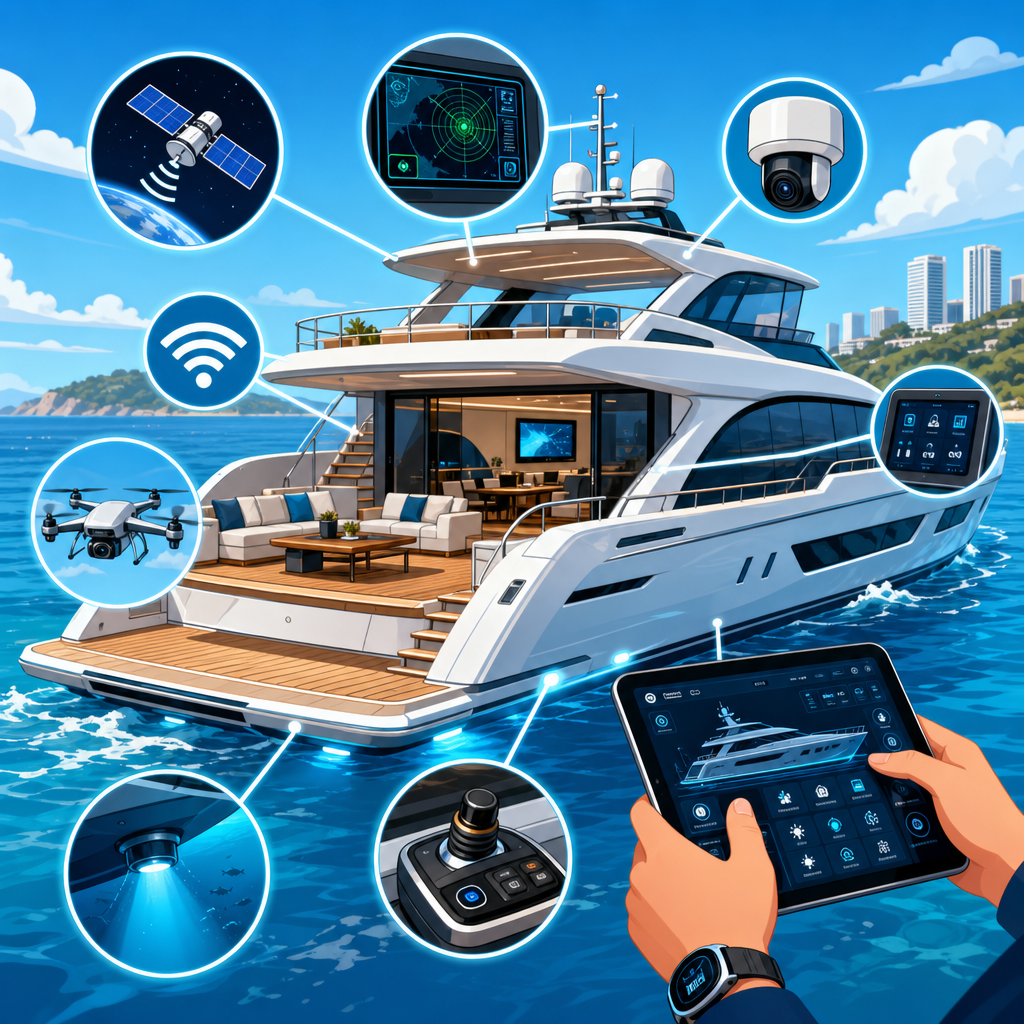
The most important technology on any modern yacht starts at the helm. Today’s leading builders and refit yards favor integrated bridge systems that combine chartplotters, radar, AIS, autopilot, engine data, sonar, thermal imaging, and switching controls into a coordinated command environment. Brands such as Garmin, Raymarine, Furuno, and Simrad dominate this space, while larger superyachts often use bespoke bridge packages from companies like Böning or Rolls-Royce marine integration partners. The advantage is not just cleaner displays. It is decision speed. A captain can cross-check weather overlays, target tracking, route planning, depth data, and engine load from a few synchronized screens instead of bouncing between standalone instruments.
One standout feature is dynamic positioning, sometimes branded as Skyhook, DPS, or joystick station keeping depending on the manufacturer. Using GPS, heading sensors, wind input, and computer-controlled thrusters or pods, the yacht can hold its position without anchoring. In real use, this is valuable when waiting for a fuel berth, hovering near a dive site, or keeping clear of a reef shelf where anchoring would be unsafe or prohibited. Another major upgrade is joystick docking, which combines thrusters and drives to make close-quarters maneuvering far more predictable. On 50- to 90-foot yachts, this technology can reduce crew stress dramatically, especially in crosswinds or stern-to Mediterranean mooring situations. Thermal cameras from FLIR also add a meaningful safety layer for night operations, helping crews identify floating debris, channel markers, and small craft beyond the range of the naked eye.
Propulsion, stabilization, and efficiency systems
Luxury yachts increasingly compete on smoothness and efficiency, not just horsepower. Pod drives from Volvo Penta IPS and inboard systems paired with advanced bow and stern thrusters have changed handling and interior layout possibilities. Pods can improve fuel efficiency at cruise, free up internal volume, and integrate naturally with joystick controls. Conventional shaft-drive yachts still remain popular for heavier displacement vessels and long-range cruisers because they are robust, easier to service globally, and preferred by many captains for offshore durability. The best configuration depends on mission profile, but high-end buyers should focus on how the yacht delivers quiet operation, low vibration, and predictable service access rather than choosing a drive system by trend alone.
The technology that guests notice immediately is stabilization. Gyro stabilizers such as those from Seakeeper have become one of the most requested features in the luxury segment because they reduce roll at anchor and underway, transforming comfort for diners, children, and anyone prone to seasickness. Fin stabilizers from brands like Sleipner and ABT TRAC are also common, especially on larger yachts, and many systems now include at-rest capability. In my experience aboard stabilized yachts in beam chop, the difference is not subtle. Drinks stay on tables, sleep improves, and owners use the boat more often because rough anchorages become tolerable. Efficiency technology also includes interceptor trim systems, active ride control, and hull monitoring tools that help captains optimize fuel burn and maintain proper running attitude across changing sea states.
| Technology | Main Benefit | Best Use Case | Tradeoff |
|---|---|---|---|
| Pod drives | Efficiency and joystick control | Fast motor yachts and owner-operator boats | Higher system complexity |
| Shaft drives | Durability and global service familiarity | Long-range cruisers and heavier yachts | Less interior packaging flexibility |
| Gyro stabilizer | Roll reduction at anchor and underway | Comfort-focused luxury cruising | Weight, cost, and power demand |
| Fin stabilizers | Strong stabilization on larger vessels | Passagemaking and superyacht use | External appendages require maintenance |
Smart power management and hybrid onboard energy
Power systems are one of the clearest signs that modern yachts now borrow heavily from advanced residential and commercial building design. Traditional marine setups relied on shore power, diesel generators, inverter chargers, and lead-acid battery banks. Premium yachts still use those foundations, but the best new vessels add lithium iron phosphate battery systems, sophisticated energy management software, variable-speed generators, and silent operating modes. This matters because owners increasingly want to run air conditioning, lighting, refrigeration, entertainment systems, and hotel loads for hours without generator noise. On high-end builds, battery banks can support overnight anchoring profiles, and software can automatically balance charging sources, load priorities, and reserve margins.
Hybrid yacht technology is also becoming more credible. While full-electric propulsion is still constrained by energy density for larger luxury yachts, diesel-electric and hybrid-assist systems are realistic in select applications, especially for displacement or semi-displacement vessels. Builders such as Silent, Sunreef, and select superyacht engineering firms have pushed solar integration, battery storage, and regenerative concepts further than mainstream production brands. Even where propulsion remains conventional, smart monitoring brings real benefits. Owners can check tank levels, battery state, bilge alarms, shore power quality, and generator status remotely through systems from EmpirBus, CZone, or Maretron. For a yacht kept in another country, that visibility is not a luxury. It is risk management. Early alerts can prevent flat batteries, spoiled provisions, or a minor leak becoming a major insurance claim.
Connected interiors, comfort automation, and digital guest experience
Inside the yacht, high-tech features are now judged by invisibility. The best systems disappear into the experience, allowing guests to control lighting scenes, blinds, climate zones, media, and service requests from touch panels or mobile devices without feeling as though they are operating industrial equipment. Premium automation platforms from Crestron, Savant, Lutron, and KNX-based integrators are common on larger yachts, often linked to marine-specific switching systems so hotel functions and vessel functions communicate reliably. A well-designed installation allows one-touch settings for dinner mode, cinema mode, overnight mode, and boarding mode, while still giving crew manual override in case of failure or guest confusion.
Connectivity is another major differentiator. A decade ago, offshore internet was often slow, expensive, and inconsistent. Today, many luxury yachts combine marina Wi-Fi, cellular boosters, and satellite internet into managed networks that switch sources automatically. Low Earth orbit services have improved bandwidth expectations dramatically, making video calls, cloud access, and streaming more feasible even away from shore. That changes how owners use yachts. Some now work remotely from onboard offices for weeks at a time, while charter guests expect uninterrupted access across cabins and exterior decks. Audio-video systems have advanced as well, with hidden televisions, marine-tuned surround sound, media servers, and outdoor cinema setups becoming common. The best installations account for acoustics, ventilation, and vibration, because consumer-grade equipment fails quickly when installers ignore the marine environment.
Safety, security, and maintenance intelligence
On a serious yacht, high technology should first reduce risk. Beyond radar and GPS, modern safety systems now include networked smoke detection, thermal engine-room monitoring, CCTV, access control, water ingress sensors, electronic engine diagnostics, and automated alarm forwarding to crew phones. Fire suppression remains governed by established marine standards and class requirements, but digital monitoring makes those systems more transparent and easier to inspect. Security technology is also increasingly relevant as yachts travel through mixed marinas and international ports. Cameras with remote access, geofencing alerts, and digital door management help owners protect tenders, toys, and guest areas when the yacht is unattended or operated by rotating crew.
Maintenance intelligence may be less glamorous, but it is one of the most valuable features on any high-end boat. Condition-based monitoring can track generator hours, service intervals, battery health, fuel polishing status, HVAC faults, and pump cycles before they become trip-ending problems. Systems from MTU, MAN, Caterpillar, Volvo Penta, and other engine makers increasingly provide detailed diagnostic data that can be reviewed onboard or by authorized technicians ashore. In practice, this shortens troubleshooting time and improves parts planning. A captain who sees rising exhaust temperature trends or abnormal alternator performance can schedule corrective work before peak cruising season. That protects resale value because maintenance records backed by digital logs are far more credible than vague assurances from a seller.
Watersports technology, tenders, and the luxury lifestyle layer
Not every advanced feature is hidden behind panels. Some of the most visible innovations on modern yachts appear in garages, beach clubs, and stern platforms. Hydraulic swim platforms now launch tenders, personal watercraft, and submersible toys with much less crew effort than older davit systems. Premium tenders themselves have become technology showcases, with touchscreen navigation, electric propulsion options, and refined suspension seating. Owners also look for integrated charging and storage for e-foils, seabobs, dive compressors, and drone equipment. A well-planned yacht does not simply carry toys. It supports them with power distribution, freshwater rinse-downs, secure tie-downs, ventilation, and quick-launch ergonomics.
Beach club design has also become more technical. Fold-down terraces, underwater lighting, retractable ladders, air-conditioned toy rooms, and modular furniture systems turn the stern into a functional resort zone. On explorer yachts and larger superyachts, helipads, submarine interfaces, and expedition-grade cranes extend the same logic into more ambitious territory. Even wellness has a technology component now, including circadian lighting, advanced air purification, heated deck systems, and compact spa infrastructure. These are not superficial upgrades when executed properly. They broaden how the yacht is used, which is the real measure of value in the luxury yachts and high-end boats market.
The best high-tech features found in modern yachts are the ones that solve real problems while making life onboard feel effortless. Integrated helm systems improve situational awareness and docking control. Stabilizers, refined propulsion packages, and ride-management tools increase comfort and expand usable cruising days. Smart power architecture and remote monitoring reduce generator dependence and give owners better oversight of expensive assets. Interior automation, strong onboard connectivity, and carefully engineered entertainment systems turn a yacht into a practical floating residence rather than a beautiful inconvenience. Safety monitoring and predictive maintenance add another layer of confidence, especially for owners who cruise internationally or rely on hired crew.
For anyone exploring luxury yachts and high-end boats under the Best Boats & Reviews umbrella, the smartest next step is to compare features by use case, not by brochure language. A family-focused coastal cruiser needs a different technology mix than a charter platform, a long-range explorer, or an owner-operator sport yacht. Ask how each system performs in heat, salt, vibration, and real docking scenarios. Review service networks, upgrade paths, and the quality of integration, because isolated gadgets age quickly while well-planned systems hold value. Use this hub as your starting point, then move deeper into individual yacht reviews, brand comparisons, and buyer guides to find the technology package that genuinely fits the way you plan to cruise.
Frequently Asked Questions
What are the most valuable high-tech features on a modern yacht?
The most valuable high-tech features on a modern yacht are the ones that improve the onboard experience in clear, practical ways rather than simply adding novelty. At the top of the list are integrated bridge systems, advanced navigation electronics, smart vessel monitoring, stabilization technology, and centralized automation for lighting, climate, entertainment, and security. These systems work together to make the yacht safer, easier to operate, more fuel-efficient, and significantly more comfortable whether the vessel is underway or at anchor.
For owners, one of the biggest advantages is visibility and control. Modern yacht management platforms can bring engine data, tank levels, battery status, shore power input, bilge alerts, and security feeds into one easy-to-use interface. That reduces guesswork and allows crew to identify issues early, often before they become expensive problems. On the guest side, high-tech comfort systems can quietly manage temperature zones, lighting scenes, blinds, air quality, and media streaming in a way that feels seamless rather than overly technical.
Just as important, the best technology on a yacht is often the least intrusive. Features such as gyro stabilizers, dynamic positioning, advanced autopilot, and noise-reduction engineering can dramatically improve comfort and confidence without requiring guests to interact with anything at all. In other words, the most valuable yacht technology is not necessarily the flashiest. It is the equipment that enhances safety, reliability, and luxury while staying largely invisible in day-to-day use.
How do modern navigation and safety systems make yachts better?
Modern navigation and safety systems have transformed yachts from relatively isolated vessels into highly informed, data-driven platforms. Today’s best-equipped yachts typically include multi-function displays, radar, AIS, GPS chartplotters, sonar, digital switching, thermal cameras, depth and wind instruments, and integrated autopilot systems. When these tools are properly networked, they give the captain and crew a much more complete view of the yacht’s surroundings, route, weather conditions, traffic, and mechanical status in real time.
From a navigation standpoint, integration is the real breakthrough. Rather than checking multiple standalone devices, the bridge team can view chart data, radar overlays, AIS targets, engine information, and route planning on coordinated displays. This improves situational awareness, especially in poor visibility, congested harbors, or unfamiliar cruising grounds. Some systems also support remote diagnostics, voyage logging, and predictive maintenance, which are increasingly important on larger yachts that travel long distances or operate on tight itineraries.
Safety technology has improved just as dramatically. Thermal imaging can help detect small craft, navigation markers, or floating debris at night. Advanced alarm management can alert crew to fire risks, flooding, intrusions, smoke, power issues, or abnormal machinery readings. Stabilization and station-keeping systems can reduce risk during tender operations or rough weather. Many yachts also feature sophisticated communications systems, including satellite connectivity, emergency beacons, and redundant network paths, ensuring that the vessel remains connected when offshore. The result is a yacht that is not only easier to navigate, but also much better prepared to prevent, detect, and respond to problems before they escalate.
What smart automation features are commonly found on luxury yachts today?
Smart automation is now one of the defining characteristics of a modern luxury yacht. Onboard automation systems often control lighting, HVAC, window treatments, audiovisual equipment, access control, water systems, and even certain engineering functions through centralized touch panels, mobile apps, or crew-only management consoles. The goal is not to make the yacht feel like a gadget showroom, but to create a smooth and intuitive environment where comfort settings can be adjusted instantly and consistently across the vessel.
In guest spaces, automation often appears in subtle but meaningful ways. Owners can set predefined lighting scenes for dining, entertaining, movie nights, or overnight mode. Climate systems can be managed by zone to keep cabins cool while reducing energy consumption in unused spaces. Blinds, curtains, and ambient lighting can be synchronized to create a more refined interior atmosphere. Entertainment systems can distribute high-definition video and audio throughout the yacht without cluttering each room with separate hardware. On many premium yachts, this all happens through a polished interface that feels more like a luxury residence than a traditional marine control panel.
Behind the scenes, automation is equally useful for crew and engineers. Centralized monitoring can track pumps, generators, electrical loads, freshwater production, blackwater systems, refrigeration, and battery banks. Automated alerts help crew respond quickly when values move outside preset limits. Some yachts can also support remote owner access, allowing the owner or management team to check security cameras, shore power status, cabin temperature, or maintenance alerts from anywhere in the world. The best systems are designed with redundancy, manual override capability, and user-friendly operation, because on a yacht, convenience matters, but reliability matters even more.
How important are stabilization, propulsion, and energy-efficiency technologies on a yacht?
These technologies are extremely important because they directly affect how the yacht feels, how far it can travel, how much it costs to operate, and how enjoyable time onboard will be for everyone. Stabilization is one of the most appreciated features by owners and guests alike. Gyro stabilizers and fin stabilizers can dramatically reduce rolling motion both underway and, in many cases, at anchor. That means less fatigue, less seasickness, safer movement around the yacht, and a much more comfortable experience during meals, socializing, or overnight stays.
Propulsion technology has also advanced significantly. Modern yachts may feature highly efficient diesel engines, pod drives, joystick docking systems, hybrid propulsion, or integrated power management systems that optimize how the yacht uses engines, generators, batteries, and hotel loads. These setups can improve maneuverability, reduce fuel burn, lower noise levels, and give captains more precise control in tight marinas or crowded anchorages. Hybrid and battery-assisted systems are especially attractive because they can support quieter operation, reduced emissions, and silent periods at anchor for guest comfort.
Energy efficiency has become a major focus across the yacht industry, not only for environmental reasons but also for operational practicality. LED lighting, advanced insulation, variable-speed pumps, smart HVAC controls, heat recovery systems, lithium battery banks, and solar support on select vessels all contribute to reduced energy demand. When combined with intelligent monitoring software, these technologies help crew manage onboard power more effectively and extend time away from shore support. In real-world terms, this means a yacht that runs more quietly, more cleanly, and more economically without sacrificing luxury.
What entertainment and connectivity features should owners expect on a high-end modern yacht?
On a high-end modern yacht, owners should expect entertainment and connectivity systems that rival or exceed what they have at home, with the added challenge of functioning reliably at sea. This usually includes high-speed satellite internet, onboard Wi-Fi networks with enterprise-grade coverage, distributed 4K video, premium audio zones, streaming integration, dedicated cinema rooms or media lounges on larger yachts, and smart control interfaces that allow guests to manage content easily from touch panels, remotes, or mobile devices. The best systems are engineered to be powerful without being complicated for guests to use.
Connectivity is now considered essential rather than optional. Owners often want to work remotely, join video calls, monitor business operations, or stay in contact with family while cruising. Guests expect stable internet for streaming, social media, messaging, and cloud access. To support this, modern yachts may combine multiple connectivity sources such as satellite, cellular boosters, and marina Wi-Fi with intelligent failover systems that prioritize the strongest available connection. Network segmentation is also increasingly important so that crew operations, navigation systems, owner devices, and guest traffic remain secure and properly separated.
Entertainment design has become more refined as well. Instead of simply installing large televisions and speakers, top yacht builders and integrators focus on acoustics, hidden hardware, intuitive control, and seamless integration with the yacht’s interior design. Outdoor decks may include weatherproof audio, cinema screens, DJ inputs, and synchronized lighting for events, while private cabins can have personalized media profiles and on-demand content libraries. Ultimately, the best entertainment and connectivity features are the ones that make life onboard feel effortless, connected, and tailored to how the owner actually uses the yacht, whether that means hosting guests, relaxing with family, or staying productive while cruising.