A mayday call is the most urgent voice distress signal in marine radio communications, and knowing how to respond to one can save lives, reduce confusion, and keep a manageable emergency from becoming a fatal accident. In boating laws and regulations, maritime distress signals and communication rules exist because emergencies on the water escalate fast: weather shifts, engines fail, people fall overboard, and distance from medical help turns small mistakes into serious consequences. I have worked with recreational captains and safety trainees long enough to see the same pattern repeatedly: many boaters know how to place a mayday call in theory, but far fewer understand how to respond correctly when they hear one. That gap matters because the first station to answer may be another nearby vessel, not the Coast Guard.
Properly responding starts with understanding the language. “Mayday” is the international voice distress call used only when a vessel, aircraft, or person faces grave and imminent danger and requires immediate assistance. It is different from “Pan-Pan,” which signals urgency without immediate life-threatening danger, and “Sécurité,” which broadcasts important safety information such as navigation hazards or weather concerns. The main communication channels also matter. In most coastal and inland recreational boating contexts, VHF Channel 16 is the primary distress, safety, and calling channel. Digital Selective Calling, Emergency Position-Indicating Radio Beacons, radar, AIS, flares, and sound signals all support distress communication, but the mayday voice call remains a central tool because it conveys location, nature of distress, number of people involved, and immediate needs in plain language.
This hub article explains the full response process, from recognizing a valid mayday to relaying unanswered distress traffic, coordinating with authorities, and avoiding common legal and operational mistakes. It also connects the broader subject of maritime distress signals and communication: the difference between distress levels, required radio procedure, how visual signals fit in, what boating law expects from nearby operators, and where good seamanship meets legal duty. If you operate a powerboat, sailboat, personal watercraft support vessel, or small commercial craft, this knowledge is not optional. It is a practical skill set that supports compliance, improves search-and-rescue outcomes, and helps every operator use the radio with confidence when seconds count.
What a Mayday Call Means and When You Must Treat It as Real
A mayday call must always be treated as genuine unless competent authorities clearly determine otherwise. The operator hearing it should assume grave and imminent danger exists. Under international radio procedure and standard Coast Guard practice, the distress call typically includes “Mayday” spoken three times, the vessel name and call sign, position, nature of distress, assistance required, and number of persons on board. In reality, many calls are incomplete. A frightened operator may only say, “Mayday, mayday, we are sinking off the inlet,” then release the microphone. That is still a distress call, and it demands immediate attention.
The legal and practical reason for this presumption is simple: delay kills. Recreational boaters often expect perfect radio discipline, but real emergencies sound messy. I have heard transmissions clipped by waves, weak batteries, and panicked breathing. Good responders listen for the essentials rather than criticizing the format. If the call indicates collision, fire, flooding, capsize, grounding in surf, medical emergency threatening life, or a person overboard in severe conditions, you are hearing a true distress scenario unless proven otherwise.
Boaters should also understand what does not qualify as mayday. A disabled engine in calm weather close to a marina is generally an urgency matter, not distress. Running low on fuel is not mayday. Confusing these categories wastes rescue resources and can trigger penalties for false distress communications. Still, if another vessel uses mayday incorrectly, your response should prioritize safety first and categorization second. Confirm the facts, determine the actual risk level, and let rescue authorities decide the final disposition.
The Immediate Response on VHF Radio
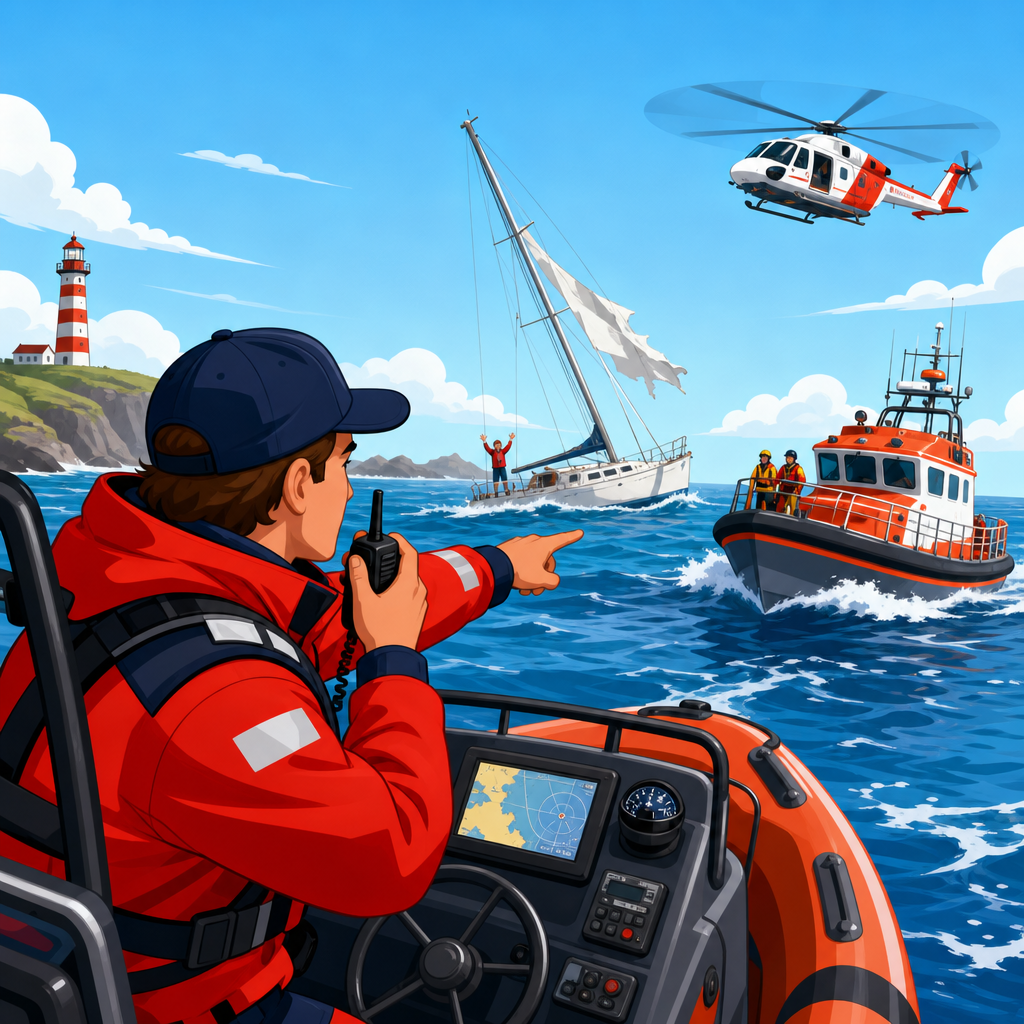
When you hear a mayday on Channel 16, stop nonessential radio traffic at once and listen carefully. Your first task is not to talk; it is to gather information. Note the vessel name, position, number of persons on board, and nature of distress. If a Coast Guard station or other rescue authority responds immediately and takes control, maintain radio silence unless you have relevant information or are specifically called. Distress traffic has absolute priority over routine communications, and unnecessary transmissions can block life-saving instructions.
If no authority answers within a short interval and you are in a position to assist, respond clearly: “Mayday [vessel name], this is [your vessel name]. Received your mayday.” Then ask for missing essentials in plain order: position, persons on board, condition, and immediate hazards. Keep the exchange short. A distressed operator may have only moments before abandoning ship, losing power, or dropping the radio. Repeat back the information to confirm accuracy.
After acknowledgement, contact the Coast Guard or the relevant marine rescue authority on Channel 16 if they have not already joined the traffic. Give the distressed vessel’s details, your position, and whether you are proceeding to assist. If instructed to shift to a working channel, do so, but never leave the distress net unless the transition is confirmed. The point is coordinated communication: one channel for alerting, another for ongoing rescue management when possible. Strong radio procedure reduces duplicated effort, mistaken positions, and dangerous assumptions.
When to Relay a Distress Call and How to Do It
A distress relay is appropriate when a mayday call is not answered by authorities, when you are better positioned to contact rescue services, or when the distressed station is weak, broken, or unreadable to others. In coastal boating, this happens more often than many realize. Terrain, antenna height, weather, and radio power can make one vessel hear a mayday that shore stations miss. Your role then shifts from witness to communication link.
The relay format should be deliberate. State “Mayday Relay” three times, identify the station in distress, provide its last known position, describe the emergency, give the number of people involved if known, and identify yourself as the relaying station. Do not invent information. If the location is uncertain, say “position unconfirmed” and provide the last reported reference, such as “approximately two miles east of Cape Lookout Sea Buoy.” Search planning depends on accuracy. A wrong coordinate can send rescue assets miles off target.
Relaying does not automatically mean you should physically intervene. The decision to assist on scene depends on your vessel type, crew competence, weather, distance, fuel, and risk to your own passengers. Maritime law generally recognizes a duty to render assistance when possible without serious danger to your own vessel or crew. The key phrase is without serious danger. A nineteen-foot runabout should not charge into breaking surf to reach a capsized craft if doing so creates a second emergency. Communication support alone can be invaluable.
Assessing Whether You Should Go to the Scene
Every mayday response requires a rapid but disciplined risk assessment. Ask four questions: How close am I? What assistance can I realistically provide? What conditions exist between me and the casualty? Will my involvement improve the outcome or complicate it? I teach operators to avoid the heroic impulse that ignores vessel limitations. The right move may be immediate diversion to the scene, standing by at a safe distance, acting as a communication relay, or guiding professional rescuers with visual references.
Distance matters, but so does capability. A nearby kayak cannot tow a disabled cruiser out of surf, but it may spot a person in the water sooner than anyone else. A cabin boat with first-aid supplies may be best suited for a medical evacuation transfer. A sailboat under heavy heel may be poorly configured for man-overboard recovery from another vessel but useful as a visible marker and radio platform. Match your response to your actual tools.
Environmental factors are decisive. Night operations, cold water, lightning, strong current, shallow bars, and lee shores increase hazard dramatically. In several training reviews I have done, secondary casualties occurred because helpers approached a burning vessel from downwind, failed to account for fuel slicks, or came alongside a sinking boat too early and got entangled. Sound seamanship means helping in ways that preserve your own vessel’s maneuverability and crew safety while still supporting rescue efforts.
On-Scene Actions That Help Rather Than Harm
If you proceed to the scene, your first job is scene safety and communication discipline. Approach slowly, keep clear of propellers near people in the water, and consider wind and current before maneuvering. Maintain a proper lookout and assign tasks: one person on radio, one observing the casualty, one preparing life-saving gear. If the emergency involves fire, remain upwind and be alert for explosion risk from fuel vapors or pressurized containers. If flooding or sinking is underway, expect debris and sudden movement from the casualty vessel.
Simple actions often matter most: throwing flotation, marking the GPS position, using searchlights wisely at night, and giving calm verbal instructions. If people are in the water, prioritize flotation and retrieval methods that avoid running directly over them. Use a heaving line, throwable device, recovery sling, swim ladder, or low freeboard access point. For hypothermia risk, reduce time in the water and handle survivors carefully after recovery. If a vessel must be abandoned, account for all persons immediately; many search cases are prolonged by uncertainty about whether everyone got off.
Coordinate with official rescuers as soon as they arrive or establish contact. Report what you see, not what you assume: number of people visible, whether life jackets are worn, whether the vessel is drifting, and any hazards such as smoke, shoaling water, or disconnected persons in the water. Clear observation is more useful than dramatic narration.
| Situation | Best Initial Response | Common Mistake |
|---|---|---|
| Unanswered mayday on Channel 16 | Acknowledge, gather facts, relay to authorities | Talking over the distressed vessel |
| Person in the water | Throw flotation, mark position, approach carefully | High-speed approach with propeller risk |
| Vessel fire | Stay upwind, prepare rescue if abandonment occurs | Coming alongside through smoke or fuel |
| Flooding or sinking | Confirm persons on board and flotation status | Focusing on property before people |
| Medical distress offshore | Relay symptoms, age, vitals if known, ETA | Using vague descriptions without specifics |
Understanding the Full Distress Communication System
Mayday is only one part of maritime distress communication. A complete understanding includes visual, audible, and electronic signals that support rescue. Recreational boaters should know the standard visual distress signals recognized under U.S. carriage rules, including approved flares, orange distress flags, electric distress lights, and in some contexts day-or-night signaling devices required by federal and state rules. On the electronic side, DSC-equipped VHF radios can transmit a distress alert with position from an integrated GPS, dramatically improving response speed when properly registered with an MMSI number. EPIRBs and Personal Locator Beacons provide satellite-based alerting, and AIS man overboard devices can improve local tracking.
These tools do not replace voice procedure; they reinforce it. In actual incidents, redundancy saves time. A mayday call gives rescuers the story. DSC gives a digital alert and position. AIS shows nearby traffic. Flares identify the exact target in darkness or low visibility. Sound signals may assist in fog. The strongest emergency setup is layered communication, not dependence on one device. This hub topic also connects naturally to related subjects every operator should study in depth: how to make a mayday call, VHF radio etiquette, distress signal equipment requirements, EPIRB registration, DSC setup, and legal obligations after collision or casualty.
Legal Duties, False Distress, and Recordkeeping
Boating laws and regulations impose real responsibilities during distress incidents. Masters are generally expected to render assistance to persons in danger at sea so far as they can do so without serious risk to their own vessel and crew. Interfering with distress traffic, making hoax mayday calls, or using marine radio improperly can lead to fines, criminal penalties, and civil liability. The Federal Communications Commission regulates radio use, while Coast Guard enforcement and state boating law may also apply depending on the event.
Keep a written or electronic record after any significant mayday involvement. Note the time heard, channel used, vessel identification, reported position, actions taken, and authorities contacted. This is not bureaucratic trivia. Accurate records support investigators, insurers, and rescue agencies, especially when timelines are disputed. I recommend that every skipper carry a radio log sheet or use a waterproof notebook at the helm. In training scenarios, operators who write down coordinates and times consistently outperform those who trust memory under stress.
Conclusion
Responding properly to a mayday call means recognizing true distress, preserving radio discipline, collecting essential facts, relaying information when needed, and offering assistance only within the limits of safety and capability. The process is straightforward when practiced: listen first, acknowledge clearly, involve rescue authorities, assess your role honestly, and support the scene with calm, precise action. Maritime distress signals and communication are not separate from boating laws and regulations; they are one of the clearest places where legal duty and practical seamanship meet.
The main benefit of learning this system is simple: you become the kind of operator who helps create order when the water turns chaotic. That protects your passengers, supports professional rescuers, and may save another crew before the situation worsens. Review your VHF procedures, confirm your MMSI and GPS integration, inspect your distress signals, and make mayday response part of every boating safety plan.
Frequently Asked Questions
What should I do first when I hear a Mayday call on the radio?
The first thing to do is stop talking, listen carefully, and write down every detail you can catch. A Mayday call is the highest-priority distress call in marine radio communications, which means all non-emergency traffic should immediately cease. Pay close attention to the vessel’s name, position, nature of distress, number of people on board, and any description of the boat. If you miss part of the call, keep listening because the distressed vessel or another station may repeat it.
Once you have the information, determine whether the Coast Guard or another rescue authority has acknowledged the call. If a rescue authority answers, your role is usually to remain silent unless you are directly asked to help. If no one responds and you are in a position to assist, you may need to relay the distress message. Staying calm matters. Panic on the radio creates confusion, and confusion costs time. A proper response starts with silence, attention, and accurate information gathering.
How do I know whether I should answer the Mayday call or stay off the radio?
In most cases, if the Coast Guard, harbor patrol, or another clearly responsible rescue authority responds, you should stay off the radio and keep the channel clear. The purpose of radio discipline during a distress situation is to prevent overlapping transmissions and ensure the people coordinating the rescue can communicate efficiently. Even well-meaning boaters can accidentally block critical instructions if they jump in too soon.
You should answer or relay the Mayday call if no one acknowledges it, if you are the nearest capable vessel, or if you have information that could materially assist the rescue. For example, if you know the local area, can reach the vessel faster than official responders, or have visual contact, your response may be valuable. If you do respond, be brief, clear, and professional. Identify who you are, confirm that you received the distress call, and state what assistance you can provide. If you are not in a safe position to help physically, you can still be useful by relaying the distress message to rescue authorities or monitoring the situation until help is established.
What information should I repeat if I need to relay a Mayday call?
If you must relay a Mayday, repeat the information in a structured order so rescuers can act quickly. Start by saying “Mayday Relay” three times, followed by your vessel identification, then the distressed vessel’s identification if known. After that, give the last known position as accurately as possible using latitude and longitude, GPS coordinates, distance and bearing from a known landmark, or any other precise location reference that was transmitted. Then state the nature of the emergency, such as fire, sinking, collision, medical emergency, flooding, or person overboard.
You should also include the number of people on board, any injuries reported, a description of the vessel, and any immediate dangers such as heavy seas, disabled engines, or taking on water. If the distressed vessel mentioned safety equipment like life rafts, immersion suits, or flares, include that too. The goal is not to sound formal for its own sake; it is to make sure rescue teams receive a complete, accurate picture. Relaying the wrong location or leaving out the nature of distress can delay rescue efforts dramatically, so repeat only what you heard and avoid guessing.
Should I go directly to help the vessel in distress, or wait for instructions?
That depends on your distance, your vessel’s capabilities, weather and sea conditions, and whether going to help would place your own crew in danger. Maritime law and good seamanship both support assisting others in distress when it is safe and reasonable to do so, but that does not mean charging into a dangerous situation without a plan. If your boat is too small for the conditions, lacks the right equipment, or would become a second emergency, your best help may be to relay communications, maintain a listening watch, or stand by at a safe distance until trained responders arrive.
If you are close enough and capable of assisting safely, advise rescue authorities or the distressed vessel that you are proceeding to their location. Continue to monitor the distress channel and provide position updates if helpful. Approach carefully, especially if there is fire, fuel in the water, breaking seas, a medical emergency, or people overboard. In many cases, rendering aid means more than simply towing a boat. It may involve recovering people from the water, passing life jackets or flotation, standing by until rescue units arrive, or using your vessel as a communications platform. The key principle is simple: help effectively, but do not create another casualty.
What mistakes should boaters avoid when responding to a Mayday call?
One of the most common mistakes is transmitting unnecessarily and cluttering the distress channel. During a Mayday situation, every second matters, and overlapping radio traffic can block critical details like the vessel’s position or the rescue coordinator’s instructions. Another major mistake is failing to write down the distress information as it is heard. Memory is unreliable under stress, and small errors in coordinates, vessel name, or number of people on board can have serious consequences. Boaters also make the mistake of assuming someone else must have heard the call. If no one responds, silence is not safety; it may mean you are the only one in a position to help relay it.
Another dangerous error is attempting assistance beyond your skill level or vessel capability. Good intentions do not overcome rough weather, poor visibility, or inadequate equipment. Approaching too fast, towing improperly, or putting your own passengers at risk can make the emergency worse. Finally, avoid speculation on the radio. Only transmit confirmed facts. If you do not know the vessel’s exact location, say it is the last reported position. If you did not hear the number of people on board, do not invent one. Clear, disciplined, factual communication is what turns a chaotic emergency into a coordinated rescue.