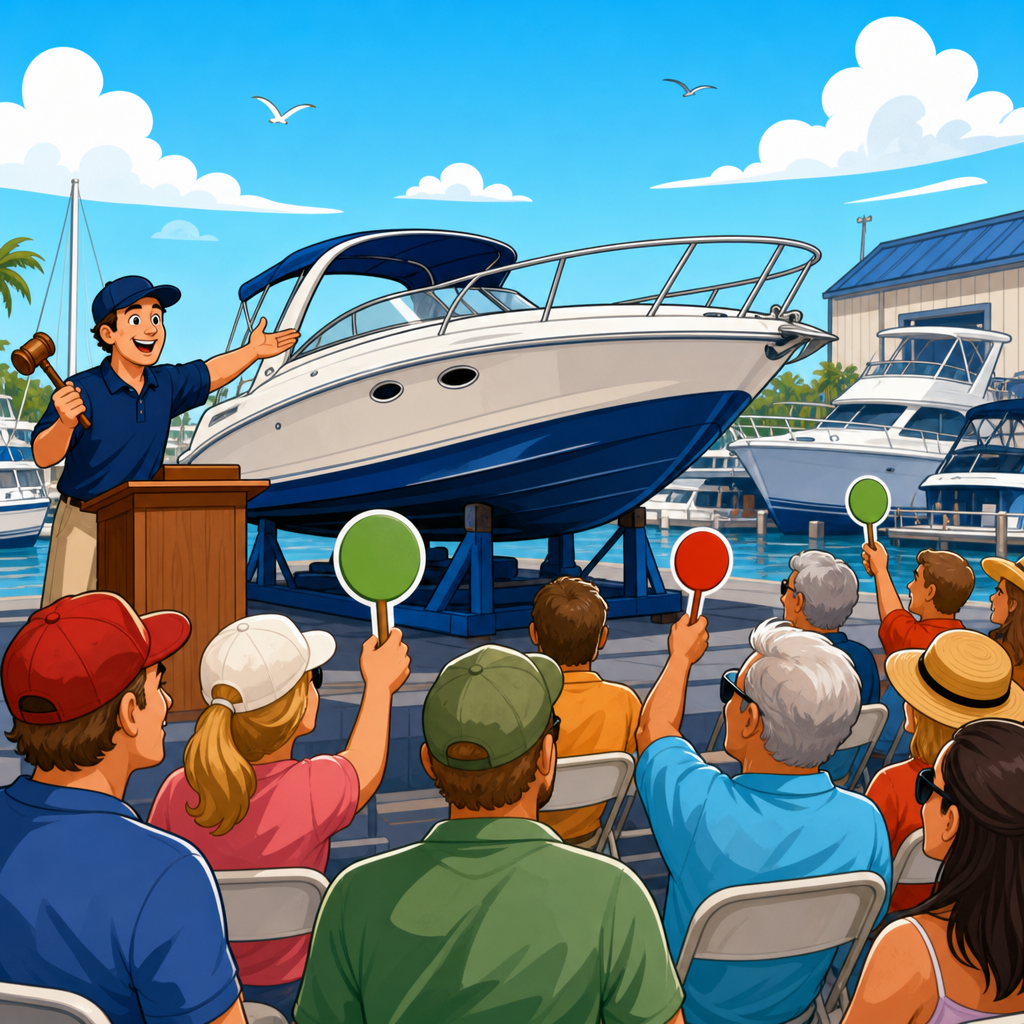
Buying a boat at auction can save thousands of dollars, but it can also expose you to hidden damage, title problems, and costly mistakes if you do not understand how marine auctions work. In the buying and selling boats market, “auction” usually means a timed online sale, a live lender liquidation, a government surplus event, or a salvage disposal, while “dealer purchase” means buying through a licensed business that inspects, markets, and often services the vessel before sale. I have helped buyers evaluate both routes, and the difference is not just price; it is risk allocation. Auctions shift more responsibility to the buyer, including research, inspection, transport, and paperwork. Dealers generally charge more because they absorb part of that work, carry overhead, and may offer financing, sea trials, warranties, or trade-in support. This guide explains how to buy a boat at auction, how auction buying compares with buying a boat from a dealer, what costs matter beyond the hammer price, and how to decide which path fits your budget, mechanical skill, and tolerance for uncertainty. If you want the shortest answer, it is this: buy at auction when you can verify title, condition, and repair economics; buy from a dealer when convenience, financing, and after-sale support matter more than achieving the lowest initial price.
Boat auctions attract first-time buyers, flippers, marinas, charter operators, and experienced owners looking for a project or a bargain on a late-model vessel. The appeal is obvious. Banks, insurers, government agencies, and private consignors often want inventory moved quickly, so opening bids can look dramatically lower than retail listings on YachtWorld, Boat Trader, or local classified sites. The problem is that low opening bids do not equal low total acquisition cost. A repossessed center console with neglected outboards may need a complete fuel-system cleaning, battery replacement, new electronics, trailer tires, and overdue engine service before it is even safe to launch. A storm-damaged cruiser can hide moisture intrusion in stringers, saturated foam, corroded wiring, and compromised through-hulls. Even a clean boat can become expensive if storage fees, buyer’s premiums, transport permits, registration, and sales tax are overlooked. That is why smart buyers treat auctions as a disciplined acquisition process, not a treasure hunt. They set a ceiling price, verify documents, inspect wherever the terms allow, and compare every auction opportunity against dealer inventory to avoid paying “cheap” prices for expensive problems.
How boat auctions work and who should consider them
Most boat auctions fall into four categories: lender repossessions, insurance losses, government surplus, and private consignments. Repossession boats may have been maintained well or ignored entirely during financial distress. Insurance boats range from lightly damaged theft recoveries to true salvage after fire, sinking, collision, or hurricane exposure. Government surplus vessels can include patrol boats, research craft, inflatables, and workboats, often sold “as is, where is.” Private consignment auctions usually feature boats sold by owners seeking a faster transaction than a brokered listing. The listing terms tell you what you are really bidding on. Key details include whether the vessel is operational, whether keys or batteries are included, whether a trailer conveys, and whether the title status is clean, lien sale, salvage, or bill of sale only.
Auctions suit buyers who can inspect critically, estimate repairs, and move quickly after winning. If you are comfortable reading engine-hour reports, checking hull moisture, identifying freeze damage, and sourcing transport, an auction can be efficient. If you need guidance on model selection, financing options, sea-trial validation, and warranty support, a dealer is usually the safer route. I have seen buyers do well at auction when they targeted simple, proven platforms such as aluminum fishing boats, skiffs with readily available outboards, and trailerable bowriders with broad parts support. I have also seen buyers lose money on attractive but complex vessels such as aging express cruisers with generator issues, pod-drive service needs, and deferred maintenance hidden behind polished gelcoat. The rule is simple: complexity multiplies auction risk.
How to research a boat before you bid
The best auction buyers begin with identification and documentation. Confirm the hull identification number, registration number, engine serial numbers, and trailer VIN, then match them to the auction description. Run the HIN through your state agency if possible, review U.S. Coast Guard documentation records for documented vessels, and ask whether there are outstanding liens, missing releases, or title delays. A clean title matters because unresolved ownership issues can prevent registration, financing, resale, or export. When records are incomplete, price the boat as a problem asset, not a retail-ready vessel.
Next, research the market value of the exact make, model, year, and engine package. Compare recent dealer listings, broker listings, and sold-market clues from NADA Guides, J.D. Power values, and regional comps. Then adjust for actual condition, electronics age, trailer condition, engine hours, and service history. A ten-year-old center console with current Garmin electronics, documented 100-hour services, and a galvanized trailer is not equivalent to the same hull with sunburned upholstery, corroded wiring, and no maintenance records. When I build a bid ceiling, I start with realistic local retail value, subtract immediate repairs, subtract deferred maintenance, subtract auction fees and taxes, and then subtract a contingency reserve. What remains is the maximum bid, and I do not exceed it.
| Checkpoint | What to verify | Why it matters |
|---|---|---|
| Ownership papers | Title, registration, lien releases, Coast Guard documentation | Prevents registration and resale problems |
| Hull condition | Cracks, repairs, moisture, soft decks, transom integrity | Structural repairs are expensive and time consuming |
| Powertrain | Engine hours, compression, service records, corrosion, lower unit | Engines often determine whether the deal works financially |
| Trailer | VIN, brakes, bearings, tires, lights, frame rust | Transport and legal compliance depend on trailer condition |
| Total costs | Premium, tax, storage, transport, launch, repairs | Low bids can become high total acquisition costs |
Inspection basics: what to check on the hull, engine, and trailer
If the auction permits in-person preview, use it. Bring a flashlight, moisture meter if you know how to interpret one, a mirror, paper towels, a multimeter, and a camera. Walk the hull slowly. Look for impact repairs, mismatched gelcoat, spider cracking radiating from hardware, chine damage, and signs of blistering below the waterline. Bounce on the deck to feel for soft spots around hatches, consoles, and seat bases. Inspect the transom around scuppers, transducers, and mounting bolts for staining or flex. Open compartments and smell for mildew, fuel, or burnt wiring. Heavy odor often reveals chronic leaks or electrical issues long before instruments power up.
Engines deserve the most scrutiny because replacement cost can erase any auction savings. On outboards, inspect the skeg, propeller, lower unit seals, steering movement, trim-and-tilt operation, cowling corrosion, and wiring harness condition. Pull the dipstick on four-strokes and look for water contamination or burnt oil. Check the fuel system for cracked primer bulbs, brittle hoses, and stale fuel. On sterndrives and inboards, inspect bellows, manifolds, risers, couplers, shaft seals, and signs of saltwater intrusion. Compression and computer diagnostics are ideal, but many auctions do not allow them. When hard data is unavailable, discount aggressively. A non-running engine is worth substantially less than a seller’s optimistic description suggests.
Do not ignore the trailer. Many auction buyers focus on the boat and later discover they cannot move it safely. Check tire age by DOT date code, inspect for sidewall cracking, spin the wheels if allowed, look for leaking hubs, and inspect brake lines, actuators, bunks, rollers, and frame corrosion. Verify capacity ratings against the boat’s actual wet weight including fuel and gear. On larger boats, measure beam, height, and overhang before assuming standard road transport will work. Oversize permits, escorts, or yard forklifts can add meaningful cost.
Understanding auction fees, taxes, and the real cost of ownership
The hammer price is only one line item. Most boat auctions charge a buyer’s premium, commonly a percentage of the winning bid or a tiered fee structure. You may also owe documentation charges, administrative fees, loading fees, gate fees, marina extraction fees, and daily storage if the boat is not removed on time. Sales tax rules vary by state and whether the transaction is dealer-facilitated, titled, documented, or moved immediately out of state. Some buyers also need survey costs, transport insurance, launch fees, cleaning, shrink-wrap removal, and emergency recommissioning.
After pickup, ownership costs continue. Engines may need impellers, fluids, filters, plugs, thermostats, and batteries before first use. Safety equipment may be missing or expired. Depending on size and type, you may need registration, Coast Guard documentation renewal, marina fees, winter storage, bottom paint, and hull insurance. Insurance is especially important to price before bidding on high-performance boats, older cruisers, or salvage-history vessels because some underwriters impose restrictions or decline coverage entirely. I advise buyers to get an insurance indication and a transport quote before the auction closes. If either number surprises you, the boat was never a bargain.
Buying a boat from a dealer: when paying more makes sense
Buying a boat from a dealer usually costs more up front, but the premium often buys clarity and convenience. Dealers typically verify paperwork, prepare the boat for showing, and may perform basic service, cleaning, battery charging, and systems checks. New-boat dealers offer manufacturer warranties and rigging support. Reputable used-boat dealers may provide limited warranties, financing relationships, title handling, and the ability to sea trial before closing. For buyers without mechanical experience, those services reduce uncertainty more than the price difference suggests.
Dealer buying also creates better conditions for comparison shopping. You can evaluate multiple boats of the same type, ask detailed questions about prior service, and often negotiate based on survey findings or needed repairs. If a bilge pump fails on a dealer lot during demonstration, that tells you something immediately. At auction, the same issue may be your problem the moment the invoice is paid. This does not mean every dealer boat is superior. Some dealer inventory is trade-in stock sold quickly with minimal refurbishment. The key is that dealer transactions generally provide more inspection access, more disclosure, and more support. If you are deciding between buying a boat at auction or from a dealer, ask yourself whether you are purchasing a vessel or purchasing certainty. Certainty has a price, and in many cases it is worth paying.
Bid strategy, negotiation alternatives, and common mistakes to avoid
Successful auction buying depends on discipline. Set your maximum all-in number before the bidding starts and include every cost: premium, tax, transport, immediate repairs, and contingency. Bid late if the format favors it, but never chase another bidder beyond your ceiling. Emotional bidding is the fastest way to turn a promising auction into a bad investment. I have seen buyers overpay simply because they had already arranged a tow vehicle and mentally “won” the boat before the auction ended. The market does not reward that mindset.
Compare every auction target with dealer and private-party alternatives. Sometimes the spread between a risky auction boat and a dealer boat with service records is only a few thousand dollars. In that case, the dealer boat is often the better value. Use model-specific owner forums, ABYC safety standards, and NMMA-certified brand documentation to understand known issues before committing. Red flags that should stop a bid include missing title documentation, visible waterline inside the cabin, severe corrosion around electrical panels, impact damage near the transom, seized steering, or signs the engine was submerged. Also be realistic about your own capacity. If you do not have time for repairs, storage space, or trusted marine technicians, the cheapest boat can become the costliest one. Start by defining your use case, line up your financing or cash, inspect thoroughly, and pursue auction deals only when the numbers still work under conservative assumptions.
Buying a boat at auction is not inherently risky or inherently smart; it is a method that rewards preparation and punishes guesswork. The right buyer can acquire a solid boat below retail, especially when targeting simple models with clear paperwork, predictable parts availability, and manageable transport requirements. The wrong buyer can end up with title disputes, hidden structural damage, or an engine replacement that exceeds the boat’s finished value. That is why the best approach is comparative, not ideological. Measure every auction opportunity against what a dealer offers in condition, documentation, support, and total cost. If the discount is real after fees, repairs, and risk, bid confidently. If the discount disappears under scrutiny, walk away.
The main benefit of this process is control. When you understand auction terms, inspect carefully, verify title status, and cap your all-in budget, you stop buying on hope and start buying on evidence. Whether you choose a lender auction, an insurance sale, or a dealer lot, the same fundamentals apply: confirm ownership, evaluate structure and power, calculate true costs, and match the purchase route to your skill level. Use this page as your hub for buying a boat at auction or from a dealer, then build your shortlist and verify each candidate methodically before you commit.
Frequently Asked Questions
1. Is buying a boat at auction really cheaper than buying from a dealer?
It can be, but the lower price tag does not automatically mean the boat is the better value. Auctions often attract buyers because vessels may sell below retail market value, especially in lender liquidations, government surplus events, timed online auctions, or salvage sales. In some cases, buyers can save thousands of dollars compared with a traditional dealer listing. That said, the real question is not whether the hammer price is low, but whether the total cost of ownership stays low after the purchase.
Unlike a dealer purchase, auction boats are commonly sold as-is, where-is, with limited or no warranties, no meaningful return period, and little assurance that the vessel has been inspected, serviced, water-tested, or properly represented. A dealer often absorbs part of the risk by checking systems, addressing obvious defects, handling paperwork, and preparing the boat for sale. At auction, much of that responsibility shifts directly to the buyer. If the boat needs an engine overhaul, transom repair, electronics replacement, trailer work, or title correction, your apparent bargain can disappear very quickly.
The smartest way to compare auction versus dealer pricing is to calculate the full acquisition cost. That includes the winning bid, buyer’s premium, administrative fees, storage charges, transport, registration, taxes, repairs, missing equipment, and any professional inspection costs. If a dealer boat is priced higher but is turnkey, documented, and sea-trialed, it may actually be the cheaper purchase in practical terms. Auctions can absolutely be a great source of value, but only for buyers who price in risk and do not confuse a low opening bid with a low final cost.
2. What are the biggest risks when buying a boat at auction?
The biggest risks are hidden damage, title or documentation problems, incomplete information, and bidding without a firm repair budget. Boats sold at auction may have been repossessed, neglected, storm-damaged, partially submerged, vandalized, abandoned, or tied up in legal or administrative issues. Photos can make a vessel look better than it really is, and auction descriptions are often brief, generic, or written with strong liability disclaimers. It is very common to see language stating that accuracy is not guaranteed and that the buyer must verify all details independently.
Mechanical and structural issues are among the most expensive surprises. A boat can appear cosmetically acceptable while hiding soft decks, moisture intrusion, stringer rot, corrosion, bad fuel, seized engines, damaged lower units, electrical faults, or inoperative pumps and navigation systems. If the boat has been sitting for a long time, age-related issues alone can be substantial. Even if the hull is sound, the cost of recommissioning a neglected vessel can be significant. A cheap auction boat that needs extensive work can quickly become a project worth far less than the money invested.
Paperwork risk is just as important. Before bidding, buyers should understand whether the vessel is being sold with a clear title, a transferable registration, a bill of sale only, salvage branding, or Coast Guard documentation issues. Liens, missing hull identification details, trailer title problems, and unpaid storage or marina disputes can complicate or delay ownership transfer. In some cases, the boat may be legally purchasable but difficult to insure, finance, register, or resell. If you are not comfortable evaluating both the boat and the paperwork, it is wise to involve a marine surveyor, documentation specialist, or attorney before placing a serious bid.
3. How can I inspect a boat before bidding at auction?
The inspection process depends on the type of auction, but the rule is the same across the board: gather as much verified information as possible before you commit. Some auctions allow in-person preview days, while others offer only photos, basic condition notes, and limited access. If physical inspection is allowed, take full advantage of it. Walk the deck, inspect the hull and trailer, look for cracks, repairs, impact damage, waterlines, corrosion, mildew, and signs of neglect. Open compartments, check wiring, inspect upholstery, and verify that major components shown in the listing are actually present.
If the boat is in the water and a sea trial is not available, you may still be able to arrange a survey or dockside inspection, depending on the auction terms. A qualified marine surveyor can identify structural concerns, safety deficiencies, and signs of water intrusion that an average buyer might miss. For powerboats, a mechanic’s evaluation can be equally important, particularly on outboards, inboards, stern drives, and diesel systems where repair costs can be very high. Compression tests, engine hours, lower-unit condition, fluid checks, battery status, and electronic system functionality can all affect the real value of the vessel.
If you cannot inspect in person, do not rely on hope. Request additional photos, ask specific written questions, confirm the hull identification number, ask whether keys and titles are available, and verify whether the engine runs, cranks, or is untested. Also ask about missing components such as props, covers, seats, electronics, and trailer parts. The less access you have, the more conservative your bidding should be. Experienced auction buyers protect themselves by assuming there may be defects not visible in the listing and reducing their maximum bid accordingly.
4. What fees and extra costs should I expect when buying a boat at auction?
Many first-time buyers focus on the bid price and underestimate how many additional charges can attach to an auction purchase. The most common extra cost is the buyer’s premium, which is added to the winning bid and can materially increase the total purchase price. There may also be online bidding fees, documentation charges, title processing fees, sales tax, local tax, marina release fees, loading charges, gate fees, storage charges if the boat is not removed quickly, and late-payment penalties if auction timelines are missed.
Transportation is another major expense. A boat may be located far from your home, and moving it can require a professional hauler, permits for oversized loads, trailer repairs, crane services, or launch fees. If the boat comes with a trailer, do not assume the trailer is roadworthy. Tires, bearings, brakes, lights, winches, bunks, and couplers may all need immediate attention. If no trailer is included, your logistics costs can increase sharply. Buyers also need to consider insurance, registration, documentation transfer, and possible marina or storage fees after pickup.
Then there is the post-purchase repair and recommissioning budget. Even a clean-looking vessel may need batteries, fuel system cleaning, impellers, pumps, safety gear, electronics updates, canvas work, detailing, and engine service before it is ready for use. The best practice is to set a hard all-in budget before bidding. Work backward from the boat’s realistic retail value in running condition, subtract repair estimates, subtract fees and transport, and leave room for unexpected issues. That disciplined approach helps prevent emotional bidding and keeps an auction opportunity from turning into an expensive mistake.
5. What should I do before placing my first bid on a boat at auction?
Before placing your first bid, define exactly what type of boat fits your needs and what your maximum all-in budget will be. That sounds basic, but it prevents one of the most common auction errors: bidding on a boat because it seems cheap rather than because it suits your intended use. Consider where you will use it, how many people it needs to carry, whether you need a trailer, what power system you are comfortable maintaining, and what local registration or insurance requirements may apply. A good auction buy starts with a clear buying plan, not just enthusiasm.
Next, research the specific auction platform or event. Read the terms and conditions carefully, including payment deadlines, deposit requirements, inspection rights, buyer’s premiums, title language, removal deadlines, and dispute limitations. Verify how the boat is being sold, whether as repossessed, surplus, salvage, abandoned, or consigned inventory. Learn whether the seller has made any representations about title status, running condition, included equipment, or known damage. If anything in the listing is vague, ask questions before the sale closes, not after you win.
Finally, line up your support and your exit plan. If you are not experienced with marine purchases, speak with a surveyor, boat mechanic, transporter, and if necessary a title or documentation professional before bidding. Have funds ready, understand how quickly you must pay, and know how the boat will be picked up or shipped. Check comparable market values so you know what the vessel would be worth in excellent, fair, and poor condition. The most successful auction buyers are disciplined, prepared, and realistic. They know when to bid, when to stop, and when a dealer purchase may actually be the safer and smarter choice.