How to attach and use a tow rope for water sports starts with understanding that the rope is not just a line between boat and rider; it is a load-bearing safety system that affects acceleration, control, comfort, and risk. In practical terms, a tow rope connects a powered boat or personal watercraft to a person using skis, a wakeboard, kneeboard, tube, or similar recreational equipment. The way that rope is attached, the material it is made from, and the way it is handled on the water all influence performance. After rigging boats for family tubing days, wake sessions, and waterski instruction, I have seen the same pattern repeatedly: most towing problems come from poor attachment points, the wrong rope for the activity, or careless handling during launch and retrieval.
This topic matters because towing sports combine speed, tension, and human movement in an environment that changes by the second. A wakeboard line may stretch differently than a tube rope, altering the rider’s pull and the driver’s throttle response. A misplaced attachment can create dangerous forces on a stern cleat, transom ladder, or rail that was never designed for towing loads. Even a quality rope becomes unsafe if it is knotted, frayed, or dragged into the propeller. For anyone building out a complete boating gear and equipment setup, tow ropes sit at the center of water sports and recreational equipment because they connect the boat, the rider, and the safety plan.
At hub level, this guide covers the core decisions every boater needs to make before drilling into sport-specific gear. It explains where to attach a tow rope, how different ropes work, what lengths and handles fit each sport, how to launch and retrieve riders, how to inspect and store gear, and what legal and operational rules shape safe towing. If you are comparing watersports equipment for a pontoon, runabout, ski boat, or PWC, these fundamentals will help you choose compatible gear and avoid expensive mistakes. They also create a base for deeper articles on wakeboard ropes, ski pylons, towable tubes, observer seating, life jackets, and propeller safety.
Choose the Correct Attachment Point First
The first rule of attaching a tow rope for water sports is simple: use a manufacturer-approved towing point. On many ski and wake boats, that means a ski pylon, tow eye, or tower designed to carry dynamic loads. On runabouts and bowriders, it may be a reinforced stern tow eye or a bridle connected to twin transom eyes. On PWCs, it is usually a dedicated tow hook specified in the owner’s manual. Never assume a cleat, grab rail, swim ladder, seat base, or canvas frame can handle towing forces. Those parts may support docking or boarding but can fail suddenly under a rider’s pull, especially during hard turns or when a tube crosses the wake.
A proper tow point changes both safety and performance. Elevated points such as towers reduce drag on the rope and can improve pop for wakeboarding, while lower stern eyes are common for tubing and recreational skiing. The goal is not just to keep the rope attached; it is to maintain a predictable line angle so the rider tracks correctly behind the boat. I have replaced bent hardware on family boats where someone clipped a tube line to a transom rail because it looked convenient. The repair bill was higher than the price of the correct towing hardware, and the failure could easily have injured the riders.
Before each outing, inspect the mounting hardware closely. Look for backing plates, tight fasteners, stress cracks in fiberglass, corrosion on stainless fittings, and any movement when the line comes under light tension. If the owner’s manual lists a maximum person count or towable limit, follow it exactly. Boats are not universally rated for every watersport. A compact aluminum fishing boat may pull a single skier at moderate speed but be unsuitable for wide, whip-heavy tubing. Matching the attachment point to the boat’s design is the foundation for every other water sports equipment decision.
Select the Right Tow Rope for the Sport
Not all tow ropes are interchangeable. Waterski ropes are typically low-stretch polypropylene blends that float, making them easier to see and less likely to sink near the propeller. Wakeboard ropes often use low-stretch polyethylene or Spectra-type constructions because riders want consistent pull and precise edging. Tube ropes are built for higher shock loads and are rated by the number of riders, often one to four persons or more. Kneeboard ropes may resemble ski ropes but can have different handle sections and length configurations. Choosing the wrong rope affects control immediately. A stretchy general-purpose line can make wakeboard starts mushy, while an underspecified rope can snap under a loaded tube.
Length matters as much as material. A standard recreational waterski rope often runs around 70 to 75 feet including handle sections, with removable segments to fit skier ability and wake width. Wakeboard lines commonly range from about 55 to 75 feet, though advanced riders tune length to boat speed, wake shape, and ballast. Towable tube ropes usually span around 50 to 60 feet to keep the tube in cleaner water and maintain safe tracking behind the boat. Personal watercraft often call for specialized tow lines because the tow point geometry and craft handling differ from conventional boats. For tubing, always use a rope specifically labeled for towables, with a clear tensile strength or rider rating from a recognized manufacturer.
Handle design also changes the experience. Ski handles are narrower and built for grip control during cuts. Wakeboard handles are wider and often feature EVA or suede-style grips for comfort and durability. Tube ropes may use quick-connect hardware at the towable end rather than a rider-held handle. Avoid improvising with hardware-store rope, climbing rope, or anchor line. Those products are designed for different load patterns, abrasion profiles, and buoyancy characteristics. A proper water sports tow rope is engineered to float, resist UV exposure, and perform under repeated towing cycles.
Match Rope, Handle, and Length to Common Water Sports
Building a complete water sports and recreational equipment kit is easier when you treat the rope as part of a system. The table below shows the common combinations boaters use and why each works on the water.
| Sport | Typical Rope Type | Common Length | Best Attachment | Why It Works |
|---|---|---|---|---|
| Waterskiing | Low-stretch floating ski rope with handle | 70 to 75 ft | Ski pylon or stern tow eye | Gives predictable pull and easy deep-water starts |
| Wakeboarding | Low-stretch wake rope with padded handle | 55 to 75 ft | Tower or pylon | Higher line angle improves edging and wake pop |
| Kneeboarding | Kneeboard or ski rope | 60 to 75 ft | Pylon or stern tow eye | Balanced pull supports starts and simple tricks |
| Towable tubing | Tube-rated rope sized for rider count | 50 to 60 ft | Stern tow eye or bridle | Handles shock loads and keeps tube in clean wake |
| Barefoot skiing | Specialized barefoot line and handle | 70 to 90 ft | Pylon or boom system | Supports higher speeds and smoother tracking |
| PWC towing | Manufacturer-approved tow rope | Varies by craft and sport | Dedicated PWC tow hook | Matches the craft’s geometry and handling limits |
These ranges are starting points, not universal rules. Boat speed, engine torque, wake shape, rider size, and local regulations all matter. A heavily ballasted wake boat may shorten the effective sweet spot for a beginner wakeboarder, while a direct-drive ski boat often supports longer ski lines in flatter water. The key is to use sport-specific equipment first, then fine-tune based on real conditions rather than guesswork.
Attach the Rope Correctly and Prepare for Launch
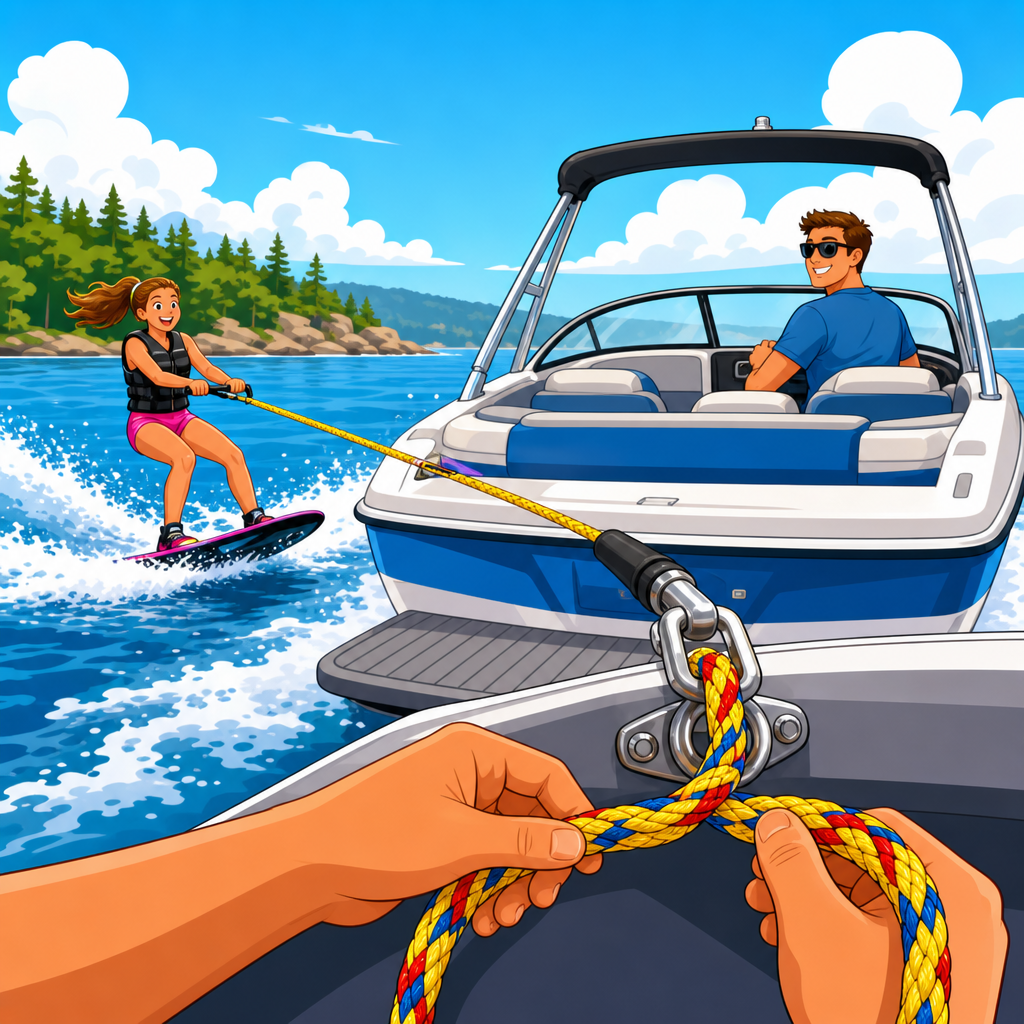
Once you have the right rope, attach it with a clean, manufacturer-intended connection. If your boat has a tow eye, thread the loop or clip exactly as directed and confirm that any gate or carabiner-style connector is fully closed. If you are using a bridle for tubing behind a boat with twin tow eyes, secure each side evenly so the center pulley or connector rides freely and shares the load. Keep the line clear of outdrives, jet nozzles, transducers, trim tabs, and boarding ladders. On an outboard or sterndrive boat, I always route the line with the engine centered and check that nothing can sweep into the prop during a restart or turn.
Before launch, stretch the rope straight in the water and remove twists, knots, and loops. Knots reduce strength significantly because they create stress concentrations and uneven loading. Confirm that the handle is undamaged, the end caps are secure, and any protective tubing at connection points is intact. The rider should wear a U.S. Coast Guard-approved life jacket suitable for tow sports, and the boat should have an observer if required by law. Many states require either a dedicated spotter or a wide-angle mirror; the National Association of State Boating Law Administrators highlights observer requirements and other towing rules that vary by state.
Use clear hand signals before the engine goes into gear. Riders need a standard thumbs-up for faster, thumbs-down for slower, hand across the throat to stop, and directional signals if the group uses them. Drivers should accelerate smoothly rather than hammering the throttle, especially with skiers in a deep-water start or children on a tube. A clean launch reduces rope shock, keeps the rider centered, and lowers the chance of a sudden snap or awkward fall. Good towing is not dramatic. It looks steady, measured, and boring in the best possible way.
Drive, Communicate, and Manage Rope Tension on the Water
Using a tow rope well is as much about driving as rigging. The driver’s job is to maintain a steady path and speed appropriate for the sport and rider. Recreational waterskiing often falls around 20 to 30 mph depending on skier size and skill, while beginner wakeboarders may ride closer to 15 to 20 mph. Tubing speeds are usually lower for children and moderate for adults, but speed alone does not define intensity. Turn radius, wake crossing, and boat size can multiply forces quickly. I have seen a tube feel tame at 16 mph in a straight line and aggressive at the same speed when the driver swings wide around repeated turns.
Rope tension should stay consistent. Sudden throttle changes create slack and snap-back, which can yank a handle from a rider’s hands or jerk a tube unpredictably. If a rider falls, reduce throttle promptly, keep the person in sight, and circle back according to safe local practice, always approaching with the rider on the driver’s side when possible for better visibility. Put the engine in neutral while the rope is being recovered near the stern. Propeller awareness is nonnegotiable.
Communication matters throughout the set. Ask riders what they want before each run: slower deep-water starts, wider turns, shorter line sections, or calmer water. Children and first-time riders often need reassurance more than speed. Experienced wakeboarders may want exact rope length changes of five feet to find the cleanest wake transition. By treating rope setup as a performance adjustment rather than a fixed accessory, you get better sessions and fewer incidents.
Inspect, Store, and Replace Tow Ropes Before They Fail
Tow ropes wear out gradually, then fail suddenly. Regular inspection prevents that surprise. After each day on the water, rinse the rope and handle with fresh water, especially after saltwater use. Salt crystals, sand, and sunscreen residue can accelerate abrasion and degrade grip surfaces. Lay the rope out and look for fuzzy sections, flat spots, discoloration, cuts, melted fibers, and stiffness near splices or loops. Check handle stitching, foam or EVA grip condition, end caps, and any molded connectors. If a tube rope has overloaded and stretched unevenly, retire it even if it has not snapped.
Storage affects lifespan more than many owners realize. UV exposure weakens synthetic fibers over time, and wet ropes stored in sealed compartments can mildew or develop persistent odor. Dry the rope loosely, then coil it without hard kinks and store it in a ventilated rope bag. Keep it away from fuel, battery acid, and sharp hardware. Do not use a tow rope for docking, anchoring, or trailering. Cross-use introduces hidden damage and contamination that only shows up later under load.
Replacement intervals depend on use, but heavy weekend towing can justify annual evaluation of high-load ropes, especially tube lines and beginner ski ropes that take repeated shock starts. Premium brands such as HO Sports, Hyperlite, O’Brien, Airhead, and Radar publish ratings and intended use clearly; follow those specifications rather than relying on appearance alone. When in doubt, replace early. A new rope costs far less than an injury, damaged towable, or lost day on the water.
Know the Safety Rules, Limits, and Gear That Complete the System
A tow rope is only one part of safe water sports equipment. The complete system includes approved life jackets, a legal observer setup, a boarding plan, engine cutoff awareness, and boat capacity compliance. The U.S. Coast Guard Boating Safety guidance and state boating agencies consistently emphasize that operators must know local age restrictions, observer laws, hours for towing, and distance requirements from swimmers, docks, and shorelines. Many jurisdictions prohibit towing after sunset. Some waters restrict towing near congested channels or environmentally sensitive areas.
Equipment compatibility matters too. A towable tube should have a quick-connect rated by the manufacturer, not a generic clip. A wake tower should have rated hardware and proper backing, not aftermarket parts added without considering load paths. Ski mirrors help on boats where an observer is still allowed but visibility needs improvement. Gloves can help barefoot or training-line users, but bulky gloves may reduce handle feel for wakeboarding. Every addition should solve a defined problem.
The biggest takeaway is that learning how to attach and use a tow rope for water sports is really about building a dependable towing system. Start with an approved tow point, choose a rope designed for the specific sport, match length and handle to the rider, and use disciplined launch, driving, and recovery habits. Inspect gear often, store it correctly, and retire it before damage becomes failure. When boaters treat the rope as serious safety equipment instead of an afterthought, water sports become smoother, safer, and more enjoyable for everyone on board. Review your boat’s manual, inspect your current setup, and upgrade any weak link before your next day on the water.
Frequently Asked Questions
How do you properly attach a tow rope to a boat for water sports?
To properly attach a tow rope, always start by connecting it to a designated tow point that is specifically rated for towing riders. On most boats, this may be a tow pylon, ski eye, or approved tow tower. On a personal watercraft, it should be the manufacturer-approved tow attachment point. Never tie a tow rope to cleats, handrails, seats, or other hardware that is not designed to handle the repeated pulling forces created during acceleration, turning, and rider movement. A tow rope is a load-bearing safety component, so using the correct anchor point is essential for both performance and safety.
Before attaching the rope, inspect the hardware and the rope itself. Look for fraying, cuts, worn loops, damaged handles, stretched fibers, or weak stitching. If the rope uses a looped end, place it securely over the tow point exactly as the manufacturer instructs. If a quick-connect or bridle system is used, confirm that all clips and connection points are locked and compatible with the towing setup. The connection should be snug, centered, and free from twists. A poorly attached rope can affect tracking, increase stress on the line, and raise the chance of failure under load.
Once attached, lay the rope out carefully behind the boat so it is straight and clear of the propeller, intake, and passengers. Never allow loose rope to remain near the motor or inside the boat where it can tangle around feet or equipment. Before the rider starts, confirm that the line runs cleanly from the tow point to the handle or towable without knots or wraps. Good attachment is not just about securing the rope; it also includes making sure the entire line is positioned for smooth, predictable towing.
What type of tow rope should you use for skiing, wakeboarding, tubing, or other water sports?
The right tow rope depends on the activity, the rider’s skill level, and the towing vessel. Different water sports place different demands on the rope. For water skiing, ropes are typically designed to be relatively low-stretch so the skier gets a direct pull and predictable response. Wakeboarding ropes are also commonly low-stretch, helping riders maintain consistent line tension for edging and tricks. Tubing ropes, on the other hand, are built to handle heavy and shifting loads from one or more riders and are usually labeled according to the number of riders and maximum towing capacity. Kneeboard and beginner recreational ropes may offer a balance of comfort, visibility, and ease of handling.
Material matters because it affects stretch, durability, and feel. Polypropylene ropes float, which is helpful for visibility and propeller safety, and they are common in many recreational towing applications. Spectra and Dyneema blends are often used in higher-performance ropes because they offer very low stretch and strong tensile strength. Rope length also affects the ride. A shorter line can change the rider’s position in relation to the boat wake, while longer lines may provide a smoother path or more room depending on the sport. The wrong length or material can make starts harder, reduce control, or create inconsistent pull.
It is also important to use a rope that is specifically labeled for towing people on the water. General utility rope, dock line, climbing rope, or bungee-style rope should never be substituted. These products are not designed for the dynamic loads and safety demands of water sports. Check the manufacturer’s capacity rating, recommended use, and compatibility with the boat and equipment. Choosing the correct rope improves acceleration, rider comfort, handling, and overall safety, while an incorrect rope can increase fatigue, instability, and the chance of equipment failure.
Why is tow rope length and tension important when towing a rider?
Tow rope length and tension have a major influence on how the ride feels and how safely the rider can perform. Length determines where the rider sits relative to the boat’s wake, turbulence, and turning radius. In sports like wakeboarding and skiing, small changes in line length can affect control, edging, wake crossing, and how smoothly the rider is pulled. For tubing, rope length can influence how sharply the tube reacts outside the wake and how much whip or swing the riders experience. A line that is too short or too long for the activity can make the ride less stable and less predictable.
Tension is equally important because it controls the transfer of force from the boat to the rider. A properly tensioned rope delivers a smooth pull during starts and while underway. Excessive slack can create sudden jerks when the rope tightens, which may cause a rider to lose balance, experience discomfort, or be pulled in an unsafe manner. Constant jerking also puts extra stress on the rope, handle, tow point, and rider. Smooth throttle control from the driver and correct rope handling from the crew help maintain more consistent tension and reduce shock loading.
In practical use, rope management means matching the setup to the rider and the sport, then driving in a steady, controlled way. Beginners often benefit from a stable, moderate setup that allows gentle starts and predictable line tension. More advanced riders may prefer specific lengths to place them at a certain point on the wake. Regardless of skill level, the goal is the same: a rope that runs straight, stays appropriately tensioned, and delivers controlled force rather than abrupt impact. That combination improves comfort, performance, and safety on the water.
What safety checks should you do before using a tow rope for water sports?
Before every session, inspect the rope from end to end. Look closely for frayed strands, abrasions, discoloration from UV exposure, flattened sections, melted fibers, loose stitching, worn loops, and damage around the handle or connectors. Any weakness in the rope can worsen quickly once load is applied. Also inspect the tow point on the boat or personal watercraft for corrosion, cracks, looseness, or signs that it has been overloaded in the past. If any part of the rope or hardware appears compromised, replace it before towing anyone.
Next, verify that the rope is appropriate for the activity and rider. Make sure the line is rated for water sports towing and, if applicable, for the number of riders on the tube or towable. Confirm the handle is secure and comfortable, and that any bridle or quick-connect system is installed correctly. The rope should be free of knots unless the manufacturer specifically allows them, because knots can significantly reduce rope strength. It should also be dry enough to handle safely and organized so it can be deployed without tangling.
Beyond the rope itself, complete a full towing safety check. Ensure there is a spotter if required by local law, establish clear hand signals with the rider, and confirm everyone is wearing appropriate life jackets or personal flotation devices. Check that the area is clear of swimmers, docks, shallow hazards, and other boats. Make sure the rope is fully clear of the propeller before starting. These checks may seem routine, but they are one of the best ways to prevent sudden equipment problems, unsafe starts, and on-water accidents.
How should you handle, store, and maintain a tow rope to keep it safe and durable?
Proper tow rope care begins as soon as the ride ends. Bring the rope into the boat carefully and avoid letting it drift near the propeller or become wrapped around hands, arms, or gear. Rinse the rope with fresh water after use, especially if it has been exposed to salt water, muddy water, or heavy algae. Contaminants can degrade fibers over time and make the rope harder to inspect. After rinsing, allow it to dry thoroughly before long-term storage to reduce mildew, odor, and material breakdown.
Storage conditions matter more than many people realize. Keep the rope loosely coiled in a clean, dry, shaded area away from direct sunlight, fuel, oils, and sharp objects. Extended UV exposure can weaken certain rope materials, while chemical contact can damage fibers and handles. Avoid stuffing the rope into a tight compartment while wet, and do not store heavy equipment on top of it. Organized storage helps the rope deploy cleanly on the next outing and reduces the chance of hidden kinks, twists, or wear points.
Maintenance also means knowing when a rope has reached the end of its service life. Even if it still appears usable, a rope that has become stiff, badly faded, rough, stretched, or repeatedly shock-loaded may no longer perform safely. Retire any rope with visible structural damage or uncertain history. Replacing a worn tow rope is far less costly than dealing with a failure on the water. When handled correctly, cleaned regularly, and inspected often, a tow rope can provide reliable performance while helping protect both the rider and the towing crew.