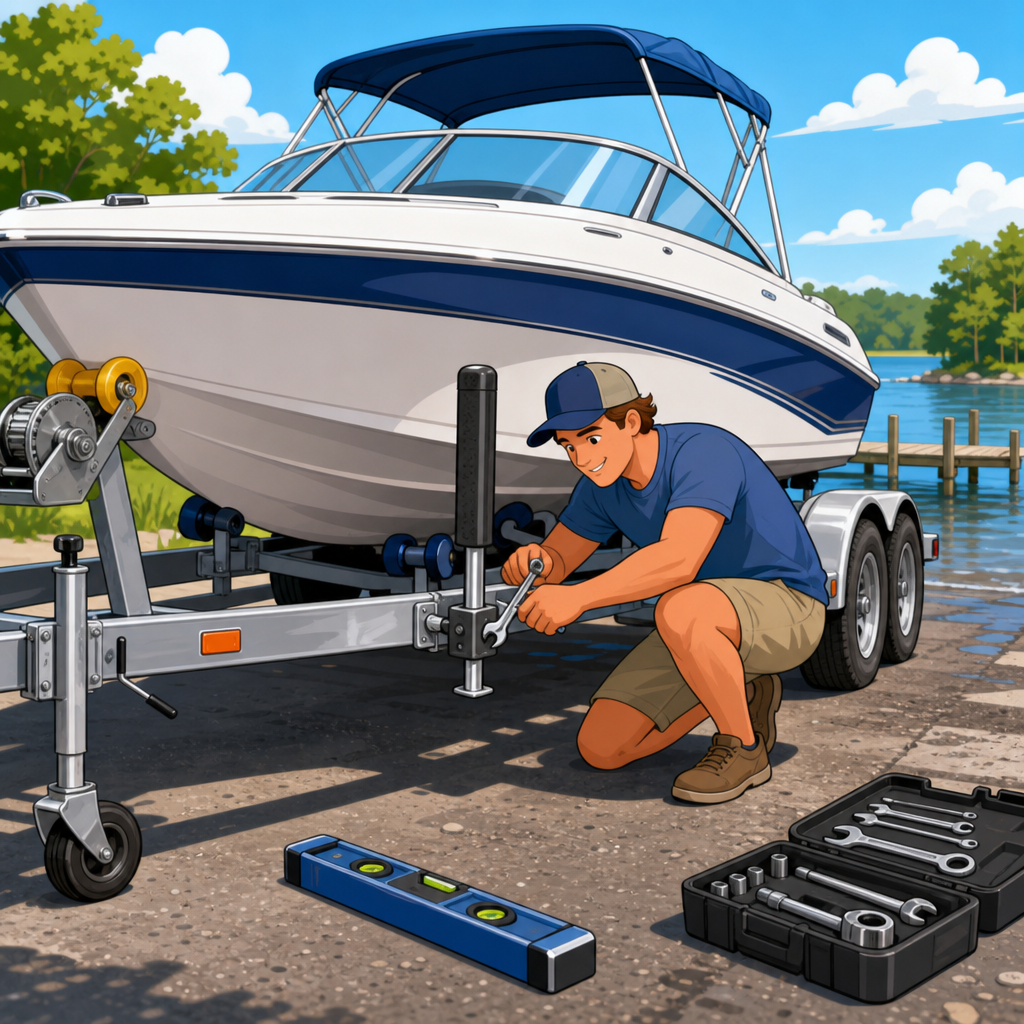
A properly balanced boat trailer tracks straight, brakes predictably, and protects both your boat and tow vehicle from avoidable stress. In practical terms, adjusting and balancing a boat trailer means setting tongue weight, axle position, bunks or rollers, winch stand placement, tire pressure, brake function, and load distribution so the trailer carries the hull evenly and remains stable at highway speed. This matters because an unstable trailer can sway, overload the hitch, wear tires unevenly, damage the hull, and turn a routine ramp run into a dangerous towing event.
As the hub page for boat trailers and towing equipment, this guide explains the core principles every boat owner should understand before drilling new holes, moving an axle, or assuming sway is just a wind problem. I have adjusted single-axle skiff trailers, tandem-axle bunk trailers for fiberglass center consoles, and roller trailers for heavier deep-V hulls, and the pattern is always the same: when the trailer geometry matches the boat and the load is centered correctly, towing becomes dramatically calmer. When it does not, no premium hitch, sway bar, or oversized truck fully compensates.
Boat trailer balance starts with a few key terms. Tongue weight is the downward force the coupler applies to the hitch ball. Gross trailer weight is the total weight of trailer, boat, engine, fuel, batteries, gear, and water trapped in bilges or livewells. Gross Vehicle Weight Rating, or GVWR, is the trailer’s maximum allowed loaded weight. Axle rating, tire load index, bunk placement, brake capacity, and coupler rating all have to support that real-world load, not a dry brochure number. For most conventional bumper-pull trailers, a tongue weight of roughly 7 to 10 percent of total trailer weight is the reliable starting target, with many towing setups feeling best near 8 to 9 percent.
This article also serves as a comprehensive entry point to the broader subject of boat trailers and towing equipment. If you are researching trailer sizing, bunks versus rollers, trailer brakes, wheel bearings, trailer tires, tie-down systems, guide-ons, winches, lighting, hubs, jack selection, or pre-trip inspections, those decisions all connect back to balance. A trailer can have excellent hardware and still tow poorly if the center of mass sits too far aft, the bunks load the hull unevenly, or one side carries more weight than the other. Good balance is the foundation that lets every other towing component do its job.
Start With Ratings, Measurements, and a Real Loaded Weight
The first step is not moving parts blindly; it is verifying numbers. Read the trailer VIN label and note GVWR, axle rating, tire size, recommended cold inflation pressure, and brake specification. Then compare those limits with the actual loaded rig. The number that matters is not the manufacturer’s dry boat weight. Add the outboard or sterndrive, fuel, batteries, anchors, coolers, trolling motor, safety kit, and any gear stored in compartments. Water held in ballast spaces, ski lockers, or a wet bilge also counts. I have seen “light” fishing boats gain several hundred pounds over listed dry weight once rigged for a weekend.
The best method is to weigh the full setup on a certified scale. Record total trailer weight, tow vehicle axle loads if possible, and tongue weight using a tongue scale or a public scale procedure. These measurements show whether the problem is true imbalance or simple overloading. For example, a 4,000-pound loaded trailer should usually carry around 280 to 400 pounds on the tongue. If tongue weight is only 150 pounds, the trailer will often feel light at the hitch and begin to sway after bumps, crosswinds, or steering corrections. If tongue weight is 600 pounds, rear suspension sag and poor steering response are more likely.
Do not ignore side-to-side balance. Boats often carry batteries, chargers, water tanks, and gear asymmetrically. On single-axle trailers, side imbalance can show up as one tire running hotter or wearing faster. On tandem trailers, it may cause one side to scrub during turns and stress springs or equalizers unevenly. A quick check with individual wheel scales is ideal, but even visual clues matter: one fender sitting lower, one bunk carrying more contact, or one tire shoulder wearing excessively usually points to uneven load distribution.
How to Set Tongue Weight for Stable Towing
Tongue weight is the single most important stability setting on a boat trailer because it governs how firmly the trailer follows the tow vehicle. Too little tongue weight shifts the center of mass rearward relative to the axle group, making the trailer easier to yaw. That yaw can build into sway. Too much tongue weight pushes excessive load onto the hitch and rear axle of the tow vehicle, which can reduce front axle traction and lengthen stopping distances. Stability is a balancing act, not a maximum-number game.
In the shop and at the ramp, I approach tongue weight methodically. First, load the boat exactly as it will travel: full typical fuel, batteries installed, anchors aboard, and gear secured. Then measure tongue weight on level ground with the trailer coupler at normal towing height. If the reading is below target, move the boat slightly forward on the trailer, move cargo forward if safe and practical, or as a last resort reposition the axle group rearward. If the tongue weight is too high, do the opposite in small increments. Usually, moving the boat an inch or two makes a noticeable difference, especially on shorter single-axle trailers.
A common mistake is trying to fix poor balance with cargo placement alone. Shifting a cooler or tackle bag helps only at the margins. The primary relationship is between the hull’s center of gravity and the axle centerline. On many trailers, the winch stand and bow stop are easier to adjust than the axle assembly, so start there if the boat can safely move without compromising transom support or bunk alignment. The bow eye should seat firmly against the bow stop under strap tension, but not because the boat is forced unnaturally far forward just to chase a number.
| Loaded Trailer Weight | Typical Tongue Weight Range | Common Symptoms if Too Light | Common Symptoms if Too Heavy |
|---|---|---|---|
| 2,000 lb | 140 to 200 lb | Sway after bumps, wandering, light hitch feel | Rear sag, harsh ride, reduced steering feel |
| 3,500 lb | 245 to 350 lb | Crosswind instability, trailer steering the vehicle | Overloaded receiver, nose-down tow vehicle stance |
| 5,000 lb | 350 to 500 lb | Persistent sway, poor emergency handling | Brake dive, front axle unloading, hitch stress |
Adjust Axles, Bunks, and Winch Stand Without Creating New Problems
Once you know the target, make structural adjustments carefully. Moving the axle assembly changes tongue weight more dramatically than moving loose gear, but it also changes fender clearance, bunk relationship, brake line routing, and sometimes step or guide-on position. On leaf-spring trailers, axle location must remain square to the frame. Measure from the coupler to each spindle end or use fixed frame reference points on both sides. Even a small skew can cause dog-tracking, tire scrub, and persistent pull. Tandem axles add another layer because equalizer geometry must remain correct for balanced load sharing.
Bunk placement matters just as much as axle position because the bunks determine how the hull is supported. On fiberglass boats, bunks should contact strong longitudinal areas of the hull, often near strakes or manufacturer-recommended support zones, without point-loading unsupported panels. If bunks are too narrow, too low, or twisted, the boat can sit off-center and transfer weight unevenly. On aluminum hulls, support under ribs or reinforced areas is especially important. I always loosen bunk brackets enough to let the carpeted surfaces self-seat against the hull, then tighten evenly after confirming full contact.
The winch stand sets final fore-aft position and bow restraint. Adjust it so the bow eye aligns naturally with the winch strap and the bow stop contacts the boat squarely. If the strap pulls downward at a steep angle or the bow stop contacts only an edge, the stand is wrong. That misalignment can encourage the boat to settle differently each time you load it, which changes tongue weight trip to trip. Also check transom support. The boat should not hang excessively behind the aft bunk or rear roller. Unsupported overhang increases frame leverage and can stress the hull on rough roads.
Roller trailers require extra attention. Their low friction makes launching easy, but it also means the hull can shift more readily during loading and braking if the winch, safety chain, or bow stop arrangement is poor. Rollers must turn freely and contact the hull evenly. Frozen rollers create point loads and let the boat rest on fewer support points than intended. Whether you use bunks or rollers, recheck all fasteners with a torque wrench after adjustment and again after the first few trips, because fresh movement in brackets and U-bolts is common.
Match Tires, Brakes, Hitch Height, and Towing Equipment to the Trailer
Balance is not only about where the boat sits. The trailer also has to run level and on properly matched equipment. Start with tires. Use trailer-designated tires in the correct load range, and inflate them to the pressure listed on the sidewall or trailer placard as appropriate for the application. Underinflation creates heat, softens sidewalls, and worsens sway. Passenger-car tires are not a substitute because trailer tires are built with stiffer sidewalls for lateral stability. Check date codes as well; many trailer tire failures come from age and UV exposure more than tread wear.
Hitch height is another overlooked variable. A trailer that tows nose-high often loses tongue weight effect and can overload the rear axle set on tandem trailers. Nose-low attitude may increase tongue weight and alter braking behavior. Measure frame height front and rear on level ground and adjust ball mount drop or rise so the trailer sits level when coupled and loaded. This is especially important after changing tow vehicles, adding suspension helpers, or switching tire sizes on the truck or SUV.
Brake setup must match loaded trailer mass and the environments where you tow. Many jurisdictions require brakes above certain weight thresholds, but legal minimums are not the same as best practice. Surge brakes are common on boat trailers because they work well around water and avoid in-cab electronics, while electric-over-hydraulic systems offer stronger control for heavier rigs. Either way, brakes should apply smoothly, release fully, and share load evenly across axles. If one rotor runs much hotter than another after a drive, investigate calipers, lines, actuator function, and bearing drag before towing again.
Other towing equipment supports stability rather than replacing it. A correctly rated coupler, hitch ball of the right diameter, safety chains crossed under the tongue, breakaway system where required, and transom tie-downs in good condition are non-negotiable. Weight-distribution hitches are uncommon on many boat trailers because of surge brake compatibility and launch-angle considerations, but on some heavy setups with suitable hardware they can help restore tow vehicle balance. The key point is simple: use accessories to refine a sound trailer setup, not to mask bad geometry.
Pre-Trip Inspection, On-Road Diagnostics, and Common Balance Mistakes
Even a well-adjusted boat trailer can become unstable if maintenance slips. Before each trip, inspect tire pressure, lug nut torque, coupler engagement, safety chains, lights, winch strap, safety chain at the bow eye, and transom straps. Spin each wheel if possible and listen for rough bearings or brake drag. At the ramp, make sure the boat reloads centered between guide posts and settles fully against the bow stop before you strap it down for the road. A half-inch offset at the stern can become a meaningful side-load at speed.
On the road, the trailer tells you what is wrong if you know the signs. Sway that begins around a repeatable speed often points to low tongue weight, underinflated tires, or a trailer that is slightly nose-high. A harsh, bouncy ride may indicate too much tongue weight, overinflated tires for the trailer specification, or bunks carrying the hull unevenly. One hot hub after twenty miles usually means bearing trouble or brake drag, not an aerodynamic issue. If the steering wheel feels light or the tow vehicle porpoises, stop and verify hitch load before continuing.
The most common mistakes are predictable. Owners use brochure dry weight instead of actual loaded weight. They replace old tires with the wrong load range. They load coolers and fuel aft because it is convenient. They assume the boat is centered because it looks close enough at the ramp. They tow with a mismatched ball height after changing vehicles. And they ignore the trailer after winter storage, even though tires flat-spot, brake parts corrode, and bunk hardware loosens. Boat trailer stability is rarely ruined by one dramatic failure; it is usually lost through several small compromises.
For a subtopic hub on boat trailers and towing equipment, that principle ties everything together. Wheel bearings, hubs, brakes, tires, bunks, rollers, winches, jacks, lights, guide-ons, couplers, and tie-downs are all connected by the same goal: keep the boat supported correctly and the trailer following the tow vehicle without drama. If you build your setup around measured tongue weight, actual loaded mass, correct hull support, level ride height, and disciplined inspection, the result is safer towing, less wear, and far more confidence at highway speed.
The essential takeaway is straightforward: a stable boat trailer is engineered, not guessed at. Start by confirming ratings and real loaded weight, then set tongue weight in the proper range, center the hull, support it correctly with bunks or rollers, and make sure tires, brakes, and hitch height match the job. When those fundamentals are right, sway drops, braking improves, tire life increases, and the boat arrives at the ramp with less stress on every component.
Boat trailers and towing equipment deserve the same attention owners give engines and electronics because towing is the first safety system in every trip. A few measurements and careful adjustments prevent most handling problems long before they become emergencies. Use this hub as your starting point, inspect your trailer with a critical eye, and make the next towing setup change based on numbers rather than guesswork.
Frequently Asked Questions
What is the correct tongue weight for a boat trailer, and why does it matter so much for stability?
The correct tongue weight for most boat trailers is typically about 5% to 7% of the total loaded trailer weight, although many towing setups perform best when they are closer to 7% to 10%, depending on the trailer design, boat size, and tow vehicle. Tongue weight is the downward force the coupler applies to the hitch ball, and it has a direct effect on how stable the trailer feels on the road. If the tongue weight is too light, the trailer is much more likely to sway at highway speed because there is not enough forward load keeping it tracking straight behind the tow vehicle. If it is too heavy, the rear of the tow vehicle can squat, steering can feel lighter, braking balance can suffer, and both the hitch and suspension can be overloaded.
To check it accurately, the trailer should be loaded exactly as it will be towed, including fuel, batteries, gear, and anything stored in compartments. A tongue weight scale is the most precise tool, but a commercial vehicle scale or a properly set up bathroom-scale method can also work for lighter trailers. The goal is not just hitting a number, but finding a balance where the boat sits correctly on the trailer, the tow vehicle remains level enough to steer and brake normally, and the trailer tracks predictably without fishtailing. If your trailer feels unstable, tongue weight is one of the first things to verify because even a well-built trailer will behave poorly if the weight distribution is wrong.
How do I adjust axle position or boat position on the trailer to improve balance?
Balancing a boat trailer usually comes down to moving the axle assembly, moving the boat on the trailer, or both. If the tongue weight is too low, the boat’s center of mass is likely sitting too far back relative to the axle. In that case, the boat can often be moved slightly forward by adjusting the winch stand and bow stop so the hull rests farther ahead on the bunks or rollers. On some trailers, the axle or tandem axle assembly can also be shifted rearward to increase tongue weight. If tongue weight is too high, the opposite applies: the boat may need to move slightly rearward, or the axle may need to move forward, assuming the trailer frame design allows for adjustment.
Any changes should be made in small increments and followed by re-measuring tongue weight. It is important to make sure the boat still has proper support along the hull after any shift. You never want to chase balance by positioning the boat so far forward or backward that the bunks no longer support the strongest sections of the hull. The bow should remain secure at the stop, the stern should not be hanging unsupported, and the boat should sit centered left to right. If you are working with a bunk trailer, check that the bunks contact the hull evenly after repositioning. If you are working with rollers, verify that the rollers are carrying the load where intended. The best adjustment is one that improves tongue weight and towing stability without compromising hull support, launching ease, or frame clearance.
How should bunks, rollers, and the winch stand be set up to support the boat evenly?
Bunks, rollers, and the winch stand should work together to hold the boat securely, distribute weight evenly, and prevent stress points in the hull. On a bunk trailer, the bunks should match the hull shape and make solid, even contact over a meaningful portion of the boat’s weight-bearing surfaces. They should not be pressing hard in one area while leaving gaps elsewhere. On a roller trailer, the rollers should turn freely and contact the hull where the manufacturer or trailer design intends, so the load is shared instead of concentrated on a few seized or poorly aligned rollers. In either case, the boat should sit level, centered, and fully supported, with no obvious lean to one side.
The winch stand should be positioned so the bow eye meets the winch strap at the proper angle and the bow rests firmly against the bow stop when fully loaded. If the winch stand is too far forward, the boat may not seat correctly. If it is too far back, the boat can shift during braking or leave too much load behind the axle. The winch strap should pull the boat forward into the stop, not upward at an extreme angle that changes how the hull sits on the supports. After adjusting bunks or rollers, recheck side-to-side centering, fender clearance, transom support, and how the boat launches and reloads. A trailer that is balanced on paper can still be a poor setup if the hull is twisted, pinched, or unevenly supported. Proper support protects the boat structure and is a major part of long-term towing stability.
What role do tire pressure, brakes, and load distribution play in keeping a boat trailer stable?
Tire pressure, brake condition, and load distribution are critical because trailer stability is not only about where the boat sits, but also about how the entire trailer behaves under speed, cornering, and braking. Trailer tires should be inflated to the pressure specified on the tire sidewall or according to the trailer manufacturer’s guidance for the actual load, using the same pressure side to side unless the manufacturer states otherwise. Underinflated tires build heat, flex excessively, and can contribute to sway, sluggish tracking, and rapid edge wear. Overinflation can reduce contact patch quality and create a harsher ride. Uneven tire pressure from one side to the other can also make the trailer pull or sit unevenly, which affects handling.
Brakes need to engage smoothly and evenly. If one brake is grabbing harder than the others, or if a caliper, drum, actuator, or brake line has a problem, the trailer can feel unstable when slowing down. Surge brakes and electric-over-hydraulic systems both need to be inspected for proper operation, fluid condition, response, and wear. Wheel bearings, suspension components, and alignment also matter because poor mechanical condition can mimic balance problems. Load distribution is the final piece. Batteries, coolers, anchors, fuel, and other gear should be placed intentionally, not tossed wherever they fit. Heavy gear concentrated too far aft reduces tongue weight and encourages sway. Heavy gear all on one side can create a lean, overload one tire, and produce uneven braking and tire wear. A stable trailer is the result of the whole system working together, not just one adjustment.
What are the warning signs that a boat trailer is out of balance, and how can I correct them safely?
The most common warning signs of a poorly balanced boat trailer are sway at highway speed, wandering or fishtailing behind the tow vehicle, excessive rear-end squat on the tow vehicle, steering that feels unusually light, harsh bouncing, uneven tire wear, and a trailer that seems to pull to one side. You may also notice that braking feels inconsistent, especially if the trailer pushes the tow vehicle or feels unstable during deceleration. At the launch ramp or in the driveway, a visual clue can be that the boat appears too far back, too far forward, tilted, or unsupported at the stern or chines. Sometimes the issue is also audible: tire scrub, clunking at the coupler, or suspension noises can point to poor setup or overloaded components.
To correct the problem safely, start with the basics before making major changes. Confirm the trailer and tow vehicle are both within their rated capacities. Measure tongue weight with the boat loaded as it is actually towed. Check tire pressure, tire condition, wheel bearings, brake operation, hitch height, and coupler fit. Then inspect whether the boat is centered and properly supported by bunks or rollers. If tongue weight is off, make measured adjustments by shifting gear, repositioning the boat slightly, or adjusting axle placement if the trailer is designed for it. Test changes gradually and re-measure rather than guessing. If sway occurs on the road, do not accelerate aggressively or make sudden steering inputs. Instead, hold the wheel steady, reduce speed gradually, and stop to inspect the setup. If repeated adjustments do not solve the issue, a trailer technician can verify axle placement, alignment, brake balance, and structural setup. Stability problems should be addressed immediately because they rarely improve on their own and can quickly become a serious towing hazard.