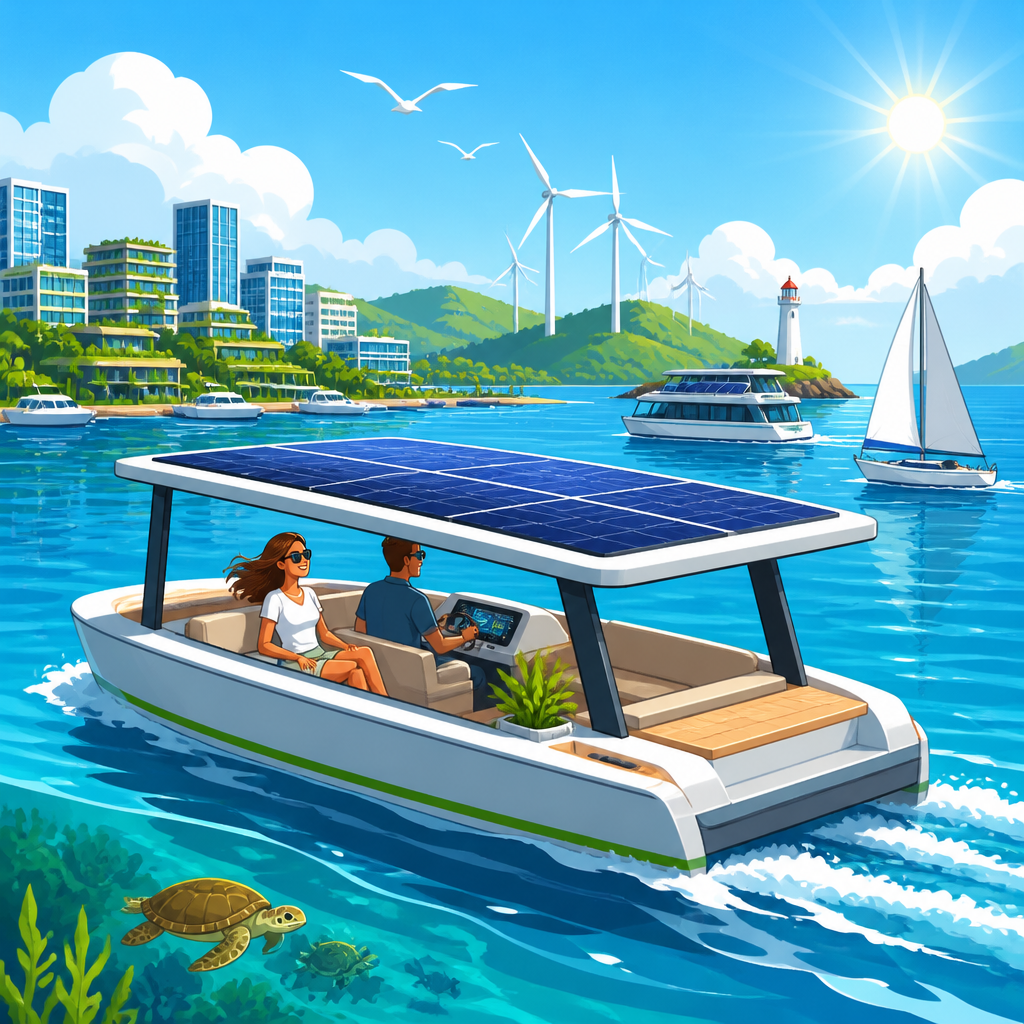
Solar-powered boats are reshaping marine transport by turning sunlight into usable propulsion energy, cutting fuel burn, noise, maintenance, and local emissions in one of the world’s most traditionally diesel-dependent industries. In practical terms, a solar-powered boat uses photovoltaic panels to generate electricity, batteries to store it, and electric motors to drive the hull through the water, either as a fully solar-electric vessel or as part of a hybrid energy system. This matters because boating sits at the intersection of recreation, tourism, fishing, ferries, inland transport, and workboats, and every one of those segments faces pressure to reduce operating costs and environmental impact. I have worked with electric propulsion refits and marina charging plans, and the same pattern appears repeatedly: once owners understand energy demand in kilowatt-hours rather than fuel liters, vessel decisions become more precise and more economical. Solar power is not a gimmick bolted onto a deck; it is an energy strategy tied to hull efficiency, battery chemistry, route planning, charging access, and regulatory trends.
Across the broader category of electric and solar-powered boats, the key distinction is between propulsion energy and onboard hotel loads. Propulsion moves the boat. Hotel loads run navigation electronics, refrigeration, lighting, pumps, air-conditioning, and communications. Solar can support both, but its greatest value depends on vessel type. On a slow displacement catamaran, a large roof area can contribute meaningfully to daily propulsion. On a high-speed planing boat, solar usually offsets auxiliary consumption and extends battery range rather than supplying full thrust. Understanding that difference is essential for buyers, operators, builders, and marina managers evaluating whether solar propulsion is practical. As battery prices have fallen, motor efficiency has improved, and hull designers have optimized low-drag platforms, solar boats have moved from niche showcase projects to commercially serious assets. Ferries in lakeside cities, sightseeing boats in protected waterways, and private cruisers built around silent anchoring all show that solar-assisted electric boating is no longer experimental. It is becoming a durable branch of modern marine design.
How solar-powered boats work in real operation
A solar-powered boat combines four systems: photovoltaic modules, a charge controller or maximum power point tracker, a battery bank, and an electric propulsion package with motor, inverter, and monitoring. The panels convert sunlight into direct current electricity. The controller optimizes voltage and safely charges the batteries. The battery bank, commonly lithium iron phosphate in newer builds, stores energy for use when sunlight drops or power demand rises. The motor converts electrical energy into shaft power, often with far less wasted energy than an internal combustion engine. In many marine applications, total drivetrain efficiency from battery to propeller exceeds 80 percent, while small gasoline systems lose far more energy as heat, vibration, and exhaust. That efficiency changes operating economics immediately.
The real-world performance of solar propulsion depends first on boat speed and hull type. Water resistance rises sharply with speed, so slow and efficient hulls benefit most. A canal cruiser moving at six knots might need only a modest continuous power draw, making roof-mounted solar genuinely useful during cruising hours. By contrast, a planing runabout at twenty-five knots may demand many times more power than its roof can harvest, so shore charging does the heavy lifting and solar becomes a supplemental source. This is why many successful solar boats are catamarans, ferries, barges, and displacement cruisers. Their beam creates panel area, their hull form reduces drag, and their routes are predictable enough to match solar production and charging windows with daily use.
Operators also need to understand energy budgeting. If a vessel uses 40 kilowatt-hours on a daily excursion and its array can produce 10 to 15 kilowatt-hours in favorable conditions, solar is not replacing the battery bank; it is reducing shore power demand, preserving reserve range, and supporting hotel loads. That still has measurable value. On charter boats, for example, refrigeration, induction cooking, and overnight lighting can otherwise force generator use. Solar reduces that dependency and improves guest experience through silence. Good system design therefore starts with a load analysis, then aligns panel area, battery capacity, propeller sizing, and cruising profile to the intended use case. Boats that perform well on paper but ignore this basic engineering usually disappoint their owners.
Where electric and solar-powered boats make the biggest impact
The strongest market for solar-electric boating is not every boat equally; it is specific operating profiles where predictable routes, moderate speeds, and high utilization make clean energy financially sensible. Passenger ferries on lakes and urban rivers are a leading example. These boats return to base frequently, can charge on schedule, and benefit from low wake, quiet operation, and zero tailpipe emissions around dense populations. Tourism operators have adopted similar logic. Wildlife cruises, eco-lodges, and guided nature excursions gain a commercial advantage when guests can hear birds, water movement, and spoken interpretation instead of engine noise. In these settings, electric and solar-powered boats improve the product itself, not just the sustainability story.
Private cruising is another major growth area. Owners of trawlers, houseboats, and expedition catamarans increasingly want generator-free anchoring, simpler maintenance, and lower vibration. With a properly designed solar array, these boats can support navigation electronics, watermakers, refrigeration, laptops, and lighting for extended periods while preserving propulsion reserves. I have seen owners reduce generator runtime from many hours per day to near zero in summer conditions simply by combining efficient appliances with serious solar surface area and battery storage. That shift changes not only fuel consumption but also service intervals, onboard comfort, and the practical use of remote anchorages where fuel availability is limited.
Commercial workboats are progressing more cautiously, but the direction is clear. Harbor launches, patrol boats, aquaculture support craft, and small municipal service vessels are testing electric propulsion where daily duty cycles are known. The key barrier is often not technology but charging infrastructure and conservative procurement practices. Still, ports and public agencies now have stronger incentives to evaluate total cost of ownership, emissions accounting, and community noise reduction. As a result, electric and solar-assisted vessels are entering pilot fleets that would have been dismissed a decade ago.
| Use case | Why solar-electric fits | Main limitation |
|---|---|---|
| Lake or river ferry | Predictable route, regular charging, high passenger comfort | Peak demand during fast turnaround schedules |
| Tour boat | Quiet operation improves guest experience and wildlife viewing | Weather can reduce solar contribution on long excursions |
| Cruising catamaran | Large roof area and efficient hulls support hotel loads and range extension | High-speed passages still require substantial battery reserves |
| Houseboat | Large flat surfaces and low-speed use make solar highly effective | Air-conditioning can dominate energy consumption in hot climates |
| Harbor workboat | Frequent returns to dock favor charging logistics | Heavy towing or emergency duty can exceed practical battery sizing |
Economic advantages, tradeoffs, and total cost of ownership
The clearest financial case for solar-powered boats comes from total cost of ownership rather than headline purchase price. Upfront costs remain higher than comparable combustion boats because batteries, marine-grade power electronics, and certified installation add capital expense. However, running costs are often dramatically lower. Electricity is generally cheaper and more stable in price than marine gasoline or diesel on an energy-equivalent basis. Electric motors have fewer moving parts, no oil changes, no fuel polishing, no impellers in the same pattern of engine service, and fewer vibration-related failures. For fleet operators, that means less downtime and more predictable maintenance planning.
Battery life is the most discussed economic variable, and it should be analyzed with care. Modern lithium iron phosphate batteries can deliver several thousand cycles when properly managed within safe temperature and depth-of-discharge limits. For a ferry or charter operator cycling daily, that can still imply eventual replacement as a major capital event, but one that is increasingly predictable. The correct comparison is not battery cost in isolation; it is batteries versus years of fuel, engine overhauls, filter changes, exhaust system maintenance, and the opportunity cost of vessel downtime. In many inland or nearshore operations, the numbers now support electrification even before accounting for grants or green procurement incentives.
There are tradeoffs. Weight distribution matters more with battery banks than many new buyers expect, and poor placement can hurt trim or service access. Charging speed depends on marina electrical capacity, which is uneven across regions. Insurance, survey, and compliance processes also require competent documentation. Standards from bodies such as ABYC and classification rules from organizations like DNV or Lloyd’s Register matter because marine electrical systems operate in corrosive, vibration-heavy environments. Cheap components and undocumented installations create real safety risks. Owners who treat a solar-electric boat as a systems-engineering project, not a gadget purchase, achieve better reliability and stronger resale value.
Design trends driving the next generation of solar boats
Several design trends are accelerating adoption. The first is integrated naval architecture. Early electric boats often looked like conventional hulls with batteries added. Newer vessels are designed around energy efficiency from the start, using lightweight composite structures, reduced drag appendages, and propellers optimized for electric torque curves. The second trend is smarter energy management. Modern displays let captains monitor solar harvest, motor draw, battery state of charge, and remaining range in real time, turning energy use into an operational discipline rather than guesswork. The third is modularity. Builders increasingly offer standardized battery racks, motor packages, and rooftop solar sections that simplify service and future upgrades.
Panel technology is improving too, though not as dramatically as marketing sometimes suggests. Marine designers still depend primarily on durable, high-quality crystalline modules because reliability and real output matter more than novelty. Flexible panels can be useful on curved surfaces, but they often trade efficiency, longevity, or heat management for easier installation. Battery chemistry choices are also maturing. Lithium iron phosphate has become common because of its thermal stability, cycle life, and suitability for repeated marine use, though higher-energy chemistries may appear in specialized applications where weight is critical. Meanwhile, charging ecosystems are expanding. Marinas are adding higher-capacity pedestals, and some ports are pairing dockside charging with solar canopies and battery storage to manage grid demand.
Another important trend is hybridization. Not every boat will be fully solar-electric in the near term, and that is acceptable. Serial hybrids, generator-assisted electric systems, and plug-in architectures can cut fuel burn substantially while preserving range for demanding routes. In practice, hybrid systems often serve as transitional platforms that help operators gain confidence in electric propulsion and collect real duty-cycle data. Once usage patterns are measured accurately, later vessel generations can move toward greater battery reliance and larger solar contribution with less risk.
What buyers, builders, and marinas should do now
Anyone evaluating electric and solar-powered boats should begin with mission clarity. Define average speed, daily distance, payload, overnight loads, charging availability, and acceptable reserve margins. Those inputs determine whether a boat should be fully electric, solar-assisted, or hybrid. Buyers should ask builders for an energy model in kilowatt-hours per day and kilowatts at cruising speed, not vague range claims. Builders should document battery protection, cable sizing, ventilation, ingress protection, and emergency isolation. Marinas should assess transformer capacity, pedestal upgrades, fire response planning, and billing systems that support higher electrical use transparently.
It also helps to separate realistic expectations from marketing simplifications. Solar alone rarely powers fast boats continuously, but it can transform slow and moderate-speed vessels, dramatically reduce generator dependence, and lower operating costs across many use cases. Range anxiety is best managed through route planning, live energy monitoring, and conservative reserve policies, the same way responsible mariners already manage weather, fuel, and tides. Procurement decisions should include crew training as well. Captains and technicians who understand charging windows, battery health, and efficient speed selection get better results than teams handed new technology without operational guidance.
For readers exploring the wider eco-friendly and sustainable boating landscape, this hub topic connects naturally to battery maintenance, shore power infrastructure, electric outboards, hybrid propulsion, sustainable marina design, and lifecycle emissions analysis. Solar-powered boats are changing the industry because they align environmental goals with quieter operation, lower maintenance, and increasingly credible economics. The benefit is not abstract. It shows up in cleaner waterways, calmer onboard experiences, and business models less exposed to fuel volatility. If you are planning a new build, a retrofit, or a marina upgrade, start with a serious energy audit and use it to map the right electric or solar-powered boating path.
Frequently Asked Questions
1. How do solar-powered boats actually work?
Solar-powered boats convert sunlight into propulsion energy through a straightforward but highly effective system. Photovoltaic panels mounted on the boat capture solar energy and turn it into electricity. That electricity is either sent directly to the electric motor for immediate use or stored in onboard battery banks for later operation. The motor then drives the propeller or propulsion system, moving the vessel without relying solely on diesel fuel. In many designs, advanced energy management systems constantly balance solar input, battery charge levels, motor demand, and onboard electrical loads to maximize efficiency throughout the day.
There are several configurations in use across the industry. Some vessels are fully solar-electric, meaning propulsion comes entirely from energy generated by solar panels and stored in batteries. Others use hybrid systems that combine solar with shore power charging, backup generators, or even conventional engines for extended range and operational flexibility. This is especially useful for ferries, tour boats, leisure craft, and workboats that operate on predictable routes or spend long periods in sunny conditions. The result is a cleaner, quieter, and increasingly practical alternative to traditional marine propulsion.
2. Why are solar-powered boats considered such a major shift for the marine industry?
Solar-powered boats represent a major shift because they challenge one of the marine sector’s longest-standing assumptions: that dependable propulsion must come from burning fuel. For decades, much of the boating and commercial marine world has relied heavily on diesel engines, which are effective but noisy, maintenance-intensive, and associated with both greenhouse gas emissions and local waterway pollution. Solar propulsion offers a fundamentally different model by using renewable energy to reduce or even eliminate fuel consumption during operation.
This matters at both the vessel level and the industry level. Individual boat owners and operators can lower fuel costs, reduce engine wear, and simplify maintenance schedules because electric drivetrains have fewer moving parts than combustion engines. On a broader scale, marinas, ferry systems, tourism operators, and municipal fleets can use solar-electric or hybrid boats to meet tightening environmental regulations and sustainability targets. The technology also improves the onboard experience by reducing vibration and engine noise, which is especially valuable in ecologically sensitive areas, nature tourism, passenger transport, and premium recreational boating. Taken together, these advantages are why solar-powered boats are not just a niche innovation, but a meaningful step toward a more efficient and lower-emission marine economy.
3. What are the biggest benefits of solar-powered boats compared with traditional diesel boats?
The biggest advantage is reduced fuel use. Because solar-powered boats generate electricity from sunlight, they can dramatically cut the amount of diesel or gasoline needed for propulsion, and some vessels can avoid liquid fuel entirely for routine trips. This lowers operating costs over time, especially where fuel prices are high or routes are repetitive and predictable. In commercial settings, even partial fuel reduction can make a real financial difference across an entire fleet.
Another major benefit is lower maintenance. Electric motors generally require less routine service than internal combustion engines because they have fewer moving parts, no oil changes, and less mechanical complexity. That can translate into less downtime, fewer repairs, and a longer service life for key propulsion components. Noise reduction is also a major selling point. Solar-electric boats operate much more quietly than diesel-powered vessels, which improves passenger comfort and reduces disturbance to marine wildlife and waterfront communities.
Environmental performance is equally important. Solar-powered boats produce little to no local exhaust emissions while underway, helping improve air quality around harbors, lakes, rivers, and coastal zones. They also reduce the risk of fuel spills and lessen dependence on fossil fuels. For operators focused on sustainability, public image, or compliance with emerging clean-transport policies, these are significant advantages. In short, solar-powered boats combine operational savings, user comfort, and environmental responsibility in a way traditional propulsion systems struggle to match.
4. Are solar-powered boats practical for commercial and everyday use?
Yes, in the right applications they are already proving practical, and their usefulness continues to expand as solar, battery, and electric motor technologies improve. Solar-powered boats are particularly well suited for operations with defined routes, moderate speeds, and predictable energy demands. Examples include passenger ferries, canal boats, eco-tour vessels, marina shuttles, research craft, and private leisure boats. These use cases often allow operators to take advantage of daylight charging, overnight battery charging at the dock, and efficient trip planning that aligns well with electric propulsion.
That said, practicality depends on the mission profile. A small recreational boat cruising on inland waters has very different energy needs than a high-speed offshore vessel or a heavy cargo ship operating long distances without stopping. Solar alone may not yet be enough for every marine application, especially where high continuous power or long-range endurance is required. In those cases, hybrid systems can bridge the gap by combining solar generation with battery storage and supplemental power sources. This flexible approach helps more operators adopt cleaner technology without sacrificing reliability.
As infrastructure improves and battery energy density continues to rise, solar-powered boats are likely to become practical for an even wider range of uses. What is clear today is that they are no longer just experimental concepts. They are already being used in real-world transport, tourism, and utility roles, demonstrating that solar-assisted marine propulsion can be both functional and commercially relevant.
5. What challenges are still limiting the wider adoption of solar-powered boats?
The biggest limitation is energy availability. Boats require power not only to move through the water but also to support onboard systems, and solar panels can generate only a finite amount of electricity based on available surface area, weather conditions, and sunlight intensity. That means solar-powered vessels must be designed very carefully for efficiency, including hull shape, weight, cruising speed, and route profile. On larger or faster vessels, energy demand can outpace what onboard solar panels alone can realistically supply.
Battery capacity and charging infrastructure are also important factors. Although battery technology has improved substantially, marine batteries still add cost and weight, and charging access can vary widely by region and marina. Initial purchase prices for solar-electric boats may be higher than those of conventional boats as well, even if long-term operating costs are lower. For some buyers and fleet operators, that upfront investment remains a hurdle.
There are also operational and market challenges. Boat owners may be unfamiliar with electric propulsion systems, and some marine sectors are naturally cautious about adopting new technologies until reliability is proven over time. In addition, not every boating environment provides ideal solar conditions year-round. Even so, these challenges are increasingly manageable. Better batteries, smarter power management, lighter materials, and more efficient hull designs are steadily improving performance and return on investment. As a result, the barriers to adoption are shrinking, and solar-powered boats are becoming a more realistic option across a growing portion of the industry.