Oil spill response boats are specialized work and utility boats designed to contain, recover, and support cleanup of petroleum releases before they spread through sensitive waterways. In practice, they are the frontline vessels I look for whenever a marina, port authority, pipeline operator, or offshore facility needs a fast, controlled answer to a spill. They matter because oil moves quickly, adheres to shorelines and wildlife, disrupts fisheries, and creates costly long-tail damage that can persist long after the visible sheen disappears. As a sub-pillar within the broader types of boats category, this hub explains what oil spill response boats do, how they are built, where they fit among work and utility boats, and why they remain one of the most important environmental protection tools on the water.
Within the work and utility boats segment, oil spill response boats sit alongside tugboats, pilot boats, patrol craft, research vessels, dredgers, and firefighting boats. What separates them is mission design. A response boat is not simply a fast hull with storage space. It integrates spill detection, boom deployment, skimming, temporary storage, towing, maneuverability at low speed, and deck layouts that support hazardous operations. Key terms help clarify the field. Containment boom is the floating barrier used to corral oil. A skimmer is the device that removes oil from the water surface. Temporary storage may be onboard tanks or inflatable barges. Dispersants, sorbents, and decanting systems can also be part of the toolkit, depending on regulations and spill conditions.
The reason this topic deserves a hub article is that many readers ask the same practical questions: What is an oil spill response boat, how does it work, what kinds exist, and when is each type used? Those questions are not academic. The answer determines procurement decisions, emergency planning, crew training, and environmental outcomes. During drills and vessel reviews, I have seen the difference between a purpose-built response craft and a general utility boat fitted with spill gear. Purpose-built boats deploy boom faster, hold station more effectively in current, and support safer deck workflows. In a narrow harbor, those details can mean containing a diesel spill inside a basin instead of letting it drift toward wetlands, intakes, or beaches.
Environmental protection is the core objective, but the operational context is broad. Response boats work in ports, rivers, estuaries, nearshore waters, offshore fields, inland terminals, and industrial waterfronts. They support government agencies, commercial spill response organizations, coast guards, salvage companies, and energy operators. Some boats are trailerable and used for small harbor incidents. Others are large catamarans or multipurpose utility vessels equipped for offshore recovery. The best fleets are planned around risk: fuel transfer zones, tanker routes, current patterns, local habitat, and expected weather. Understanding oil spill response boats therefore gives buyers and planners a practical lens into the wider world of work and utility boats.
What Oil Spill Response Boats Do During an Incident
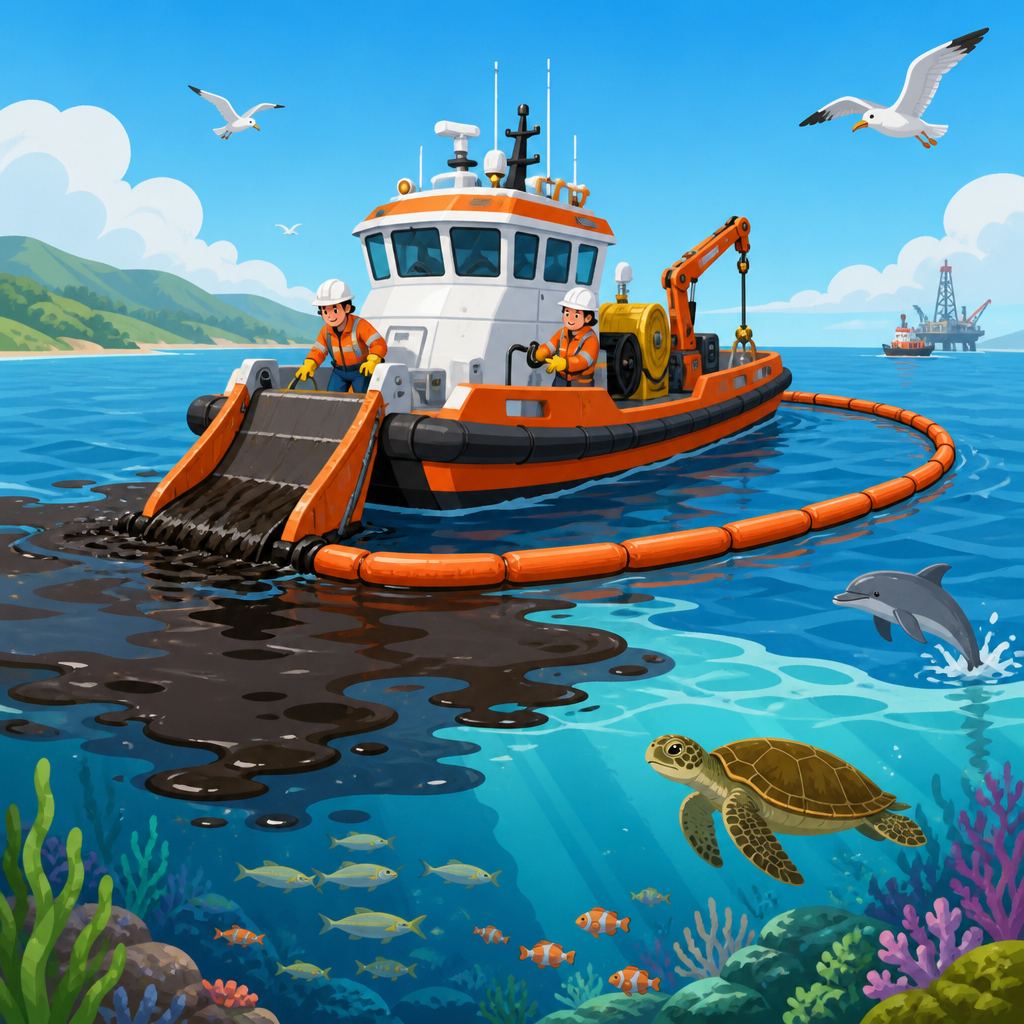
An oil spill response boat protects the environment by enabling the first three priorities of spill control: locate the release, contain its spread, and recover as much product as possible before it disperses naturally or reaches shore. The boat carries trained crews and acts as a mobile platform for boom reels, skimmers, pumps, tow posts, cranes, storage tanks, and communications equipment. In a small marina spill, one boat may tow boom around the source while another positions absorbent boom near storm drains and seawalls. In a larger harbor release, several boats may create exclusion zones, tow sweeping arms, and feed recovered oil into barges or portable tanks.
Speed matters, but maneuverability matters more. Most cleanup work happens at low speeds where precise station keeping is critical. Boats need enough thrust and control authority to deploy boom without fouling propellers, maintain tow geometry in current, and work close to piers, pilings, or rocky shoreline. That is why many response craft use waterjets, protected propellers, twin screws, bow thrusters, or catamaran hulls with stable working decks. The environmental benefit is direct: if boom can be placed correctly in the first hour, the overall footprint of contamination is usually much smaller, which reduces wildlife exposure and cuts shoreline remediation costs later.
Response boats also support the command structure around an incident. They may carry surveillance teams, sample collection gear, drones, side-scan sonar support, or thermal cameras used to map thick oil. They shuttle personnel, establish safe work zones, tow floating storage bladders, and transport anchors used in shoreline protection strategies. Under standards such as the Incident Command System and response planning rules enforced in many jurisdictions, the vessel becomes one integrated node in a larger operation that includes onshore command, logistics, waste handling, and wildlife rehabilitation. That systems role is one reason these boats belong firmly within the work and utility boats category rather than recreational or general service craft.
Main Types of Oil Spill Response Boats Within Work and Utility Boats
Not every oil spill response boat is built the same, because spills differ by product type, sea state, water depth, and operating area. Harbor response boats are often compact aluminum workboats optimized for rapid launch and close-quarters handling. They may carry reel-mounted containment boom, a small skimmer, hydraulic power packs, and deck space for sorbents. Nearshore response vessels are larger and more seaworthy, commonly with enclosed wheelhouses, greater fuel endurance, and heavier cranes. Offshore recovery vessels may be purpose-built with sweeping systems, integrated storage tanks, high-capacity skimmers, and dynamic positioning support for extended operations far from port.
Another distinction is between dedicated response boats and multipurpose utility boats. Dedicated boats are designed around spill operations from the keel up, which improves workflow and payload management. Multipurpose boats may alternate between patrol, firefighting, line handling, and spill response. They are common where budgets are limited or where ports need flexible assets. I have seen well-designed multipurpose catamarans perform admirably, especially when equipment is pre-rigged and crews drill often. Still, compromise is real. A deck cluttered by non-response equipment slows deployment, and a hull chosen primarily for speed may be less stable during skimming operations.
| Boat type | Typical operating area | Primary strengths | Main limitation |
|---|---|---|---|
| Trailerable harbor response boat | Marinas, rivers, small ports | Fast launch, low draft, close-quarters control | Limited storage and rough-water capability |
| Nearshore utility response vessel | Harbors, estuaries, coastal waters | Good endurance, deck space, towing capacity | Higher operating cost than small craft |
| Offshore recovery vessel | Open water, terminals, offshore fields | Large skimming systems and storage capacity | Needs significant crew and logistics support |
| Multipurpose spill/fire/patrol boat | Industrial ports, municipal fleets | Versatile asset for varied missions | Performance tradeoffs during specialized recovery work |
These categories link naturally to the wider hub of work and utility boats. Readers comparing oil spill response boats should also understand related vessel classes such as patrol boats, firefighting boats, tugboats, and research vessels, because many operators build mixed fleets. A port may use a patrol craft for detection, a tug for tow support, and a dedicated response catamaran for recovery. Seeing the ecosystem of boats together leads to better planning than evaluating one hull in isolation.
Core Equipment and Design Features That Drive Performance
The most effective oil spill response boats are defined by systems, not just hull shape. Deck arrangement is fundamental. Crews need clear pathways, tie-down points, nonskid surfaces, protected hydraulic lines, and enough beam for safe boom handling. A stern roller or side handling frame can simplify deployment, while cranes or A-frames assist with skimmers and anchors. Storage must separate clean gear from contaminated gear. Freeboard affects whether crews can work the waterline safely and whether skimming heads maintain efficient contact with oil.
Skimmer choice influences boat design. Weir skimmers remove floating liquid by allowing oil to flow over a lip into a sump, making them useful in calm conditions with thicker product. Oleophilic drum, disk, or brush skimmers use materials that attract oil and repel water, improving selectivity in many conditions. Suction systems can be effective for pooled product in protected areas. Each method has tradeoffs in throughput, emulsification, debris tolerance, and water content. Boats intended for diverse scenarios often carry modular skimming packages so crews can match equipment to the product and environment.
Power and control systems are equally important. Hydraulic packs drive reels, winches, and skimmers. Modern response boats may integrate joystick controls, electronic engine monitoring, AIS, radar, thermal imaging, and differential GPS for precise positioning. In shallow or debris-laden water, waterjets reduce fouling risk and improve maneuverability, though they can be less efficient than propellers at some duty cycles. Catamaran hulls are common because they provide stability and deck area, while monohulls may offer simpler construction and favorable performance in certain sea states. Material choice usually favors marine-grade aluminum for corrosion resistance, repairability, and weight savings.
Safety features protect both crew and environment. Explosion-proof electrical components may be required around volatile products. Fire suppression, vapor monitoring, recovery tank venting, and decontamination washdown points reduce operational risk. Lighting matters because many incidents happen at night or in poor weather. Good boatbuilders also think about maintainability: access to pumps, hose routing, corrosion control, and spare parts standardization. In my experience, maintainability is often overlooked during procurement, yet it determines whether a boat is actually ready when an incident happens six months later.
How These Boats Prevent Environmental Damage in Real Conditions
The environmental value of an oil spill response boat is measured in prevented spread. Oil on open water quickly fragments under wind, waves, and current. Light fuels can evaporate, but they also create toxic exposure for fish, shellfish, and birds in the short term. Heavy oils persist longer, smother habitat, coat shorelines, and are much harder to remove once stranded. A response boat interrupts that trajectory. By surrounding a leaking vessel with boom, towing a skimmer into the thickest patch, or protecting a marsh entrance before contamination arrives, the crew buys time and reduces ecological contact.
Consider a diesel spill at a commercial fishing harbor. Without a quick marine response, slicks can drift beneath docks, contaminate hulls, and enter adjacent tidal flats. With two small response boats, crews can establish a U-shaped boom, recover the concentrated product with an oleophilic skimmer, and place absorbents at culverts. Cleanup remains localized, businesses reopen sooner, and bird exposure stays limited. In a larger scenario, such as a bunker fuel release near a container terminal, response boats may stage protective booming around mangroves, seawater intakes, or aquaculture pens while larger vessels recover product offshore. The same principle applies: containment close to the source is almost always more effective than chasing oil after it spreads.
These boats also reduce collateral damage from cleanup itself. Shoreline remediation is labor intensive and can disturb habitat if heavy machinery or intrusive methods are used. Mechanical recovery on the water, when feasible, is generally preferable because it removes oil before it strands. Response boats allow that earlier intervention. They also support targeted tactics that respect sensitive areas, such as exclusion booming around bird roosts or low-wake approaches near marsh edges. Environmental protection is therefore not only about recovering oil; it is about choosing the least damaging operational pathway.
Training, Regulations, and Fleet Planning for Reliable Response
A capable boat without trained crew is only potential. Effective spill response depends on repeated drills in local conditions, clear maintenance procedures, and regulatory alignment. Operators typically train on boom deployment geometry, anchor setting, skimmer troubleshooting, communications protocols, personal protective equipment, and contamination control. In many regions, planning follows national contingency frameworks and standards set by coast guards, environmental agencies, or maritime authorities. Vessel owners involved in oil transfer may also be subject to response plan requirements that specify time to scene, available equipment, and contracted response resources.
Fleet planning should begin with risk assessment rather than catalog shopping. Start with credible worst-case discharge scenarios, product types handled, tide and current patterns, shoreline sensitivity, and access constraints such as bridges or shallow flats. Then match boats to tactics. A refinery on a sheltered river may need shallow-draft utility response boats with strong towing ability. An offshore terminal may require larger vessels with integrated storage and all-weather endurance. Ports often benefit from layered capability: one fast assessment craft, one primary response vessel, and supporting utility boats. This hub-and-spoke view mirrors how successful workboat fleets are built across patrol, firefighting, salvage, and environmental operations.
Procurement decisions should emphasize lifecycle value. Ask how quickly the boat can be mobilized, whether skimming gear is modular, what the contamination cleaning process looks like, and how spare hydraulic components are sourced. Confirm compatibility with local trailers, davits, docks, and fuel systems. Review class, stability data, and emissions compliance where applicable. Most importantly, require on-water demonstrations. I trust performance proven in current and crosswind more than brochure claims. A response boat earns its place by making difficult, messy work safer and faster when the water is moving and the clock is running.
Oil spill response boats are essential work and utility boats because they convert emergency planning into practical environmental protection. They contain slicks, recover floating oil, support incident coordination, and protect shorelines, wildlife, fisheries, and infrastructure from wider contamination. The best boats are purpose matched: small harbor craft for rapid local action, nearshore utility vessels for versatile port work, and offshore recovery platforms for large-scale incidents. Their performance depends on integrated design, including boom handling, skimming systems, stable decks, precise maneuvering, safety features, and maintainable machinery.
For readers using this page as a hub within the work and utility boats topic, the main lesson is simple: spill response success comes from matching vessel type, equipment, and crew training to real operating risk. Oil spill response boats do not work alone, but they are the central marine asset that makes containment and recovery possible in the crucial early hours. If you are evaluating boat types for a port, industrial waterfront, or emergency fleet, use this article as your starting point, then map your local hazards and compare the related workboat categories that support a complete response system.
Frequently Asked Questions
What does an oil spill response boat do during an emergency?
An oil spill response boat is built to act fast when petroleum is released into the water. Its primary job is to help contain the spill before wind, current, and tide spread it into a much larger environmental problem. In the earliest stage of a response, these boats are often used to assess the size and movement of the slick, establish safety zones, and deploy containment booms to keep oil away from shorelines, marinas, wetlands, intake systems, and wildlife habitat. That rapid first action is critical because oil can travel surprisingly quickly and become much harder to recover once it disperses.
Beyond containment, many response boats are equipped to support active recovery operations. Depending on the vessel and the spill conditions, crews may use skimmers, pumps, storage tanks, vacuum systems, or towing gear to remove oil from the water’s surface. Some boats also serve as command, transport, or support platforms for cleanup personnel, equipment, and shoreline teams. In other words, these vessels are not just “boats at the scene”; they are specialized working platforms designed to help responders control the situation, reduce environmental exposure, and make the overall cleanup more effective and organized.
How do oil spill response boats help protect the environment?
Oil spill response boats protect the environment by stopping pollution from spreading into the most sensitive and difficult-to-clean areas. When oil reaches marshes, estuaries, beaches, shellfish beds, or mangroves, the damage can last for years and become extremely expensive to remediate. Response boats give cleanup teams a practical way to intercept the spill on open water, where containment and recovery are usually more manageable. By placing booms strategically and beginning recovery early, these vessels help reduce the amount of oil that reaches habitats where birds, fish, marine mammals, and aquatic vegetation are most vulnerable.
They also help limit secondary impacts that many people do not immediately think about. A spill can disrupt fisheries, recreational boating, tourism, shipping operations, and industrial water use, all while creating ongoing risks to wildlife and shorelines. Response boats support a more controlled cleanup, which means less oil has the chance to sink, emulsify, or break apart into harder-to-capture contamination. The environmental benefit is not only in visible removal; it is in reducing the long-tail damage that can persist after the initial spill event. Fast, well-coordinated vessel response can make the difference between a localized incident and a much broader ecological and economic crisis.
What features make oil spill response boats different from standard workboats?
Oil spill response boats are different from general-purpose workboats because they are designed specifically for pollution control, recovery support, and safe operation in contaminated conditions. While a standard workboat may be useful for transport or towing, a response boat is typically configured with equipment and deck layouts that support boom deployment, skimming operations, equipment storage, and rapid crew movement during a spill. Many are built with open working decks, reinforced towing points, shallow-draft or highly maneuverable hulls, and power systems sized for the demands of cleanup gear and long operational periods.
Another major difference is how these boats are optimized for mission flexibility. Some are intended for harbors and inland waterways, where tight maneuvering and quick launch capability matter most. Others are built for offshore use, where sea conditions, endurance, and equipment capacity become more important. Depending on the application, the vessel may include crane systems, hydraulic power packs, onboard tanks, fire suppression support, navigation electronics, communications gear, and pollution-response tool storage. The best response boats are designed around real operational needs: getting to the spill quickly, working safely around oil, and supporting multiple containment and recovery tasks without delay.
Who typically uses oil spill response boats, and why are they important for ports and industrial operators?
Oil spill response boats are commonly used by port authorities, marinas, terminals, pipeline operators, offshore energy facilities, environmental response contractors, and government agencies responsible for marine safety and pollution control. Any organization that stores, transfers, transports, or operates around petroleum products on the water has a strong reason to maintain access to these vessels. Spills can happen during fueling, cargo handling, pipeline incidents, vessel collisions, equipment failures, or storm-related disruptions, so having a dedicated marine response capability is often a core part of environmental preparedness.
For ports and industrial operators, the importance goes beyond regulatory compliance. A spill can shut down operations, trigger costly cleanup obligations, damage public trust, and create liability that extends long after the immediate event. Response boats help these organizations act quickly, show operational control, and reduce the likelihood that a small incident becomes a major interruption. They are especially valuable in busy waterways where petroleum can spread into neighboring docks, commercial routes, fisheries, and public shorelines. In that setting, the right response vessel is not just an environmental asset; it is a practical tool for business continuity, risk management, and responsible stewardship of the waterway.
Can oil spill response boats completely stop environmental damage after a spill?
Oil spill response boats are extremely important, but they are not a guarantee that all environmental damage can be prevented. Their effectiveness depends on how quickly they are deployed, the type and volume of oil released, water and weather conditions, visibility, currents, and how close the spill is to sensitive resources. In ideal conditions, a fast response can contain and recover a significant amount of oil before it spreads widely. In more difficult conditions, such as rough seas, strong winds, or delayed reporting, even highly capable vessels may face limits in how much product can be captured on the water.
That said, their role is still one of the most important parts of spill mitigation. Even when complete prevention of impact is not possible, response boats can substantially reduce the scale of contamination and improve the overall outcome. They help direct the spill away from vulnerable areas, support coordinated cleanup operations, and buy critical time for additional personnel and equipment to arrive. The real value of these vessels is not in promising perfection; it is in dramatically improving the speed, control, and effectiveness of the response. In environmental protection, reducing spread early often has lasting benefits, and oil spill response boats are central to making that happen.