Hybrid boats combine a conventional marine engine with an electric propulsion system, giving owners a practical way to cut fuel use, lower emissions, and reduce noise without sacrificing the range and reliability that boaters still expect. In simple terms, a hybrid boat uses two power sources that can work separately or together: typically a diesel or gasoline engine for sustained cruising and battery-powered electric motors for low-speed running, harbor maneuvers, or quiet operation in sensitive waters. In the wider “Types of Boats” landscape, hybrid boats sit at the center of the eco-friendly and electric boats category because they bridge the gap between traditional combustion craft and fully electric vessels. That makes this subject especially important for buyers, marina operators, charter fleets, and policymakers trying to balance performance, operating cost, and environmental impact.
I have worked with boat owners comparing repower options, yard managers assessing battery room layouts, and operators trying to meet stricter local emissions rules, and the same question comes up repeatedly: are hybrid boats a real solution or just a transitional technology? The answer is that they are already a real, technically proven solution in the right use cases. Ferries in Scandinavia, canal boats in Europe, hybrid yachts in the Mediterranean, and research vessels in protected coastal zones use hybrid architectures today because electric torque is immediate, batteries can handle intermittent loads well, and combustion engines can be run more efficiently when they are not forced to do every task. Hybridization is not a gimmick. It is a marine engineering response to a clear operational problem.
Why does that matter now? Shipping and recreational boating are under growing pressure to reduce greenhouse gas emissions, underwater noise, and local air pollution such as nitrogen oxides and particulate matter. At the same time, fuel costs remain volatile, battery energy density is improving, and ports are gradually expanding shore power infrastructure. For many boaters, a fully electric boat still has limits tied to range, charging access, payload, and speed. Hybrid boats matter because they address those limits while delivering immediate benefits. They can let a yacht leave a marina silently at dawn, allow a tour boat to enter an urban clean-air zone compliantly, and help commercial operators smooth load demand so engines spend more time in efficient operating bands. As a hub within eco-friendly and electric boats, this guide explains how hybrid boats work, which systems are used, where they perform best, and how to evaluate whether the technology fits a vessel’s mission.
What a Hybrid Boat Is and How the Main Systems Work
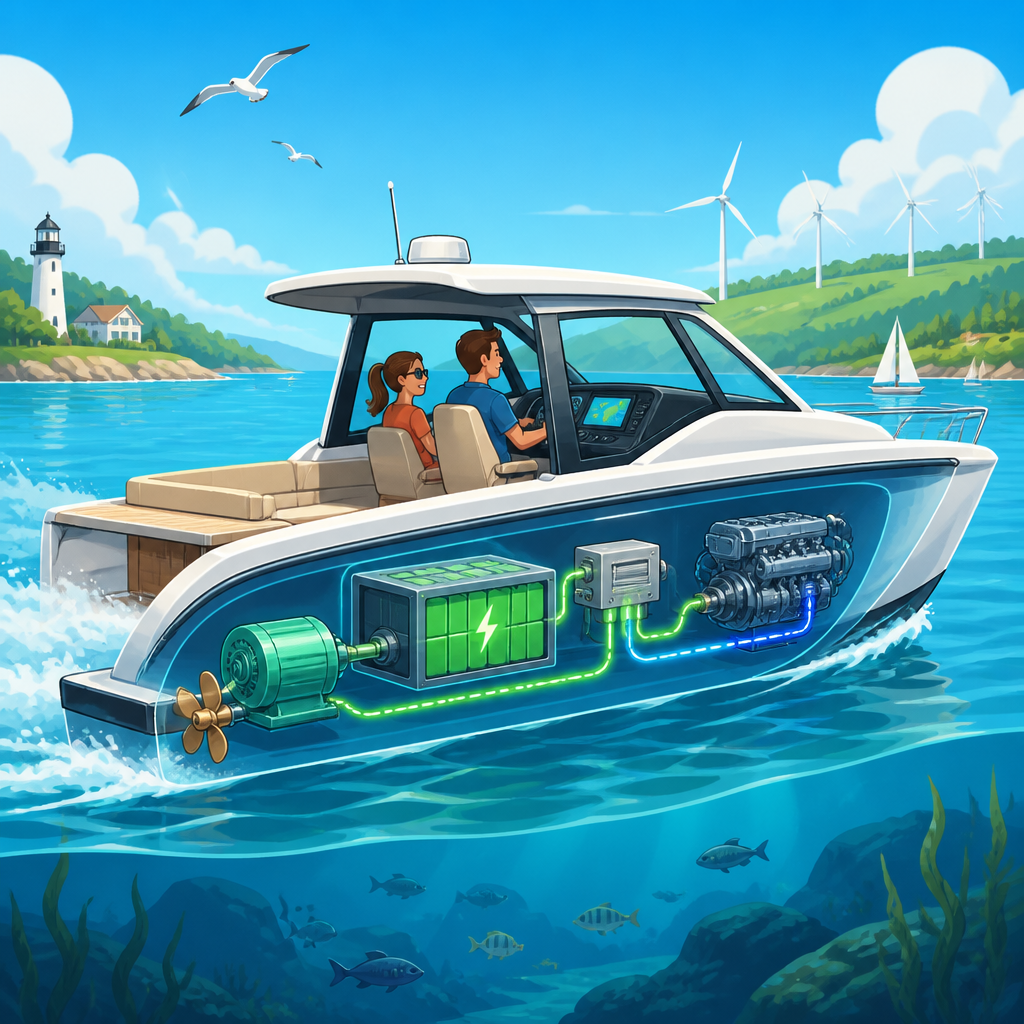
A hybrid boat is any vessel that integrates internal combustion propulsion with electric propulsion or electric-assist power management. The two most common architectures are parallel hybrid and serial hybrid. In a parallel hybrid boat, both the engine and the electric motor can drive the propeller shaft, either independently or together. This is common in leisure craft and some workboats because it preserves familiar driveline layouts. In a serial hybrid boat, the combustion engine does not directly turn the propeller. Instead, it powers a generator that supplies electricity to propulsion motors and onboard systems. Serial arrangements are often used in ferries, research boats, and vessels with highly variable load profiles because they simplify energy management and can improve engine efficiency.
The core components are straightforward but must be carefully integrated. A hybrid propulsion package typically includes an engine, an electric motor or motor-generator, a reduction gear or transmission, a high-voltage battery bank, a battery management system, inverters, DC-DC converters, control software, cooling loops, and shore charging equipment. Safety hardware matters just as much as propulsion hardware. Proper isolation monitoring, thermal management, cable routing, fire suppression, and ventilation are not optional in marine battery installations. Standards from organizations such as ABYC, DNV, Lloyd’s Register, and IEC shape how systems are designed, installed, and certified, especially for lithium-ion batteries.
From the helm, operation can be simpler than many buyers assume. Most modern systems automatically switch among electric mode, engine mode, boost mode, and charging mode based on throttle demand and battery state of charge. In electric mode, the boat runs from battery power alone, which is ideal for marina maneuvering, wildlife viewing, canal transit, or short day cruising. In engine mode, the combustion engine provides direct propulsion or supplies generator power. In boost mode, the engine and electric motor work together for acceleration or heavy sea conditions. Some boats also regenerate limited energy under sail or while decelerating, although marine regeneration is usually modest compared with road vehicles because propeller and hull conditions limit how much energy can be recovered efficiently.
Types of Hybrid Boats and Where They Fit Best
Hybrid technology is not tied to one hull style. It appears in sailboats, trawlers, catamarans, ferries, patrol craft, canal boats, expedition yachts, and passenger excursion vessels. The best fit depends on duty cycle, not trend value. Boats that spend significant time at low speed, idle frequently, or operate near shore benefit most because electric propulsion is especially efficient and useful in those conditions. A displacement or semi-displacement hull running predictably at moderate speed will usually gain more from hybridization than a planing sport boat that spends most of its life at high throttle settings, where battery draw rises quickly and the combustion engine still carries the load.
In recreational boating, hybrid trawlers and catamarans have emerged as especially sensible categories. Owners of passagemakers often value quiet overnight anchorage support, reduced generator runtime, and efficient slow cruising. Sailing catamarans can use electric propulsion for docking, short transits, and hotel loads, while the diesel side preserves offshore redundancy. In commercial use, ferries are among the clearest success stories because their routes, dwell times, and energy demand are predictable. That predictability makes battery sizing, charging schedules, and return on investment much easier to model than in loosely planned recreational use.
| Boat Type | Typical Hybrid Benefit | Best Use Case | Main Limitation |
|---|---|---|---|
| Harbor ferry | Major fuel and emissions reduction | Short fixed routes with shore charging | High upfront infrastructure cost |
| Trawler yacht | Quiet low-speed cruising and hotel load support | Coastal passagemaking | Added system complexity |
| Sailing catamaran | Silent maneuvering and auxiliary redundancy | Marina access and short motoring legs | Limited electric-only range offshore |
| Canal or tour boat | Near-silent urban and protected-water operation | Low-speed all-day service | Battery replacement planning |
| Patrol or research vessel | Low acoustic signature and flexible power management | Sensitive survey or enforcement work | Specialized integration requirements |
Real-world examples underline the pattern. Northern European passenger ferries have adopted battery-heavy hybrid and plug-in hybrid systems because fixed routes let operators charge at each terminal. In the leisure market, builders such as Greenline, Silent Yachts, and several custom yards have shown that owners will pay for silent operation if the system is intuitive and reliable. The lesson is simple: hybrid boats are strongest when the mission profile is known and the owner values more than top speed alone.
Environmental and Practical Benefits That Make Hybrid Boats Matter
The biggest reason hybrid boats matter is that they can reduce fuel burn immediately without waiting for every marina, battery chemistry, or hull platform to be reinvented. When a vessel uses electric power for docking, no-wake zones, inland waterways, and low-speed sightseeing, its engine runs fewer hours and spends less time idling inefficiently. That cuts carbon dioxide output directly because less fuel is burned. It also reduces local pollutants. In ports and enclosed waterways, lower nitrogen oxide, sulfur oxide, and particulate emissions have public health value, especially where commercial and passenger boats operate daily near dense urban populations.
Noise reduction is another major benefit, and it is often underestimated by buyers focused only on fuel savings. Electric motors are not silent, but they are dramatically quieter than diesel engines at low speed. That improves the onboard experience and can matter operationally in wildlife reserves, lakes with noise restrictions, and research missions where acoustic disturbance affects observations. I have seen owners become interested in hybrid systems for environmental reasons and then commit after experiencing how different a quiet departure from the dock feels in practice. Comfort is not a minor feature. It is one of the strongest adoption drivers in the premium market.
Hybrid boats also improve energy resilience onboard. A properly designed battery bank can support hotel loads, stabilizer spikes, bow thrusters, and overnight anchoring without requiring a generator to cycle constantly. That can reduce maintenance on gensets and engines because fewer hours are accumulated. There are caveats: battery systems add weight, require thermal controls, and eventually need replacement. But the practical benefit of flexible onboard energy management is real. For charter fleets and commercial operators, that flexibility can become a scheduling advantage because shore charging overnight may cost less than running auxiliary diesel generation for the same electrical demand.
Costs, Maintenance, Charging, and the Tradeoffs Buyers Need to Understand
Hybrid boats are not automatically cheaper to own, and the economics depend heavily on use. Upfront cost is usually the biggest barrier. Batteries, power electronics, system integration, certification work, and shore charging hardware can add substantial capital cost compared with a standard diesel installation. In smaller recreational boats, the payback period may be long if the boat is used only occasionally. In commercial service with high annual hours, the numbers often work much better because fuel savings, reduced engine wear, and compliance benefits accumulate quickly. A buyer should always model annual engine hours, average speed, idle time, hotel loads, local fuel prices, and charging availability before deciding.
Maintenance shifts rather than disappears. Electric motors generally require less routine service than combustion engines, but hybrid systems introduce new maintenance categories: battery health monitoring, software diagnostics, cooling circuit checks, high-voltage inspection, and periodic updates from the propulsion manufacturer. Good dealer support matters. So does spare-parts availability. A well-established marine supplier with a service network is usually a safer choice than a novel system with limited field support, even if the brochure specifications look similar. In marine environments, corrosion protection, ingress ratings, and fault isolation deserve as much attention as motor output.
Charging strategy is central to owner satisfaction. Plug-in hybrid boats can deliver the greatest operational savings when shore power is reliable and sized appropriately. Without regular charging, a plug-in hybrid may behave mostly like a conventional boat carrying expensive batteries. AC charging can be sufficient for overnight replenishment in many leisure applications, while commercial operators may need faster DC charging at terminals. Battery chemistry also matters. Lithium iron phosphate is popular for marine energy storage because of its thermal stability and cycle life, though exact suitability depends on system design, class requirements, and manufacturer integration.
Weight and space are the unavoidable tradeoffs. Batteries are still far less energy-dense than liquid fuels. Installing them can affect trim, payload, storage volume, and service access. That is why naval architecture and lifecycle planning matter from the start. A good hybrid boat is not just a standard hull with batteries added wherever they fit. The installation must account for structural support, cooling, cable runs, emergency access, and future replacement. Buyers who understand those tradeoffs are more likely to choose a system that performs as promised rather than one that looks impressive on paper.
How to Evaluate a Hybrid Boat and Where the Market Is Heading
The best way to evaluate a hybrid boat is to begin with the mission profile. Ask how far the boat travels on a typical day, how often it returns to shore power, what speed it maintains most of the time, and how much onboard electrical demand it carries beyond propulsion. Then examine system architecture, usable battery capacity rather than headline capacity, continuous motor output rather than peak output, and the boat’s expected electric-only range at realistic speeds. Sea trials should include low-speed maneuvering, transition between modes, noise levels, software response, and charging workflow. A serious buyer should also ask about battery warranty terms, thermal derating behavior, replacement cost, and remote diagnostics capability.
This hub article should also guide readers deeper into the eco-friendly and electric boats space. Closely related topics include fully electric boats, electric outboards, solar-assisted boats, hydrogen and fuel-cell vessels, shore power systems, marine battery technologies, and sustainable marina infrastructure. Understanding hybrid boats makes those adjacent topics easier to compare because hybrids reveal the core design tension in modern boating: balancing energy density, charging access, operating profile, and environmental performance. That is why hybrid propulsion is such a useful reference point within the broader types of boats conversation.
Looking ahead, hybrid boats will remain important even as fully electric marine technology improves. Battery costs have generally trended down over the long term, software control is getting better, and ports are investing more in electrification. But combustion engines will not disappear from all marine segments soon, especially where long range, heavy loads, or weak charging networks persist. Hybrid systems therefore have a durable role as both a bridge and a destination technology. They let many operators make meaningful environmental gains now, using proven engineering and real operational data rather than waiting for a perfect future solution.
Hybrid boats matter because they turn sustainability from an abstract goal into an operational choice boaters can use today. They work by pairing electric propulsion with conventional power so each system handles the jobs it does best: quiet, efficient low-speed running from batteries and dependable long-range cruising from fuel. For ferries, tour boats, trawlers, sailing cats, and research craft, that combination can reduce emissions, cut noise, improve onboard comfort, and create more flexible energy management. The tradeoffs are real—higher purchase price, added complexity, charging requirements, and battery lifecycle planning—but they are manageable when the boat is matched to the right duty cycle.
As the eco-friendly and electric boats hub within the broader types of boats category, this topic deserves close attention from anyone buying, operating, or specifying a modern vessel. Hybrid propulsion is no longer experimental. It is a practical marine option shaped by standards, service networks, and measurable operating results. If you are comparing greener boat technologies, start by mapping your actual usage, then evaluate whether a hybrid system fits your range, speed, and charging reality. That process will lead to better decisions and a more efficient boat.
Frequently Asked Questions
What is a hybrid boat, and how does it actually work?
A hybrid boat is a vessel that uses two propulsion systems: a conventional internal combustion engine, usually diesel or gasoline, and an electric motor powered by batteries. The core idea is simple: each power source is used where it makes the most sense. The electric side handles low-speed operation, marina maneuvering, idle-speed cruising, and other situations where quiet, smooth, low-emission performance is especially valuable. The combustion engine takes over for higher-speed travel, longer passages, and situations where sustained power and maximum range are important.
In many designs, the systems can operate independently or together. For example, a boater may leave the dock under electric power, cruise quietly through a no-wake zone, and then switch to the engine once clear of the harbor. Some hybrid boats also use the combustion engine to help recharge the battery bank while underway, while others can recharge from shore power when docked. More advanced systems may include energy management software, regenerative charging in certain configurations, and automated mode switching that optimizes efficiency based on speed, load, and battery state. The result is a more flexible propulsion setup that blends traditional reliability with the advantages of electric operation.
Why do hybrid boats matter for fuel savings and emissions reduction?
Hybrid boats matter because they directly address two of the biggest concerns in modern boating: fuel consumption and environmental impact. Traditional marine engines are often least efficient during low-speed running, idling, and frequent stop-and-go maneuvering. Those are exactly the conditions where electric propulsion performs well. By using battery power for docking, canal cruising, short-distance operation, or extended slow-speed travel, hybrid boats can significantly reduce the amount of fuel burned during the parts of a trip that would otherwise be inefficient.
That fuel reduction translates into lower emissions, including carbon dioxide and localized exhaust pollutants. This is particularly important in harbors, lakes, inland waterways, and environmentally sensitive coastal areas where air quality, noise, and waterway stewardship are increasingly important. Hybrid systems also reduce engine hours, which can lower wear and maintenance demands over time. While the exact savings depend on vessel size, hull type, usage patterns, and the design of the hybrid system, the broader benefit is clear: hybrid boats offer a practical path to cleaner boating without requiring owners to give up the cruising range and confidence that conventional engines still provide.
Are hybrid boats as reliable and practical as conventional boats?
For many owners, yes. One of the strongest advantages of a hybrid boat is that it preserves the dependability of a conventional engine while adding the flexibility of electric propulsion. If the batteries are low or the trip requires more distance than electric power alone can comfortably support, the combustion engine provides the familiar range and refueling convenience boaters expect. That makes hybrid technology especially attractive to people who want better efficiency and quieter operation but are not ready to rely entirely on battery-electric propulsion.
In practical use, hybrid boats are often well suited for day cruising, coastal passages, harbor operation, and mixed-use boating. They can deliver a more comfortable onboard experience with less vibration and less engine noise at low speeds. At the same time, their complexity is higher than that of a purely conventional boat, because owners are dealing with batteries, power electronics, motor controls, and software in addition to the engine itself. Reliability depends heavily on system quality, installation standards, and manufacturer support. When the system is properly engineered and maintained, a hybrid boat can be a very practical choice, especially for boaters whose real-world usage includes a meaningful amount of low-speed or short-range travel.
What are the main benefits of electric operation on a hybrid boat?
Electric operation offers several advantages that are immediately noticeable on the water. The first is quietness. Running on electric power dramatically reduces engine noise and vibration, which improves comfort for passengers and creates a more peaceful boating experience. This is especially valuable when leaving early in the morning, entering a marina, cruising through residential waterfront areas, fishing, wildlife viewing, or traveling in locations where minimal disturbance is preferred.
Another major benefit is precise low-speed control. Electric motors deliver torque smoothly and instantly, which can make docking and close-quarters maneuvering feel more controlled and predictable. Electric propulsion also eliminates exhaust emissions at the point of use, which is a meaningful advantage in enclosed or congested waterfront settings. In addition, using electric power for short trips or idle-speed operation can reduce the number of hours placed on the main engine. That may help extend service intervals for some components and reduce routine engine wear. Taken together, these benefits make electric mode far more than a novelty; in the right use cases, it is one of the most practical and valuable parts of owning a hybrid boat.
Who should consider buying a hybrid boat, and what should they evaluate before choosing one?
Hybrid boats are a strong fit for owners who want to lower fuel use, reduce noise, and move toward cleaner boating without giving up the reassurance of an onboard combustion engine. They make particular sense for people who spend time in marinas, inland waterways, protected bays, canals, or environmentally sensitive areas where quiet and low-emission operation adds real value. They may also appeal to commercial operators, tour boats, yacht owners, and recreational boaters whose cruising patterns include regular low-speed segments mixed with occasional longer runs.
Before choosing a hybrid boat, buyers should look closely at how they actually use their vessel. Key questions include how often they operate at low speeds, how long their typical trips are, whether shore charging is readily available, and how important quiet operation is to their boating lifestyle. It is also important to evaluate battery capacity, electric-only range, charging time, service network support, system warranty, and the integration quality between the electric and combustion components. Upfront cost is usually higher than for a conventional boat, so the decision should be based not only on purchase price but also on expected fuel savings, operating profile, maintenance considerations, and long-term ownership goals. For the right owner, a hybrid boat can offer a very smart balance of efficiency, comfort, and real-world usability.