Exploring Everglades National Park by boat is one of the most immersive ways to understand both the scale of this subtropical wilderness and the practical realities of boating in national parks. Everglades National Park covers more than 1.5 million acres in South Florida and protects a mosaic of mangrove estuaries, shallow bays, freshwater marshes, coastal creeks, mudflats, and Gulf waters. For boaters, that variety creates exceptional opportunities and serious navigational challenges at the same time. This hub article explains the best Everglades boating routes, the wildlife you are most likely to encounter, and the broader rules and trip-planning principles that apply when boating in national parks.
When people picture the Everglades, they often imagine a uniform sawgrass marsh. In practice, boat travel here spans several distinct environments. Florida Bay is broad, shallow, and exposed to wind. The Gulf Coast side is a maze of mangrove islands and tidal rivers. Inland, marked trails lead paddlers through tunnels of red mangrove roots and quiet backcountry ponds. Because water depth, tides, salinity, weather, and remoteness can change quickly, the phrase boating in national parks means more than launching and cruising. It means understanding protected habitats, respecting wildlife distances, using official charts, carrying safety gear, and matching your vessel to the route.
I have planned and reviewed many park-waterway itineraries, and Everglades National Park stands out for one reason: mistakes compound fast. A route that looks short on a map can become difficult because of tide, heat, thunderstorms, or confusing creek junctions. Cell coverage is unreliable in much of the park. Grounding on a flat is common for operators unfamiliar with Florida Bay. Mosquitoes can be intense in windless weather. Yet careful preparation pays off. With the right boat and route, you can watch dolphins feed along a mangrove edge, idle past roseate spoonbills on a flat, or reach a backcountry chickee campsite that feels entirely removed from modern life.
As a hub for boating in national parks, this guide focuses on the core questions searchers usually have. Which Everglades boat routes are best for beginners? Where can powerboats safely run? What wildlife can you realistically see from a boat? What permits, tides, and seasonal factors matter most? The answers begin with route choice, because in the Everglades the best trip is rarely the longest trip. It is the one suited to your draft, skill level, weather window, and tolerance for remote conditions.
Understanding Everglades boating zones and how they differ
The park is best understood as three boating regions. First is Florida Bay, generally accessed from Flamingo. This area suits experienced skippers with shallow-draft boats who want open-water fishing grounds, broad views, and access to routes toward Cape Sable, Snake Bight, and Johnson Key. Depth is the central issue here; many flats run very shallow, and changing winds can push water out quickly. Second is the Gulf Coast and Ten Thousand Islands gateway, commonly reached from Everglades City or Chokoloskee near the park boundary. Here, mangrove channels, oyster bars, and tides dominate route planning. Third is the inland and backcountry trail system, where kayaks, canoes, and small skiffs explore places like Nine Mile Pond and the Hell’s Bay area.
These zones matter because the safest boat for one area may be a poor choice for another. A flats skiff or technical poling skiff works well in Florida Bay but offers little comfort if afternoon chop builds. A bay boat handles more water but still needs caution in skinny areas. Offshore-style deep-V boats are limited by shallow approaches in many backcountry zones. Paddling craft excel on marked canoe trails but require careful heat, hydration, and insect planning. In every national park boating setting, vessel-route fit is the foundation of a safe trip, and the Everglades makes that principle obvious.
Park regulations also shape route decisions. Operators must obey no-wake zones, protect seagrass, avoid prop scarring, and follow camping permit rules for backcountry overnights. Navigation aids exist, but they are not a substitute for official park maps, NOAA charts, tide information, and local knowledge. The National Park Service strongly advises caution because markers can shift, channels can shoal, and many shorelines look identical. If you are new to boating in national parks, assume conditions are less forgiving than at a marina-centered lake destination.
Best Everglades boat routes for sightseeing, fishing, and first-time visits
For a first motorboat outing, the Flamingo area offers the clearest starting point because rentals, marina services, and ranger information are concentrated there. Short runs into Florida Bay can introduce boaters to the park without committing to a full backcountry traverse. Snake Bight is a popular target for anglers and wildlife watchers, especially at lower speeds near shoreline habitat. The route rewards early departures, when light wind improves visibility over flats and birds feed along the edges. West Lake, though often explored by paddlecraft, is another manageable area for visitors who want sheltered scenery rather than exposed open water.
For paddlers, Nine Mile Pond is one of the most accessible and educational choices. The marked canoe trail leads through marsh and mangrove habitat and gives a compact overview of Everglades ecology. Hell’s Bay is more committing but unforgettable, with narrow mangrove tunnels opening into quiet ponds. On the Gulf side, the Halfway Creek and Turner River corridors provide classic mangrove scenery and frequent bird activity. These routes suit paddlers who can manage tidal current, bugs, and changing weather, and they show why human-powered travel remains central to boating in national parks.
Experienced powerboaters often aim for longer routes from Flamingo toward Cape Sable or from Everglades City into the outer islands and rivers of the Ten Thousand Islands. These trips can be spectacular, but they demand route discipline. The distance between fuel, services, and protected docks is substantial. Sudden thunderstorms are common in the wet season, typically June through October. Winter and spring usually bring better boating weather, lower humidity, and more comfortable camping conditions, though cold fronts can still create strong winds and rough water.
| Route | Best craft | Main appeal | Key caution |
|---|---|---|---|
| Flamingo to Snake Bight | Shallow-draft powerboat | Fishing, birding, broad bay scenery | Very shallow flats and wind exposure |
| Nine Mile Pond Trail | Canoe or kayak | Beginner-friendly wildlife viewing | Heat, insects, and afternoon storms |
| Hell’s Bay Trail | Canoe or kayak | Mangrove tunnels and remote backcountry feel | Navigation complexity and isolation |
| Turner River | Canoe, kayak, small skiff | Alligators, wading birds, calm-water exploration | Tidal flow and seasonal crowding |
If your goal is a representative national park boating experience rather than a single highlight, combine a short motorized outing from Flamingo with a separate ranger-informed paddle route. That pairing reveals the Everglades better than trying to force one boat type into every environment. It also reflects a broader truth across park units from the Everglades to Voyageurs and Glacier Bay: the best route is the one that shows the landscape while minimizing impact and risk.
Wildlife you can see from a boat and how to watch responsibly
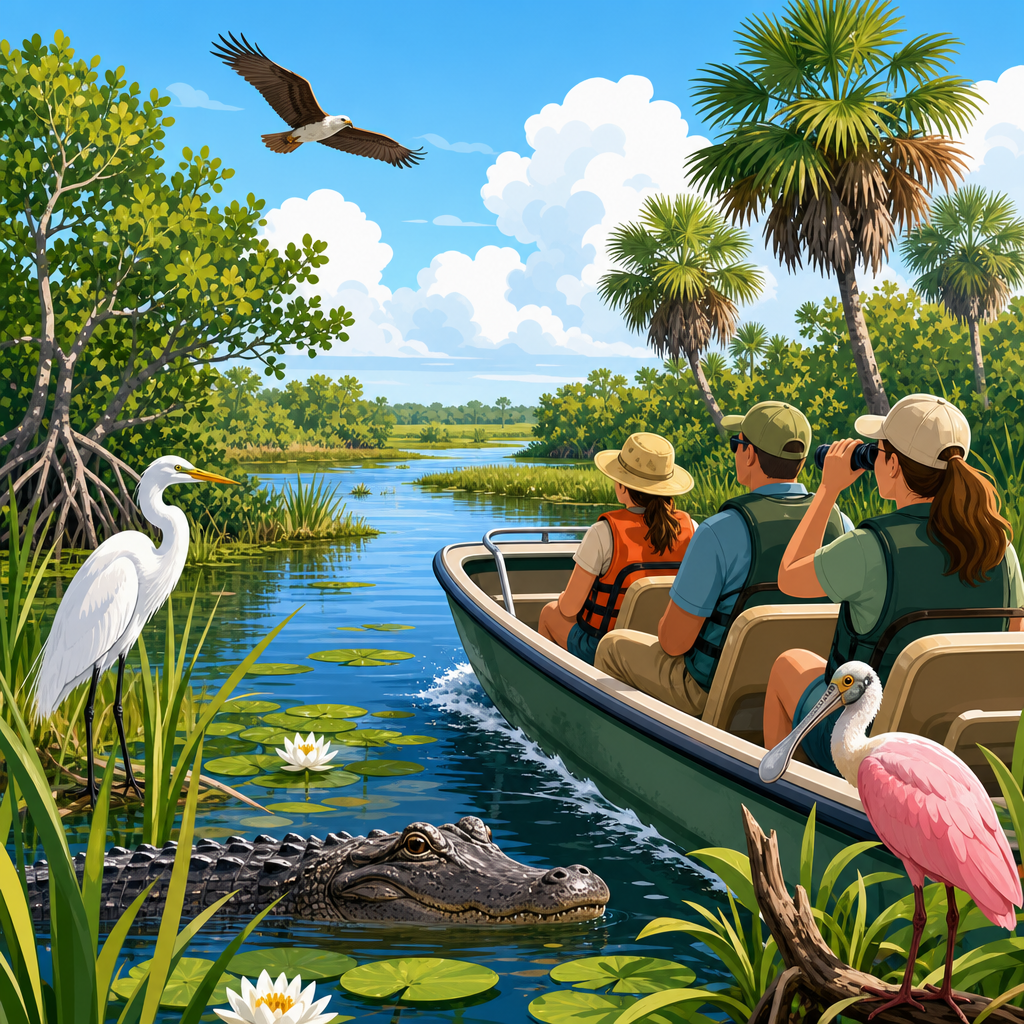
Everglades wildlife viewing from a boat is outstanding because the food web is concentrated along edges: mangrove shorelines, creek mouths, mudbanks, oyster bars, and seagrass flats. Dolphins are common in coastal waters and often seen traveling, feeding, or bow-riding at a respectful distance. West Indian manatees appear around marinas, canals, and warmer protected waters, especially in cooler months. American crocodiles are most associated with brackish and coastal habitats near Flamingo, while American alligators are more common in freshwater areas such as inland canals and river corridors. Seeing both species in the same park is one of the Everglades’ defining ecological facts.
Birdlife is even more varied. Great blue herons, tricolored herons, snowy egrets, white ibises, anhingas, ospreys, and brown pelicans are routine sightings. Roseate spoonbills, with their pink plumage, often feed in shallow water where tidal conditions concentrate prey. Bald eagles nest in the region and may be seen perched high above shorelines. During the dry season, roughly December through April, falling water levels can increase wildlife visibility because fish and crustaceans concentrate in shrinking pools and channels. That seasonal concentration is one reason winter is widely regarded as the best time for wildlife-focused boating trips.
Responsible viewing matters because wildlife stress is easy to cause from a boat. The standard practice is simple: slow down, keep your distance, never cut off an animal’s path, and do not feed anything. Manatees are especially vulnerable to propeller strikes, so obey all posted speed restrictions. Nesting birds may flush if approached too closely, exposing eggs or chicks to heat and predators. Crocodiles and alligators should be treated with equal caution; habituation to people creates management problems and safety risks. In national parks, the best wildlife encounter is one in which the animal continues natural behavior because your boat never became a disturbance.
Navigation, safety, permits, and trip planning for boating in national parks
The most important planning tools for Everglades boating are NOAA charts, National Park Service maps, local tide tables, a weather source such as NOAA Marine Forecasts, and a conservative float plan shared with someone on land. GPS plotters help, but they are not enough by themselves. I recommend carrying a paper chart in a waterproof case because electronics fail, sunlight washes out screens, and route judgment often depends on seeing the broader area at once. On longer runs, calculate fuel with a large reserve. Distances in the backcountry are deceptive, and idling through no-wake or shallow sections increases consumption.
Safety gear should exceed the legal minimum. Every person needs a properly fitted life jacket. Add extra drinking water, sun protection, a first-aid kit, a tow line, signaling devices, a VHF radio where practical, and basic repair items appropriate to your boat. For paddlers, dry bags, spare paddles, and insect protection are essential. Heat illness is a real hazard in South Florida, particularly in shoulder seasons when visitors underestimate humidity. Thunderstorms can build quickly; if lightning is active, open water becomes dangerous fast, and mangrove shorelines can offer only limited shelter.
Backcountry camping requires permits, and site choice depends on boat type and conditions. The park uses chickees, beach sites, and ground campsites, each with specific constraints. Some beach camps are tide dependent. Some chickees are better suited to paddlers than larger motorboats. If you are building a broader strategy for boating in national parks, use the Everglades as your model for permit discipline: reserve what you can, verify launch rules, understand wildlife closures, and confirm whether your route crosses protected habitat or shallow-sensitive areas.
Why Everglades boating is the model for planning national park boat trips
Everglades National Park teaches the core habits that improve boating across the national park system: choose the right craft, study charts, respect protected habitat, and let weather and water levels shape the plan. Those habits transfer directly to other destinations, whether you are evaluating motorboating access in Biscayne, paddling routes in Congaree, houseboating logistics near Lake Powell, or cold-water safety in Isle Royale. In each case, the route is only half the decision. The other half is understanding how the park’s ecosystem and regulations govern safe travel.
The main benefit of exploring the Everglades by boat is perspective. Roads show only fragments of this landscape, while boats reveal ecological connections between marsh, mangrove, estuary, and coast. You see how tides move through roots, how birds stage along shorelines, and how shallow water dictates everything from fish behavior to boat design. If this article is your starting point for boating in national parks, use it as a planning hub: shortlist the route that matches your skill level, confirm current park guidance, and build an itinerary that puts safety and stewardship first. That approach will give you a better Everglades trip and a stronger foundation for every park waterway you explore next.
Frequently Asked Questions
What are the best boating routes for exploring Everglades National Park?
The best boating route in Everglades National Park depends on your experience level, boat type, and what you want to see. For first-time visitors, the waters around Flamingo and Florida Bay are often the most practical starting points because they provide access to broad scenic areas, marked channels in some sections, and a mix of wildlife viewing opportunities. These routes can lead boaters through open bay waters, mangrove-lined creeks, and sheltered backcountry areas where wading birds, dolphins, and crocodiles are frequently spotted. The Gulf Coast area near Everglades City is another popular launch point, especially for boaters interested in the Ten Thousand Islands region, where countless mangrove islets, tidal creeks, and estuarine habitats create a classic Everglades boating experience.
For paddlers and small skiff operators, interior creeks and shorter backcountry trails can be especially rewarding because they allow quieter travel through narrow mangrove corridors and shallow-water habitat. More experienced boaters may plan longer routes that connect coastal bays, inland waterways, and designated wilderness camping areas, but those trips require careful preparation. Conditions can change quickly with tides, wind, weather, and water depth, so even a route that looks straightforward on a map may be far more technical on the water. In practical terms, the “best” route is usually one that matches your vessel, your navigation skills, and the day’s conditions rather than simply the longest or most remote option.
What wildlife can you expect to see while boating in the Everglades?
Boating in the Everglades offers some of the best wildlife viewing in North America because the park protects an enormous range of interconnected habitats. On a typical trip, boaters may see wading birds such as great egrets, herons, ibises, roseate spoonbills, wood storks, and anhingas feeding along shorelines, mudflats, and marsh edges. Ospreys and bald eagles are also common in some areas, especially where fish are plentiful. In mangrove estuaries and open bays, bottlenose dolphins are often seen surfacing near boats or feeding in tidal channels, while manatees may appear in calmer waters, marinas, and protected coves, especially during favorable seasonal conditions.
Reptiles are a major part of the Everglades experience as well. American alligators are more commonly associated with freshwater habitats, while American crocodiles are more likely to be found in the park’s brackish and coastal zones, particularly in the southern reaches. Boaters may also encounter sea turtles offshore or near coastal waters, along with rays and a variety of game and forage fish below the surface. The key is to treat every wildlife sighting as a privilege rather than an attraction to pursue. Slow down, keep a respectful distance, avoid sudden course changes toward animals, and never feed wildlife. Responsible viewing protects the animals and gives you a much better chance of observing natural behavior.
How difficult is navigation in Everglades National Park, and what should boaters be prepared for?
Navigation in Everglades National Park can be surprisingly difficult, even for experienced boaters. The park’s waterways are defined by shallow flats, oyster bars, twisting mangrove channels, changing tides, mudbanks, and vast open areas where the shoreline may offer few obvious landmarks. In some places, channels are marked, but many routes require close attention to charts, GPS, tide awareness, and local boating knowledge. A route that is passable at one tide level may become problematic at another, and wind can push water out of shallow bays quickly enough to leave sections far less navigable than expected.
Boaters should prepare as if they are entering a remote environment rather than a conventional recreational waterway. That means carrying updated nautical charts, a reliable GPS, enough fuel with a conservative reserve, drinking water, sun protection, emergency communications, and basic safety gear suited to isolation and heat. It also means understanding that cellular service may be unreliable and that assistance can take time to arrive. In addition, navigation hazards in the Everglades are often subtle rather than dramatic. Instead of large waves or obvious obstructions, the real challenges may be barely visible shoals, narrow creek entrances, strong tidal currents in passes, or long distances between services. Good planning, conservative decision-making, and a willingness to turn back are some of the most important boating skills in the park.
When is the best time of year to explore the Everglades by boat?
In general, the dry season, which typically runs from late fall through early spring, is considered the most favorable time for boating in Everglades National Park. During this period, temperatures are usually more comfortable, humidity is lower, mosquitoes are often less intense than in the wet season, and wildlife can be easier to observe as animals concentrate around remaining water sources and productive estuarine areas. These months are especially popular for sightseeing, fishing, photography, and multi-day backcountry trips, so some launch areas and services may be busier, but many visitors find the tradeoff worthwhile for the more stable weather and improved comfort.
The wet season, usually late spring through early fall, can still be rewarding, but it requires more caution. Heat, heavy rain, lightning, afternoon thunderstorms, and insects become much more significant factors, and tropical weather systems are a real consideration later in the season. Water levels and conditions can also shift access and navigability in different parts of the park. For some experienced boaters, summer offers a quieter and more dramatic Everglades, with lush landscapes and strong seasonal activity, but it is less forgiving. If you are choosing one time for a first visit by boat, the cooler dry-season months generally provide the best balance of safety, comfort, and wildlife viewing.
Do you need special permits, local knowledge, or boating experience to explore the park safely?
You do not necessarily need expert-level boating credentials to enjoy Everglades National Park, but you do need the right level of experience for the route you choose, and in many cases local knowledge is extremely valuable. Short outings from established access points can be manageable for recreational boaters who are comfortable with shallow-water operation, weather awareness, and chart-based navigation. However, remote backcountry travel, complex mangrove routes, and wilderness camping trips demand much more preparation. Depending on your plans, permits or reservations may be required for certain backcountry campsites, beach sites, or chickees, and it is always wise to check current National Park Service regulations, route advisories, launch information, and seasonal closures before departing.
For many visitors, hiring a guide, joining a ranger-led program if available, or starting with a shorter route is the smartest way to build confidence. Local captains and outfitters understand how tides, weather, and bottom conditions affect specific areas, and that knowledge can make the difference between a memorable day and a stressful one. Even skilled boaters benefit from respecting the Everglades as a place where remoteness, shallow water, and ecological sensitivity all matter at once. The safest approach is to match your trip to your real experience level, know the regulations that apply to your vessel and destination, and prioritize seamanship over ambition.