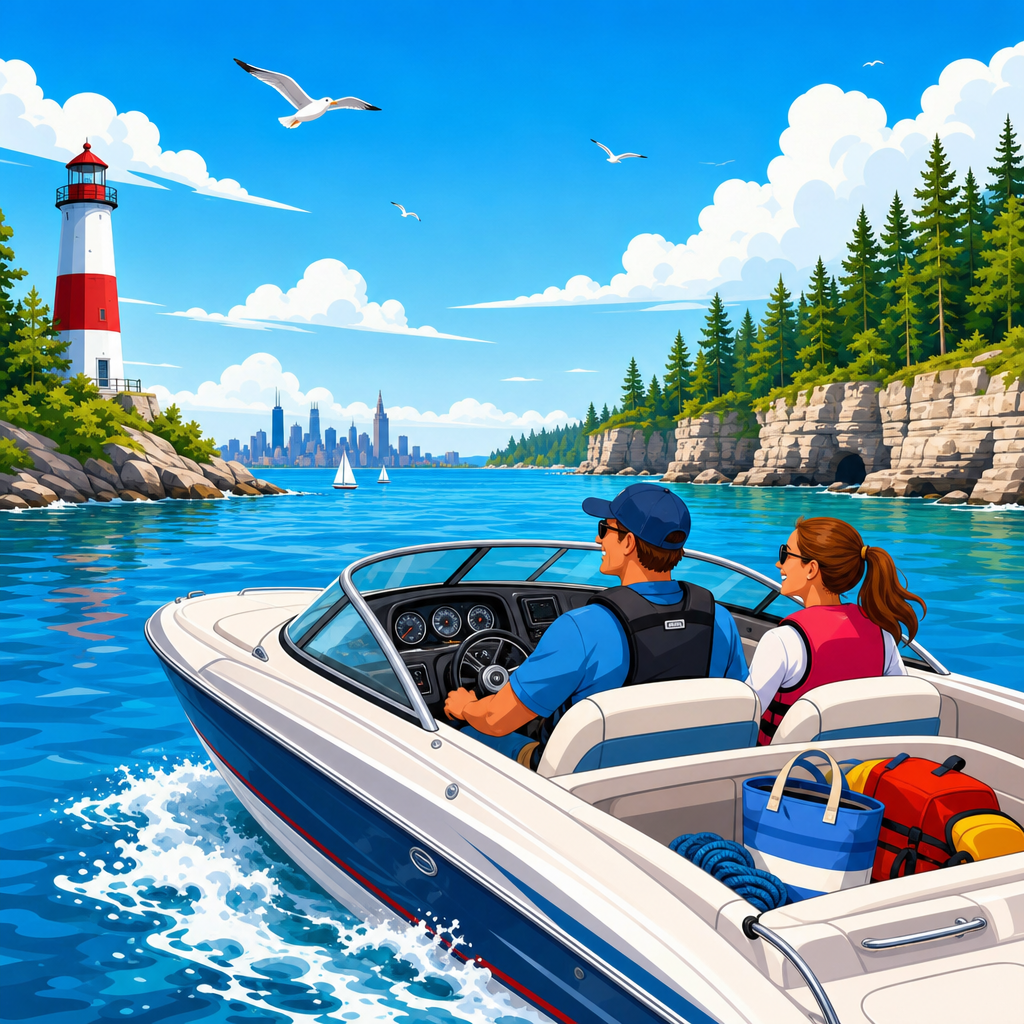
Boating on the Great Lakes demands a different mindset than a casual day on an inland reservoir because these waters behave more like an inland sea than a typical lake. The Great Lakes—Superior, Michigan, Huron, Erie, and Ontario—hold roughly one fifth of the world’s surface fresh water, span eight U.S. states plus Ontario, and create weather, wave, and navigation conditions that can change from manageable to dangerous in a matter of minutes. For boaters planning trips under the broader theme of the best boating lakes and rivers in the U.S., this region deserves special treatment because it combines world-class cruising grounds, productive fishing, historic ports, protected island chains, and some of the most demanding freshwater seamanship in North America.
In practice, boating on the Great Lakes means understanding fetch, shoaling, nearshore forecasts, cold-water risk, harbor spacing, customs procedures, and vessel range. Fetch is the uninterrupted distance wind blows across water; on the Great Lakes, long fetch creates steep, closely spaced waves that pound hulls and exhaust crews. Shoaling happens when waves build and stand up as they enter shallow water, especially near bars, reefs, and harbor entrances. Even in summer, cold water can trigger incapacitation quickly after immersion, particularly on Lake Superior and northern Lake Michigan. These facts matter whether you run a center console, trawler, sailboat, pontoon, or trailerable cruiser.
I have planned Great Lakes passages with radar overlaid on chartplotters, delayed departures because a “small” forecast shift would turn a comfortable beam sea into a punishing head sea, and rerouted to safer harbors when wind direction made an inlet untenable. That experience shapes one central point: the Great Lakes reward preparation. They are also a gateway to understanding the wider map of U.S. boating destinations. A boater researching this hub topic should know where the Great Lakes fit beside iconic inland routes like the Mississippi, Columbia, Tennessee, and Hudson, along with major recreational lakes such as Lake of the Ozarks, Table Rock, Powell, and the Finger Lakes. The Great Lakes stand apart because they combine the mileage and exposure of coastal cruising with freshwater access, marina infrastructure, and remarkable geographic variety.
Why the Great Lakes Belong at the Center of U.S. Boating Travel
If you are building a list of the best boating lakes and rivers in the U.S., the Great Lakes belong near the top because no other freshwater region offers the same scale, diversity, and navigational significance. Lake Michigan supports urban cruising from Chicago to Milwaukee, dune-lined anchorages, and harbor hopping along Michigan’s west coast. Lake Huron offers the North Channel, Georgian Bay access, and the Les Cheneaux Islands, all favorites among experienced cruisers. Lake Superior delivers remote wilderness, dramatic cliffs, and strict respect for weather windows. Lake Erie is comparatively shallow, warms faster, and serves anglers, island cruisers, and boaters heading toward Buffalo or the Detroit River corridor. Lake Ontario links major ports, the Thousand Islands region via the St. Lawrence system, and cross-border itineraries.
Compared with other U.S. destinations, the region covers a broader range of trip styles. You can do short harbor-to-harbor runs, multiweek loops, trailer-boat exploration, salmon fishing, island camping, urban waterfront cruising, or long-range passagemaking. The Mississippi River remains unmatched for long inland transit; the Tennessee River system is excellent for protected cruising; the Columbia offers scenery and current management challenges; and Florida’s Intracoastal Waterway dominates warm-weather coastal travel. Yet for freshwater boaters who want big-water skills, long horizons, and culturally rich ports, the Great Lakes provide the most complete package in the country.
Understanding Conditions: Weather, Waves, Water Temperature, and Seasonality
The biggest mistake new visitors make is assuming a calm morning guarantees a calm afternoon. Great Lakes weather is driven by frontal passages, localized thermal effects, and fast-changing wind direction. NOAA marine forecasts are the baseline planning tool, and serious boaters also monitor buoy observations, radar, water temperature maps, and harbor entrance conditions. Wind direction matters as much as wind speed. Fifteen knots offshore can be comfortable near one shoreline and dangerous on the opposite coast if it builds over long fetch. A west wind on southern Lake Michigan, for example, can create rough eastbound crossings and difficult inlets along the Indiana and Michigan shore.
Cold water risk is nonnegotiable. Air temperatures in the seventies can disguise water temperatures in the forties or fifties, especially in spring and early summer. The U.S. Coast Guard, NOAA, and boating safety instructors consistently emphasize life jacket use because cold shock occurs immediately after immersion, long before hypothermia becomes the main threat. Late June can still feel early season on Superior, while Erie may support a longer comfortable boating window due to its shallower depth and faster warming. Fog is another operational factor, particularly where warm air moves over colder water. That elevates the value of radar, AIS, sound signaling, and disciplined speed control in traffic zones.
| Lake | Primary Boating Appeal | Main Operational Challenge | Best Fit For |
|---|---|---|---|
| Superior | Remote scenery, wilderness cruising, sea caves, dramatic shoreline | Cold water, sparse harbors, fast weather shifts | Experienced cruisers, expedition-minded anglers, sea kayakers near shore |
| Michigan | Harbor towns, urban access, dunes, salmon fishing | Steep waves, crowded summer ports, long crossings | Cruisers, trailer boaters, family travelers, anglers |
| Huron | Island cruising, protected channels, North Channel access | Complex navigation around rocks and shoals | Sailors, trawlers, long-range cruisers |
| Erie | Island destinations, walleye fishing, central location | Short, sharp chop due to shallow depth | Anglers, weekend cruisers, smaller powerboats in good weather |
| Ontario | Major ports, gateway to St. Lawrence and Thousand Islands | Open-water exposure and cross-border planning | Cruisers, touring boaters, mixed U.S.-Canada itineraries |
Choosing the Right Boat, Gear, and Navigation Setup
The right boat for Great Lakes boating is the one that matches your route, crew, and margin for weather delays. A 19-foot runabout may be perfect for nearshore harbor hopping on a settled summer day, but it is not equivalent to a 28-foot pilothouse when a forecast misses by ten knots. Hull design matters. Deep-V boats generally handle Great Lakes chop better than flatter hulls, while displacement or semi-displacement cruisers trade speed for ride comfort and range. Fuel planning is critical because some stretches offer limited service, reduced hours, or long detours into marinas. I advise boaters to calculate conservative burn rates, maintain reserve fuel, and plan alternates before casting off.
Electronics should include updated charts on a dedicated chartplotter, not just a phone app. AIS, radar, DSC-capable VHF radio, and a reliable GPS are increasingly standard for anyone making open-water runs or operating in reduced visibility. Paper charts still matter as backups and for route review at the helm table. Essential safety gear includes properly sized life jackets, visual distress signals where required, throwable flotation, bilge pumps, anchor and rode sized for your displacement, and immersion-conscious clothing. On larger boats, I strongly prefer redundant communication, spare fuses, extra docking lines, and a written float plan. Trailer boaters should also inspect bearings, lights, tires, and brake systems because destination boating often begins with a long highway haul.
Best Great Lakes Routes, Destinations, and Trip Styles
The best Great Lakes route depends on whether you prioritize scenery, convenience, fishing, or cultural stops. For first-time cruisers, western Lake Michigan is one of the most forgiving introductions because it offers a sequence of established ports including Chicago, Waukegan, Racine, Milwaukee, Port Washington, Sheboygan, Manitowoc, and Door County. Distances are manageable, marinas are plentiful, and weather windows can be used for short, strategic runs. Door County in particular works well for families because you get protected bays, charming towns, state parks, and access to Green Bay waters that are often less intimidating than the open lake.
For a more advanced itinerary, northern Lake Huron and the North Channel are often described by veteran cruisers as among the finest freshwater cruising grounds in the world. The appeal comes from granite shorelines, pine-fringed anchorages, clear water, and a mix of marinas and wild stops. Lake Superior attracts a different audience: boaters comfortable with remoteness, long planning horizons, and self-sufficiency. Apostle Islands National Lakeshore is a standout destination, offering historic lighthouses, sea caves, and sheltered anchorages when conditions align. On Lake Erie, the Lake Erie Islands—Put-in-Bay, Kelley’s Island, and South Bass Island—draw social cruisers and anglers, while the western basin is nationally known for walleye fishing. Lake Ontario supports itineraries that combine Rochester, Oswego, Sodus Bay, and routes toward the St. Lawrence corridor.
As a hub within boating destinations and travel, this topic also helps frame where to go after the Great Lakes. Boaters who love island hopping often graduate to the Thousand Islands, the San Juan Islands, or Florida Bay. Those drawn to river towns and lock systems may prefer the Tennessee River, the Erie Canal, or the Upper Mississippi. Anglers comparing freshwater trips often weigh Great Lakes salmon and trout against bass-focused destinations like Kentucky Lake or Lake Guntersville. The practical takeaway is simple: the Great Lakes can function as both a destination and a benchmark. If you can plan safely here, you can transfer those skills to many of the best boating lakes and rivers in the U.S.
Regulations, Cross-Border Logistics, and Smart Trip Planning
Great Lakes boating is easier when you treat logistics as part of seamanship. Registration and titling requirements follow your home state, but local rules, no-wake zones, invasive species protocols, and fishing regulations vary by jurisdiction. If you cross into Canadian waters or land in Canada, you must follow reporting procedures through the Canada Border Services Agency; returning to the United States triggers U.S. Customs and Border Protection requirements, and many frequent cross-border boaters use the ROAM app to streamline reporting. These are not minor details. Failing to handle customs correctly can turn a good cruise into an expensive enforcement problem.
Trip planning should include marina reservations during peak season, especially in high-demand ports and island destinations. Weather lay days are not wasted time; they are part of a safe itinerary. Build them in. Review harbor entrances in cruising guides and on satellite imagery because some Great Lakes entrances become hazardous when swell aligns with shallow bars. Confirm fuel availability, pump-out access, bridge schedules, and launch ramp capacity before departure. Membership services such as TowBoatUS or Sea Tow can add valuable coverage, but they do not replace self-reliance in remote areas. The strongest habit I have seen among capable Great Lakes boaters is conservative decision-making. They leave early, monitor forecasts constantly, maintain escape options, and never confuse freshwater with low risk.
The Great Lakes deserve their reputation as one of the best boating regions in the United States because they combine vast freshwater cruising grounds with memorable towns, productive fisheries, and genuine adventure. They also demand respect. Understanding forecast interpretation, wave behavior, cold-water safety, harbor planning, and border procedures is what separates an enjoyable trip from an avoidable emergency. For boaters exploring the wider landscape of the best boating lakes and rivers in the U.S., this region is the essential hub: it offers urban waterfronts, protected island groups, remote wilderness passages, and skills that transfer to rivers, reservoirs, and coastal routes nationwide.
If you remember one principle, make it this: plan Great Lakes trips like passages, not casual outings. Choose a route that fits your boat, study weather and water temperature, equip your vessel for navigation and communication, and keep alternative harbors in reach. Start with manageable runs, then expand into longer crossings as your confidence and systems improve. From Door County and the Apostle Islands to Lake Erie’s island chain and Lake Ontario’s port circuit, the rewards are substantial for prepared boaters. Use this article as your starting point, then map your next destination, build a realistic itinerary, and get on the water with discipline.
Frequently Asked Questions
How is boating on the Great Lakes different from boating on inland lakes or reservoirs?
Boating on the Great Lakes is fundamentally different because these waters behave much more like an inland sea than a protected recreational lake. Their massive size, long fetch, commercial shipping traffic, cold water, and rapidly changing weather create conditions that demand more planning, better equipment, and a higher level of judgment. On many inland reservoirs, a forecast for moderate winds may still allow a relatively comfortable outing close to shore. On the Great Lakes, that same wind can build steep, closely spaced waves that make small-craft travel difficult or unsafe, especially when the wind direction has room to build over many miles of open water.
Another major difference is scale. Distances between harbors can be much greater than first-time visitors expect, and once you are offshore, shorelines can become less useful as a reference point than they are on smaller lakes. Navigation requires more attention to charts, shoals, breakwalls, harbor entrances, weather windows, and fuel range. Boaters also have to account for heavily traveled shipping lanes, changing water levels, fog, and the fact that help may not be immediately nearby if conditions deteriorate.
Cold water is another critical factor. Even in late spring, early summer, and sometimes well into the boating season, water temperatures can remain dangerously low. A capsize or unexpected immersion can turn life-threatening very quickly, even on a day that feels warm in the sun. That means Great Lakes boaters should think not just about comfort, but about survival: wearing life jackets, carrying reliable communications equipment, filing a float plan, and understanding that weather and water conditions can become serious in minutes. In short, the Great Lakes reward preparation and punish complacency.
What weather and wave conditions should boaters watch most closely on the Great Lakes?
The most important thing to understand is that Great Lakes weather changes fast, and wind often matters as much as, or more than, simple temperature or chance of rain. Boaters should pay close attention to marine forecasts, not just general weather apps. Specifically, watch wind speed, wind direction, wave height, wave period when available, small craft advisories, thunderstorm potential, fog, and any sudden frontal passages. A day that begins calm can become dangerous by afternoon if the wind shifts and builds over open water.
Wind direction is especially important because it influences fetch, which is the distance wind travels across the water to build waves. On a large lake, a strong wind blowing the length of open water can produce steep, punishing conditions even when the forecast number itself does not seem extreme. Local geography matters too. Points, bays, harbor mouths, shoals, and shallow areas can amplify wave steepness and create confused seas. Conditions near shore may look manageable while the open lake is significantly rougher.
Thunderstorms deserve particular respect. Summer squalls can bring sudden high winds, lightning, reduced visibility, and sharp wave development in a short time. Fog is another common Great Lakes hazard, especially when warm air moves over cold water, making radar reflectors, GPS/chartplotters, sound signals, and conservative decision-making much more important. Smart Great Lakes boaters check conditions before departure, monitor updates while underway, and always build a margin into the day’s plan. If the forecast suggests marginal conditions for your boat size or skill level, postponing is often the best decision.
What safety gear and preparation are most important before heading out on the Great Lakes?
Start with the basics required by law, but do not stop there. A properly fitting life jacket for every person on board is essential, and on the Great Lakes, wearing it is far wiser than simply storing it. Because cold water and rough conditions can shorten reaction time dramatically, life jackets should be considered standard operating gear, not emergency-only equipment. You should also carry visual distress signals, a sound-producing device, navigation lights, fire extinguishers, first aid supplies, anchor and rode appropriate for your boat, and enough fuel with reserve for changing conditions or rerouting.
Communications and navigation tools are equally important. A fixed-mount or handheld VHF marine radio is one of the most valuable pieces of safety equipment you can carry, since cell coverage can be inconsistent and marine radio gives you access to weather updates, bridge operators, marinas, and emergency assistance. GPS/chartplotter capability, paper charts as backup, a compass, and a charged phone in a waterproof case all add layers of protection. If you venture farther offshore, an emergency beacon such as an EPIRB or personal locator beacon is a wise upgrade.
Preparation also means understanding your boat’s limitations and your own. Know your fuel burn, cruising range, bilge system, battery condition, and how the boat handles in chop, quartering seas, and following seas. File a float plan with someone on shore, including departure point, route, destination, passenger list, and expected return time. Check harbor conditions, confirm marina availability if needed, and identify alternate ports of refuge before you leave. On the Great Lakes, good preparation is not about overthinking the trip; it is about giving yourself options before conditions narrow them.
Do you need special navigation knowledge or permits to boat on the Great Lakes?
You may not need a special “Great Lakes permit” in the general sense, but you do need stronger navigation awareness than many casual inland boaters are used to. The Great Lakes include marked channels, shoals, reefs, breakwalls, river entrances, busy harbor traffic, and major commercial shipping routes. Reading marine charts, understanding aids to navigation, and recognizing how wind and water levels affect approach routes are all important. Entering an unfamiliar harbor in building waves, reduced visibility, or crosswind conditions can be challenging even for experienced operators.
Because the lakes border multiple U.S. states and Ontario, boaters also need to think about jurisdiction and trip type. If your route involves crossing into Canadian waters or landing in Canada, you must understand customs, reporting, documentation, and any current entry requirements. Fishing, licensing, and local boating regulations can also vary by state, province, and waterway. If you are trailering between Great Lakes destinations, you should verify local launch rules, invasive species inspection requirements, and any equipment standards that apply where you launch and operate.
Even when formal permits are not complicated, knowledge is non-negotiable. Boaters should know the rules of the road, understand right-of-way situations involving large commercial vessels, and appreciate that freighters cannot stop or maneuver quickly. AIS, radar, and chartplotters are helpful, but they do not replace good seamanship. If you are new to these waters, taking a boating safety course, studying the local chart in advance, and starting with short, conservative runs near well-protected harbors is a smart way to build Great Lakes-specific experience.
When is the best time to boat on the Great Lakes, and how should beginners plan their first trips?
The best time depends on your boat, your tolerance for cold water, and the kind of trip you want, but for many recreational boaters, mid-summer into early fall offers the most favorable balance of weather, water access, and marina activity. Even then, conditions are never guaranteed. Spring can be beautiful but often brings very cold water, strong wind patterns, and fewer safety margins if something goes wrong. Fall can be spectacular and less crowded, but it also tends to bring stronger systems, colder air, and faster-changing weather. In every season, a “good boating day” on the Great Lakes is usually defined by a stable forecast, manageable winds, and a realistic route.
For beginners, the smartest approach is to start small and stay flexible. Choose short day trips close to protected harbors rather than long open-water crossings. Launch at a location with multiple nearby refuge options, and plan a route that allows you to turn back quickly if the lake begins to build. Leave early, since mornings are often calmer than afternoons, and give yourself extra time for docking, fueling, and navigating unfamiliar channels. Study the weather the night before and again right before departure, paying close attention to marine-specific updates.
It is also wise for first-time Great Lakes boaters to match the trip to the least experienced person aboard, not the most confident. Make sure everyone knows where safety gear is located, how to move safely around the boat, and what to do if conditions worsen. If possible, go with a more experienced local boater the first few times or hire a captain for orientation on a new area. The Great Lakes can deliver incredible cruising, fishing, sightseeing, and island-hopping opportunities, but the best first experiences come from conservative planning, close attention to weather, and the willingness to call it a day before the lake makes that decision for you.