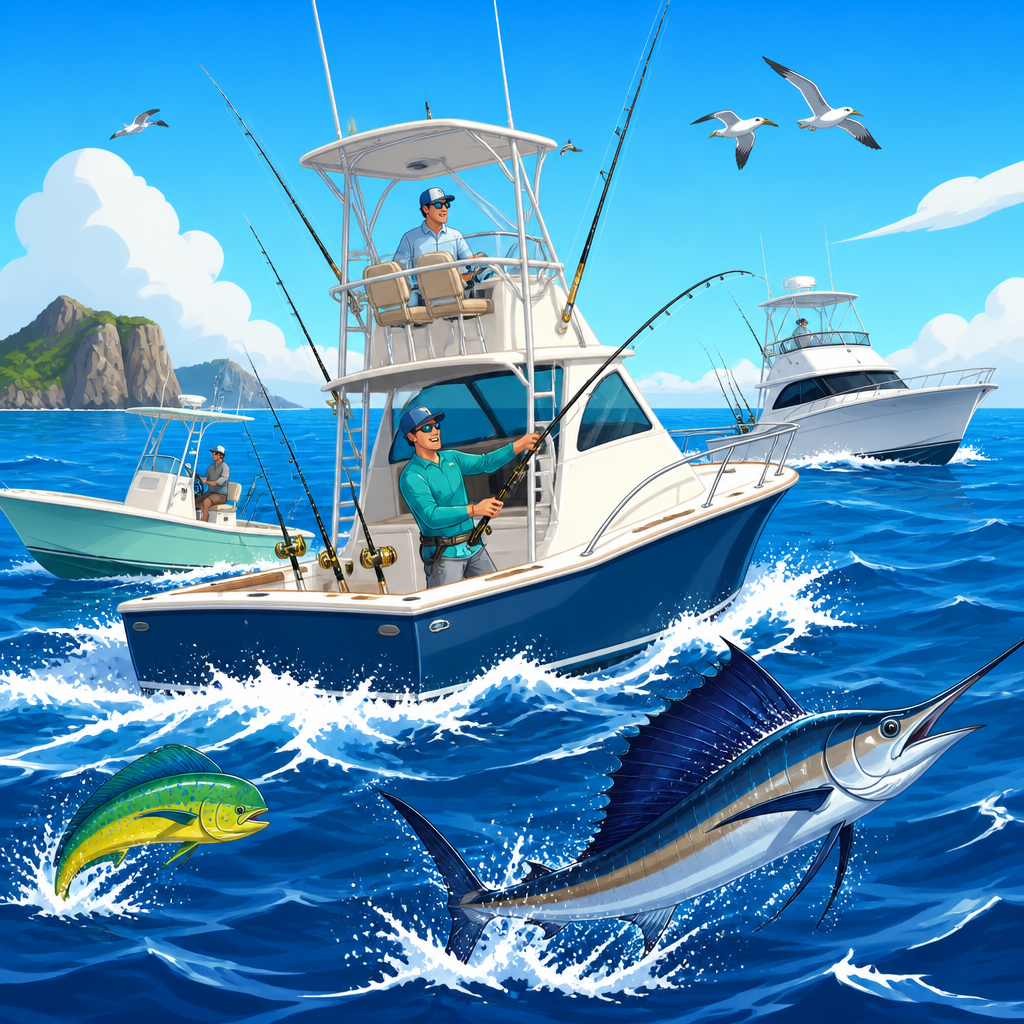
Offshore deep-sea fishing pushes boats, crews, and equipment harder than almost any other recreational pursuit on the water, which is why choosing the best boats for offshore deep-sea fishing adventures starts with understanding hull design, range, seaworthiness, and fishability rather than focusing on styling or cabin extras. In this hub guide to the best boats for fishing enthusiasts, I am looking at the boat types and decision criteria that consistently matter when runs are long, weather shifts quickly, and success depends on reaching productive water safely, carrying serious tackle, and returning with confidence. Offshore fishing generally means operating beyond protected bays and nearshore reefs, often in open coastal or bluewater conditions where waves are larger, distances are greater, and help is farther away. Deep-sea fishing commonly targets species such as tuna, mahi-mahi, marlin, swordfish, wahoo, and snapper in water that can range from a few miles offshore to well beyond the continental shelf. The right boat for that job must balance ride quality, fuel efficiency, deck layout, storage, electronics integration, and power systems in a way that matches how you actually fish.
That matters because the wrong platform creates fatigue, limits your weather window, wastes fuel, and can turn a productive trip into a safety problem. Over years of evaluating offshore-capable boats, I have seen buyers focus too narrowly on length or top speed when the better question is how a boat performs across the full fishing day: leaving the inlet in sloppy predawn seas, trolling for hours, drifting over structure, icing the catch, and cleaning up at the dock. A true offshore fishing boat is not just one that can go out on a calm day; it is one designed to maintain control, protect passengers, and support serious angling when conditions are less forgiving. This article serves as the central resource for the broader best boats for fishing enthusiasts topic by explaining the major offshore boat categories, what each does well, where compromises appear, and how to match a boat to your local waters, target species, crew size, and budget.
What makes a boat truly offshore capable
The defining features of offshore-capable fishing boats are structural strength, predictable handling in rough water, sufficient freeboard, dependable power, and a cockpit designed around active fishing. Deep-V hulls remain the dominant choice because they cut head seas more effectively than flatter-bottom designs, reducing pounding and improving comfort during long runs. A transom deadrise around 20 to 24 degrees is common on serious offshore center consoles and express boats, although more deadrise can increase ride quality at the expense of stability at rest and fuel economy. Beam also matters. A wider beam improves cockpit space and drift stability, but too much beam relative to hull form can produce a harsher ride in certain sea states.
Range is equally important. Offshore trips can easily involve 60 to 150 miles of total travel, and prudent captains reserve fuel for weather detours, current changes, and safety margin. Many experienced operators use the one-third rule: one-third of fuel out, one-third back, one-third in reserve. In practical terms, that means fuel capacity and realistic cruise burn are far more important than brochure top-end numbers. Fishing systems matter too. A proper offshore setup usually includes insulated fish boxes, circulating livewells, robust raw-water washdowns, coaming bolsters, under-gunwale rod storage, outriggers or hardtop rocket launchers, and electronics capable of integrating chartplotting, radar, sonar, AIS, and engine data. Safety is not a separate category; it is built into every one of those choices, from bilge redundancy to accessible battery switches.
Center console boats: the benchmark for versatility
For many anglers, the best boats for offshore deep-sea fishing adventures are center consoles from roughly 26 to 40 feet, because they combine speed, fishability, and 360-degree access around the boat. The center console layout keeps the helm centralized, creates open passage fore and aft, and allows multiple anglers to work a fish around the bow without obstruction. That is a major advantage when targeting fast pelagic species such as tuna or sailfish. Modern center consoles also carry substantial fuel, twin to quad outboards, large livewells, coffin boxes or in-deck fish storage, and hardtops that support radar, antennas, lights, and outriggers.
Brands such as Boston Whaler, Regulator, Contender, Yellowfin, Everglades, and Grady-White have built reputations on offshore center console performance, though each approaches the formula differently. A Regulator 31, for example, is widely respected for heavy build quality and rough-water ride, making it a strong choice for anglers who regularly run through chop and swell. A Contender 32ST emphasizes speed and fishability, appealing to tournament-minded crews that prioritize quick runs and uncluttered deck space. A dual-purpose model like the Grady-White Canyon series often adds more family comfort without giving up offshore utility. The tradeoff is exposure. Even with excellent windshield protection at the helm, center consoles leave much of the crew open to wind, spray, sun, and cold. That is manageable in warm climates and on day trips, but less ideal for overnight canyon runs or shoulder-season fisheries.
Walkaround and cuddy cabin boats: weather protection with fishing function
Walkaround and cuddy cabin boats serve anglers who want offshore capability but also need shelter, overnight potential, or a more secure feeling for family crew members. A walkaround design provides side decks around a forward cabin, preserving much of the fishability of a center console while adding enclosed storage, a berth, and often a marine head. In regions where offshore runs begin in cool morning temperatures or where weather can deteriorate quickly, that cabin becomes genuinely useful rather than decorative. It stores safety gear dry, offers a place to rest, and makes long outings easier on non-hardened passengers.
These boats do involve compromises. Side deck width can be tighter than some buyers expect, and cabin volume uses space that could otherwise expand the cockpit. On smaller hulls, the added topside structure can affect sightlines and create windage. Still, a well-designed walkaround from builders such as Pursuit, Grady-White, or Jeanneau can be an excellent bridge between dedicated offshore angling and all-around family boating. I often recommend this category to owners who split time between trolling offshore, chasing stripers or kingfish nearshore, and making occasional weekend overnights. It is especially strong where versatility counts more than maximizing every square foot of open deck.
Express and sportfishing boats: range, comfort, and tournament pedigree
If your idea of offshore fishing includes overnight canyon trips, serious trolling spreads, and enough cabin comfort to fish hard for multiple days, express boats and larger convertibles deserve attention. Express boats place the helm and seating on a raised deck with a cabin below, keeping the cockpit focused on fishing while providing substantial weather protection and interior amenities. Convertibles and flybridge sportfishing boats add elevated helm visibility, larger machinery spaces, and the offshore pedigree associated with big-game fishing. Viking, Hatteras, Bertram, Cabo, Tiara, and Pursuit have all produced respected offshore platforms in these categories.
The key strengths here are endurance and crew comfort. In rough water, diesel inboards often deliver strong torque, predictable weight distribution, and reliable long-range cruising. A large cockpit accommodates fighting chairs, mezzanine seating, tackle centers, transom doors, freezer storage, and serious rigging stations. For swordfishing overnight or trolling marlin all day, those features are not luxuries; they are operational advantages. The drawbacks are cost, draft, and complexity. Inboards require different maintenance planning than outboards, slips are more expensive, and hauling or trailering is often unrealistic. These boats make sense when offshore fishing is the main mission rather than an occasional upgrade from bay boating.
Catamarans and hybrid offshore platforms: when stability changes the equation
Power catamarans have gained significant traction in offshore fishing because their twin-sponson hulls can deliver exceptional stability at rest, large deck area for a given length, and efficient performance in many conditions. Brands such as World Cat, Freeman, and Invincible’s cat models have shown that anglers will pay for the advantages, especially in fisheries where long runs and drift fishing are common. On a drift, a cat often feels more composed than a monohull, which helps when bottom fishing, jigging, or managing multiple lines with several anglers aboard. Their beam creates huge cockpit room and impressive storage possibilities.
However, catamarans are not automatically better. Ride quality depends heavily on design, loading, and sea angle. Some cats can react differently in quartering seas, and dockage or trailering can become more difficult because of beam. Hybrids also deserve mention. Some manufacturers build bay-offshore crossover boats that stretch the definition of offshore capability, often with stepped hulls, moderate freeboard, and layouts intended for both inshore casting and occasional bluewater runs. These can work in favorable regions and for disciplined captains, but if offshore deep-sea fishing is the core mission, a purpose-built offshore hull remains the safer and more effective choice.
How to compare the best boats for fishing enthusiasts
The smartest way to compare offshore fishing boats is to evaluate them against your actual use profile rather than a generic best-of list. Start with where you fish: the Gulf of Mexico, Northeast canyons, Southern California offshore grounds, and South Florida all impose different demands. Then assess target species, average crew count, run distance, and whether you trailer, dry stack, or keep the boat in a slip. Finally, compare construction, systems access, and resale support from reputable dealers. The following framework is the one I use most often with serious buyers.
| Factor | Why It Matters Offshore | What to Look For |
|---|---|---|
| Hull design | Controls ride, spray deflection, and handling in head, following, and beam seas | Deep-V or proven cat design, quality strakes, solid lamination reputation |
| Fuel and range | Determines safe operating radius and weather margin | Realistic cruise numbers, generous tankage, reserve planning |
| Cockpit layout | Affects fish-fighting efficiency and crew safety | Unobstructed walkways, bolsters, toe rails, secure handholds |
| Fishing systems | Supports bait management, catch handling, and tackle organization | Livewells, insulated boxes, rigging station, rod storage, washdowns |
| Electronics integration | Improves navigation, fish finding, and collision avoidance | Radar, CHIRP sonar, chartplotter, AIS, autopilot, VHF redundancy |
| Serviceability | Reduces downtime and maintenance frustration | Accessible pumps, wiring, batteries, seacocks, and bilge systems |
Sea trial every serious candidate in less-than-perfect conditions if possible. Flat-water demos hide problems. Watch how the boat lands off waves, whether the windshield sheds spray, how easy it is to move around with rods, and whether engine noise or vibration becomes tiring after an hour. Check helm ergonomics while standing and seated. Open every hatch. Look at wiring labels, hose clamps, bilge finish, and pump access. Those details tell you whether the boat was designed by people who understand ownership as well as sales presentation.
Power, electronics, and safety systems that matter most
Outboards dominate the modern offshore market because they free interior space, simplify repower decisions, and offer strong performance with digital controls and joystick options on many models. Yamaha, Mercury, and Suzuki remain the main players, with horsepower choices that let builders scale from twin-engine setups to triples and quads. More engines can improve redundancy and speed, but they also increase maintenance cost, transom weight, and fuel burn. For many 28- to 34-foot monohulls, twins hit the practical sweet spot. Diesel inboards still hold major advantages in larger express and convertible boats where long-range efficiency, longevity, and weight placement matter more than trailerability.
Electronics are no longer optional extras. At minimum, an offshore deep-sea fishing boat should carry a high-quality multifunction display, fixed-mount VHF with DSC, broadband or pulse-compression radar, CHIRP sonar, GPS charting, and an EPIRB or PLB. AIS has become increasingly valuable in traffic lanes and reduced visibility. Autopilot is one of the most underrated offshore tools because it reduces fatigue, keeps trolling patterns cleaner, and helps a shorthanded crew manage rods or deploy safety gear. Safety equipment should align with U.S. Coast Guard requirements and common offshore best practice: life jackets for all aboard, throwable flotation, visual distress signals, sound-producing device, fire extinguishers, first-aid kit, ditch bag, and reliable anchor system. If a boat’s layout makes emergency gear hard to reach, the layout is flawed.
Buying strategy, budgeting, and the right next step
The best boats for offshore deep-sea fishing adventures are the ones matched precisely to your water, your experience, and your operating budget, not the ones with the biggest engines or most aggressive marketing. For most buyers, that means choosing a proven offshore center console between 28 and 34 feet, or a walkaround or express model if weather protection and overnight capability matter more. Focus first on seaworthiness, fuel range, cockpit function, and systems quality. Then evaluate comfort features, brand prestige, and cosmetic finish. A clean, well-maintained used boat from a reputable builder often delivers more real offshore value than a new entry-level model with thinner systems support or limited fuel capacity.
Budget honestly for ownership. Purchase price is only the starting point. Fuel, insurance, routine service, bottom work, electronics updates, trailer maintenance, safety gear replacement, storage, and tackle all add up quickly. A marine survey and engine inspection are mandatory on any used offshore boat, and even on newer boats I strongly advise an extended sea trial with realistic loading. If you are building out your broader knowledge of the best boats for fishing enthusiasts, use this hub as your starting point and compare offshore models against nearshore, bay, flats, and freshwater platforms based on where you fish most. The reward for choosing correctly is significant: more safe fishing days, better access to productive water, less fatigue, and a boat that works with your style instead of against it. Make a shortlist, sea trial the leaders, and buy the platform that inspires confidence when the inlet gets rough.
Frequently Asked Questions
What type of boat is best for offshore deep-sea fishing adventures?
The best boat for offshore deep-sea fishing depends on how far you plan to run, the sea conditions you expect to face, and the style of fishing you do most often, but in general, center consoles, walkarounds, express cabins, and sportfishing boats are the leading choices. Center consoles are especially popular because they offer 360-degree fishability, efficient layouts, strong outboard-powered performance, and enough deck space to fight large pelagic species without obstacles. For anglers who regularly run far offshore, larger center consoles and express boats often strike the best balance between speed, range, cockpit room, and protection from weather.
Hull design matters just as much as the category itself. A true offshore-capable boat should have a deep-V hull or another proven rough-water design that can soften the ride in chop, improve handling in head seas, and maintain confidence when conditions become less forgiving. High freeboard, solid construction, dependable bilge systems, quality hardware, and a layout designed for safe movement around the deck are all major indicators that a boat is built for offshore use rather than nearshore convenience.
If overnighting, long canyon runs, or all-day runs in changing weather are part of your plans, cabin-equipped express models or convertible sportfishers become more attractive because they add shelter, berths, enclosed heads, and additional storage while still delivering a capable cockpit. In short, the best offshore fishing boat is not simply the biggest or flashiest option. It is the one with the right hull, the right range, the right deck layout, and the right level of seaworthiness for the distances and conditions you realistically intend to fish.
How big should a boat be for safe and practical offshore deep-sea fishing?
There is no single minimum size that guarantees offshore safety, but for serious deep-sea fishing, many anglers consider the mid-20-foot range and above a more practical starting point. Boats in this class often provide a better ride, more fuel capacity, more freeboard, and enough onboard space for safety gear, bait systems, coolers, and multiple anglers to work lines without crowding. As boat length increases, you generally gain improved comfort in rough water, greater carrying capacity, and a more confidence-inspiring platform when the weather builds unexpectedly.
That said, size alone does not make a boat offshore-ready. A well-built 26-foot deep-V from a respected offshore brand can be a better choice than a longer boat with a flatter hull and less capable construction. Beam, deadrise, structural integrity, fuel load, engine setup, and the boat’s overall weight all influence how it performs offshore. A larger boat may ride better and carry more, but it also brings higher fuel costs, bigger maintenance demands, greater storage needs, and more complexity in docking and trailering. The ideal size is the one that matches your experience level, crew size, fishing range, and operating budget.
For many owners, the sweet spot is a boat large enough to provide offshore range and weather confidence without becoming so large that it is difficult or expensive to use often. That practical balance frequently lands somewhere between about 26 and 35 feet for private anglers, though serious long-range and tournament fishing may justify moving into larger express or sportfishing platforms. The key point is to choose a size that supports safety, comfort, and real-world usability rather than buying strictly by length.
What features matter most when choosing an offshore deep-sea fishing boat?
The most important features are the ones that directly affect seaworthiness, fishability, range, and safety. Fuel capacity and efficiency are critical because offshore fishing often involves long runs to productive grounds and limited margin for error. A boat should have enough fuel to complete the trip with a healthy reserve, even if weather, sea state, or detours increase consumption. Reliable power, modern navigation electronics, VHF communication, radar where appropriate, and a robust electrical system all play central roles in offshore confidence.
From a fishing standpoint, cockpit design is essential. Look for wide, unobstructed walkways, secure footing, substantial coaming bolsters, abundant rod storage, insulated fish boxes, livewells sized for your bait needs, tackle organization, raw- and freshwater washdowns, and enough transom space to work lines efficiently. Gunwale height and transom design also matter because offshore crews need stability and security when fighting large fish in rolling seas. Outriggers, downriggers, tuna doors, transom bait stations, and heavy-duty rod holders may also be worthwhile depending on your target species and techniques.
Equally important are the structural and safety details that are easy to overlook during a showroom walkaround. Strong cleats, quality hinges and latches, dependable bilge pumps, good drainage, easy engine access, sturdy handholds, self-bailing decks, and well-designed storage for safety gear all contribute to offshore readiness. Comfort features like shade, seating, and a cabin are certainly valuable, but they should come after the fundamentals. On offshore trips, the features that matter most are the ones that help the boat run safely, fish effectively, and bring everyone home with confidence.
Why is hull design so important for offshore fishing boats?
Hull design is one of the most important factors in offshore performance because it affects ride quality, dryness, efficiency, stability, and control in changing conditions. When you are running long distances in open water, the boat’s ability to handle chop, swells, quartering seas, and sudden weather changes becomes far more important than styling or dockside comfort. A well-designed offshore hull can reduce pounding, improve tracking, and help the captain maintain safer, more predictable control as conditions deteriorate.
Deep-V hulls are widely favored for offshore deep-sea fishing because they cut through waves more effectively than flatter-bottom designs and generally provide a softer ride in rough water. That does not mean every deep-V performs the same, however. The entry angle, chine design, strakes, beam, weight distribution, and transom deadrise all influence how the boat lifts, turns, lands, and rests at drift. Some hulls prioritize speed and agility, while others are tuned for heavier, more planted offshore performance. Understanding those tradeoffs is essential when comparing models.
Hull design also influences how comfortable and productive the fishing experience will be once lines are in the water. A boat that drifts predictably, stays composed when multiple anglers move around, and does not throw spray constantly will be easier to fish from all day long. In practical terms, the right hull helps protect crew energy, improves safety, and expands the range of fishable days. That is why experienced offshore anglers spend so much time evaluating running characteristics and reputation in real sea conditions rather than judging a boat only by layout or horsepower figures.
How do I choose the right offshore fishing boat for my budget and experience level?
Start by being honest about how you will actually use the boat, not how you imagine using it on your most ambitious day. Consider your average run distance, the number of people typically onboard, the species you target, the sea conditions common in your area, and whether you want a simple day boat or a platform capable of overnight trips. This immediately narrows the field and helps prevent overspending on size, engines, or luxury features that do not materially improve your offshore fishing experience.
Next, evaluate the total cost of ownership rather than focusing only on purchase price. Offshore-capable boats carry ongoing costs that can add up quickly, including fuel, insurance, storage, maintenance, electronics, safety gear, bottom service if applicable, trailer upkeep, and engine service. Twin or triple-engine boats may deliver excellent offshore confidence and performance, but they also raise maintenance and operating expenses. For many buyers, a slightly smaller, well-built offshore hull with sensible power and proven systems is a smarter long-term choice than stretching the budget for a larger boat that becomes expensive to run regularly.
Your own boating experience should guide the decision as much as your budget. A newer offshore angler may be better served by a manageable, confidence-building platform with straightforward systems, good visibility, and easy handling characteristics. More experienced operators who routinely make long runs and fish in variable weather may be ready for a larger center console, express, or sportfishing boat with more complexity and capability. The right choice is the boat you can operate safely, maintain properly, and use often. In offshore fishing, confidence, preparedness, and consistency matter far more than owning the most aggressive setup at the marina.