Best trailer hitches for secure boat transport start with matching the hitch, tow vehicle, trailer, and boat as one system rather than shopping for a single shiny part. In marine towing, the hitch is the mechanical link that carries tongue weight, controls articulation over bumps and turns, and transmits braking and sway forces from trailer to vehicle. If that link is undersized, poorly adjusted, or simply wrong for the trailer coupler, even a short drive to the ramp can become unsafe. I have set up towing packages for aluminum fishing boats, center consoles, and wake boats, and the pattern is always the same: most problems blamed on “the trailer” begin with hitch selection, height, or load balance.
For boat owners, secure transport matters because marine trailers face unusual stresses. Boat ramps add steep approach angles, saltwater accelerates corrosion, and long rear overhangs on tow vehicles can amplify bounce. A secure setup protects the boat hull, outboard skeg, trailer frame, lights, tires, and everyone else on the road. This hub article covers the essential trailer hitch types, weight ratings, ball mounts, corrosion considerations, wiring, brake control, and setup checks that belong in any serious guide to boat trailers and towing equipment. It also explains when each hitch style works best, what mistakes to avoid, and how to choose components that fit both current and future towing needs.
Before comparing products, define the key terms. Gross Trailer Weight, or GTW, is the total weight of the loaded trailer. Tongue weight is the downward force the trailer applies to the hitch ball, and for most conventional boat trailers it should usually land around 7 to 10 percent of loaded trailer weight, though exact recommendations vary by manufacturer. Receiver class refers to the hitch receiver’s capacity and opening size, commonly Class II, III, IV, or V for boat towing. A ball mount inserts into the receiver, a hitch ball bolts to the mount, and the trailer coupler clamps onto that ball. Safety chains, wiring connectors, trailer brakes, and the breakaway system are not optional accessories; they are core safety equipment.
Choosing correctly is not just about pulling power. It is about preserving steering control, braking distance, suspension geometry, rear axle load, and visibility. A half-ton pickup rated to tow a midsize boat may still need a specific drop hitch to keep the trailer level. A unibody SUV may handle a 19-foot bowrider confidently with a Class III receiver and surge brakes, while a heavy offshore boat on a tandem-axle trailer may call for a Class IV or V setup, a longer wheelbase vehicle, and stronger cooling capacity. The best trailer hitches for secure boat transport are the ones that fit the actual load, resist marine corrosion, and keep the trailer tracking straight mile after mile.
Understanding Hitch Classes and Which Boats They Fit
The first decision is receiver class. For smaller personal watercraft trailers and lightweight jon boats, a Class II hitch may be enough, but most boat owners should focus on Class III and above. Class III receivers typically use a 2-inch opening and are common on midsize SUVs, body-on-frame SUVs, and half-ton trucks. They are well suited to many aluminum fishing boats, compact fiberglass runabouts, and small center consoles when the loaded trailer weight stays inside both the hitch rating and the vehicle rating. Class IV also commonly uses a 2-inch receiver but carries higher capacity, making it a better choice for heavier single-axle and tandem-axle boat trailers. Class V hitches are common on heavy-duty trucks and use either a 2-inch or 2.5-inch receiver depending on design, intended for larger offshore rigs, cabin boats, and heavier multi-axle trailers.
In practice, I recommend buying for the heaviest realistic towing scenario, not the lightest. If your current 18-foot aluminum boat weighs 2,800 pounds loaded, a Class III may be enough, but if you expect to move to a 22-foot fiberglass boat with fuel, batteries, gear, and tandem axles, stepping up early can prevent replacing half the towing package later. The hard limit is always the lowest-rated component in the system. If the receiver is rated for 6,000 pounds but the ball mount is rated for 5,000 and the hitch ball for 3,500, your towing limit is 3,500. This is why secure boat transport starts with reading all stamped ratings rather than relying on sales labels.
Fit also matters at the vehicle level. Some factory tow packages include integrated wiring, transmission cooling, and receiver mounting points engineered by the manufacturer. Others rely on aftermarket installations, which can be excellent when the hitch is vehicle-specific and installed to torque specification. Brands such as CURT, Draw-Tite, Reese, and B&W all produce reputable receivers, but the “best” model is always the one certified for that exact vehicle configuration, including engine, wheelbase, and sometimes trim. Cross-check the owner’s manual, door-jamb payload sticker, and hitch manufacturer fit guide before buying anything.
Ball Mounts, Hitch Balls, and Trailer Leveling
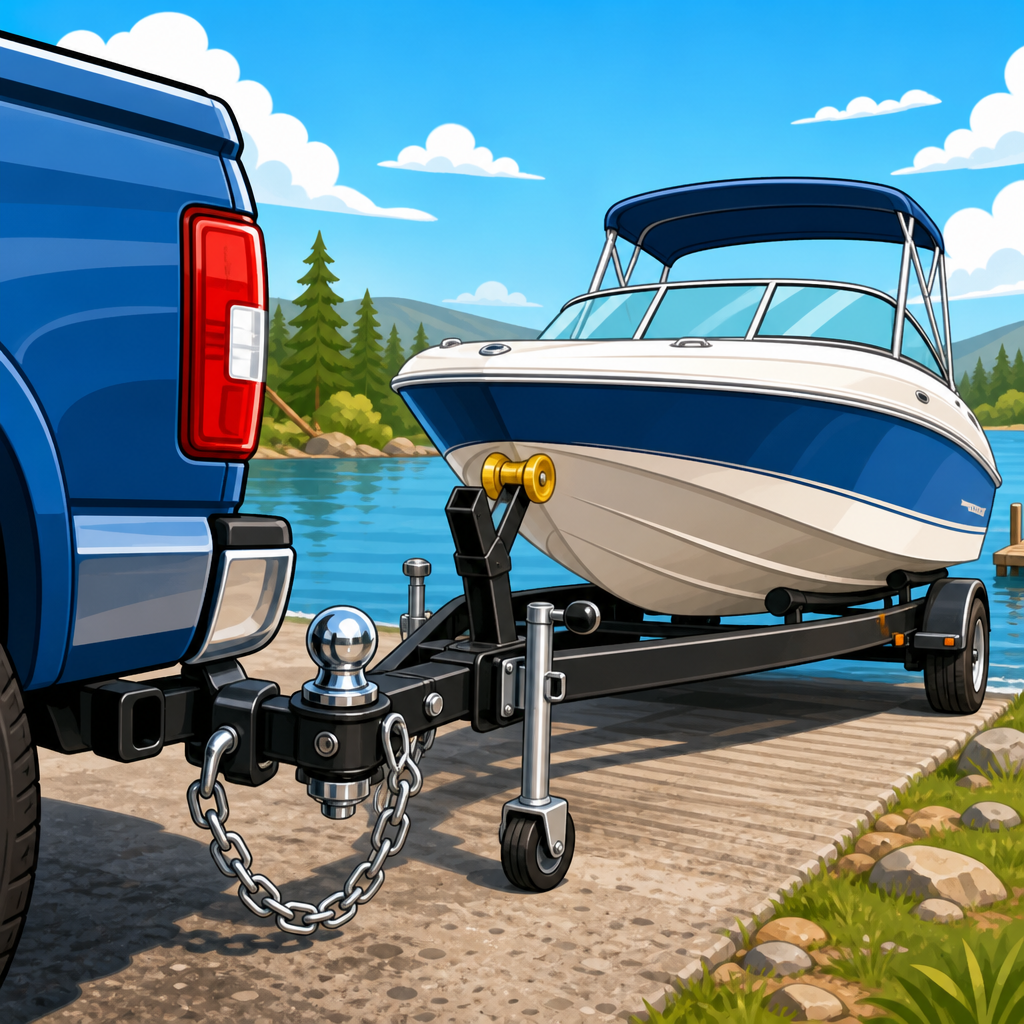
A receiver alone does not tow a boat securely. The ball mount and hitch ball determine coupler fit and trailer attitude. The most common ball sizes are 1-7/8 inch, 2 inch, and 2-5/16 inch. Small utility trailers may use 1-7/8 inch, but many boat trailers use 2 inch or 2-5/16 inch couplers. The coupler size must exactly match the hitch ball size. A mismatched ball can appear latched and still disconnect under load, especially on rough ramps or railroad crossings. I have seen couplers worn enough to feel loose even on the right ball size, which is a sign to replace the coupler rather than “make it work.”
Height is equally important. A trailer should tow level or slightly nose down, not nose high. When the tongue rides high, sway risk increases and axle loading shifts unfavorably. When the tongue rides too low, coupler clearance, braking behavior, and ramp approach angle can suffer. Measure from the ground to the top of the receiver opening on the tow vehicle, then from the ground to the bottom of the trailer coupler when the trailer is level. The difference tells you how much drop or rise you need. Adjustable ball mounts are especially useful for households that tow multiple boats or alternate between a boat trailer and utility trailer. They also make it easier to fine-tune stance after changing tire size or suspension components.
| Boat and Trailer Setup | Typical Hitch Choice | Common Ball Size | Key Setup Priority |
|---|---|---|---|
| Personal watercraft or small jon boat | Class II or light Class III receiver | 1-7/8 inch or 2 inch | Confirm actual loaded weight and tongue weight |
| 17 to 20 foot aluminum fishing boat | Class III receiver with proper drop mount | 2 inch | Keep trailer level and wiring sealed |
| 20 to 24 foot fiberglass bowrider or center console | Class III or IV receiver | 2 inch or 2-5/16 inch | Use brakes, check payload, monitor sway |
| Large wake boat or offshore boat on tandem trailer | Class IV or V receiver | 2-5/16 inch | Prioritize capacity, cooling, and corrosion resistance |
Choose a solid shank mount from a known manufacturer and use the correct pin and clip or a locking hitch pin rated for towing. Hollow, lightly plated bargain mounts can rust quickly in marine use. For the ball itself, look for a forged or hot-forged steel ball with a stamped capacity above your actual GTW. Torque the ball nut to manufacturer specification with the correct washer arrangement. Under-torqued balls can loosen; over-torqued hardware can damage threads. A little discipline here prevents expensive failures later.
Corrosion Resistance and Marine-Specific Durability
Boat towing adds one factor many general towing guides ignore: water exposure. Freshwater is easier on metal, but repeated dunking at ramps still drives moisture into connectors, chain hooks, pins, and ball mounts. Saltwater is much harsher. The best trailer hitches for secure boat transport in coastal use have durable powder coating, quality e-coat beneath the finish, stainless or corrosion-resistant hardware where practical, and seals or caps that reduce water intrusion into the receiver tube. Aftermarket anti-rattle clamps can help with noise, but they should never interfere with proper insertion depth or pin engagement.
Galvanized trailers are common in saltwater regions because they sacrifice appearance for longevity. Hitches on the vehicle side are rarely galvanized, so owners need a maintenance routine. Rinse the receiver, ball mount, safety chain hooks, and electrical connector with fresh water after immersion or spray exposure. Remove the ball mount periodically so the shank does not seize inside the receiver. Apply a light corrosion inhibitor to the hitch ball and exposed hardware, but keep grease off the ball only if your coupler manufacturer specifically advises against lubrication. Many standard couplers benefit from light lubrication to reduce wear; check the manufacturer guidance instead of guessing.
Wiring deserves special attention. Flat-four connectors are common on very light trailers, but many boat trailers with brakes use five-pin, six-pin, or seven-way connectors. Heat-shrink butt connectors, marine-grade tinned wire, and sealed LED lights dramatically improve reliability. If you launch in saltwater, dielectric grease on electrical contacts can slow corrosion, though it is not a cure for poor seals or broken insulation. When troubleshooting chronic lighting issues, look first at grounds. Trailer frames, rusted fasteners, and wet conditions create weak grounds that mimic major electrical faults.
Braking, Sway Control, and Load Balance
Secure boat transport is about more than pulling the load forward. Stopping and stabilizing the trailer are the real tests. Many states require brakes above a specific trailer weight threshold, often around 3,000 pounds, but legal minimums should not define your safety standard. Surge brakes are common on boat trailers because they work well in wet environments and do not require an in-cab brake controller. Electric-over-hydraulic systems are also used on heavier trailers and provide stronger, more tunable braking with the right controller. Conventional electric drum brakes are less common on frequently submerged boat trailers because water exposure is harder on components.
Load balance starts with tongue weight. Too little tongue weight is a primary cause of sway; too much overloads the rear axle and lightens the steering axle. Boats complicate this because gear placement changes constantly. Full fuel tanks, coolers, anchors, spare props, batteries, and trolling motors all shift weight. If a rig tows poorly despite correct hitch height, put it on a scale. Public CAT scales and trailer tongue weight scales make this measurable. I have corrected “mystery sway” by moving coolers aft to center storage, shifting gear forward of the axle, and adjusting the winch stand so the bow sat correctly on the trailer. Small changes matter.
Weight-distribution hitches are common in RV towing, but they are less common with boat trailers and may not be compatible with some surge brake couplers or launch conditions. For many boat setups, the right solution is not added hitch complexity but correct boat position, proper tongue weight, a level trailer, and adequate tow vehicle wheelbase. Sway control devices can help in some towing applications, yet a properly loaded boat trailer with the correct hitch setup should track cleanly without relying on add-ons to mask an underlying mismatch.
Best Hitch Types for Common Boat Towing Scenarios
For small freshwater boats under roughly 3,500 pounds loaded, a Class III receiver with a fixed drop ball mount is often the sweet spot. It is simple, affordable, and strong enough for most compact fishing rigs. Pair it with a 2-inch ball if that matches the coupler, crossed safety chains, functioning lights, and trailer brakes if required. This setup works well on midsize trucks, body-on-frame SUVs, and some properly rated crossovers, though crossovers often run out of payload before tow rating, especially with passengers and gear.
For midweight fiberglass boats, including many 19- to 23-foot bowriders and bay boats, a Class III or IV receiver with an adjustable ball mount is usually the better choice. Adjustable mounts help maintain level towing across different loads and trailers, and the heavier hardware generally resists flex better. If the trailer uses a 2-5/16 inch coupler, step up to a matching ball with ample capacity. Vehicles in this category benefit from factory tow packages, integrated transmission cooling, extended mirrors if needed, and a seven-way connector when brakes are installed.
For larger wake boats, offshore center consoles, and cabin boats on tandem- or triple-axle trailers, Class IV and Class V hitches are the right starting point. These boats often carry substantial fuel, batteries, ballast systems, and gear, pushing real-world loaded weight far above brochure numbers. A heavy-duty receiver, high-capacity ball mount, 2-5/16 inch ball, and robust braking system are mandatory. Owners should also evaluate tire load ratings, spare tire condition, axle service intervals, and the tow vehicle’s rear axle ratio. On steep ramps, four-wheel drive and low-range capability can matter as much as published tow capacity.
Buying Checklist, Maintenance, and Smart Upgrades
When shopping for a hitch, verify five things in order: vehicle tow rating, payload, receiver rating, ball mount rating, and ball rating. Then confirm coupler size, receiver size, drop or rise needed, wiring connector type, and brake compatibility. Read the installation instructions before purchase, because some receivers reduce spare-tire clearance or require fascia trimming on SUVs. If you install the hitch yourself, use a torque wrench, follow the hole-cleaning requirements, and recheck fasteners after the first towing miles. Improper torque is one of the most common self-install mistakes.
Maintenance should be scheduled, not improvised before a trip. Inspect the coupler latch, safety chains, hooks, breakaway cable, wiring insulation, and connector pins every launch season. Check for elongated pin holes, cracked welds, rust jacking under the hitch finish, and slop between receiver and mount. Replace worn hitch balls that show flat spots, heavy corrosion, or thread damage. Keep the trailer jack functioning smoothly and verify that the winch strap and safety chain at the bow eye are both in good condition. At least once a year, confirm trailer level and tongue weight because tire changes, suspension sag, or added accessories can quietly alter geometry.
The smartest upgrades are usually modest. An adjustable drop hitch helps level varied trailers. Sealed LED trailer lights reduce failures. A quality hitch lock and coupler lock improve security at marinas and storage yards. Better trailer tires with the correct load range are often more important than expensive accessories. If you tow in mountains or hot climates, transmission temperature monitoring and fresh brake fluid are practical upgrades. Secure boat transport comes from a complete, compatible towing system, so use this hub as your starting point and audit every component before your next launch day.
Frequently Asked Questions
What type of trailer hitch is best for secure boat transport?
The best trailer hitch for secure boat transport is the one that properly matches your tow vehicle, boat trailer, and total loaded towing weight as a complete system. For most recreational boat owners, a receiver-style hitch is the standard choice because it allows you to use the correct ball mount, hitch ball, and accessories for the trailer you are pulling. In many cases, a Class III, Class IV, or Class V hitch is used, depending on the size of the boat and the trailer’s gross trailer weight and tongue weight. Smaller fishing boats may be safely handled with a lighter-duty setup, while larger center consoles, wake boats, and cabin boats often require a heavier-rated hitch and towing package.
What matters most is not buying the “strongest-looking” hitch, but choosing one with ratings that meet or exceed the fully loaded trailer weight, including fuel, gear, batteries, coolers, anchors, and anything else carried on the boat or in the trailer. Secure towing also depends on using the correct hitch ball size for the coupler, making sure the drop or rise keeps the trailer level, and confirming the receiver, ball mount, ball, coupler, safety chains, and trailer jack all work together properly. For boat transport, corrosion resistance is also important because hitches and hardware are frequently exposed to water, road salt, and ramp conditions. A properly rated and correctly installed hitch system will always outperform an oversized but mismatched setup.
How do I know if my hitch is rated correctly for my boat and trailer?
To know if your hitch is rated correctly, you need to compare several numbers, not just one. Start with the trailer’s gross trailer weight, which is the total weight of the trailer plus the boat, fuel, gear, motor, batteries, and supplies. Then check tongue weight, which is the downward force the trailer applies to the hitch. Your hitch receiver, ball mount, hitch ball, coupler, and tow vehicle must all be rated to handle those loads. The safe rule is that the system is only as strong as its lowest-rated component, so if one part falls short, the whole towing setup is effectively limited by that part.
You should also verify your vehicle’s tow rating and payload capacity, since even a high-capacity hitch does not increase what the vehicle itself can legally or safely tow. Secure boat transport usually requires proper tongue weight balance as well, typically enough to keep the trailer stable without overloading the rear suspension. If the tongue weight is too light, the trailer may sway. If it is too heavy, steering, braking, and suspension performance can suffer. The best way to confirm your setup is to weigh the loaded trailer and tongue weight, then compare those measured numbers to the ratings on the hitch label, vehicle owner’s manual, trailer identification plate, and hitch components. Guessing is where towing problems start; verified numbers are what create a secure and predictable towing experience.
Is a weight distribution hitch necessary for towing a boat trailer?
A weight distribution hitch may be necessary for some boat trailers, but not all. Its purpose is to redistribute tongue weight more evenly across the tow vehicle’s front and rear axles and, in some cases, the trailer axles as well. This can improve steering response, braking stability, and ride height when towing heavier loads. If your boat and trailer place a significant tongue load on the back of the vehicle, or if your tow vehicle squats noticeably when connected, a weight distribution system may be recommended or required by the vehicle manufacturer once certain weight thresholds are reached.
That said, boat trailers present a few special considerations. Because they are frequently submerged at launch ramps, spring bars and related hardware may be exposed to water and corrosion. Some trailer and surge brake combinations are also not ideal candidates for certain weight distribution setups, so compatibility matters. The right answer depends on trailer weight, tongue weight, wheelbase of the tow vehicle, suspension behavior, and manufacturer guidance. If the trailer tows level, remains stable, and your measured tongue weight and vehicle axle loads are within spec, you may not need one. But if you are dealing with rear-end sag, vague steering, headlight aim issues, or unstable handling, a properly selected weight distribution hitch can make boat transport much more secure. Always check the recommendations for your vehicle, trailer, and brake system before installing one.
What causes trailer sway when transporting a boat, and can the hitch help prevent it?
Trailer sway is usually caused by an imbalance somewhere in the towing system, and yes, the hitch plays a major role in preventing it. Common causes include insufficient tongue weight, improper loading, an incorrect hitch height that leaves the trailer nose too high or too low, worn suspension components, underinflated tires, excessive speed, crosswinds, and mismatched equipment ratings. With boat trailers, sway can also be influenced by how gear is stored in the boat, whether fuel tanks are full or empty, and whether the boat is correctly positioned on the trailer bunks or rollers. Even a small mistake in setup can create instability at highway speeds.
The hitch helps prevent sway by maintaining a secure, properly aligned connection between the vehicle and trailer. Choosing the right ball mount rise or drop to keep the trailer level is one of the simplest but most important adjustments. A correctly rated receiver and ball mount also reduce flex and help the towing combination respond more predictably to bumps, lane changes, and braking. In heavier setups, sway control features or a properly matched weight distribution system may add another layer of stability, though they should never be used to compensate for poor loading or an improperly sized hitch. The first line of defense is always correct trailer balance, proper tongue weight, and a hitch setup that matches the trailer coupler and loaded towing demands. When all of those are correct, sway becomes much less likely.
What hitch maintenance and safety checks should I perform before towing a boat?
Before towing a boat, inspect the entire hitch system as if every component matters, because it does. Start with the receiver hitch itself and look for rust, cracks, bent metal, loose mounting bolts, or any sign of impact damage. Check that the ball mount is the correct size for the receiver and that the hitch pin and clip or locking pin are fully installed. Inspect the hitch ball for the correct diameter, confirm it matches the trailer coupler exactly, and make sure the ball nut is torqued properly. The coupler should latch securely over the ball without excessive play, and the safety pin or lock for the coupler latch should be in place every time.
Next, inspect the safety chains for wear, corrosion, twisted links, or improper length, and cross them under the coupler so they can help cradle the tongue if it ever disconnects. Check the breakaway cable to ensure it is attached correctly to the tow vehicle, not looped around the hitch ball or safety chains. Verify trailer wiring, brake lights, turn signals, and running lights are all functioning. If the trailer has brakes, confirm they engage correctly and that surge or electric brake components are in good condition. Also review tire pressures on both the vehicle and trailer, wheel lug torque, wheel bearing condition, winch strap security, transom straps, and the trailer jack position before moving. For secure boat transport, routine inspection is not overkill; it is the habit that prevents small equipment issues from becoming dangerous failures on the road or at the launch ramp.