A utility boat earns its keep by doing jobs that pleasure craft cannot handle reliably, repeatedly, or safely. In the broadest sense, a utility boat is a practical vessel designed for transport, hauling, maintenance, fishing support, shoreline work, rescue, or all-weather access to places where a conventional runabout would be out of its depth. Within the wider Types of Boats category, utility boats sit inside the work and utility boats segment, covering everything from compact aluminum jon boats and side consoles to welded skiffs, landing craft, shallow-draft workboats, and rugged multi-role vessels used by marinas, contractors, guides, and public agencies. If you are shopping in this category, the most important question is not simply what looks durable. It is what specific features match the job, the water, the load, and the maintenance reality you will live with after the purchase.
I have helped owners compare boats for dock work, inland property access, and fishing operations, and the same mistake appears again and again: people buy around horsepower or price, then discover that layout, hull shape, storage access, and construction details determine whether the boat is useful every day. A true utility boat must launch easily, carry weight predictably, recover from abuse, and support tools, gear, or passengers without turning simple work into a balancing act. That makes feature selection critical. The right configuration improves safety, lowers running costs, and extends service life. The wrong one creates downtime, fatigue, and expensive retrofits.
This hub article explains the top features to look for in a utility boat and how those features apply across work and utility boats as a class. It also gives you a framework you can use before reading deeper model-specific guides, comparisons, and buying articles within this subtopic. By the end, you should be able to identify the right hull, material, power setup, deck plan, and safety equipment for your intended use instead of relying on generic sales language.
Start with mission, load, and water conditions
The best utility boat is the one built around a clearly defined workload. Before comparing brands, define the mission in measurable terms: number of people onboard, total payload, towing needs, distance traveled, launch conditions, and expected sea state. A boat used to inspect docks on a protected lake needs different features from a river work skiff carrying pumps and fuel cans, or a bay boat supporting crab pots and shoreline repairs. Payload and deck activity matter as much as speed. If the boat will regularly carry three adults, a dog, a cooler, and 400 pounds of tools, that load should be treated as the baseline, not the exception.
Water type changes everything. Shallow rivers reward a flatter running surface and minimal draft. Open bays punish flat bottoms in chop and usually justify a modified-V or deeper-V hull for a softer ride and better directional control. Tidal zones may require corrosion-resistant fittings, self-bailing decks, and stronger boarding arrangements. Cold-weather operators should care about traction, enclosed storage, and reliable bilge access because wet decks and frozen hardware create real hazards. If your launch site is rough gravel instead of a paved ramp, keel protection and trailer setup move from nice-to-have features to necessities.
Beam, freeboard, and onboard workflow should also be considered early. A wider beam generally improves initial stability and usable deck space, which matters when two people are moving gear on one side. Higher freeboard can increase security and dryness, but it may make beach loading or dockside transfers less convenient. Every tradeoff should be tied back to the job.
Hull design and construction quality
Hull design is the foundation feature because it determines ride, draft, stability, fuel efficiency, and load behavior. Flat-bottom utility boats are popular for protected water, hunting access, and shallow work because they float in little water, plane quickly with modest power, and feel stable at rest. Their weakness is ride quality in chop; they pound hard and can become uncomfortable or unsafe when conditions build. Modified-V hulls split the difference, offering better wave entry and tracking while preserving practical draft and stability. Deep-V utility boats handle rougher water best, but they usually draw more water, need more horsepower, and give up some workmanlike simplicity.
Construction method matters just as much as hull shape. In aluminum boats, welded hulls are usually preferred for heavier duty use because they better tolerate repeated impacts, hard use, and commercial-style loading. Riveted aluminum boats can be lighter and less expensive, but for demanding service, weld integrity, gauge thickness, and structural bracing deserve close inspection. Ask about bottom thickness, side thickness, rib spacing, transom reinforcement, and whether high-wear zones are gusseted. On fiberglass workboats, inspect stringer construction, lamination quality, deck-to-hull joint design, and the accessibility of repair areas.
Good builders publish capacities and performance data, but the smarter evaluation happens at deck level. Walk the floor and look for flex. Open every hatch. Check weld consistency, hardware backing plates, drain placement, and how wiring is routed away from standing water or abrasion points. The strongest utility boats reveal thoughtful engineering in small details.
Layout, deck space, and storage functionality
A utility boat should make routine tasks easier, not force workarounds. Open deck space is valuable because it allows multiple roles: hauling traps one day, moving supplies the next, taking the family out after work. That said, an entirely open interior without organized storage often becomes cluttered and unsafe. The best layouts balance clear working space with secure places for fuel tanks, batteries, life jackets, anchor gear, ropes, tools, and electronics.
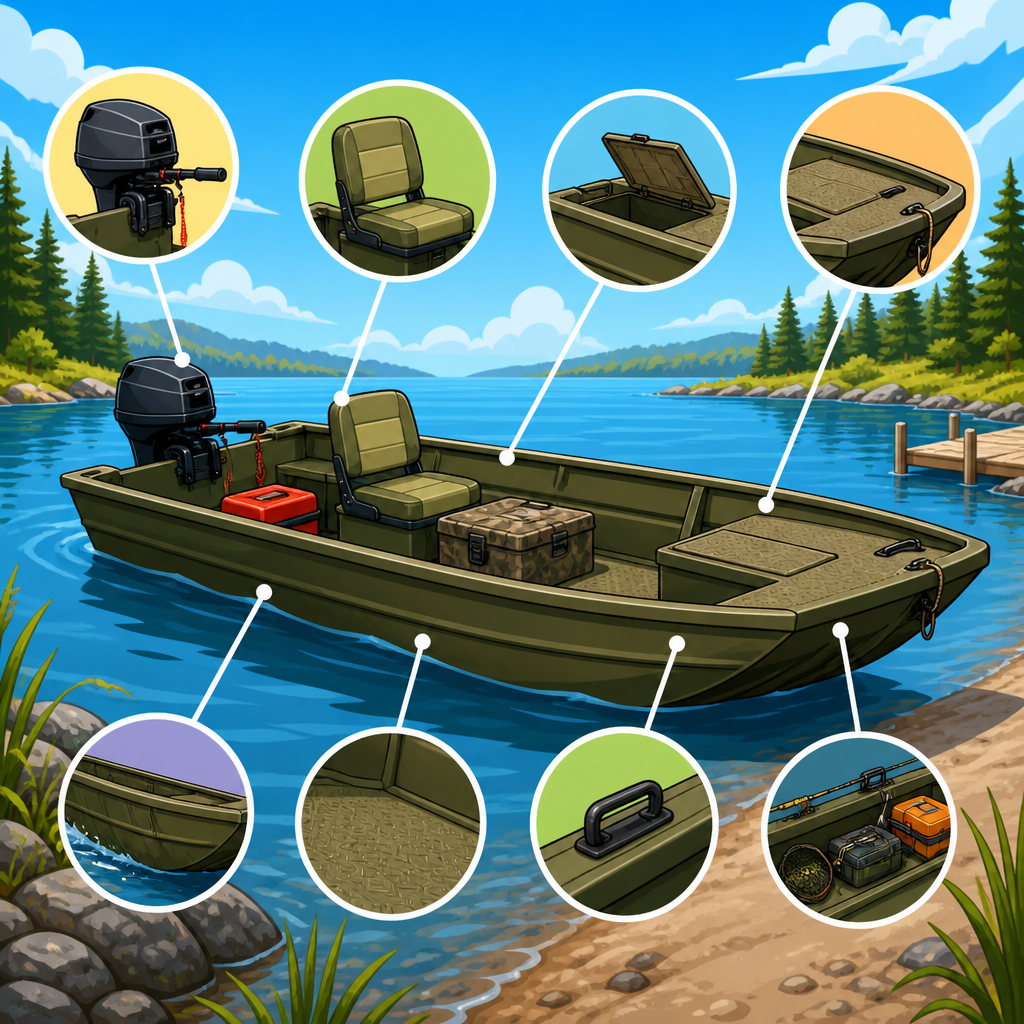
Side-console and center-console layouts preserve movement better than full-width bench arrangements when the boat is used for active work. Removable seating is an underrated feature because permanent benches can limit cargo flexibility. Flat, non-slip deck surfaces improve footing when carrying awkward loads. Storage lids should open fully without blocking movement, and compartments should drain properly. If the boat will be used around mud, fish waste, shell, or construction debris, smooth cleanout access saves time every trip.
| Feature | Why it matters | Best fit |
|---|---|---|
| Open bow or cargo deck | Improves loading of bulky gear, anchors, and shoreline supplies | Property access, marina work, hunting |
| Center or side console | Keeps walkways open and improves control visibility | Multi-role utility use |
| Self-bailing deck | Reduces standing water and speeds cleanup | Coastal and all-weather service |
| Lockable dry storage | Protects tools, electronics, and safety gear | Contractors, guides, remote access users |
| Boarding ladder or low entry point | Makes personnel transfer safer | Swim support, dock work, rescue assistance |
Think carefully about where heavy items sit. Batteries, fuel, anchors, and coolers affect trim. A boat with smart storage near the center of gravity stays better balanced and runs more predictably. In practice, that often matters more than a slight difference in top speed.
Power, propulsion, and fuel efficiency
Choosing propulsion for a utility boat is not about chasing the highest horsepower rating. It is about matching torque, reliability, and serviceability to the hull and load. Outboards dominate this category for good reason: they are easy to service, maximize interior room, and simplify shallow-water operation. Tiller steering works well on smaller boats where cockpit simplicity and weight savings matter, while remote steer setups improve ergonomics and control on larger utility hulls carrying people or equipment over distance.
Do not underpower a utility boat that will routinely haul loads. An engine running near full throttle all day can burn more fuel and suffer more wear than an appropriately sized outboard working in its efficient midrange. On the other hand, excessive power can compromise low-speed control, raise acquisition cost, and encourage unsafe operation on hulls designed primarily for work. Review manufacturer performance bulletins if available. Look for planing threshold with load, cruise fuel burn, and propeller recommendations, not just maximum speed.
Fuel capacity should match your operational pattern with reserve. Portable tanks are convenient on smaller inland boats, but built-in tanks reduce clutter and improve endurance on larger workboats. If your use includes long idle periods, towing, or repeated stop-and-go operation, alternator output becomes relevant because pumps, lights, GPS units, and live electronics draw power continuously. Owners often overlook this until batteries start failing prematurely.
For propeller selection, aluminum props are common and affordable, but stainless steel offers better durability and grip for heavier service. In debris-prone shallows, a prop guard or jet setup may be worth considering, though each comes with efficiency tradeoffs. The right answer depends on the bottom conditions you face every week.
Safety, stability, and weather readiness
Safety features in work and utility boats should be judged by prevention, not by brochure language. Stability at rest matters when passengers move suddenly, step aboard from a dock, or handle equipment over the side. Freeboard, hull beam, and load distribution all influence this. A boat that feels secure with one person can become twitchy with three adults clustered near the gunwale. That is why capacity labels should be treated as hard operational limits, not optimistic suggestions.
Look for non-skid surfaces, sturdy grab handles, proper navigation lighting, accessible fire extinguishers, and bilge pumps sized for the boat’s exposure. A self-bailing cockpit is valuable in rain, spray, and surf-zone work, but it must be paired with scuppers that do not backflow under load. Rescue and boarding features matter more than many first-time buyers realize. A reboarding ladder, transom steps, or side door can turn an incident into a routine recovery.
Weather readiness also includes windshield protection, spray deflection, canvas options, and electrical durability. Marine-grade tinned wiring, heat-shrink connections, and sealed switch panels reduce failures in wet service. In my experience, electrical shortcuts are one of the fastest ways a utility boat becomes unreliable. Corrosion starts small and then shows up when pumps or lights are needed most.
Durability, maintenance access, and long-term value
The most useful boats are not necessarily the cheapest to buy; they are the least disruptive to own. Long-term value comes from durable materials, easy inspection points, replaceable wear items, and strong parts support. Aluminum remains a favorite for many utility applications because it resists impacts well, keeps weight manageable, and is straightforward to repair. Fiberglass can provide a quieter ride and cleaner finish, but in harsh work settings it may show cosmetic damage sooner and can require more specialized repair work.
Maintenance access is a buying feature. You should be able to reach the bilge, pumps, battery terminals, fuel filters, and rigging connections without dismantling half the boat. Hinges, latches, and deck hardware should be stainless or similarly corrosion-resistant, but hardware grade alone is not enough; proper installation with sealant and backing support prevents leaks and deck damage. Trailer fit also matters. A poorly matched trailer creates hull stress, launch frustration, and premature wear.
Finally, consider dealer network, warranty terms, and resale demand. Utility boats from recognized builders such as Lund, Lowe, Crestliner, Alumacraft, and Wooldridge often hold value because buyers trust their layouts and support. The best purchase is the boat you can keep working, maintain sensibly, and adapt as your tasks change. Make a checklist based on hull, construction, layout, propulsion, safety, and serviceability, then compare each candidate against your real operating conditions. That approach will lead you to the right utility boat faster than any glossy brochure, and it will pay off every time the boat leaves the trailer for another day of dependable work.
Frequently Asked Questions
What are the most important features to prioritize in a utility boat?
The most important features in a utility boat come down to durability, stability, load capacity, layout, and propulsion. Unlike recreational boats that are designed primarily for comfort or speed, a utility boat needs to perform repeated tasks dependably in changing conditions. A strong hull is usually the first priority. Aluminum is especially popular because it is lightweight, corrosion-resistant, and able to withstand hard use around docks, shorelines, ramps, and shallow water. Welded construction is often preferred for heavy-duty use because it can offer greater long-term toughness than lighter riveted designs, especially when the boat will be used for hauling gear or working in rough environments.
Stability is just as critical. A wide beam, a flatter bottom profile, or a modified-V hull can make a major difference depending on how the boat will be used. For example, a flatter hull may provide excellent stability for loading equipment, fishing, or stepping in and out near shore, while a deeper-V may improve ride quality in choppier water. Load capacity should never be treated as a minor specification. A utility boat must carry people, fuel, tools, coolers, tackle, maintenance supplies, or even towing and rescue gear without compromising safety or performance.
The interior layout matters more than many first-time buyers expect. Open floor space, bench placement, storage compartments, tie-down points, and easy movement from bow to stern all affect real-world usefulness. Practical details such as non-slip flooring, reinforced transoms, accessory mounts, and drain plugs also add long-term value. Finally, the right propulsion setup—whether a tiller outboard, remote-steer outboard, or even electric motor support for quiet work—should match the boat’s intended tasks. The best utility boat is not the one with the most extras; it is the one built to handle the work you need it to do safely, efficiently, and repeatedly.
Which hull design is best for a utility boat?
The best hull design for a utility boat depends almost entirely on where and how the boat will be used. There is no single perfect hull for every job, which is why understanding hull shape is one of the most important parts of shopping intelligently. Flat-bottom hulls are a common choice for utility use because they draft very little water, are easy to launch, and offer excellent initial stability. That makes them ideal for calm lakes, ponds, marshes, rivers, and near-shore work where shallow access is more important than a soft ride in waves. If your tasks include hauling gear, fishing in protected water, or moving around while loading and unloading, a flat-bottom design can be extremely practical.
A modified-V hull offers more versatility. It keeps some of the stability and utility-friendly layout of a flatter boat, but adds better wave-cutting ability and improved handling in rougher conditions. For boaters who expect to work in larger lakes, open bays, or changing weather, a modified-V may be the better all-around option. Deep-V hulls are less common in pure utility applications because they can reduce interior space and stability at rest, but they are useful when ride comfort and rough-water performance are top priorities.
Another factor is how the hull affects efficiency, carrying ability, and maintenance. A stable, simple hull can be easier to clean, easier to beach, and easier to use around docks or unimproved shorelines. Chine width, beam, and transom design also influence how the boat performs under load. In practical terms, the best hull is the one that supports your environment and workload without forcing compromises in safety or access. If your utility boat will spend most of its life in shallow, protected water, a flat-bottom jon boat may be ideal. If you need a broader range of capability, especially in mixed conditions, a modified-V design is often the smarter long-term investment.
How much size and load capacity do I really need in a utility boat?
Choosing the right size and load capacity is one of the most important buying decisions because a utility boat that is too small can quickly become unsafe, inefficient, and frustrating. Buyers often focus on overall length first, but load rating and usable interior space are just as important. A compact utility boat may be easy to tow, store, and launch, but if it cannot comfortably carry your crew, fuel, equipment, batteries, safety gear, and any cargo you expect to move, it will not perform the role you need. Overloading affects stability, freeboard, fuel economy, hole shot, steering, and overall control, especially in wind or chop.
A smart approach is to think in terms of real working weight rather than passenger count alone. Start by estimating the total weight of the people who will commonly be aboard, then add the weight of fuel, anchor, trolling motor, battery, tools, fishing gear, coolers, pumps, maintenance supplies, or anything else specific to your tasks. If the boat may be used for shoreline work, duck hunting, camp access, property maintenance, or rescue support, build in extra capacity rather than shopping to the bare minimum. Utility work has a way of expanding over time, and having reserve capacity adds both flexibility and safety.
Boat size also affects ride quality and confidence. A slightly longer, wider utility boat may feel dramatically more secure and capable than a very small model, particularly when carrying uneven loads or operating in changing weather. That said, bigger is not always better if it creates towing, storage, or access problems. The ideal choice balances capacity with the places you need to launch and operate. In most cases, buyers are happiest when they choose a boat with more carrying ability and room than they think they need, provided it still fits their budget, towing setup, and storage situation.
What materials and construction details indicate a high-quality utility boat?
High-quality utility boats stand out in the details of their materials and construction, not just in brand reputation or appearance. Aluminum remains one of the most trusted materials in this category because it combines toughness, low maintenance, and relatively light weight. Marine-grade aluminum construction is especially valuable for owners who need a dependable boat for repeated work, frequent trailering, and exposure to rough handling. Thickness matters here. Heavier-gauge aluminum generally offers better dent resistance and overall rigidity, which can be important if the boat will be used around stumps, rocky landings, work sites, or heavily loaded conditions.
Construction method is another important quality marker. Welded hulls are often favored for demanding utility applications because they tend to be robust and well-suited to repeated stress. Riveted boats can still be excellent and are often lighter and more affordable, but the best choice depends on intended use and build quality. Look closely at transom reinforcement, corner bracing, flooring support, and how benches, decks, and storage compartments are integrated into the hull. A reinforced transom is especially important if you plan to run a larger outboard or carry extra stern weight such as batteries, fuel tanks, or auxiliary equipment.
Finish quality matters too, but not only for cosmetic reasons. Good drainage, sealed compartments where appropriate, corrosion-resistant hardware, and practical weld consistency all suggest a boat designed for real service life. Non-slip floor surfaces, solid grab points, and durable seat mounting can improve both safety and usability. If the boat includes electrical systems, check the quality of wiring runs, connections, and battery access. A well-built utility boat should feel purposeful and sturdy, with no wasted features and no flimsy components in high-stress areas. Ultimately, quality in this segment is about how well the boat holds up after years of loading, trailering, beaching, and working—not just how it looks in the showroom.
What practical features improve safety and day-to-day usefulness in a utility boat?
The most valuable practical features are often the ones that make the boat easier and safer to use every single trip. Good onboard organization is high on that list. Storage compartments for ropes, life jackets, tools, and fuel-related items help keep the deck clear and reduce tripping hazards. An open, uncluttered layout is especially useful in a utility boat because people may be boarding from shore, moving with gear, handling fish, operating near docks, or performing work tasks that require fast, stable movement. Wide, secure footing and non-slip surfaces make a major difference in wet or cold conditions.
Safety also improves when the boat includes proper seating placement, grab handles, navigation lights, bilge or drainage solutions, and easy access to required safety equipment. If the boat will be used before sunrise, after dark, or in remote areas, dependable lighting and electrical capacity become more important. Strong cleats, tie-down points, and a solid bow eye help with docking, towing, and securing cargo. A reinforced transom and reliable motor mounting system contribute directly to safe operation, especially under load. For owners who use their boat for hunting, rescue support, or property maintenance, boarding ladders, step plates, or side access can also be extremely useful.
Day-to-day convenience features should not be overlooked. Easy trailer compatibility, manageable hull weight, simple cleaning, and straightforward maintenance all add up over time. A utility boat should be quick to launch, easy to drain, and easy to inspect after use. Features such as accessory rails, removable seating, trolling motor mounts, livewell options, and weather-resistant storage can tailor the boat to multiple roles without sacrificing simplicity. In the end, the best practical features are those