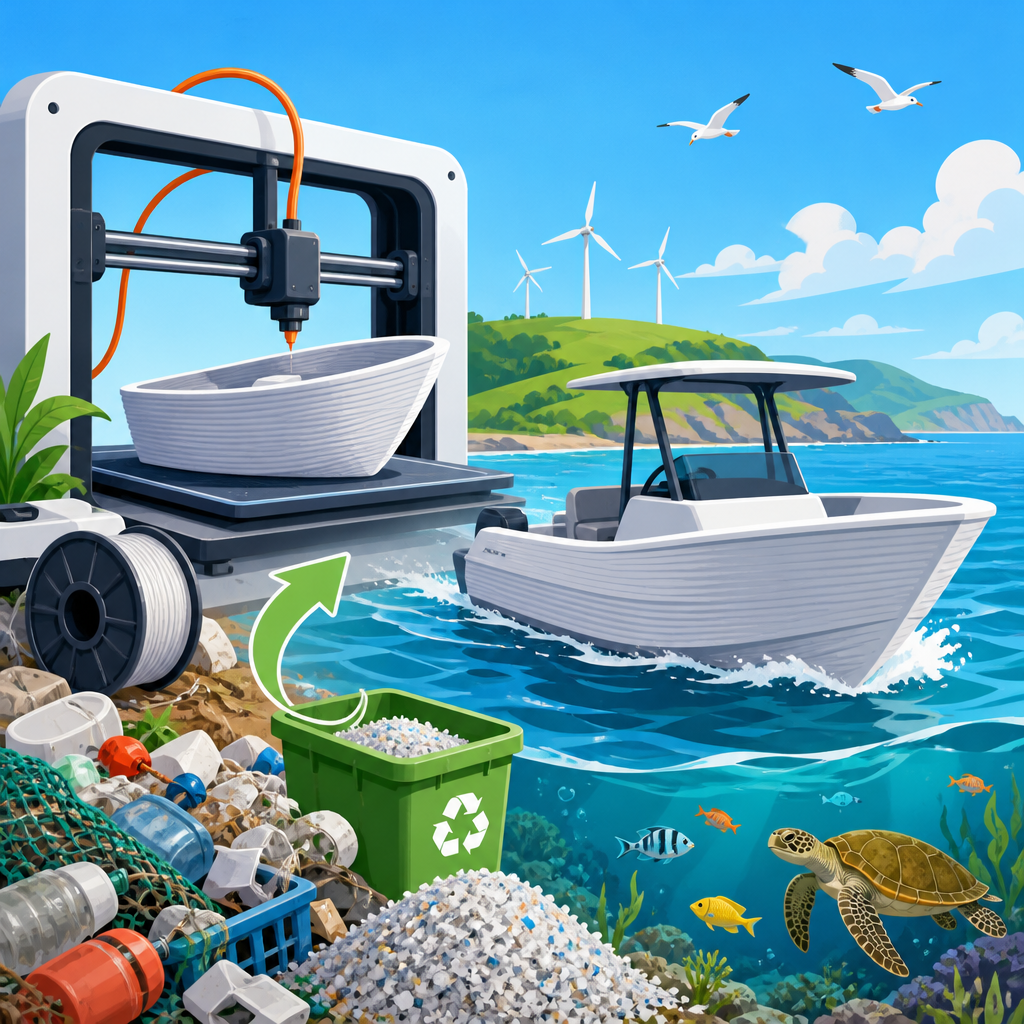
Can 3D-printed boats reduce waste in the marine industry? Yes, but only when the technology is matched with smart material choices, efficient design, realistic production volumes, and end-of-life planning. In boatbuilding, waste comes from many sources: offcuts of fiberglass cloth, excess resin, disposable molds, sanding dust, packaging, failed prototypes, and the premature replacement of parts that are difficult to repair. 3D printing, also called additive manufacturing, approaches production differently by building parts layer by layer from a digital model. That process can sharply reduce waste created during fabrication, especially compared with subtractive methods that cut material away or composite methods that depend on single-use tooling.
This matters because the marine industry faces a sustainability challenge on several fronts at once. Traditional fiberglass boats are durable and affordable, but they are energy-intensive to produce and notoriously difficult to recycle. Aluminum and steel can be recycled more easily, yet their extraction and forming still carry environmental costs. At the same time, marinas, regulators, insurers, and buyers are asking tougher questions about lifecycle impact, repairability, and the carbon footprint of marine products. I have seen this shift firsthand in conversations with builders evaluating cleaner production methods: they are no longer looking only at fuel efficiency on the water. They are also examining what happens in the yard, the factory, the supply chain, and the scrapyard.
Within the broader future of green boating technology, 3D printing is emerging as a practical hub topic because it connects to several other innovations. It affects lightweight design, electric propulsion packaging, recycled polymers, digital spare parts, modular construction, and localized manufacturing. It also forces a useful question: is sustainability better served by building boats differently, by using better materials, or by extending the life of boats already in service? The honest answer is all three. A 3D-printed hull alone will not make boating sustainable, but additive manufacturing can eliminate specific waste streams that conventional marine manufacturing has accepted for decades.
To understand the opportunity, it helps to define the main categories. Large-format additive manufacturing uses robotic arms, gantries, or pellet-fed extrusion systems to print big sections such as hull molds, deck modules, or even complete small craft. Polymer filament printing is more common for smaller components, jigs, fixtures, vent housings, and hardware covers. Hybrid methods combine printed cores or molds with fiberglass, carbon fiber, or natural-fiber laminates. In marine settings, the most relevant sustainability metrics are material utilization rate, embodied carbon, durability in saltwater and ultraviolet exposure, repairability, and recyclability. Those factors determine whether 3D-printed boats actually reduce waste or simply move it to another stage of the product lifecycle.
Where Boatbuilding Waste Comes From Today
Waste in conventional boatbuilding is structural, not incidental. In fiberglass production, a builder often creates a plug, then a mold, then the final part. Each step consumes material, labor, and energy, and errors at any stage can scrap expensive tooling. Open-mold lamination can generate volatile organic compound emissions from polyester or vinylester resins, while trimming cured parts creates dust and offcuts that are hard to recover. Even builders using vacuum infusion and closed-mold processes still discard peel ply, flow media, bagging film, and consumables after each run. Those materials do not show up in the finished boat, but they are part of the real waste profile.
Tooling waste is especially important for low-volume production, which describes much of the recreational marine market. A mold for a specialty console, seat base, or tender hull may be used for a limited production run and then stored or retired. I have visited yards where obsolete molds occupied valuable floor space for years because disposal was costly and redesign would require starting over. That legacy burden is rarely counted when people compare boat materials. Additive manufacturing changes that equation by allowing direct production or rapidly produced tooling from digital files, reducing the dependence on heavy, single-purpose molds.
There is also hidden waste in maintenance and spare parts. When a plastic vent, dash surround, or pump bracket fails on an older boat, the original component may no longer be available. Owners then replace larger assemblies or improvise with unsuitable parts, which shortens service life and leads to more discarded material. Digital manufacturing can address this problem by enabling on-demand replacement parts without maintaining large inventories. In sustainability terms, keeping existing boats functional is often more impactful than building a small number of experimental green vessels.
How 3D Printing Can Reduce Material Waste
The clearest waste benefit of 3D printing is high material efficiency during production. Because material is deposited only where the design requires it, there is far less trimming and fewer offcuts than in sheet-based or molded composite methods. In large-format systems that use pellet extrusion, manufacturers can print from thermoplastics including recycled feedstocks, then grind and reprocess some failed prints internally. That closed-loop potential is one reason shipyards, research labs, and startup boatbuilders are testing additive workflows for molds, cores, and finished parts.
Another advantage is design optimization. Engineers can print shapes that are difficult or uneconomical to make with traditional tooling, including internal stiffening structures, lattice reinforcements, cable channels, and integrated mounting points. In practice, this can reduce the number of separate components in a boat. Fewer parts usually means fewer fasteners, less adhesive, simpler assembly, and fewer opportunities for defects. For sustainability, part consolidation matters because every eliminated component removes packaging, transport, warehousing, and eventual disposal from the equation.
Rapid prototyping also reduces development waste. In a traditional program, changing the geometry of a console, cleat recess, or battery enclosure after tooling is made can be expensive and wasteful. With additive manufacturing, teams can test several iterations from the same digital workflow before committing to final production. That speeds up learning and reduces the chance of scrapping large molds or entire production runs. For a marine business working on electric boats, hydrofoils, or lightweight tenders, the ability to iterate quickly can save both material and capital.
| Marine application | Conventional waste issue | 3D-printing advantage | Main limitation |
|---|---|---|---|
| Hull or deck molds | Large, costly tooling with short useful life | Rapid printed tooling from digital files | Surface finishing still required |
| Small boat hulls | Trim waste, consumables, multiple parts | Layered production and part consolidation | Material durability must be proven |
| Spare parts | Obsolete inventory and whole-assembly replacement | On-demand local production | Quality control and certification |
| Interior fittings | Offcuts from sheet fabrication | Custom shapes with minimal scrap | UV and fire performance vary |
What Materials Make 3D-Printed Boats More Sustainable
Material choice determines whether additive manufacturing delivers a real environmental improvement. Printing with virgin plastic alone is not automatically green. The strongest cases for waste reduction involve recycled thermoplastics, recyclable polymers, bio-based composites, and hybrid systems that make repair easier. Large marine printers often use thermoplastic pellets instead of filament because pellets cost less, print faster, and can incorporate recycled content more readily. Recycled polyethylene terephthalate glycol, polypropylene, and ABS blends have all been explored in marine-adjacent applications, though each comes with tradeoffs in stiffness, heat resistance, and weathering.
Thermoplastics offer one major sustainability advantage over thermoset fiberglass: they can potentially be reheated, reshaped, or mechanically recycled. By contrast, conventional fiberglass laminates set permanently and are difficult to turn back into high-value feedstock. That is why printed molds, interior components, and non-structural parts are currently some of the most credible marine uses. For structural hulls, builders often reinforce printed thermoplastic forms with fibers or use chopped fiber-filled polymers. This can improve strength, but it may complicate recycling. The sustainability score improves when designers specify a material system that can be separated, repaired, and documented from the start.
Standards matter here. UV stability, flame spread, water absorption, and mechanical performance cannot be guessed. Builders should test to recognized marine and materials benchmarks, including ISO small craft standards where applicable, as well as ASTM methods for tensile, impact, and environmental exposure performance. In my experience, the companies making serious progress are not marketing “printed” as the innovation by itself. They are publishing data on layer adhesion, porosity control, and real service conditions such as salt fog, thermal cycling, and impact from docking.
Real-World Examples and Current Use Cases
The marine sector is still early in adopting large-scale additive manufacturing, but the examples are concrete enough to show direction. University programs and naval research teams have printed prototype boat hulls to explore rapid production and recycled polymer use. Dutch and Italian projects have drawn attention for 3D-printed small boats made from thermoplastics, often highlighting reduced labor and the possibility of using recycled feedstock. In the United States, boatyards and marine suppliers are more commonly using 3D printing for tooling, patterns, ducts, housings, and custom rigging accessories than for complete production hulls. That is typical of how industrial technologies mature: they solve small, expensive problems first.
One of the most useful examples is printed tooling for composite manufacturing. Instead of machining a mold from foam or building it by hand, a yard can print the mold or a mold master, finish the surface, and then use it for infusion or hand layup. This can shorten lead times dramatically and cut waste from one-off or short-run parts. Another practical use is replacement hardware mounts and interior trim for aging vessels, where digital scanning and additive production make restoration feasible without remanufacturing large assemblies.
These examples also show a limit. Most marine businesses are not yet replacing all conventional methods with additive manufacturing, and they should not rush to do so. The strongest sustainability gains today come from targeted applications: low-volume parts, customized components, printed molds, electric-boat enclosures, and service parts that extend vessel life. That makes 3D printing a green-boating enabler rather than a total replacement for composite, aluminum, or wood construction.
The Main Barriers: Durability, Scale, Cost, and Regulation
If 3D-printed boats are going to reduce waste at industry scale, they must perform safely in an unforgiving environment. Boats face ultraviolet radiation, wave slamming, cyclic loading, abrasion, fuel and oil exposure, and constant moisture. Layered parts can fail along interlayer boundaries if process control is poor. Surface porosity can trap moisture or require labor-intensive finishing. Thermal expansion and creep behavior also matter more on a vessel than on a decorative land-based product. These are not minor engineering details; they determine whether a printed boat lasts ten years or becomes waste far sooner than a conventional alternative.
Economics are another constraint. Large-format printers, robotic systems, drying and material handling equipment, software, and skilled operators require significant investment. For some yards, CNC cutting, infusion, and modular composite tooling are already optimized and may remain more cost-effective. There is also an energy question. Additive manufacturing can reduce material waste while still consuming substantial electricity, especially in heated environments or long print cycles. A credible sustainability assessment therefore needs lifecycle analysis, not just a tally of production scrap.
Regulatory acceptance can slow adoption as well. Builders selling production boats must satisfy design categories, flotation requirements, fire safety expectations, and insurer concerns. Classification societies and surveyors will ask for material traceability, process repeatability, and repair protocols. That scrutiny is appropriate. Green technology in boating succeeds only when it is both lower-waste and seaworthy. The path forward is careful qualification, pilot projects, and transparent testing rather than headline-driven experimentation.
How 3D Printing Fits the Future of Green Boating Technology
As a hub topic within eco-friendly and sustainable boating, 3D printing connects directly to the technologies that will shape lower-impact vessels over the next decade. Lightweight structures improve range for electric boats. Digital part consolidation creates more usable space for batteries and control systems. Localized manufacturing can reduce transport emissions and shorten service timelines. On-demand spares support circular maintenance models, where parts are repaired or reproduced instead of discarded. These are practical, not theoretical, advantages.
The most promising future is a hybrid one. Expect printed molds for cleaner composite production, printed thermoplastic interiors designed for disassembly, recyclable workboat components, and digital inventories for marinas and service yards. Also expect better pairing with recycled materials, robotic finishing, and software-driven topology optimization. Builders that combine additive manufacturing with lifecycle thinking will reduce waste most effectively because they will design for production, operation, repair, and retirement as one system rather than separate decisions.
3D-printed boats can reduce waste in the marine industry, but the biggest gains come from using additive manufacturing where it solves a specific waste problem. It works best when it replaces disposable tooling, cuts scrap in low-volume production, enables recycled or recyclable materials, and extends the service life of boats through on-demand parts. It works poorly when the printed object is treated as sustainable by default, without proof of durability, repairability, and end-of-life options.
For builders, buyers, and marina operators, the key takeaway is simple: focus on lifecycle value, not novelty. Ask what material is being used, how much scrap is avoided, how the part will be repaired, and what happens when it reaches end of life. Those questions reveal whether 3D printing is reducing waste or merely shifting it. In the broader future of green boating technology, additive manufacturing deserves a central place because it links cleaner production with smarter maintenance and better design.
If you are building a sustainable boating strategy, start by identifying one application where waste is measurable today—tooling, spare parts, or low-volume custom components—and evaluate whether 3D printing can improve it. That practical first step will tell you more than any marketing claim.
Frequently Asked Questions
How can 3D-printed boats reduce waste compared with traditional boatbuilding?
3D-printed boats can reduce waste because additive manufacturing builds parts layer by layer, placing material only where it is needed instead of cutting shapes out of larger sheets or relying on labor-intensive mold-based processes. In conventional marine manufacturing, waste often comes from fiberglass offcuts, excess resin, disposable tooling, sanding dust, trimming, packaging, and multiple prototype iterations. By contrast, 3D printing can streamline production by combining several parts into one printed component, reducing assembly waste and lowering the number of consumables required during fabrication.
Another important advantage is design precision. Digital modeling allows builders to optimize hull sections, interior structures, and secondary components before production begins, which can reduce material overuse and minimize errors. If a part needs to be changed, the file can often be updated without scrapping expensive molds or retooling an entire production line. That flexibility can be especially useful for custom parts, replacement components, and low-volume builds where traditional tooling waste would otherwise be high. Still, the waste-saving benefits are strongest when printing is used strategically, not simply as a substitute for every established boatbuilding method.
What types of waste in the marine industry are most likely to be reduced by 3D printing?
3D printing is most likely to reduce waste tied to material inefficiency, tooling, prototyping, and spare-part production. In traditional boatbuilding, large amounts of waste are generated from cutting fiberglass cloth, applying excess resin, building one-time molds, trimming cured laminates, and discarding trial parts that do not fit properly. Additive manufacturing can help address several of these issues by using only the amount of feedstock needed for the final geometry and by making it easier to test designs digitally before producing physical parts.
It can also reduce inventory-related waste. Marine manufacturers and repair yards often keep rarely used replacement parts in storage or discard outdated stock when designs change. With 3D printing, certain components can be produced on demand, which lowers the need for overproduction and long-term warehousing. This approach may be particularly useful for brackets, housings, ducts, fittings, interior panels, and non-structural custom components. In some cases, it can also extend the life of a vessel by making older, hard-to-source parts easier to replace instead of forcing premature upgrades or full component replacement. However, savings vary depending on whether the printed part is structurally appropriate, durable in marine conditions, and made from materials that can be responsibly reused or recycled.
Are 3D-printed boats automatically more sustainable, or are there tradeoffs?
No, 3D-printed boats are not automatically more sustainable. The technology has real potential to cut waste, but the outcome depends heavily on material selection, energy use, production scale, and end-of-life planning. If a boat or marine component is printed from difficult-to-recycle polymers, requires large amounts of energy, fails early in service, or cannot be repaired easily, the environmental benefits can shrink quickly. In other words, additive manufacturing can reduce waste in one stage of production while creating new challenges somewhere else in the lifecycle.
There are also practical tradeoffs related to performance and durability. Marine environments are harsh: saltwater, UV exposure, temperature swings, impact, and fatigue all place serious demands on materials. A printed part that works well in a prototype setting may not always match the long-term reliability of a conventionally manufactured equivalent. That means sustainability should be measured across the full lifespan of the boat, not just at the point of manufacture. The best results usually come when 3D printing is paired with thoughtful engineering, realistic application choices, recyclable or lower-impact materials, and a maintenance strategy that supports repair rather than replacement.
Which boat parts are best suited for 3D printing if the goal is to reduce waste?
The best candidates are typically parts that benefit from customization, small production runs, complex shapes, or on-demand replacement. Examples include non-structural interior features, cable guides, vents, housings, brackets, storage components, dashboard elements, light-duty fittings, jigs, tooling, and prototype parts. These applications often deliver the clearest waste-reduction benefits because they avoid unnecessary machining, reduce the need for molds, and make it possible to produce only what is needed when it is needed.
3D printing can also be valuable for replacement parts in older vessels, especially when original molds no longer exist or sourcing from suppliers would create excessive shipping, packaging, and delay. In those cases, printing a part locally can keep a boat in service longer and reduce waste associated with full-system replacement. For larger structural components, the picture is more nuanced. Some advanced projects have successfully printed sizable hull sections or boat bodies, but these applications require careful engineering, suitable materials, and strong quality control. From a waste-reduction standpoint, the smartest path is often selective adoption: use additive manufacturing where it clearly improves material efficiency and repairability, while continuing to rely on proven conventional methods where they remain more durable or resource-efficient.
What needs to happen for 3D-printed boats to meaningfully reduce waste across the marine industry?
For 3D-printed boats to make a meaningful difference, the industry needs more than impressive prototypes. It needs a full systems approach that includes smart design, responsible feedstock choices, efficient printer operation, realistic production volumes, and clear end-of-life planning. Designers must create parts for additive manufacturing rather than simply printing shapes that were originally intended for other methods. Material suppliers need to expand options for recycled, recyclable, and marine-appropriate feedstocks. Builders need to track print failures, support structures, and energy use so that waste is measured honestly rather than assumed to be lower.
Repair and circularity are just as important. A printed boat or boat part offers the greatest waste benefit when it can be maintained, refurbished, and eventually recycled or repurposed. Standardized digital part libraries, localized production networks, and better material recovery systems could all help reduce overproduction and unnecessary disposal. At the same time, companies should focus on applications where additive manufacturing provides a clear advantage, such as custom components, replacement parts, tooling, and limited-run production. When 3D printing is matched with the right use cases and supported by lifecycle thinking, it can become a practical tool for reducing waste in the marine industry rather than just a novel manufacturing experiment.