Buying a used boat can save substantial money, but hidden transom rot is one of the fastest ways to turn a smart purchase into an expensive structural rebuild. The transom is the reinforced vertical section at the stern that carries the outboard motor, sterndrive loads, trim forces, and repeated shock from waves. In many fiberglass boats built over the last several decades, the outer skin looks solid while the core inside is plywood or composite. When water gets through mounting holes, stress cracks, bad sealant, or neglected fittings, that core can soften, delaminate, and lose strength long before the surface shows dramatic failure. I have inspected boats that looked glossy at the dock yet flexed dangerously once the engine was trimmed up, and those cases nearly always traced back to moisture trapped in the transom structure.
That is why learning how to inspect a boat before buying starts with understanding hidden structural risk, not just cosmetics. A soft seat cushion is cheap; a transom replacement can run from several thousand dollars on a small outboard skiff to well into five figures on a larger fiberglass boat with extensive teardown. This guide is the hub for used-boat pre-purchase inspection, with transom rot as the central issue because it often overlaps with stringer decay, wet decks, poorly sealed hardware, and neglected maintenance. You will learn what transom rot is, why it matters to safety and resale value, which warning signs show up on land and on the water, what tools help verify suspicion, and when to call a marine surveyor. If you are serious about buying smart, this process will help you separate a fixable issue from a deal-breaking structural defect.
What transom rot is and why buyers miss it
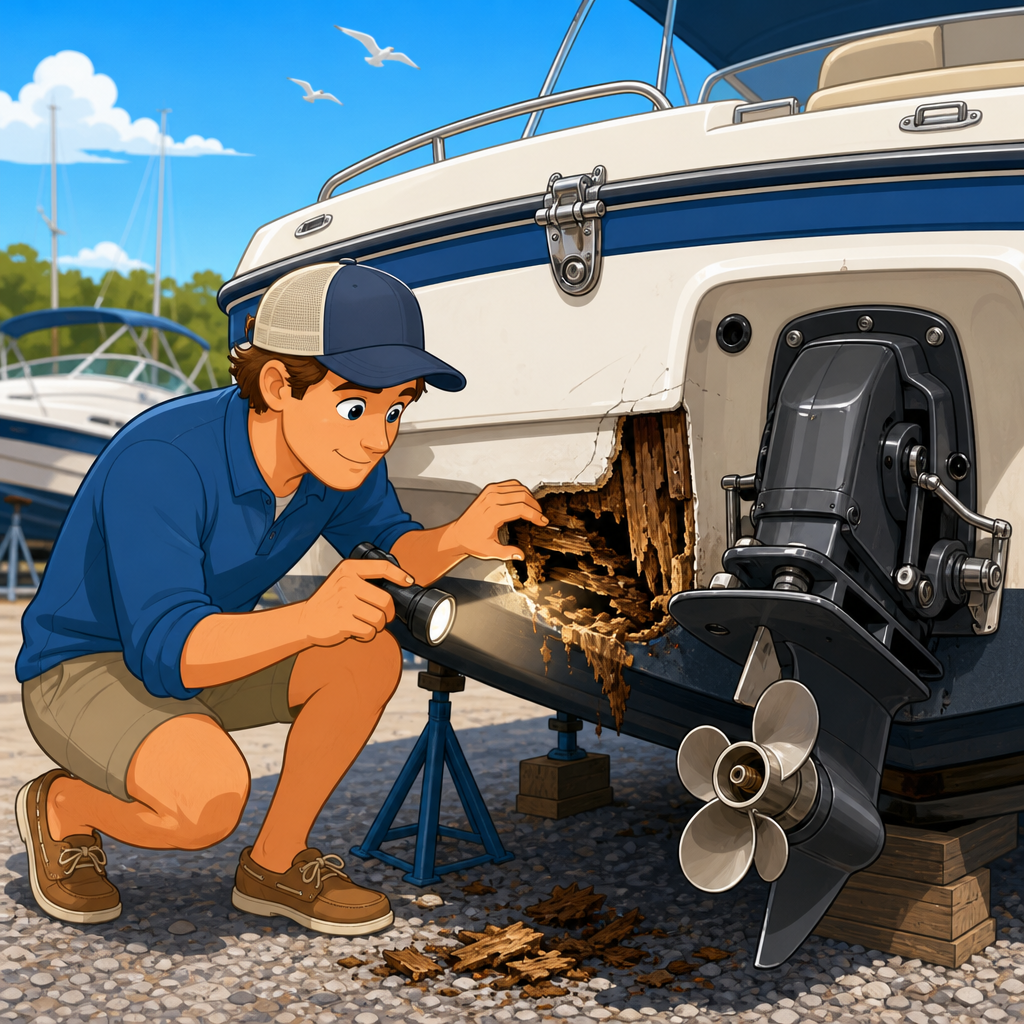
Transom rot is deterioration of the core material inside the stern structure, usually caused by water intrusion over time. On many older fiberglass boats, that core is marine plywood laminated between fiberglass skins. Water enters through unsealed bolt holes for the engine bracket, swim platform hardware, transducers, tie-down eyes, ladder mounts, or splashwell drains. Once trapped, moisture can break down wood fibers, reduce compression strength, and separate the core from the fiberglass skins. The result is a transom that may still appear shiny and intact from outside while losing the stiffness needed to support engine weight and thrust.
Buyers miss it because the earliest signs are subtle. Sellers often clean and wax the stern, and many small cracks around fittings are dismissed as normal age. A boat may sit on a trailer with the motor tilted down, masking flex that appears only under load. Some owners genuinely do not know there is a problem. Others know enough to avoid discussing soft spots, recurring sealant repairs, or a bilge that never seems dry. During one inspection, I found a strong-smelling fresh bead of silicone around engine bolts on a nineteen-foot center console. The outside looked recently maintained, but moisture readings and percussion tapping told a different story: the core around the upper mounting holes was saturated and beginning to crush.
Hidden transom rot matters because it affects safety, seaworthiness, and value at once. A weakened transom can let the outboard shift, crack the splashwell, loosen steering components, and eventually fail under acceleration or in rough water. Even moderate rot complicates insurance, financing, and resale because survey findings follow the boat. If you are learning how to inspect a boat before buying, treat the transom as a primary structural checkpoint, not a minor cosmetic concern.
Start with paperwork, history, and build details
Before touching the boat, ask questions that establish risk. Request maintenance records, prior surveys, invoices for repowers, and receipts for transom or engine-mount work. A repowered boat deserves extra scrutiny because increased horsepower or added engine weight can overstress a marginal stern. Check the capacity plate or manufacturer specifications and confirm the installed engine is within rated limits. If the seller says the transom was rebuilt, ask who did the work, what core material was used, whether moisture-damaged stringers or knees were also repaired, and whether backing plates and holes were epoxy sealed. A legitimate rebuild usually leaves a paper trail.
Boat age and construction style matter too. Many fiberglass outboard boats from the 1970s through early 2000s used plywood-cored transoms. Some premium builders used better lamination schedules and drainage design, but none are immune to water intrusion if fittings were installed carelessly. Aluminum boats can also suffer transom problems, though corrosion, cracked welds, and wet wood encapsulated behind aluminum skins are more common than classic fiberglass delamination. On sterndrive boats, inspect the transom assembly cutout closely because bellows leaks and hardware penetrations can direct water into the core.
Ownership and storage patterns provide clues. Boats stored bow-high and covered properly often fare better than stern-low boats left uncovered with standing water in the splashwell. Freshwater use can be gentler on hardware, but freshwater boats still rot if holes are unsealed. Saltwater accelerates corrosion around fasteners, which can enlarge pathways for water entry. A boat that has changed hands frequently with little documentation deserves a more skeptical inspection than a one-owner boat with organized records and winterization receipts.
Visual inspection: what to look for at the transom and nearby structure
Begin with a systematic walkaround on the trailer or lift. Look for stress cracks radiating from engine mounting bolts, splashwell corners, drain fittings, trim-tab mounts, transducers, and tie-down eyes. Hairline gelcoat crazing alone is not proof of rot, but clustered cracks around high-load points deserve attention. Sight down the transom from each side. Any hook, bulge, depression, or asymmetry may indicate compression or prior repair. Check whether the outboard sits square. Misalignment can suggest damaged mounting holes or a flexing transom.
Inside the boat, inspect the splashwell, bilge, aft compartments, and access ports. Dark staining, peeling tabbing, exposed raw wood, swollen fiberglass, mold lines, or unusually wet foam nearby all suggest chronic water intrusion. Use your nose. A musty, sweet rot odor in an enclosed bilge often tells the story before instruments do. Examine the seam where the transom meets stringers and knees. If the tabbing is cracked or separating, the structure may be moving under load. Also look at the deck near the stern. A soft aft cockpit sole often accompanies transom issues because water rarely stays isolated to one component.
Pay attention to repair signatures. Different gelcoat color, uneven fairing, oversized washers, fresh sealant around old hardware, or nonmatching bolts can mean previous water intrusion or a localized repair. Repair is not automatically bad; many rebuilt transoms are stronger than original construction when done correctly with epoxy, proper laminates, and sealed penetrations. What matters is quality, documentation, and whether the surrounding structure was addressed.
Hands-on tests and tools that reveal hidden damage
Once visual checks are done, use simple physical tests. With the engine lowered, grasp the lower unit or skeg and apply steady upward and side pressure. You are not trying to damage anything; you are feeling for transom movement independent of the hull. Excess flex, creaking, or visible separation around the splashwell is a warning sign. Watch the top of the transom and engine bolts while someone else gently rocks the motor. On a healthy structure, movement should be minimal and unified. On a weak transom, the skin can visibly deflect.
Percussion sounding is one of the oldest and most useful techniques. Tap the transom in a grid pattern with a phenolic hammer or the plastic handle of a screwdriver. Solid laminate over dry core usually produces a crisp, sharp note. Wet or delaminated areas tend to sound dull and flat. This method takes practice because thickness changes and internal bracing affect tone, but side-by-side comparison often makes suspect zones obvious. I rely on sounding heavily during preliminary inspections because it is fast, non-destructive, and surprisingly informative when combined with visual context.
A marine moisture meter adds another layer, especially on fiberglass hulls. Tools from Tramex and Sovereign are common in the field, though all moisture meters require interpretation. Bottom paint, metal backing plates, laminate thickness, and trapped condensation can skew results. A high reading alone does not prove structural rot, but elevated readings around hardware penetrations, engine bolts, and splashwell corners should never be ignored. If access allows, inspect the inside of bolt holes by loosening one fastener at a time with seller permission. Dark, wet wood fibers on the threads are strong evidence of core saturation.
| Inspection method | What it can reveal | Main limitation |
|---|---|---|
| Visual check | Cracks, staining, poor repairs, hardware leak paths | Early internal rot may leave no surface clues |
| Engine flex test | Structural movement under load | Severely damaged boats are easiest to identify; mild cases can be subtle |
| Percussion sounding | Delamination or softened core zones | Requires experience and comparison across the surface |
| Moisture meter | Elevated moisture near penetrations and suspect areas | Readings can be affected by metal, laminate thickness, and coatings |
| Fastener inspection | Wet wood, crushed core, poor bedding practices | Needs access and seller approval |
| Professional survey | Integrated structural assessment and written valuation impact | Costs money and may still recommend invasive follow-up |
Sea trial clues, surveyor red flags, and the full pre-purchase inspection process
A sea trial can confirm what dockside inspection suggests. Watch the transom while accelerating onto plane, crossing wakes, and trimming the engine. Excess vibration, unusual splashwell movement, steering misalignment, or creaks from the stern are concerning. On some boats with wet transoms, you can actually see the engine oscillate relative to the hull when shifting from idle to forward thrust. Also monitor bilge water. New water entering around the stern after basic operation may point to failed seals, drains, or transom penetrations.
Because this is a hub for how to inspect a boat before buying, keep transom checks connected to the larger structural picture. Inspect the hull bottom for repairs, osmotic blistering, and impact damage. Check stringers, bulkheads, floors, fuel tank compartments, steering systems, wiring quality, battery installation, and trailer fit. Compression-test the engine, scan electronic fault codes if supported, and verify the hull identification number matches title documents. On outboard boats, inspect mounting height, backing plates, and whether mounting holes show elongation. On sterndrives, inspect the transom assembly, gimbal area, and bellows. A weak transom often exists alongside other deferred maintenance.
Know when to stop and hire a surveyor. If the boat is valuable, older, recently repowered, or shows conflicting signs, a SAMS or NAMS-accredited marine surveyor is worth the fee. Surveyors combine moisture readings, sounding, sea-trial observations, and repair-cost context in a written report that supports negotiation. They also know the difference between acceptable cosmetic stress and structural movement that compromises safety. Invasive testing such as core samples is rarely done casually, but when every non-destructive clue points toward hidden damage, it may be the only way to confirm the extent before purchase. If a seller refuses reasonable inspection steps, treat that as a red flag in itself.
Checking a used boat for hidden transom rot is really about making a disciplined pre-purchase decision based on structure, not shine. Start with history and documentation, then inspect the transom visually, physically, and under way. Look for crack patterns around hardware, moisture pathways, movement when the engine is loaded, dull sounds during tapping, and evidence of poorly sealed fasteners. Keep the bigger inspection picture in view, because wet transoms often overlap with compromised stringers, decks, and stern hardware. A boat can have a beautiful gelcoat finish and still hide expensive structural decay where it matters most.
The main benefit of this process is simple: you protect your safety and your budget before the title changes hands. If the transom is sound, the rest of the purchase becomes easier to evaluate. If it is wet or flexing, you either negotiate from solid evidence or walk away before inheriting a major rebuild. Use this article as your buying checklist hub, apply the same rigor to the hull, engine, and systems, and bring in a qualified marine surveyor whenever the clues do not line up. Inspect carefully, ask direct questions, and never let a clean exterior outrank structural proof.
Frequently Asked Questions
What are the most common signs of hidden transom rot in a used boat?
Hidden transom rot often reveals itself through a combination of subtle visual clues, movement, and changes in sound rather than one obvious failure. One of the first things to look for is cracking around the motor mounts, splashwell corners, drain fittings, or along the transom cap. These cracks do not always mean the transom core is rotten, but they can indicate that the fiberglass skin is flexing more than it should because the material inside has weakened. Another warning sign is discoloration or water staining near bolt holes, drains, tie-down eyes, trim tab fasteners, or transducers. If water has been entering through improperly sealed hardware for years, the core can deteriorate long before the outer fiberglass looks damaged.
You should also pay attention to movement. When an outboard is trimmed up slightly and gently rocked by hand, a solid transom should feel firm and unified with the hull. Excess flex, creaking, or a delayed “spongy” response can indicate structural deterioration inside the core. Inside the boat, inspect the splashwell and any accessible inner transom skin for bulges, separated fiberglass, ripples, or repaired sections that appear newer than the surrounding area. In severe cases, the inner skin may show compression marks around large washers or backing plates, suggesting the engine mounting bolts have been pulling into softened material.
A tap test can also be revealing. Tapping the transom with a plastic or phenolic hammer should produce a relatively crisp, consistent sound across healthy areas. Dull, dead, or uneven tones may point to moisture intrusion, delamination, or rotted core sections. None of these signs alone is absolute proof, but when several appear together, they strongly suggest the need for deeper inspection before purchase.
How can I physically test a used boat’s transom before buying it?
A careful physical inspection starts with the boat out of the water, where you can see the entire stern and apply light pressure safely. Begin by visually checking the transom from outside and inside. Look for stress cracks radiating from engine bolts, jack plate mounts, swim platform brackets, ladder fasteners, trim tabs, and drain fittings. Then inspect the bottom corners of the transom, where water often collects and where damage frequently begins. If the boat has a splashwell, lean in and inspect around bolt heads, sealant lines, and corners for signs of movement, poor repairs, or moisture staining.
Next, gently test for flex. With the motor trimmed up enough to give leverage but not dangerously high, grasp the lower unit and carefully rock it up and down and side to side. The key is not to force it aggressively, but to observe whether the transom moves independently, whether the splashwell flexes, or whether you hear cracking, popping, or wet creaking sounds. A healthy transom typically feels tight and integrated into the hull structure. If the engine seems to make the transom “work” or the inner fiberglass skin visibly shifts, that is a serious warning sign.
After that, perform a tap test over the entire transom, both inside and outside where accessible. Healthy laminate over a sound core usually gives a sharper, more uniform note, while compromised areas often sound muted or hollow. A moisture meter can add useful information, especially around hardware penetrations, but readings in fiberglass boats must be interpreted carefully because metal, laminate thickness, and bottom coatings can distort the results. If the seller allows it, removing one or two non-critical fasteners such as an accessory screw can be very informative. Dark, damp, soft, or foul-smelling wood on the threads is a bad sign. For high-value purchases, the best physical test is still a professional marine survey combined with moisture mapping and, when justified, limited invasive inspection.
Where does water usually get into the transom, and why is rot often hidden?
Water usually enters a transom through hardware penetrations and damaged sealing points rather than through the fiberglass skin itself. The most common entry points are outboard mounting bolts, transducer screws, tie-down eyes, trim tab screws, swim platform brackets, stern lights, boarding ladders, and drain tubes. Any hole that was drilled into the transom core and not properly sealed can become a pathway for moisture. Over time, even a once-correct installation can fail if sealant dries out, bolts loosen, fittings shift under load, or freeze-thaw cycles create microscopic gaps.
Rot is often hidden because fiberglass skins can remain visually intact long after the plywood core behind them has become saturated and structurally weak. In many boats, the transom is built like a sandwich: fiberglass on the outside, a wood or composite core in the middle, and fiberglass on the inside. If water enters the core, it can spread along the grain of plywood or through voids, but the outer surfaces may still look smooth and glossy. That is why a boat can appear cosmetically clean while harboring major internal damage.
Another reason hidden rot is so deceptive is that transom loads are intermittent. The transom may seem fine sitting on a trailer, but under engine thrust, wave impact, trimming forces, and road vibration, weakened sections can flex dramatically. Sellers may not notice the problem, or they may mistake the early symptoms for normal age-related cracking. Because deterioration often begins around one fitting and slowly migrates, damage can remain localized for a time before becoming widespread. That is why every penetration at the stern deserves close attention during a pre-purchase inspection.
Can a boat with some transom moisture still be worth buying?
Yes, but only if you understand exactly what you are buying, how advanced the damage is, and what the repair will cost relative to the boat’s value. Not every elevated moisture reading means catastrophic rot. Some boats show mild moisture around an old fitting or a drain tube without major structural loss, especially if the issue is caught early and limited to a small area. In those cases, targeted repairs such as rebedding hardware, replacing a drain tube, drying localized sections, or performing a small core repair may be manageable.
The problem is that moisture and structural failure are not the same thing, and you need to know which one you are dealing with. A damp transom that is still hard, stable, and free of flex is very different from a transom that compresses around bolts, sounds dead across large sections, or moves under engine load. Once the core loses integrity, repair usually becomes much more invasive and expensive. Full transom replacement on a fiberglass boat can involve removing the engine, cutting inner or outer skins, replacing core material, re-glassing, fairing, finishing, and reinstalling all hardware correctly. Costs can quickly exceed the value of an older boat.
If you are considering buying a boat with suspected transom issues, get a marine surveyor or qualified fiberglass repair specialist involved before committing. Ask for a realistic estimate, not a best-case guess. Then compare the total purchase price plus repair cost against the market value of a similar boat with a verified sound transom. A compromised transom does not automatically make a boat a bad buy, but it should always change the negotiation, the risk assessment, and your willingness to proceed.
Should I hire a marine surveyor, and what should I ask them to check?
If there is any suspicion of hidden transom rot, hiring a marine surveyor is one of the smartest steps you can take. A surveyor brings experience, methodical inspection habits, and tools that most buyers do not have. More importantly, a good surveyor knows how to distinguish between cosmetic age, normal stress cracking, moisture that is concerning but manageable, and structural deterioration that should stop the sale. On a used boat purchase, especially one with a larger outboard, a bracket, a jack plate, or signs of previous repairs, a professional assessment can save you from an expensive mistake.
When you speak with the surveyor, specifically ask them to focus on the transom, engine mounting area, splashwell, drain fittings, and any stern-mounted accessories. Ask whether they will perform percussion sounding, moisture meter readings, and close inspection of fastener penetrations. If the boat has signs of repair, ask whether the work appears cosmetic or structural. You should also ask them to inspect adjacent areas that can be affected by the same water intrusion, including stringers, the aft deck, bilge compartments, and the hull-to-transom joints. In some cases, transom issues are part of a broader moisture problem, not an isolated defect.
It is also wise to ask the surveyor how confident they are in their findings and whether they recommend any invasive confirmation by a repair yard. Surveyors are often limited in how much they can disassemble, so if readings are questionable or symptoms conflict, the next best step may be to have a shop remove a fitting or inspect a core sample with the seller’s permission. A thorough survey is not just about identifying damage; it is about giving you enough reliable information to negotiate intelligently, walk away when necessary, or buy with confidence.