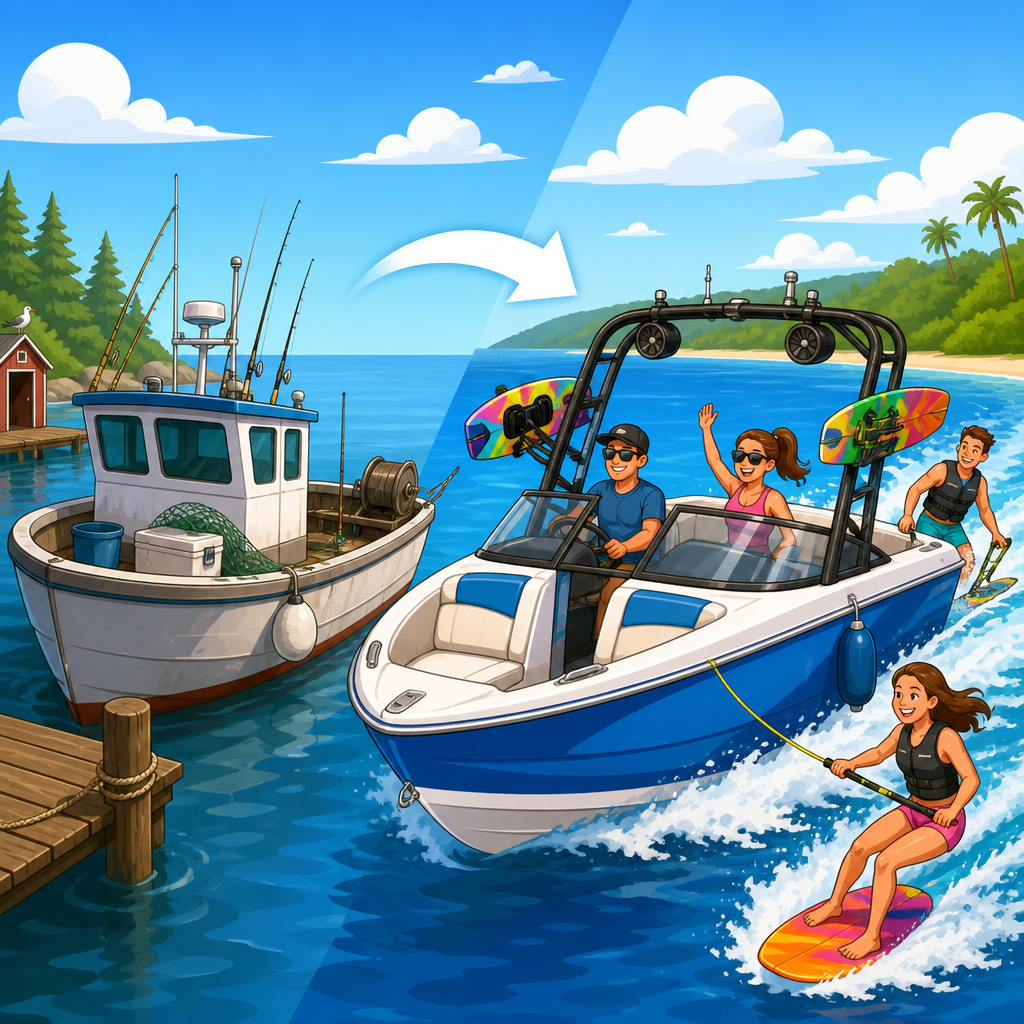
Converting a fishing boat into a watersports boat is one of the most practical ways to get more value from a single hull, especially for families who want to troll in the morning, pull a tube in the afternoon, and keep storage, safety, and comfort in balance. A fishing boat is designed around stability, open deck space, rod access, livewells, and fishability, while a watersports boat prioritizes tow geometry, passenger seating, acceleration, wake behavior, and protection for people moving around the cockpit. A multi-purpose boat for fishing and watersports sits between those priorities. It will never match a dedicated bass boat for tournament efficiency or a purpose-built wake boat for surf performance, but with the right upgrades it can serve both jobs remarkably well. I have worked through these conversions with aluminum deep-V models, bay boats, dual consoles, and center consoles, and the same pattern always holds: success depends less on flashy accessories and more on hull suitability, engine setup, towing hardware, weight distribution, and safe passenger flow. This matters because many owners already have the right starting platform and do not need to buy a second boat. With fuel, storage, maintenance, and insurance costs rising, a well-planned conversion can extend the usefulness of an existing rig while keeping it compliant, comfortable, and enjoyable for mixed-use days on the water.
The best candidate is usually a stable runabout-style fishing boat, dual console, fish-and-ski model, modified-V aluminum boat, or bay boat with enough freeboard, horsepower, and cockpit room to manage skiers, tubers, and extra passengers. Key terms matter here. Tow point means the attachment location for a rope, ideally elevated and engineered to handle lateral loads. Hole shot describes how quickly the boat accelerates onto plane, which is critical when pulling a rider from the water. Prop pitch affects acceleration versus top speed. Trim changes running attitude and can improve pull efficiency or passenger comfort. Wake size, tracking, and chine behavior influence how suitable the boat feels for tubing, skiing, or casual wakeboarding. As the hub article for multi-purpose boats for fishing and watersports, this guide covers the full conversion logic: how to evaluate your hull, which upgrades deliver the biggest improvement, how to set up seating and storage, what legal and insurance issues to check, and where the tradeoffs remain. If you want one boat to fish and play without making unsafe compromises, the process starts with choosing realistic goals and building around the capabilities of the hull you already own.
Choose the right fishing boat platform before buying parts
Not every fishing boat should be converted. The most versatile hulls are fish-and-ski boats, dual consoles, deck boats with angling packages, and aluminum deep-V boats in the 17- to 22-foot range. They typically offer enough beam for passenger movement, enough power for towing, and enough cockpit structure to support add-on hardware. A bass boat, by contrast, often has low freeboard, sparse passenger protection, and deck layouts that are excellent for casting but awkward for family watersports. A flats boat can be efficient and fun, yet many are optimized for shallow draft rather than rough-water comfort with a full crew. Center consoles can work very well for tubing and skiing, especially in coastal areas, but the open layout requires careful rope management and passenger handholds.
When I evaluate a hull for mixed use, I focus on four questions. First, does it plane quickly with the engine and passenger load you actually carry? Second, is there a safe, clear area for a spotter and for gear that will otherwise become deck clutter? Third, can the transom and deck structure support a tow pylon or ski arch if needed? Fourth, does the boat’s running attitude stay predictable in turns with side loads on the tow rope? If the answer to any of those is no, the conversion may cost more than it is worth. Multi-purpose boats for fishing and watersports succeed because they start from balanced geometry, not because accessories magically change the hull.
Set realistic performance goals for tubing, skiing, wakeboarding, and cruising
Different watersports ask different things from the boat. Tubing is the easiest requirement. It needs dependable acceleration, a safe tow point, and enough cockpit space to manage ropes and riders. Recreational water skiing requires stronger hole shot and steadier tracking, especially when pulling an adult slalom skier. Casual wakeboarding benefits from a higher tow point and moderate wake shape, although most converted fishing boats will never create the clean, surf-style wave produced by ballast-heavy inboards. Kneeboarding and beginner wakeboarding sit comfortably within the range of many outboard-powered fish-and-ski or deep-V platforms.
Top speed matters less than controlled acceleration. A 150-horsepower outboard on a 19-foot aluminum deep-V can often pull tubes and beginner skiers effectively if the propeller is chosen for midrange thrust rather than maximum speed. In practice, I have seen owners gain more usable towing performance from a lower-pitch stainless prop than from cosmetic upgrades that changed nothing on the water. For family use, the target is predictable pull power at common towing speeds: roughly 15 to 20 mph for tubing, 18 to 25 mph for wakeboarding beginners, and 26 to 34 mph for water skiing depending on rider size and skill. If the boat cannot maintain those speeds cleanly with real passengers aboard, the setup needs adjustment before you buy racks, speakers, or tower lights.
Upgrade the towing system with hardware designed for load and safety
The tow point is the most important conversion component because it carries repeated shock loads and affects rope clearance, rider lift, and cockpit safety. Many fishing boats already include a ski tow eye or transom tow point, but you should verify the manufacturer rating before using it for anything more demanding than a tube. If there is no rated tow fitting, install one that is designed for marine towing loads and backed properly through structural members, not just thin fiberglass or aluminum skin. On some boats, a removable ski pylon tied into the deck and stringer area is the cleanest solution because it elevates the rope while preserving fishing access when removed.
A wakeboard tower or ski arch can transform usability, but only if the boat’s structure and layout support it. Towers add height, storage options, and a better rope angle for wakeboarding, yet they also add weight, windage, and cost, and they can interfere with casting or bridge clearance. For many multi-purpose boats for fishing and watersports, a pylon is the smarter middle ground. It gives a strong tow angle without permanently turning the boat into a watersports-only layout. Use tow ropes matched to the activity, keep them clear of outboards and boarding ladders, and never attach a rope to cleats, rails, or seats.
Dial in engine setup, propeller choice, and trim for stronger pull performance
Engine setup determines whether the conversion feels effortless or frustrating. The simplest gains usually come from propeller selection. Lower pitch improves acceleration and pulling power, while higher pitch favors top speed. Stainless props often hold shape better under load than aluminum, which can sharpen bite during hole shot. Engine mounting height also matters. If the outboard is too high, ventilation during a hard pull can ruin rider starts; too low, and you may lose efficiency and speed. Trim should be managed actively: trim in slightly for starts to help the boat climb onto plane, then trim out gradually for efficient towing once speed stabilizes.
I also recommend confirming the tachometer is accurate and comparing wide-open throttle rpm against the engine manufacturer’s recommended range. Many mixed-use boats are overpropped from the factory because owners chase brochure speed. That setup feels sluggish with a tube, full cooler, and four passengers. Smart rigging fixes that. Hydraulic steering, trim tabs on larger deep-V hulls, and modern digital throttle systems can further improve control. None of these upgrades are glamorous, but they affect every minute on the water and are often the difference between a boat that can technically tow and one that does it confidently.
Reconfigure seating, storage, and deck flow for people instead of tackle alone
A pure fishing layout often leaves passengers with limited back support, too few cupholders, and gear spread across walking areas. Watersports adds towels, vests, inflatables, ropes, dry bags, snacks, and more frequent boarding activity. The goal is not to remove every fishing feature but to create a cockpit that converts quickly between uses. Start by identifying tripping hazards. Pedestal fishing seats, protruding electronics mounts, loose tackle trays, and landing nets should have dedicated removal or stowage plans before a rider ever enters the water.
Comfort upgrades make a bigger difference than many owners expect. Snap-in cushions for casting decks, removable rear jump seats, and leaning-post backrests can turn a fishable layout into a family-friendly one without permanent compromise. Add non-skid traction where wet feet land, especially near the boarding ladder and aft cockpit. Dry storage is essential because life jackets, ropes, and phones should not share space with bait tools and fish residue. A simple rule I use is that every watersports item needs a home that remains accessible while the boat is underway. If passengers must dig through rod lockers for a tow rope, the layout is still acting like a fishing boat first.
Use accessories that support both fishing and watersports, not just one side
The most effective conversion parts are the ones that improve both activities. A quality boarding ladder helps swimmers, skiers, and anglers reboard safely after a swim or after landing at a sandbar. A freshwater washdown, if available, keeps fish slime off decks and also makes post-swim cleanup easier. A bimini top provides shade during long family days and can often coexist with rod holders if positioned carefully. Marine audio upgrades are popular, but prioritize battery capacity and charging before adding amplifiers that may leave you with weak starting power after hours at anchor.
Electronics can also pull double duty. A GPS-enabled multifunction display helps with navigation to fishing structure and with speed control for skiing or wakeboarding. Some owners add aftermarket speed-control systems, though many outboards can maintain target speed adequately with practice and a clear tach reference. Cooler placement matters more than it sounds. Keep heavy coolers low and centered to maintain trim, and use secure tie-downs so they do not shift during turns. For families building a true multi-purpose boat, modular accessories always outperform permanent clutter.
| Upgrade | Fishing Benefit | Watersports Benefit | Main Tradeoff |
|---|---|---|---|
| Removable ski pylon | Keeps deck open when removed | Better tow angle for skiing and wakeboarding | Uses cockpit space when installed |
| Boarding ladder | Easier reboarding after swimming or beaching | Safer rider recovery | Must clear prop and tow rope path |
| Bimini top | Sun protection during long drifts | Comfort for passengers between runs | Can interfere with casting or tower placement |
| Lower-pitch propeller | Stronger load carrying with gear aboard | Improved hole shot for towing | Reduced top-end speed |
| Snap-in deck cushions | Preserve casting space when removed | More seating comfort | Need dry storage when not in use |
Protect safety, compliance, and insurance before inviting riders aboard
Safety is where many DIY conversions fall short. Capacity plate limits are not suggestions. Watersports usually means more people, more movement, and more heavy gear than a fishing trip, so respect maximum persons, weight, and horsepower ratings. Keep a dedicated observer seat if your state requires a spotter in addition to the driver. Review local laws on tow flags, mirror use, hours of operation, and minimum distances from shore, docks, and swimmers. The U.S. Coast Guard carriage requirements still apply, and watersports days often justify carrying more wearable life jackets in a wider size range than you would on a solo fishing run.
Insurance deserves a direct call to your carrier. Some policies assume normal recreational use but want notification if you install a tower, alter seating, or routinely tow skiers and tubers. If you add structural hardware, keep receipts and installation documentation. Emergency prep should match the new use case: propeller should be off during boarding, engine cut-off lanyard should be routine, and a throwable flotation device should be easy to reach. I also advise a pre-run briefing for guests, covering handholds, no-go zones near the outboard, rope awareness, and how to reboard on the ladder side only.
Understand the tradeoffs of a true multi-purpose boat and plan around them
A converted fishing boat can be excellent, but compromise is the defining feature. Added seating and cushions can reduce casting freedom. Towers and pylons can complicate rod storage. Lower-pitch props improve towing but may cut fuel economy or top speed on solo runs. Extra passengers and inflatables change trim, which can affect how the boat drifts over structure or responds in chop. Fish boxes and livewells are useful volume, yet they are not always ideal for storing wet tow ropes unless cleaned carefully. None of this means the idea is flawed. It means the best multi-purpose boats for fishing and watersports are managed intentionally, not treated like two separate boats occupying the same space without conflict.
The owners who get the best results usually rely on checklists and modularity. They keep a fishing configuration and a family tow-sports configuration, each with defined gear, seat placements, and storage assignments. They know their preferred trim settings, towing speeds, and passenger limits. Most important, they match expectations to the hull. If your goal is tubing, cruising, casting, and occasional beginner wakeboarding, many fishing platforms can deliver. If your goal is tournament bass performance plus surf-quality wakes, the honest answer is that one boat probably cannot do both well. The benefit of a thoughtful conversion is not perfection in either role. It is dependable versatility, lower ownership cost, and more days when the whole crew wants to come along.
Converting a fishing boat into a watersports boat works best when you treat the project as a systems upgrade rather than an accessory spree. Start with the right platform, define the sports you actually plan to do, install a rated tow solution, optimize propeller and engine setup, and redesign the cockpit for safe passenger movement and quick gear access. Add dual-purpose accessories, verify legal compliance, and involve your insurer before the season starts. Those steps create a boat that can support early-morning angling, afternoon tubing, and sunset cruising without feeling improvised or unsafe.
As a hub for multi-purpose boats for fishing and watersports, the core lesson is simple: the most successful setups respect the limits of the hull while improving the details that matter most on the water. A stable platform, smart tow hardware, correct prop choice, organized storage, and disciplined safety habits will outperform cosmetic add-ons every time. If you are planning your own conversion, inspect your boat honestly, make a prioritized upgrade list, and build a setup that serves your real family routine. Done well, one boat can deliver far more than one kind of day.
Frequently Asked Questions
Can any fishing boat be converted into a watersports boat, or are some hulls better suited than others?
Not every fishing boat will make an equally good watersports platform, but many can be adapted successfully if the hull, power, and layout are a good match. The first thing to evaluate is the boat’s intended design. Deep-V fishing boats, multi-species boats, larger bay boats, and some center consoles often have enough horsepower, cockpit space, and structural capacity to handle tubing, skiing, or casual wakeboarding. In contrast, very small jon boats, ultra-light tiller boats, or highly specialized flats skiffs may not provide the speed, passenger comfort, or stability needed for towing riders safely.
Hull shape matters because it affects ride quality, acceleration, and wake behavior. A fishing boat typically emphasizes stability at rest and fishability, which is excellent for casting and moving around the deck, but watersports demand predictable tracking and enough power to plane quickly with extra people onboard. A boat that struggles to get on plane with a full crew will usually struggle even more when pulling a skier or tube. Freeboard, transom strength, engine size, and weight distribution also play major roles. If the stern sits too low once passengers and gear are added, the boat may become less safe and less efficient for tow sports.
It is also important to think realistically about what kind of watersports you want to do. Tubing and beginner skiing are generally easier to accommodate than advanced wakeboarding or wakesurfing. Most fishing boats can be adapted for light recreational towing if they have adequate horsepower and a proper tow point, but very few will replicate the wake shape, interior layout, or low-speed surf characteristics of a dedicated tow boat. In other words, a conversion is often about versatility rather than perfection. If your goal is a family-friendly dual-purpose setup that still allows fishing trips, many fishing boats can do the job extremely well with the right upgrades and realistic expectations.
What upgrades are most important when turning a fishing boat into a safe and functional watersports boat?
The most important upgrades usually center on towing, seating, storage, and onboard safety. A proper tow point is at the top of the list. Depending on the boat, that could mean a ski pylon, a reinforced tow bar, or a wake tower specifically approved for that hull. The tow point needs to be mounted correctly and rated for the loads created by a rider cutting side to side, because tow forces are very different from simple static pulling. Attaching a rope to an unsuitable cleat, rail, or transom fitting is one of the biggest mistakes owners make.
Passenger comfort and security are the next major priorities. Fishing boats are often designed with open casting decks and pedestal seating, which work great for angling but are not ideal when people are riding at speed or moving around between tow runs. Converting the layout may involve replacing pedestal seats with more secure seating, adding cushions in approved areas, improving handholds, and clearly designating where passengers can sit while underway. You also want to manage loose gear. Rods, tackle trays, landing nets, and coolers should be secured or relocated so they do not become hazards when accelerating, turning, or crossing wakes.
Storage upgrades can make a dramatic difference in how usable the boat feels for family watersports. Dedicated compartments for tow ropes, life jackets, inflatables, and wet gear help keep the deck clear and reduce tripping hazards. Reconfiguring a livewell, adding dry storage bins, or using removable organizers can help the same boat switch efficiently between fishing and recreation mode. Many owners also add a swim ladder if one is not already present, because reboarding from the water is much easier and safer with a sturdy ladder than with improvised methods.
Finally, visibility and communication equipment are essential. A rear-facing spotter seat or a comfortable location for an observer is important where legally required, and mirrors can help the driver maintain awareness of the rider. Add non-slip deck surfaces where people board from the water, ensure the engine cutoff switch is used properly, and verify that all required life jackets are suitable for watersports use. The best conversion is not just about pulling capability; it is about making the boat safer, more organized, and more comfortable for everyone onboard.
Do I need a wake tower or ski pylon, and how do I choose the right tow setup?
You do not always need a wake tower, but you do need a tow setup that is safe, strong, and appropriate for your boat and the type of riding you plan to do. For casual tubing and beginner skiing, many boats do very well with a properly installed ski pylon or manufacturer-approved tow point. A pylon can provide a cleaner rope angle than a low transom tow eye, helping keep the rope away from the outboard or stern hardware while improving the rider’s experience. It is often a practical solution for owners who want watersports capability without dramatically changing the boat’s profile or adding top weight.
A wake tower becomes more attractive if you want a higher tow point for wakeboarding, better rope clearance, or accessory mounting options such as racks, speakers, or lights. However, the tower has to be compatible with the structure of the boat. Fishing boats are not all built with the same deck reinforcement as tow-oriented boats, so a universal tower is not automatically a safe choice. Before installing one, you need to confirm mounting locations, load distribution, and whether the deck and gunwales can handle repeated dynamic stress. Professional installation is often worthwhile because tow loads can transfer through the mounting points in ways that are not obvious at first glance.
The right choice also depends on how strongly you want to preserve fishability. A tower may interfere with casting, storage, covers, bridge clearances, or garage fit, while a removable pylon can offer a more flexible compromise. If your family mainly wants to pull tubes and occasional skiers, a simpler tow solution may be all you need. If wakeboarding is a regular priority, a more elevated tow point may deliver better performance and a more enjoyable pull. In every case, the best setup is the one that matches the boat’s structure, the engine’s towing ability, and the actual activities you expect to do most often.
How should I manage seating, storage, and deck layout so the boat works for both fishing and watersports?
The key is to create a layout that can shift cleanly between two different uses without compromising safety in either one. Fishing boats are typically optimized for movement, casting access, and open surfaces, while watersports days call for secure seating, uncluttered traffic flow, and easy water entry. A smart conversion keeps the core strengths of the fishing platform while adding modular solutions rather than permanent changes that limit one side of the boat’s purpose.
Start by identifying what truly needs to stay and what can become removable or convertible. Pedestal fishing seats, tackle stations, coolers, and loose accessories can often be swapped out or stowed when the boat is in watersports mode. If your front or rear casting deck doubles as a lounging area, marine cushions with secure attachment points can make the boat more family-friendly without eliminating fishability. Clear passenger zones are important. People should have safe, stable places to sit while the boat is underway, and there should be enough handholds for boarding, acceleration, and rougher water conditions.
Storage planning is where dual-purpose boats either succeed or feel chaotic. Keep tow ropes dry, organized, and separate from hooks, knives, sinkers, and sharp tackle. Use labeled bins or dedicated compartments so the transition from fishing to tubing does not involve digging through gear on the deck. Wet storage for life jackets, a mesh bag for ropes, and a dedicated space for inflatables or tow harnesses can greatly improve efficiency. If the boat has livewells or under-seat compartments that are not always in use, they may be repurposed temporarily for watersports gear, provided they remain clean and suitable for the intended contents.
Also think about boarding and movement patterns. A stern ladder, transom step, or non-skid mat near the reentry point makes a huge difference after a swim or tow session. Keep the walkway from the boarding area to passenger seating unobstructed. In practice, the best deck layout is one that stays simple: secure places for people, secure places for gear, and quick-change components that let you convert the boat in minutes rather than reconfigure the whole cockpit every time you switch activities.
What safety, legal, and performance issues should I consider before towing tubers, skiers, or wakeboarders behind a fishing boat?
Safety and legality should be addressed before any hardware is installed or any rider gets in the water. First, confirm that your boat’s owner documentation, horsepower rating, and local boating regulations allow towing activities as configured. Some areas require an observer in addition to the driver unless a wide-angle mirror is used, and some have specific rules for life jackets, tow rope visibility, time-of-day restrictions, and distance from shore, docks, or other boats. Children’s life jacket requirements and age-related operator rules can also vary significantly by state or region.
From a boat-handling standpoint, understand that towing places different demands on the hull and engine than normal cruising. The boat must accelerate smoothly, maintain controlled turns, and stay predictable with a rider in tow. Propeller selection can influence hole shot and low-to-midrange pulling power