Choosing the right fish finder for your boat starts with understanding how modern marine electronics turn sonar returns, GPS data, and digital charts into practical decisions on the water. A fish finder is a sonar-based device that displays what is below and around the boat, including depth, bottom hardness, structure, bait schools, and, in the right conditions, individual fish targets. In today’s market, the term often overlaps with chartplotter, multifunction display, and navigation system because many units combine sonar, mapping, radar integration, engine data, and wireless connectivity in one screen. If you fish inshore creeks, troll offshore, or simply want safer navigation on unfamiliar water, choosing the right fish finder affects catch rates, fuel efficiency, and situational awareness.
I have installed and tested units on aluminum skiffs, bay boats, center consoles, and freshwater bass boats, and the biggest mistake buyers make is shopping by screen size alone. The better approach is to match the electronics package to the boat, the fishing style, the waters you run, and the level of integration you actually need. Electronics and navigation systems are the nerve center of modern boating gear, and this article serves as a hub for that wider category: sonar technologies, GPS chartplotters, transducers, display networking, digital charts, radar compatibility, AIS, trolling motor integration, and installation planning. When you understand those pieces before you buy, the “best fish finder” stops being a generic product ranking and becomes the right system for your specific boat.
At a basic level, a fish finder works by sending sound pulses through a transducer and measuring the return time and intensity of echoes. Traditional 2D sonar gives a vertical slice beneath the boat. CHIRP sonar sweeps a range of frequencies for better target separation. Side imaging and side scan show structure to the left and right. Down imaging or down scan sharpens detail beneath the hull. Forward-facing sonar shows movement ahead of the boat in near real time. GPS and chartplotter functions add waypoint marking, route planning, contour mapping, and navigation overlays. The right buying decision depends on which of these functions matters most, how your hull can accept a transducer, and whether you want a stand-alone sounder or a networked multifunction display that can grow with the boat.
Start with your boat, water type, and fishing style
The first filter is not brand; it is use case. A kayak angler on small lakes needs a very different fish finder than a 28-foot offshore boat running canyons. If you fish shallow freshwater, side imaging and precise contour mapping usually matter more than extreme depth performance. If you bottom fish wrecks offshore, high-output CHIRP, a quality transducer, and a bright display that stays readable in hard sun become more important. On tidal flats, shallow-water detail, fast chart redraw, and reliable GPS positioning often matter more than maximum wattage. On the Great Lakes or offshore coasts, chart quality, waypoint management, radar compatibility, and split-screen usability are essential.
Boat size affects more than mounting room. Smaller boats often have limited battery capacity, fewer clean rigging paths, and more transducer turbulence from hull shape or trailer bunks. A tiller boat may be well served by a compact 7-inch unit with built-in GPS. A bay boat with a bow trolling motor and a console helm may need two networked displays, one for navigation and one for sonar control. A larger center console may justify a 12-inch or 16-inch multifunction display that integrates sonar, charts, radar, AIS, and VHF data. Before comparing models, write down where you fish, typical depths, cruising speeds, whether you fish solo or with crew, and what electronics you may add in the next three years. That list usually narrows the field faster than spec sheets do.
Understand the sonar technologies before you buy
If you are asking what type of fish finder is best, the practical answer is that traditional CHIRP sonar is the baseline, and every other technology is an add-on chosen for a specific purpose. Traditional sonar remains the most dependable tool for tracking bottom at speed, judging depth, and separating fish from structure. CHIRP improves on fixed-frequency sonar by transmitting across a frequency band, which increases resolution and target separation. In real use, that means bait and game fish appear as more distinct marks, and hard bottom transitions are easier to read.
Side imaging, called SideScan by some brands, is especially valuable for finding structure without driving directly over it. On reservoirs, I use it to identify brush piles, channel edges, and rock transitions out to each side, often 80 to 150 feet depending on depth and conditions. Down imaging adds photo-like detail below the boat, making timber, bridge pilings, and wreck pieces easier to distinguish than they appear on 2D sonar. Forward-facing sonar has changed bass and crappie fishing by letting anglers watch fish behavior in real time, but it is expensive, power-hungry, and less critical for many saltwater or cruising applications. For most boat owners, a fish finder with CHIRP plus side and down imaging offers the best balance of value and capability.
| Technology | What it does best | Best fit | Main limitation |
|---|---|---|---|
| Traditional CHIRP sonar | Depth reading, bottom tracking, fish arches, running on plane | All boats | Less detail on structure shape |
| Down imaging/down scan | Sharper view directly below the boat | Structure fishing, inland lakes, wrecks | Narrow coverage area |
| Side imaging/side scan | Searches left and right for structure and fish activity | Bass, inshore, lake mapping, scouting | Performance drops in rough water or excessive speed |
| Forward-facing sonar | Shows fish movement ahead of the boat in real time | Precision casting, tournament fishing | High cost and steeper learning curve |
Frequency selection also matters. Lower frequencies generally penetrate deeper water better but show less fine detail. Higher frequencies provide sharper images in shallower water but lose effectiveness at depth. CHIRP helps by blending that range, but the transducer still determines much of the final performance. That is why experienced installers focus on the transducer first and the head unit second. A premium display cannot rescue weak sonar returns from a poor transducer installation.
Choose the right display, mapping, and navigation features
Screen quality determines whether you can actually use the information you paid for. Resolution, brightness, anti-glare performance, and touchscreen responsiveness all matter more on the water than they do on a showroom floor. A 9-inch display is often the sweet spot for single-station boats because it provides enough room for split screens with chart and sonar. A 7-inch unit works on tighter budgets or smaller consoles, but menus and chart details can feel cramped. Once you start combining side imaging, chartplotter, engine data, and radar overlays, 10 to 12 inches becomes much easier to live with.
Mapping is equally important. A fish finder with weak chart support is a partial navigation tool, not a complete electronics solution. Look for compatibility with established cartography such as Navionics, C-MAP, Garmin Navionics+, LakeMaster, or proprietary coastal and inland chart packages depending on brand. The details that matter are contour density, tide and current data, autorouting quality, satellite overlay support, and update policy. On inland water, one-foot contour maps can transform how you fish ledges and humps. On coastal runs, detailed marsh contours, inlet markers, and depth shading improve both fishing and safe passage.
Waypoint management should not be overlooked. If you fish wrecks, docks, brush, or reef edges, you will accumulate hundreds or thousands of marks. The unit should let you name, sort, export, and back up waypoints cleanly. For a hub-level understanding of electronics and navigation systems, remember that chartplotters connect this whole category: VHF radios use GPS position for DSC distress calling, AIS targets can overlay on charts, radar gains value when overlaid on a chartplotter, and autopilots rely on accurate position and heading inputs. A good fish finder increasingly functions as the central navigation display, so chart quality and interface design are as important as sonar pictures.
Transducers, installation, and networking determine real performance
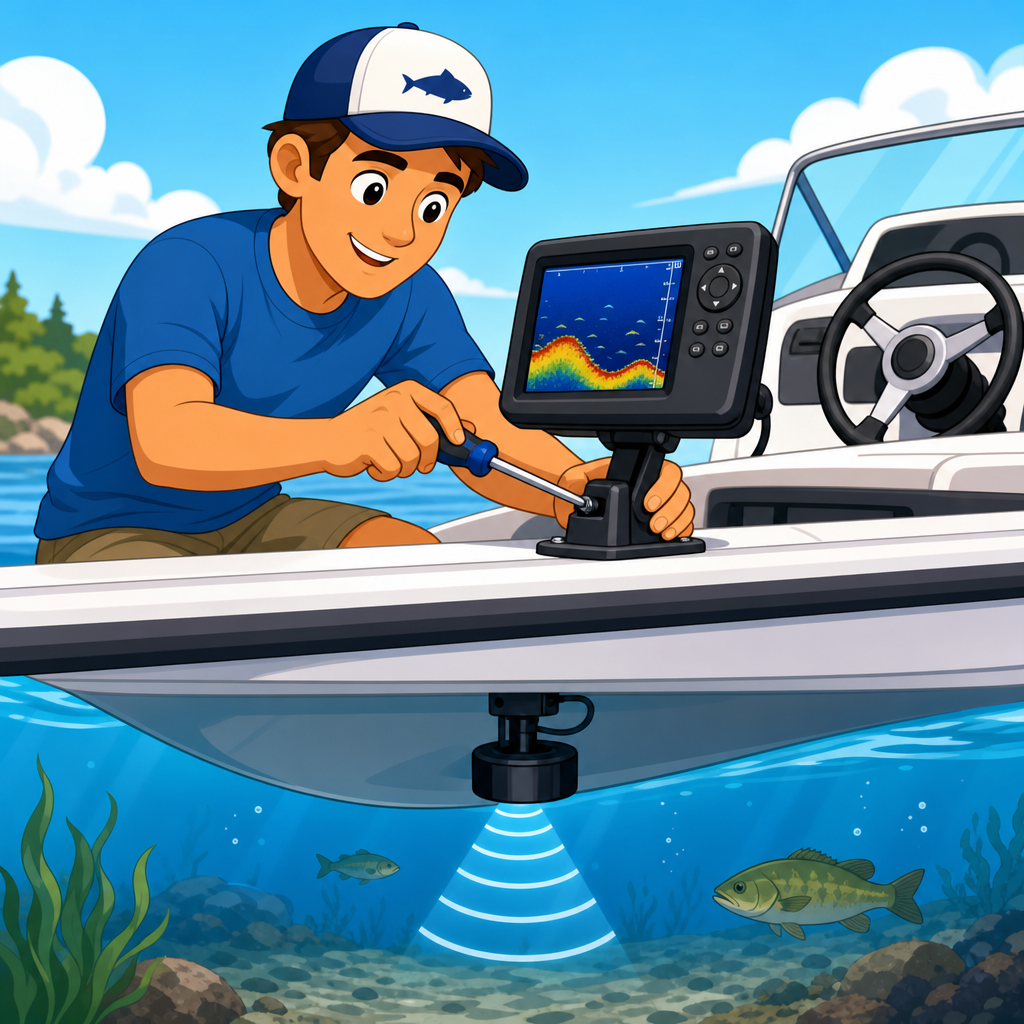
The transducer is the working end of the system. It converts electrical energy into sound and back again, and placement determines whether the sonar reads cleanly at rest, while drifting, and on plane. Common types include transom-mount, through-hull, in-hull, and trolling-motor-mount transducers. Transom mounts are common and cost-effective, but they can suffer from aerated water and impact risk. Through-hull transducers cost more and require drilling, yet they deliver superior high-speed performance on many offshore boats. In-hull shoot-through installations are simple on some fiberglass hulls for basic depth reading, but they do not support imaging and can reduce signal strength.
Power rating, beam angle, and frequency range all need to match the mission. A 300-watt to 600-watt recreational setup may be plenty for lakes and nearshore use. Offshore anglers targeting deep bottom often step into 1-kilowatt transducers from recognized manufacturers such as Airmar because holding bottom in several hundred feet while drifting or running offshore demands more energy and better element design. Hull deadrise, strakes, step hulls, jack plates, and trailer clearance all affect transducer choice. I have seen expensive side imaging units blamed for poor results when the actual problem was a transducer mounted too low, too high, or directly in prop wash.
Networking is the other half of real-world performance. If you want two displays to share sonar, charts, waypoints, radar, or trolling motor control, confirm the network standards and module compatibility before buying. NMEA 2000 supports engine data, heading sensors, fuel flow, and many onboard sensors. Ethernet or brand-specific high-speed networking handles sonar sharing and radar. Some systems also support Power-Pole anchors, Minn Kota trolling motors, Rhodan GPS anchoring, Fusion audio, or Mercury and Yamaha engine integration. Buyers who think ahead save money by choosing an expandable platform instead of replacing a non-networkable unit a year later.
Compare brands, budgets, and upgrade paths realistically
The leading brands each have strengths. Garmin is widely praised for intuitive menus, strong chart integration, and excellent live-sonar products. Humminbird remains a major force in side imaging, LakeMaster mapping, and integration with Minn Kota trolling motors through One-Boat Network. Lowrance is popular for flexible networking, strong charting options, and broad adoption across freshwater and saltwater segments. Simrad, which shares parentage with Lowrance under Navico, leans more heavily toward offshore and cruising-oriented multifunction displays. Raymarine stands out in many radar and sailing applications while still offering capable sonar. Furuno remains a benchmark in serious offshore sounder performance, particularly when paired with high-end transducers and dedicated modules.
Budget should be divided into system cost, not just display price. A fish finder package may require a separate map card, upgraded transducer, mounting bracket, heading sensor, network hub, or professional installation. A “$700 unit” can easily become a $1,300 project once all required parts are included. At the upper end, a 12-inch multifunction display with a premium transducer, charts, and networking accessories can climb well beyond $3,000 before radar or live sonar enters the picture. That does not mean more expensive is always better. For a family boat that fishes a few weekends each month, a reliable midrange CHIRP/side-imaging combo often delivers more usable value than a flagship screen loaded with features the owner never uses.
Think carefully about upgrade path. Can the unit add radar later? Can it share waypoints with a bow unit? Does it support software updates for several years? Are replacement transducers and mounts easy to source? The smartest purchase is usually the one that fits today’s fishing while leaving room for one meaningful expansion, not ten hypothetical ones. When in doubt, spend more on screen quality and transducer quality, and less on niche features you may never activate.
Common buying mistakes and the best setup for most boaters
The most common mistake is buying based on marketing screenshots. Sonar images in ads are often captured in ideal conditions with premium transducers and perfect setup. Real performance depends on water clarity, depth, bottom composition, boat speed, electrical noise, and tuning. The second mistake is underestimating screen size. Split-screen chart and sonar on a cramped display leads many owners to replace the unit quickly. The third mistake is ignoring installation quality, cable routing, fuse protection, battery health, and software updates. Marine electronics are systems, not gadgets.
For most freshwater and inshore boaters, the best fish finder for a boat is a 9-inch or 10-inch chartplotter/sonar combo with built-in GPS, CHIRP sonar, side imaging, down imaging, quality coastal or lake charts, and networking support for a future second display. Offshore anglers should prioritize sunlight-readable displays, robust charting, a high-quality transducer sized for target depths, and compatibility with radar and AIS. Small-boat owners should prioritize simple menus, efficient power draw, and a mounting solution that survives trailering and rough water. No single model wins every category, but the right buying framework does. Match the fish finder to your boat, your water, and your next likely upgrade, and you will buy once instead of twice.
The right fish finder improves more than fishing success; it sharpens every part of boating decision-making. You navigate with better charts, mark hazards and productive spots accurately, interpret bottom and structure with more confidence, and build an electronics setup that supports how you actually use the boat. As the hub for electronics and navigation systems within boating gear and equipment, this topic connects sonar, chartplotters, transducers, radar, AIS, VHF integration, and onboard networking into one practical buying decision. When those components work together, the boat becomes safer, easier to run, and more effective on the water.
If you are ready to choose, start with a simple checklist: boat type, fishing style, target depth, desired screen size, chart needs, transducer mounting options, and future networking plans. Then compare brands based on those requirements instead of chasing the loudest feature list. That process leads to a fish finder that performs well now and remains useful as your boating and fishing evolve. Use this guide as your starting point, then map out the exact electronics package your boat needs before you buy.
Frequently Asked Questions
What features matter most when choosing the right fish finder for my boat?
The most important features depend on how and where you fish, but a few core capabilities matter for almost everyone. Start with sonar performance, because that is the heart of any fish finder. A good unit should clearly show depth, bottom contour, structure, bait schools, and suspended targets in the water column. Traditional CHIRP sonar is a strong baseline because it uses a range of frequencies to improve target separation and bottom detail, making it easier to tell the difference between fish, weeds, and structure. If you fish shallow cover, docks, brush piles, or rock edges, side imaging and down imaging can add a major advantage by showing what is beside and directly below the boat in much more detail than basic 2D sonar.
Screen quality is also critical. A larger display with strong brightness, high resolution, and good viewing angles is much easier to read in direct sunlight and rough water. A compact screen may save money, but if you are trying to split the display between sonar, chart, and mapping pages, more screen space often translates into better decisions on the water. GPS and chartplotting are now just as important as sonar for many boaters. Built-in GPS lets you mark waypoints, follow trails, return to productive spots, and navigate safely. Preloaded or upgradeable charts are especially useful if you fish unfamiliar lakes, rivers, or coastal areas.
Transducer compatibility should never be overlooked. The display can only interpret the information your transducer sends, so the transducer type, mounting style, frequency range, and power output all affect real-world performance. In addition, think about networking if you plan to add accessories such as trolling motors, radar, engine data, heading sensors, or multiple displays. Finally, consider ease of use. The best fish finder is not just powerful on paper. It should have menus, controls, and screen layouts that you can operate quickly while steering, scanning, and fishing at the same time.
How do I know what screen size and display type are best for my boat?
Screen size should match both your boat size and the way you fish. On small boats, kayaks, jon boats, and simple tiller setups, a compact display may be enough if you mainly use one sonar view at a time. On bass boats, center consoles, walleye rigs, and offshore boats, larger screens become much more valuable because they allow you to view sonar, side imaging, charts, and GPS data simultaneously without sacrificing readability. If you plan to run split-screen layouts often, a larger display is usually worth the investment. Many anglers discover that the screen they first thought was “big enough” feels small once they begin using mapping and multiple sonar modes together.
Resolution matters almost as much as size. A large screen with low resolution can look coarse and make subtle details harder to interpret. A crisp, high-resolution display will better reveal contour lines, bait balls, bottom transitions, and fish arches or target returns. Brightness is another major factor, especially on open boats where glare is unavoidable. Look for a display designed for direct sunlight readability, not just indoor-style color quality. A dim screen can be frustrating even if the sonar itself is excellent.
Touchscreen versus keypad control is also worth considering. Touchscreens are fast and intuitive, especially for waypoint management and chart navigation, but physical buttons can be easier to use in rough water, rain, or cold weather. Some of the best units combine both. If possible, think beyond the showroom and imagine using the unit while the boat is moving, the sun is high, and your hands are wet. In practical terms, the best display is the one you can read instantly and control confidently in real fishing conditions.
What is the difference between basic sonar, CHIRP, down imaging, and side imaging?
Basic sonar, often called 2D sonar, sends sound waves straight down and displays the returns as a scrolling view of the water column beneath the boat. It is useful for tracking depth, seeing bottom composition, identifying bait, and spotting fish targets under the boat. For many anglers, it remains a dependable tool because it gives a continuous, easy-to-read picture of what is happening directly below them. However, its picture is more interpretive than photo-like, and it shows less detail than newer imaging technologies.
CHIRP sonar is an advancement over older single-frequency sonar. Instead of transmitting on one frequency, it sweeps across a range of frequencies, which helps improve clarity, reduce noise, and separate targets more accurately. In real-world use, that often means better fish-to-bottom separation, more precise readings in deeper water, and cleaner returns around structure or bait schools. CHIRP is often one of the first upgrades worth paying for because it improves the core sonar experience without making the unit harder to use.
Down imaging gives a sharper, more detailed picture directly below the boat, making it easier to identify brush piles, rock piles, timber, ledges, and other structure. Side imaging expands the view to the left and right of the boat, which is extremely useful for searching water efficiently and finding cover or fish-holding areas without driving directly over them. These technologies are particularly valuable for anglers who want to locate specific targets, understand how fish relate to structure, and spend less time blindly searching. If your style of fishing depends on reading structure and covering water, side and down imaging can be game-changing rather than simply nice extras.
Do I need built-in GPS and charts, or is sonar alone enough?
For most boaters today, built-in GPS and charts are more than convenience features. They are central to how a fish finder becomes a true decision-making tool. Sonar tells you what is below and around the boat right now, but GPS and mapping help you understand exactly where that information is happening. That means you can mark productive spots, return to structure you found earlier, follow breaklines, stay on safe routes, and build patterns based on repeatable locations rather than memory alone. Even if you fish smaller lakes, the ability to save waypoints on brush piles, drop-offs, humps, creek channels, and productive edges can dramatically improve consistency.
Digital charts become even more valuable on larger reservoirs, rivers, and coastal waters. Contour maps help you identify points, flats, saddles, ledges, channels, and underwater transitions before you ever idle over them. In unfamiliar water, charts help you narrow down where to search. In navigation terms, they can also help you avoid hazards, stay in marked channels, and move more confidently in low light or changing conditions. Many modern units allow chart upgrades from major mapping providers, which can improve detail and add features such as shaded relief, depth highlighting, tidal information, and satellite overlays depending on the platform.
If your boating is very simple and you only fish known water at close range, a sonar-only unit may still be adequate. But for most anglers and boat owners, a fish finder with GPS and chartplotting offers much better long-term value. It turns raw sonar returns into repeatable spots, safer navigation, and more efficient time on the water. In practical terms, sonar finds opportunities, while GPS and charts help you relocate and use them.
How should I match a fish finder to my boat type, fishing style, and budget?
The best approach is to work backward from your actual use case rather than buying the most advanced model you can afford without a plan. Start with boat type. A kayak or small jon boat usually benefits from a compact, efficient unit with good traditional sonar, GPS, and straightforward mounting options. A bass boat may justify a larger screen, advanced imaging, bow and console network integration, and compatibility with trolling motor systems. A center console or offshore boat may place a higher priority on larger multifunction displays, high-power transducers, detailed coastal charts, radar integration, and reliable operation in deeper water and rougher conditions.
Next, think about fishing style. If you mostly anchor, drift, or fish vertically, excellent 2D sonar and GPS may cover most of your needs. If you spend your time breaking down shorelines, scanning flats, locating offshore structure, or targeting fish relating to cover, side imaging and down imaging become much more important. If you fish deep water, pay closer attention to sonar power, transducer quality, and frequency options. If you fish shallow, stump-filled, or structure-heavy water, image detail and scanning coverage may matter more than raw deep-water capability.
Budget should be viewed in terms of total system value, not just display price. A lower-cost head unit may become more expensive later if it cannot support the transducer, charts, mounts, networking, or accessories you eventually want. At the same time, paying for features you will never use does not improve fishing results. A smart budget choice usually means buying the strongest sonar, display, and GPS package that fits your style today while leaving at least some room for future expansion. It is often better to buy a midrange unit with a good transducer and usable screen than a feature-packed unit with compromises in visibility or installation. The right fish finder is the one that fits your boat cleanly, supports how you actually fish, and helps you make faster, more confident decisions every time you launch.