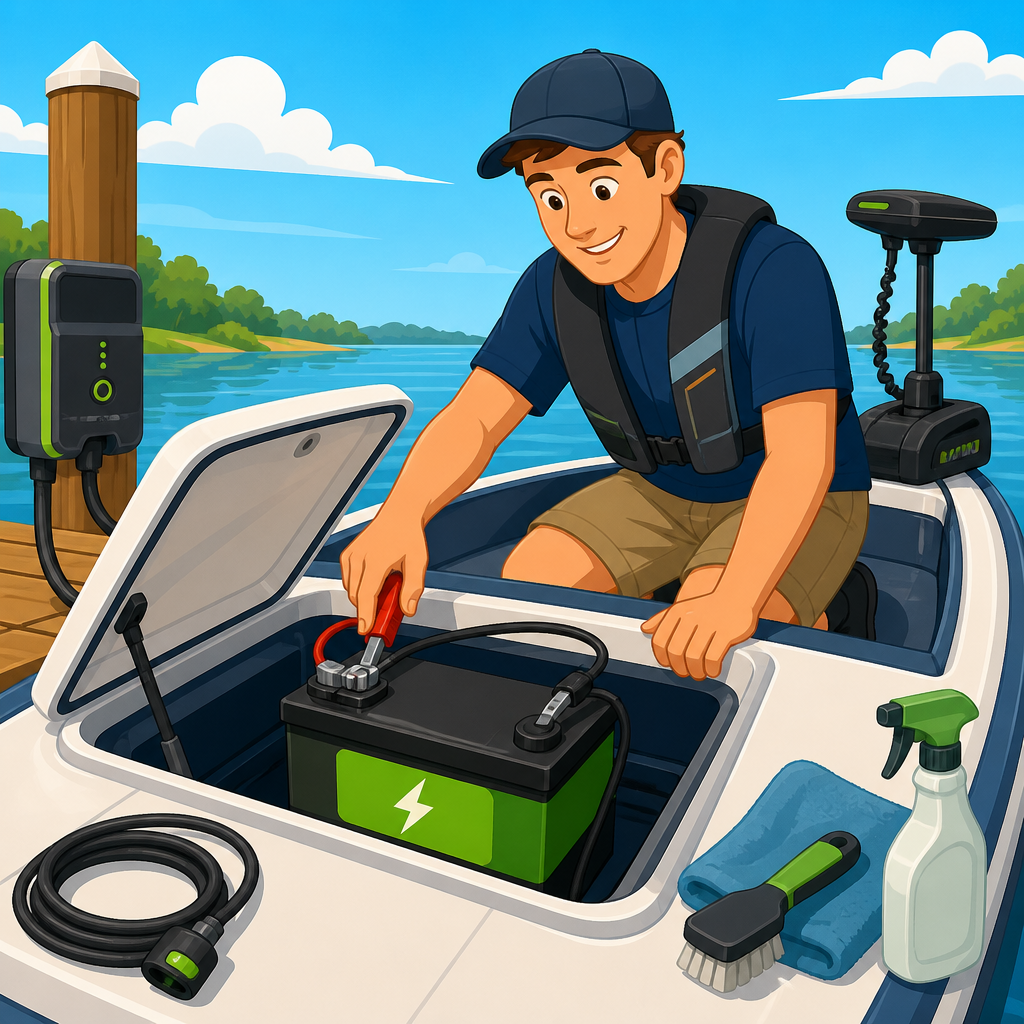
Electric boat batteries determine how far you can travel, how safely you can recharge, and how much your vessel will cost to own over time. In the electric boat projects and retrofit consultations I have worked on, battery questions always come first, because the battery is the fuel tank, engine reserve, and risk point rolled into one system. If you understand how to charge and maintain an electric boat battery, you protect range, performance, and onboard safety while making eco-friendly boating practical rather than experimental.
An electric boat battery is usually a lithium-ion pack, commonly lithium iron phosphate, or a marine deep-cycle lead-acid bank in older or lower-cost setups. Charging means restoring energy with shore power, solar input, regenerative systems, or a generator-backed charger. Maintenance includes monitoring voltage, state of charge, temperature, cabling, corrosion, charge cycles, and storage conditions. On electric boats, these tasks matter more than on small electronics because batteries operate in wet, vibrating, salt-exposed environments where mistakes can damage cells, trip battery management systems, or shorten service life dramatically.
This hub page covers the core practices every owner needs and connects the broader world of eco-friendly and electric boats. Along with charging and maintenance, it addresses battery chemistries, charging hardware, range planning, seasonal storage, safety checks, and the tradeoffs between full electric and hybrid propulsion. For readers exploring electric fishing boats, electric pontoons, solar-assist cruisers, or retrofit sailboats, battery care is the foundation. Get this right and every related decision, from motor sizing to marina charging access, becomes simpler, cheaper, and more reliable.
Know Your Battery Chemistry Before You Plug In
The first rule is simple: charge according to battery chemistry, not guesswork. The two chemistries you will see most often in eco-friendly and electric boats are flooded lead-acid or AGM deep-cycle batteries, and lithium batteries, especially LiFePO4. They do not charge the same way, they do not tolerate the same depth of discharge, and they do not reward the same maintenance habits. Using the wrong charger profile is one of the fastest ways to reduce capacity or trigger expensive failures.
Lead-acid batteries need bulk, absorption, and float stages. They prefer to be kept near full charge and suffer when left partially discharged, which encourages sulfation on the plates. They also lose usable cycle life when regularly discharged below 50 percent. Lithium iron phosphate batteries behave differently. They accept charge faster, maintain a flatter voltage curve, and usually tolerate deeper discharge, often 80 percent or more depending on the manufacturer. They generally do not need float charging the way lead-acid does, and prolonged high-state charging can create unnecessary stress if the charger is not correctly programmed.
In practice, I start every battery service visit by confirming three things: the battery label, the battery management system settings, and the charger profile. Brands such as Victron Energy, Mastervolt, Battle Born, RELiON, and Torqeedo publish exact charging voltage windows. Those numbers matter. A lithium battery bank set to a generic lead-acid charger can fail to fully charge, trip the BMS during absorption, or remain at an unhealthy high voltage for too long. Reading the manual is not optional here; it is maintenance.
Use the Right Charging Equipment and Follow a Safe Sequence
The best way to charge an electric boat battery is with a marine-rated charger matched to the battery voltage, chemistry, and bank capacity. Marine-rated matters because chargers on boats face vibration, humidity, and sometimes salt exposure. ABYC electrical guidance and reputable manufacturers stress protected installation, proper wire sizing, ventilation where required, and overcurrent protection close to the battery. A household automotive charger may work temporarily, but it is not the standard you want onboard a vessel.
For most owners, the charging sequence should be routine. First, inspect the battery compartment for water intrusion, swelling, unusual heat, or odor. Second, verify charger settings for the exact battery type. Third, connect shore power securely and confirm the charger enters the expected stage. Fourth, monitor the first portion of charging to ensure current and voltage stay within spec. Fifth, after charging, check state of charge and system logs on the display or app. Smart systems from Garmin, Simrad, Victron, and Mastervolt make this much easier because they show amperage, battery temperature, and charging history.
Charging speed should be based on the manufacturer’s recommended C-rate, which compares charge current to battery capacity. For example, a 100Ah lithium battery often charges comfortably at 50A, or 0.5C, though many can accept more. Faster is not always better. Heat is the enemy of battery longevity, especially in tight compartments during summer. If your charger allows current limiting, use it when marina power is inconsistent or when high ambient temperature makes aggressive charging unwise.
| Battery Type | Typical Usable Capacity | Best Charging Habit | Main Maintenance Risk |
|---|---|---|---|
| Flooded Lead-Acid | About 50% | Recharge fully after each use | Sulfation, water loss, corrosion |
| AGM | About 50% | Use precise multistage charger | Undercharging, heat buildup |
| LiFePO4 | Often 80% to 100% | Use lithium profile and BMS-compatible charger | Cold charging, BMS trips, overvoltage |
Charge for Longer Life, Not Just a Full Indicator
If you want maximum battery lifespan, avoid treating every outing the same. Many boaters assume charging to 100 percent after every short trip is ideal, but for lithium banks used lightly, that can be unnecessary. A better approach is to align charging with use. If you run a short harbor shuttle and know you only need 30 percent of the pack tomorrow, charging to a moderate level can reduce stress. For longer trips, charge fully shortly before departure so the battery does not sit at maximum state of charge for days.
Lead-acid systems are the exception. They should usually be recharged fully and promptly because partial-state operation shortens life. Equalization, where approved by the manufacturer, can help some flooded batteries but should never be applied blindly and is not used on lithium. For lithium systems, cell balancing often happens near the top of the charge curve, so occasional full charges still serve a purpose. The key is occasional, controlled, and based on the battery maker’s guidance rather than daily habit.
Range planning also affects charging health. In electric boats, owners often consume the last reserve because marinas may not have convenient charging at every stop. That deep-discharge habit adds wear. I advise clients to set a personal floor well above the technical minimum, such as 20 to 30 percent remaining on lithium and 50 percent on lead-acid. This reserve protects the battery and gives margin against headwinds, current, fouled hulls, or passengers adding weight unexpectedly.
Maintain the Battery System, Not Just the Cells
Battery maintenance on an electric boat extends beyond the battery case. Most failures I have seen start in the surrounding system: loose lugs, undersized cables, unsealed terminals, poor ventilation, or neglected software alerts. Begin with monthly visual checks. Look for white or green corrosion, darkened cable insulation, cracked heat shrink, and any sign of arcing at busbars or switches. On lead-acid banks, inspect electrolyte levels if the design allows and clean terminals with the power isolated.
Torque matters. Marine electrical connections loosen from vibration, and high-current propulsion systems magnify resistance problems. Follow the manufacturer torque specification on battery posts, busbars, fuse blocks, and shunts. Use adhesive-lined heat shrink, tinned marine cable, and proper strain relief. The National Marine Electronics Association and ABYC practices exist for good reason: low-resistance, protected connections reduce heat and improve charger accuracy because voltage drop is minimized.
Digital monitoring is equally important. A battery monitor with a shunt, such as a Victron SmartShunt or BMV unit, gives far more useful information than a basic voltage gauge. Voltage alone can mislead, especially with lithium, which holds near-steady voltage through much of its discharge curve. Track amp-hours consumed, charge efficiency, cycle count, and temperature trends. When a battery bank starts behaving differently, slower charging, earlier voltage sag, or unexplained cutoff, the history usually reveals the cause before a total failure occurs.
Control Temperature, Storage, and Off-Season Care
Temperature management is central to electric boat battery maintenance. Heat accelerates chemical aging, while freezing conditions can damage batteries or limit safe charging. LiFePO4 batteries generally should not be charged below 0 degrees Celsius unless they include internal heating or explicit low-temperature charging protection. Many modern marine lithium batteries have BMS low-temp cutoff, which prevents charging but can confuse owners who think the charger has failed. In winter climates, this protection is a benefit, not a defect.
For seasonal storage, clean and dry the compartment, isolate unnecessary loads, and store the bank according to the chemistry. Lead-acid batteries should be kept fully charged and maintained on an appropriate charger if shore power is reliable. Lithium batteries usually store best at a partial state of charge, commonly around 40 to 60 percent, with the battery disconnected from parasitic loads and checked periodically. Exact targets vary by brand, so use the published storage recommendation rather than forum advice.
Ventilation and compartment design matter too. While LiFePO4 is more thermally stable than other lithium chemistries, all battery systems benefit from dry, secure, and temperature-moderated installation. Do not pack chargers, inverters, and batteries into a sealed locker with no airflow. If you haul out for winter, add battery inspection to the same checklist as hull cleaning and anode replacement. Spring commissioning should include a full charge, firmware check for smart equipment, and a controlled test run under load.
Safety, Troubleshooting, and the Bigger Electric Boat Picture
Safe charging starts with prevention. Install a main fuse close to the battery, use ignition-protected equipment where required, and never bypass a battery management system to force a charge. If a lithium battery is swollen, physically damaged, or repeatedly tripping without clear cause, stop using it until it is professionally evaluated. If a lead-acid battery is hot, smells strongly of sulfur, or vents excessively, disconnect charging and investigate immediately. Water and electricity are unforgiving, and marine battery incidents are usually traceable to ignored warning signs.
Common charging problems follow a short list. If the battery is not reaching full charge, check shore power voltage, charger profile, cable voltage drop, and BMS restrictions. If range has fallen suddenly, compare actual amp-hour draw against past trips; marine growth on the hull or a damaged propeller can raise energy use as much as battery aging. If the charger cycles on and off, look for overheating, incorrect absorption settings, or an undersized extension lead at the dock. Troubleshooting becomes easier when the system has clear labels, wiring diagrams, and monitored data.
As the hub for eco-friendly and electric boats, this topic connects to everything else in the category: electric outboards, electric pontoon boats, hybrid propulsion, solar charging, marina infrastructure, and retrofit economics. Battery care sits at the center of each one. A well-maintained battery bank delivers dependable range, lower ownership cost, and cleaner boating with less noise and no fuel slicks. Learn your chemistry, use the right charger, inspect the entire system, and store the bank correctly. Then build from there by exploring the rest of the electric boat ecosystem and applying the same disciplined approach on the water.
Frequently Asked Questions
How should you charge an electric boat battery safely and efficiently?
The safest and most efficient way to charge an electric boat battery is to use a charger that is specifically matched to the battery’s chemistry, voltage, and capacity. Lithium-ion, LiFePO4, AGM, and gel batteries all have different charging profiles, and using the wrong charger can reduce performance, shorten battery life, or create a serious safety hazard. Before charging, confirm the battery bank voltage, inspect the cables and terminals for corrosion or looseness, and make sure the battery management system, if installed, is operating normally. A marine-grade charger is strongly recommended because it is designed to handle moisture, vibration, and the demands of a boat environment more reliably than a generic charger.
Charging should take place in a dry, well-ventilated area whenever possible, with shore power connections kept clean and secure. Follow the manufacturer’s recommended charging stages, which usually include bulk, absorption, and float for lead-acid batteries, while many lithium systems use a different controlled charging curve and may not require float charging in the same way. It is also wise to avoid repeatedly charging a battery immediately after hard use if it is excessively hot. Let the battery temperature normalize first unless the system is designed to manage that condition automatically. In everyday use, the best routine is steady, predictable charging with quality equipment, proper cable sizing, and regular inspection. That approach protects range, reduces ownership costs, and lowers the likelihood of onboard electrical problems.
How often should an electric boat battery be charged, and is it bad to let it run low?
In general, an electric boat battery should be charged after each outing or whenever it has been significantly discharged. The exact timing depends on battery chemistry and how the boat is used, but allowing the battery to sit for long periods in a low state of charge is one of the fastest ways to reduce long-term health. With lithium batteries, keeping the system from dropping to extremely low charge levels helps preserve cycle life and ensures the battery management system does not have to intervene under stress. With lead-acid batteries, deep discharges are especially damaging if done often, and failing to recharge promptly can lead to sulfation, which permanently reduces capacity.
It is usually best not to treat the battery like a fuel tank that should be run nearly empty before refilling. Electric boat batteries last longer when depth of discharge is managed conservatively. Many owners build a buffer into their operating routine, using only a portion of the rated capacity on a normal day and reserving the remainder for weather changes, current, docking maneuvers, or an unexpectedly long return trip. If the boat will be stored for days or weeks, follow the manufacturer’s guidance for the ideal storage charge level. Lithium batteries are often best stored partially charged rather than full, while lead-acid batteries are generally best stored fully charged and maintained. The key principle is consistency: recharge promptly, avoid extreme lows, and do not let the battery sit neglected between trips.
What maintenance does an electric boat battery need to maximize lifespan?
Battery maintenance starts with routine inspection, not just charging. Even so-called low-maintenance systems should be checked regularly for clean terminals, tight connections, undamaged cable insulation, proper mounting, and signs of moisture intrusion. Corroded terminals increase resistance, create heat, and can cause poor charging performance or voltage drops under load. A simple schedule of visual checks before outings and a more thorough inspection every month or two can catch small issues before they become expensive failures. If the battery compartment includes ventilation, drains, hold-down hardware, or monitoring equipment, those components should also be included in the maintenance routine.
The maintenance details depend heavily on battery type. Flooded lead-acid batteries may require electrolyte level checks and topping up with distilled water, while sealed AGM, gel, and most lithium batteries do not. Lithium systems benefit from monitoring software or battery displays that track voltage, current, temperature, charge status, and fault history. Those readings can reveal charging problems, parasitic loads, or imbalance before performance noticeably drops. It is also important to keep batteries within their recommended temperature range, because heat accelerates degradation and freezing conditions can be harmful depending on chemistry and charge state. Good maintenance also means protecting the whole system: use the correct fuses and breakers, keep charger firmware updated if applicable, and address any unexplained decline in range right away. Battery lifespan is rarely determined by one dramatic event; more often, it is the result of many small habits done well or done poorly over time.
Can you leave an electric boat battery plugged in all the time?
You can leave some electric boat batteries connected to a charger for extended periods, but only if the charger and battery chemistry are compatible and the manufacturer specifically allows it. This is where many owners make mistakes. A smart marine charger may safely maintain certain battery types with an appropriate maintenance mode, but a basic charger that continues pushing current unnecessarily can overcharge the battery, generate heat, and shorten service life. Lead-acid batteries often benefit from a properly controlled float or maintenance charge, while many lithium batteries are better managed with chargers and battery management systems designed to stop charging at the correct point rather than holding the pack at maximum charge indefinitely.
For seasonal or long-term storage, the best practice is not simply to plug the battery in and forget it. Instead, set up a storage plan based on the battery manufacturer’s recommendations. That may involve disconnecting loads, checking voltage periodically, maintaining a target state of charge, or using a storage mode on the charger. If the boat has onboard electronics, pumps, monitors, or other parasitic loads, they can slowly drain the battery even when the vessel is not in use, so those loads need to be accounted for. Continuous connection can be safe in the right setup, but it should be intentional, monitored, and equipment-specific. When in doubt, rely on the battery and charger documentation rather than assumptions, because overcharging and long-term neglect are both costly in different ways.
What are the most common mistakes that reduce electric boat battery performance and life?
The most common mistakes are using the wrong charger, discharging too deeply too often, storing the battery improperly, and ignoring heat, moisture, and connection quality. Many battery problems that seem mysterious are actually system problems rather than battery defects. Undersized cables, loose terminals, poor crimping, corroded connectors, or chargers with incorrect settings can all lead to weak performance, slow charging, and premature aging. Another frequent mistake is choosing battery settings based on automotive habits instead of marine reality. Boats experience vibration, humidity, variable loads, and longer idle periods, which means charging and maintenance practices need to be more disciplined.
Another major issue is neglecting battery monitoring. If you do not track state of charge, voltage trends, charging behavior, and temperature, you are often reacting after capacity has already fallen. Owners also get into trouble by pushing range too close to the limit and making deep discharge a normal part of every trip. That may work for a while, but it tends to shorten battery life and increases the risk of getting stranded or stressing the system under adverse conditions. Finally, poor off-season storage is a silent battery killer. Leaving a battery discharged, exposed to temperature extremes, or connected to unnoticed parasitic loads can do significant damage before the next season begins. The best way to avoid these mistakes is to treat the battery as the core propulsion asset it is: charge it correctly, inspect it regularly, monitor it intelligently, and store it with the same care you would give the motor itself.