When envisioning life on the water, many people conjure up images of serene living spaces that glide gently along the surface of a lake or river. Both floating homes and houseboats embody this idyllic vision, yet they serve distinctly different purposes. Understanding these differences is critical for anyone considering making the water their permanent home. In this article, we will delve into the key differences and distinctive features that separate floating homes from houseboats. This topic matters because each offers unique benefits and drawbacks, and knowing which one aligns with your lifestyle can make all the difference in your living experience.
Floating homes and houseboats are both unique housing options that offer the luxury of living on water, but they vary significantly in design, functionality, and legal status. A floating home is a stationary house built on a floating platform, permanently moored to a specific location. These homes are connected to the local utilities much like a traditional home. In contrast, a houseboat is essentially a boat with living accommodations, designed to be mobile, and is often equipped with its own propulsion system. Understanding how these two types of waterborne homes differ will illuminate their respective advantages, challenges, and legal considerations.
Choosing between a floating home and a houseboat involves multiple considerations including mobility, lifestyle, legal regulations, and utilities. Knowing the differences will allow potential dwellers to make informed decisions about which option is the best fit for their personal needs and aspirations of living on water.
Mobility: The Mobile Lifestyle vs. A Stationary Oasis
One of the most striking differences between a floating home and a houseboat is mobility. Floating homes are intended to remain in one place. They are moored to docks and connected to standard utility services such as water, sewage, and electricity. These homes offer stability and permanence, allowing homeowners to establish lasting ties with a waterside community. For instance, a floating home in Seattle’s Lake Union provides a stationary lifestyle with community ties similar to those in a conventional suburban neighborhood.
On the other hand, houseboats offer a more nomadic lifestyle. Designed to navigate waterways, houseboats can traverse rivers, lakes, and even coastal waters where permissible. This mobility offers significant freedom for those who enjoy changing scenery and exploring new locales. An example can be seen on the Sausalito waterfront in California, where many opt for houseboats and enjoy picturesque views and the adventure of exploration without being tied to a singular locale.
- Floating Homes: Permanently moored, utility-connected, stable.
- Houseboats: Mobile, engine-powered, exploratory.
Design and Structure: Style Meets Functionality
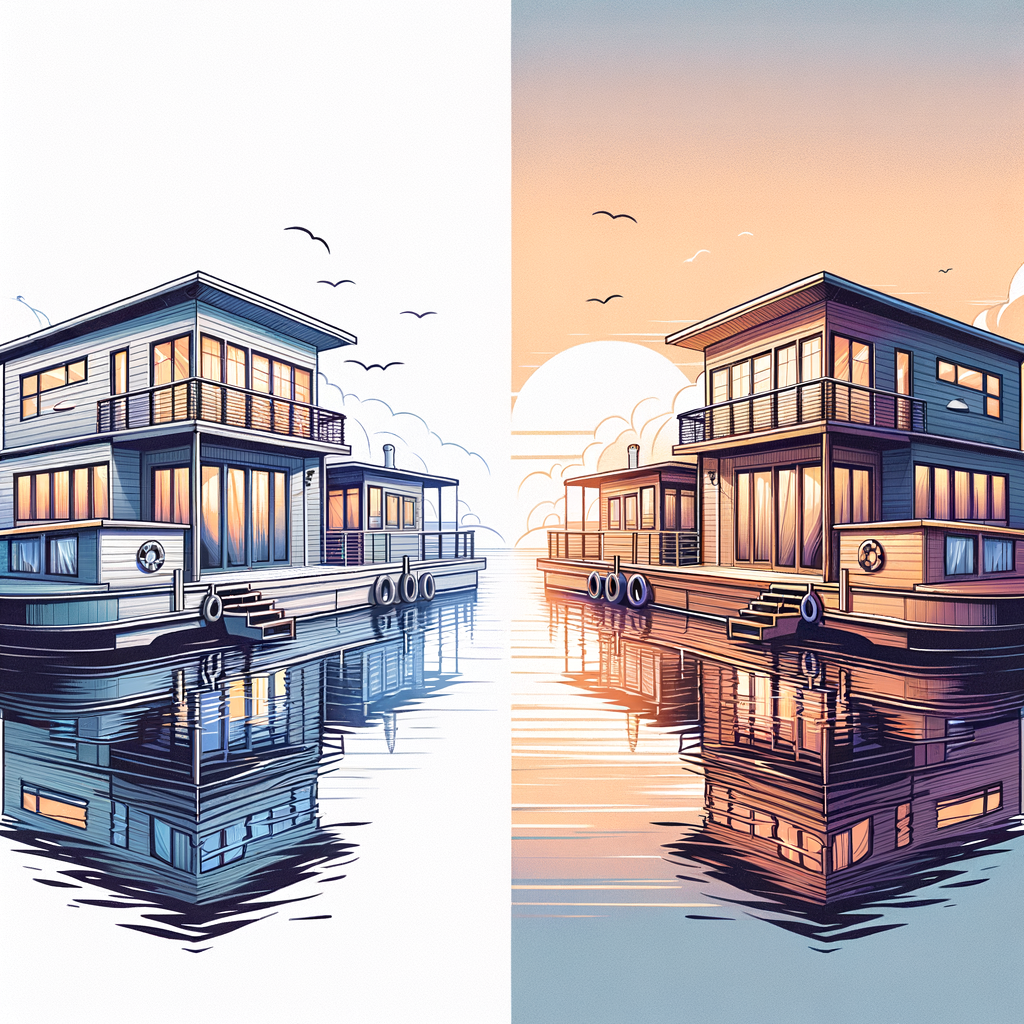
The design and structural differences between floating homes and houseboats further distinguish these two types of waterborne housing. Floating homes are often elaborate structures much like traditional homes, offering multiple stories, spacious rooms, and architectural variety. Builders design them with residential standards in mind, and owners can customize them with additions like rooftop gardens or decks.
In contrast, houseboats prioritize functionality and adaptability for water travel. These vessels typically have more compact designs to aid in buoyancy and navigation. Interiors are efficiently organized to maximize space, often featuring convertible furniture and multi-use areas, like fold-down tables and built-in storage.
Feature
Floating Homes
Houseboats
Mobility
Permanently anchored
Mobile, engine-driven
Design Style
Home-like, varied architecture
Compact, functional
Utility Connections
Connected like traditional homes
Off-grid solutions possible
Legal Status
Treated like real estate property
Regulated as boats/vessels
Legal and Regulatory Considerations
Floating homes and houseboats are governed by different sets of regulations, largely due to their distinct roles. Floating homes are considered real estate; thus, they are subject to local zoning laws, property taxes, and building codes similar to conventional houses. Owners of floating homes often form homeowners’ associations to maintain shared spaces and adhere to communal regulations. For instance, in Portland, Oregon, floating homes must conform to the city’s specific building code requirements for waterside dwellings.
Conversely, houseboats are classified as vessels, hence falling under maritime law jurisdiction rather than real estate law. In the U.S., these fall under the Coast Guard’s safety regulations and often require proof of buoyancy and safety inspections. Registration as a watercraft is also a necessity, and moorage fees in marinas where they dock can vary widely.
Utilities and Maintenance
Another critical difference lies in how utilities and maintenance are handled. Floating homes benefit from fixed connections to utilities such as water, sewage, and electricity. This connectivity offers reliability and convenience akin to conventional homes. Maintenance of these utility systems is similar, with regular upkeep to ensure safety and functionality.
Houseboats, however, often employ alternative systems. Many use onboard generators or solar panels for power. Freshwater tanks and marine toilets with holding tanks are commonly used for water supply and sewage disposal. The maintenance of these systems can be more hands-on and could require regular attention to ensure smooth operation, especially for those sailing in remote areas.
Investment and Costs
The financial implications of choosing between a floating home and a houseboat can be significant. Floating homes often resemble conventional homes in both cost and investment potential. Their prices differ significantly based on location, size, and amenities, much like terrestrial real estate. Appreciation in value is possible, making them a potentially lucrative long-term investment. The marina fees, maintenance, and property tax are akin to homeowners’ association fees and taxes on land-based homes.
In contrast, houseboats can be less expensive initially, but their return on investment is less predictable. The costs include regular mooring fees, maintenance of the propulsion and onboard systems, and periodic refitting. Some buyers choose houseboats for their lower upfront costs but should be aware of the ongoing expenses that can accompany boating life.
Community and Lifestyle
The community and lifestyle aspects tied to floating homes versus houseboats are also significant for potential buyers. Floating homes are often part of vibrant, tight-knit waterside communities, where residents share facilities and participate in communal activities. This camaraderie creates a unique village-like environment, fostering connections and neighborhood spirit.
In contrast, while houseboat dwellers have a more transient experience, marinas can still offer a sense of community. Boaters share the love of adventure and water travel, creating bonds over shared experiences of life on the move. The choice between a steady float life or an ever-changing voyage can greatly influence one’s social life and comfort levels on the water.
Environmental Impact
Finally, considering the environmental implications of choosing a floating home versus a houseboat is essential. Floating homes have a relatively stable environmental footprint, as they remain anchored, minimizing water pollution from marine engines. Their electricity and waste management are similar to those of conventional homes on land.
Houseboats, however, can pose more environmental challenges due to engine emissions and waste management issues. However, many modern houseboats are designed with eco-friendliness in mind, often using hybrid engines, solar panels, and advanced waste management systems to mitigate their ecological impact.
Conclusion: Making the Right Choice for Life on Water
In summary, floating homes and houseboats offer distinct lifestyles and housing experiences on the water. By understanding the principle differences, one can make an informed decision that best suits their desires and lifestyle needs. Floating homes provide a stable, community-oriented, and stationary lifestyle with the familiar comforts of land-based homes. In contrast, houseboats offer the adventurous spirit of mobility and exploration, albeit with a need for greater adaptability and sometimes increased maintenance.
Choosing between these options involves weighing factors like mobility, design preferences, legal regulations, utility arrangements, and the desired lifestyle. Finding the right fit hinges on personal values, expectations, and what one seeks in experiencing a life intertwined with the natural beauty and challenges of water-based living.
If the allure of living on water captivates you, take the opportunity to explore both floating homes and houseboats in person. Attend open houses or boat shows, and engage with current residents to gain firsthand insight into the realities of these unique living arrangements. Make a decision that brings the tranquility, adventure, or community you seek in your new waterborne home.
Frequently Asked Questions
1. What is the primary difference between floating homes and houseboats?
Floating homes and houseboats may share the water as their setting, yet they differ greatly in purpose and structure. A floating home is essentially a house built on a stable concrete or wood platform that is permanently moored to a dock. These homes are constructed similarly to regular houses but are designed to rest on the water. Unlike houseboats, floating homes do not have engines or the capability to move freely; they remain fixed in their designated water location.
In contrast, a houseboat is fully equipped to operate as a vessel with its own propulsion system, meaning it can navigate across waterways at will. Houseboats offer mobility; they combine living space with the freedom and adventure of water travel, allowing residents to change their scenery whenever they like. This key design element is what primarily sets houseboats apart from floating homes.
2. Can floating homes and houseboats be used as permanent residences?
Yes, both floating homes and houseboats can be used as permanent residences, but they offer different lifestyles due to their inherent characteristics. Floating homes function similarly to land-based houses and are typically connected to utility services like water, sewer, and electricity. They provide stability and permanence, making them suitable for those seeking a stationary lifestyle with the uniqueness of living on water.
Houseboats, however, offer a mobile lifestyle akin to living in a recreational vehicle but on water. They might be equipped with all the necessary amenities, and while some houseboats do dock for long periods, their ability to travel makes them more fitting for those who enjoy exploring and changing surroundings frequently. It’s important to ensure any houseboat intended as a primary residence meets local regulations and is properly equipped for long-term living.
3. Are there specific locations where floating homes and houseboats are more common?
Yes, certain areas are more synonymous with floating home and houseboat communities due to their geography and lifestyle culture. Floating homes are especially popular in locations with protected waterways and in urban environments where water views are prime real estate. Cities like Seattle and Portland in the U.S. are well-known for their vibrant floating home communities along lakes and rivers.
Houseboats, on the other hand, are prevalent in regions where water travel is a significant part of lifestyle or tourism. Places with extensive canal systems, like Amsterdam in the Netherlands, and regions with large lakes and rivers, have robust houseboat cultures. The ability to navigate through extensive waterways makes these locales ideal for houseboat dwellers.
4. What legal and logistical considerations should be taken into account for owning a floating home or houseboat?
Owning a floating home or houseboat brings its own set of legal and logistical requirements. For floating homes, one of the first considerations is securing a marina slip, which is similar to a plot of land for land-based properties. Marinas often have waiting lists, and availability can impact the timing of acquiring a floating home. Additionally, floating homes must comply with local building codes, zoning laws, and be connected to utilities, which can vary widely depending on the locale.
For houseboats, ownership involves more intricate regulatory factors due to navigation laws. Houseboat owners need to understand boating and maritime regulations, acquire the appropriate licenses, and ensure their vessel meets safety standards. Insurance differs between floating homes and houseboats, reflecting the unique risks associated with each. It’s crucial for prospective owners to research and plan thoroughly to meet these obligations.
5. Which living situation is more environmentally friendly: floating homes or houseboats?
Both floating homes and houseboats have the potential to be environmentally friendly, but it largely depends on how they are constructed and maintained. Floating homes, often built with sustainable materials, can have a lower environmental impact if equipped with energy-efficient systems and eco-friendly waste disposal methods. Their stationary nature offers opportunities for adopting renewable energy sources, such as solar panels, effectively.
Houseboats, with their mobility, inherently require fuel for movement, which could result in a higher carbon footprint if not managed properly. However, advancements in technology are allowing for more eco-friendly houseboat designs using alternative energy sources like solar or wind power, minimizing reliance on traditional fuel. Owners committed to sustainability can adopt practices that minimize waste and maximize efficiency in both scenarios, ensuring eco-friendly living on the water.